Ask any enterprise sales leader what holds their SDR team back, and "business acumen" comes up within the first three minutes. Not activity levels. Not tool adoption. The ability to look at a target account and understand what that company is actually going through, what their earnings call revealed, what their strategic initiatives signal about budget priorities, and what any of it means for the conversation an SDR is about to have. The SDR business acumen gap is real. AI is increasingly how forward-thinking teams bridge it.
SDRs are typically 22 to 28 years old, 16 months into their career on average, and being asked to engage C-suite buyers at companies with billion-dollar P&Ls. They don't lack effort. They lack context.
TL;DR: Junior SDRs struggle with business acumen because they've never read a 10-K, interpreted an earnings call, or tracked strategic initiatives across industries. AI doesn't replace that acumen. It pre-digests complex business signals into the three or four things from a 10-K that actually matter for the SDR's next conversation. The result: a higher minimum standard of research across the entire team, not just the top performers.
Why Is the SDR Business Acumen Gap a Structural Problem?
Business acumen isn't something you can train in a two-week onboarding boot camp. It's built through years of exposure to how companies make money, allocate resources, and respond to market shifts. A 15-year sales veteran reads a quarterly earnings transcript and immediately spots the budget implications. A junior SDR reads the same transcript and sees a wall of financial jargon.
This gap creates two problems that compound over time.
First, it limits outreach quality at scale. When SDRs can't connect their product's value to a prospect's strategic priorities, they default to generic messaging. And buyers can tell. Research from Gartner shows that 76% of B2B buyers get frustrated by generic outreach that doesn't reflect their specific situation. That's not a "personalize the first line" problem. That's a "you don't understand my business" problem.
Second, it concentrates knowledge in a few top performers. Most SDR teams have one or two reps who figured out how to read between the lines of a company's public filings, job postings, and press releases. They consistently book better meetings. The other 80% of the team operates on a fraction of the available intelligence. With SDR annual turnover exceeding 30% and average tenure at just 16 months, that concentrated knowledge walks out the door regularly.
The standard fix, more training, has real limits. SDR ramp time has increased 32% over the past five years, from 4.3 months in 2020 to 5.7 months in 2025. Teams are already spending $110,000 to $160,000 per rep annually in fully loaded costs. Adding weeks of financial literacy training to an already long ramp isn't practical when 83% of SDRs aren't consistently hitting quota.
What Do SDRs Actually Need from a 10-K Filing?
Here's the insight that changes the equation: SDRs don't need to develop deep financial literacy. They need the three things from a 10-K, an earnings call, or a strategic initiative announcement that are relevant to their upcoming conversation.
Consider what a typical enterprise SDR is asked to do before outreach:
- Understand the target company's current priorities
- Identify pain points or initiatives that align with what they sell
- Reference something specific that shows they did their homework
- Connect those dots to a reason for the meeting
That's a research and synthesis task, not a financial analysis task. The problem is that the raw inputs (SEC filings, earnings transcripts, investor presentations, press releases, leadership changes) require business acumen to interpret. A junior rep looks at a 50-page 10-K and doesn't know where to start. A senior rep skims to the risk factors, management discussion, and forward-looking statements in under ten minutes.
The gap isn't in the output (relevant, informed outreach). It's in the ability to extract signal from noise in complex business documents.
This is exactly where AI changes the math.

“For a junior SDR, Salesmotion also became an onboarding tool. They learn the industry, they learn relevant people, and they start connecting the dots—all within one platform.”
Adam Wainwright
Head of Revenue, Cacheflow
How AI Pre-Digests Business Intelligence for SDRs
AI-powered account intelligence doesn't teach SDRs how to read financial statements. It does something more practical: it reads the financial statements for them and surfaces the pieces that matter for their specific selling context.
Here's what that looks like in practice.
The Workflow: From Earnings Call to Outreach in Minutes
Without AI: An SDR is assigned a Fortune 500 healthcare company. The quarterly earnings call dropped last week. The transcript is 14,000 words. The SDR skims it for 20 minutes, picks up that revenue grew 8%, and sends a generic congratulations email. Or more likely, they skip the earnings call entirely and personalize based on the CEO's last LinkedIn post.
With AI-powered account intelligence: The same SDR opens their account dashboard. The platform has already processed the earnings transcript, extracted the key themes, and flagged the signals relevant to the SDR's territory. The dashboard shows:
- The CFO mentioned a "digital transformation initiative" three times, with $40M allocated over the next fiscal year
- The company is expanding its European operations and hiring 200+ roles in EMEA
- Leadership flagged "vendor consolidation" as a cost-saving priority in Q3
The SDR doesn't need to know what EBITDA margins mean. They need to know that this company is investing heavily in digital transformation, growing in Europe, and consolidating vendors. Those three data points shape a relevant conversation in a way that "congrats on the strong quarter" never could.
Salesmotion processes earnings calls, strategic initiatives, leadership changes, hiring patterns, and competitive moves across 1,000+ sources and surfaces them as account-level intelligence. Instead of requiring SDRs to develop years of business acumen, it raises the minimum standard of research across the entire team.
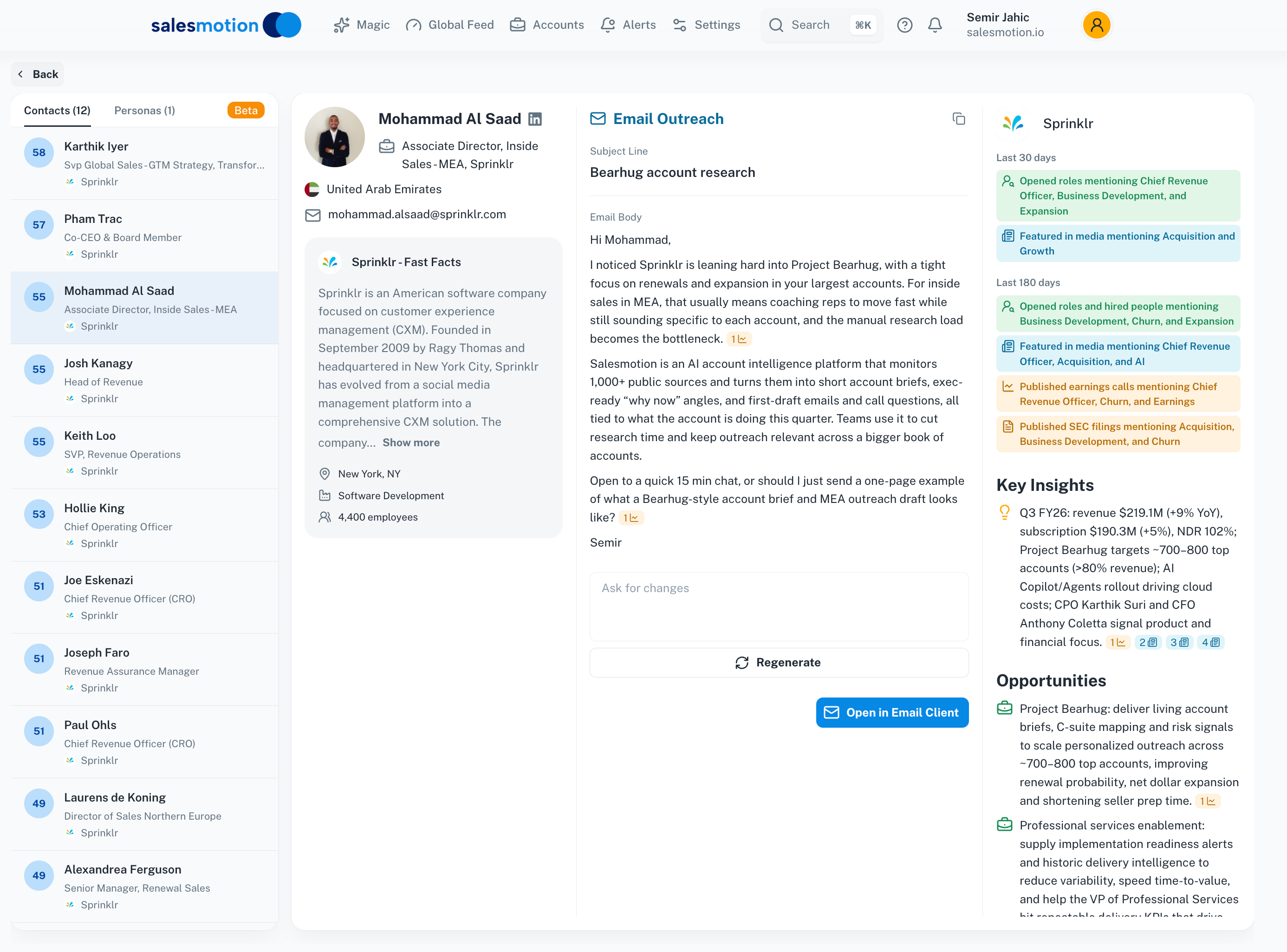 AI-generated outreach anchored to real account signals. An SDR does not need to read the 10-K to write this email.
Why This Matters More Than Training
The traditional approach treats business acumen as a skill to develop. That's true long-term. But in the short term, with 3-5 month ramp periods and 16-month average tenure, most SDRs leave before they ever develop meaningful business fluency.
AI-digested intelligence creates a floor. Every SDR, regardless of experience level, starts their research from a position of informed context rather than a blank page. The top performers still bring judgment, creativity, and relationship skills that AI can't replicate. But the gap between the best and worst researcher on the team shrinks dramatically.
This isn't about replacing critical thinking. It's about giving junior reps the same starting inputs that a 10-year veteran would extract manually. What they do with those inputs still depends on their skill, but at least they're working with real intelligence rather than surface-level Google searches.
The Onboarding Multiplier Effect
The business acumen gap hits hardest during onboarding. New SDRs are learning your product, your ICP, your sales process, and your CRM simultaneously. Asking them to also develop industry expertise across 50+ target accounts is unrealistic.
AI-powered account intelligence compresses this learning curve. When a new SDR can open any account and immediately see the company's strategic priorities, recent leadership changes, competitive landscape, and relevant signals, they're absorbing industry knowledge passively through every account they research.
This creates a compounding effect. After 30 days of reviewing AI-generated account intelligence across their territory, a new SDR has absorbed more contextual business knowledge than they would from months of classroom training. They've seen how different industries talk about growth, what digital transformation actually means in healthcare versus financial services, and which signals indicate budget availability.
Teams report that AI-powered account intelligence reduces onboarding ramp time from the industry average of 4-6 months down to 6-10 weeks. That's not just faster productivity. That's meaningful ROI when each month of ramp time represents $10,000-$15,000 in fully loaded costs with zero pipeline contribution.
See Salesmotion on a real account
Book a 15-minute demo and see how your team saves hours on account research.
Raising the Floor Without Lowering the Ceiling
The concern sales leaders often raise is that AI-assisted research creates lazy reps who don't develop real skills. The evidence suggests the opposite.
When you remove the barrier of "I don't know how to find relevant intelligence," reps spend more time on the activities that actually build business acumen: having informed conversations with prospects, understanding how different industries respond to similar challenges, and learning to connect business signals to pain points.
The best analogy is a calculator in a math class. Calculators didn't make students worse at math. They eliminated the mechanical barrier so students could focus on problem-solving. AI account intelligence does the same thing for business research. It handles the extraction and synthesis so SDRs can focus on interpretation and action.
What the floor looks like with AI intelligence:
- Every outreach references at least one company-specific signal (not just the prospect's job title)
- SDRs can articulate why they're reaching out now, not just why they're reaching out
- Meeting prep includes strategic context, not just a LinkedIn profile review
- New reps hit the same research quality baseline as tenured reps within their first month
What the ceiling still requires (human judgment):
- Deciding which signal is most relevant for a specific buyer persona
- Crafting a narrative that connects multiple signals into a compelling reason to meet
- Building multi-threaded relationships based on organizational dynamics
- Reading the room during discovery and adjusting based on buyer reactions
The debate between AI SDRs and human SDRs misses this point. The question isn't whether AI replaces human judgment. It's whether AI can give every human SDR the raw material they need to exercise better judgment. The answer is yes.
Making It Operational: What Sales Leaders Should Do
If you're a sales leader managing SDRs who struggle with business acumen, here's a practical path forward.
Audit your current research standard. Pull the last 50 outbound sequences your team sent. How many reference something specific about the target company's strategic priorities, recent earnings, or leadership changes? If the number is below 30%, you have a research quality problem, not an activity problem.
Stop asking SDRs to become financial analysts. They don't need to read 10-Ks. They need the three things from a 10-K that matter for their outreach. Invest in tools that extract and contextualize business signals rather than training programs that teach financial statement analysis.
Measure research quality, not just activity. Track the percentage of outreach that references account-specific intelligence. Track meeting-to-opportunity conversion rates by rep. Reps who use AI-digested intelligence consistently book meetings that convert at higher rates because the conversation starts from a position of informed relevance.
Use AI intelligence as an onboarding accelerant. New SDRs should spend their first week reviewing AI-generated account briefs across their territory, not sitting in product training sessions. The product knowledge matters, but it's useless without the business context to apply it. Salesmotion functions as an onboarding tool where new reps learn the industry, learn relevant people, and start connecting the dots within their first weeks.
Key Takeaways
- The SDR business acumen gap is structural, not a training failure. Junior reps lack years of exposure to how enterprises operate, and no boot camp closes that gap fast enough given 16-month average tenure.
- SDRs don't need to read entire 10-Ks or earnings transcripts. They need the three or four signals from those documents that are relevant to their next conversation.
- AI-powered account intelligence raises the minimum research standard across the team by pre-digesting complex business signals into actionable context.
- The onboarding impact is significant: teams using AI account intelligence report reducing ramp time from 4-6 months to 6-10 weeks.
- AI handles extraction and synthesis. Human judgment still drives interpretation, relationship building, and strategic account decisions. The floor rises without lowering the ceiling.
- Sales leaders should measure research quality (percentage of outreach referencing account-specific intelligence), not just activity volume.
Frequently Asked Questions
Does AI-powered account intelligence replace the need for SDR training?
No. AI raises the starting point for research quality, but SDRs still need training on sales methodology, objection handling, discovery skills, and your specific product. Think of AI intelligence as the research layer that ensures every rep works with real business context. The training builds the skills to use that context effectively in conversations.
How quickly can new SDRs start using AI-digested business intelligence?
Most teams see new SDRs producing higher-quality outreach within their first week. The platform does the heavy lifting of processing earnings calls, strategic initiatives, and leadership changes. New reps don't need deep industry knowledge to use the output. They learn the industry faster because they're absorbing contextualized business intelligence across every account they research, rather than starting from scratch with each one.
What types of business signals does AI extract from earnings calls and 10-Ks?
The most valuable signals for SDR outreach include strategic initiative announcements (with budget figures when available), leadership changes and new executive hires, geographic expansion plans, vendor consolidation or technology investment priorities, competitive positioning shifts, and risk factors that align with your product's value proposition. These are the signals that a veteran sales rep would extract manually but that junior SDRs typically miss entirely.
Is there a risk that SDRs become too dependent on AI and never develop real business acumen?
The evidence points the other direction. When SDRs consistently engage with AI-digested business intelligence, they develop pattern recognition faster than they would through traditional training alone. After six months of seeing how different industries discuss growth priorities, budget allocation, and competitive threats, SDRs build genuine business fluency. The AI accelerates the learning curve rather than replacing it.