A VP of Sales at a Fortune 500 company receives 120+ cold emails per week. An average of 3 get opened. The difference between those 3 and the other 117 is not subject line tricks or clever copywriting. It is relevance. The emails that get opened reference something the executive said on a recent earnings call, acknowledge a strategic initiative their company just announced, or connect a leadership change to a specific business outcome. According to ITSMA research, 76% of executives will take a meeting with a seller who provides insights about their business that they had not considered. The bar is not "interesting." The bar is "useful."
TL;DR: Executives do not respond to templates. They respond to sellers who demonstrate genuine understanding of their business challenges. The best enterprise AEs use real-time signals like earnings commentary, leadership changes, and strategic initiatives to craft outreach that earns executive attention. This is not about better email copy. It is about a fundamentally different research-to-outreach workflow that puts relevance before volume.
Why Templates Fail at the Executive Level
Let us be direct: the standard outbound playbook was designed for mid-level buyers. Sequenced cadences, persona-based templates, and high-volume sends work when your target is a manager who might not know your category exists. They fail catastrophically when your target is a C-suite executive who has seen every variation of "{first_name}, I noticed {company} is growing fast" in existence.
Here is what executives actually filter on:
- Specificity over flattery. "I noticed you're doing great things at Company X" gets deleted. "Your CFO's commentary on the Q3 call about consolidating vendor spend in sales tech suggests a review cycle that aligns with what we're seeing across enterprise teams" gets a response.
- Insight over introduction. Executives do not want to "hop on a quick call to learn more." They want to learn something they did not know about their own market or business.
- Timing over persistence. Sending 12 touches over 30 days is persistence. Sending 1 message the week after an earnings call that directly addresses the CEO's stated priorities is timing. Timing wins.
The problem is that this level of personalization requires deep research, and deep research at scale requires a system. You cannot manually monitor earnings calls, leadership changes, and strategic initiatives for 50+ target accounts. The reps who consistently get executive meetings have built or adopted a workflow that delivers these signals automatically.
The Signal-to-Message Framework
The best enterprise AEs follow a consistent pattern when converting signals into executive-worthy outreach. Here is the framework:
Step 1: Identify the Signal
Not all signals are equal for executive outreach. The highest-value signals for C-suite engagement are:
| Signal Type | Why It Works | Example |
|---|---|---|
| Earnings call commentary | It is the executive's own words about their priorities | CEO states "we're investing $30M in AI infrastructure this year" |
| Leadership change | New leaders need to make early impact and are more open to new vendors | New CRO hired from a company that used your solution |
| Strategic initiative announcement | Public commitment creates urgency and accountability | Company announces digital transformation program |
| Competitive disruption | External pressure forces reevaluation of current approach | Key competitor launches a feature that changes the market |
| Earnings miss or guidance change | Financial pressure drives operational scrutiny | Company misses revenue guidance by 8%, CFO signals cost review |
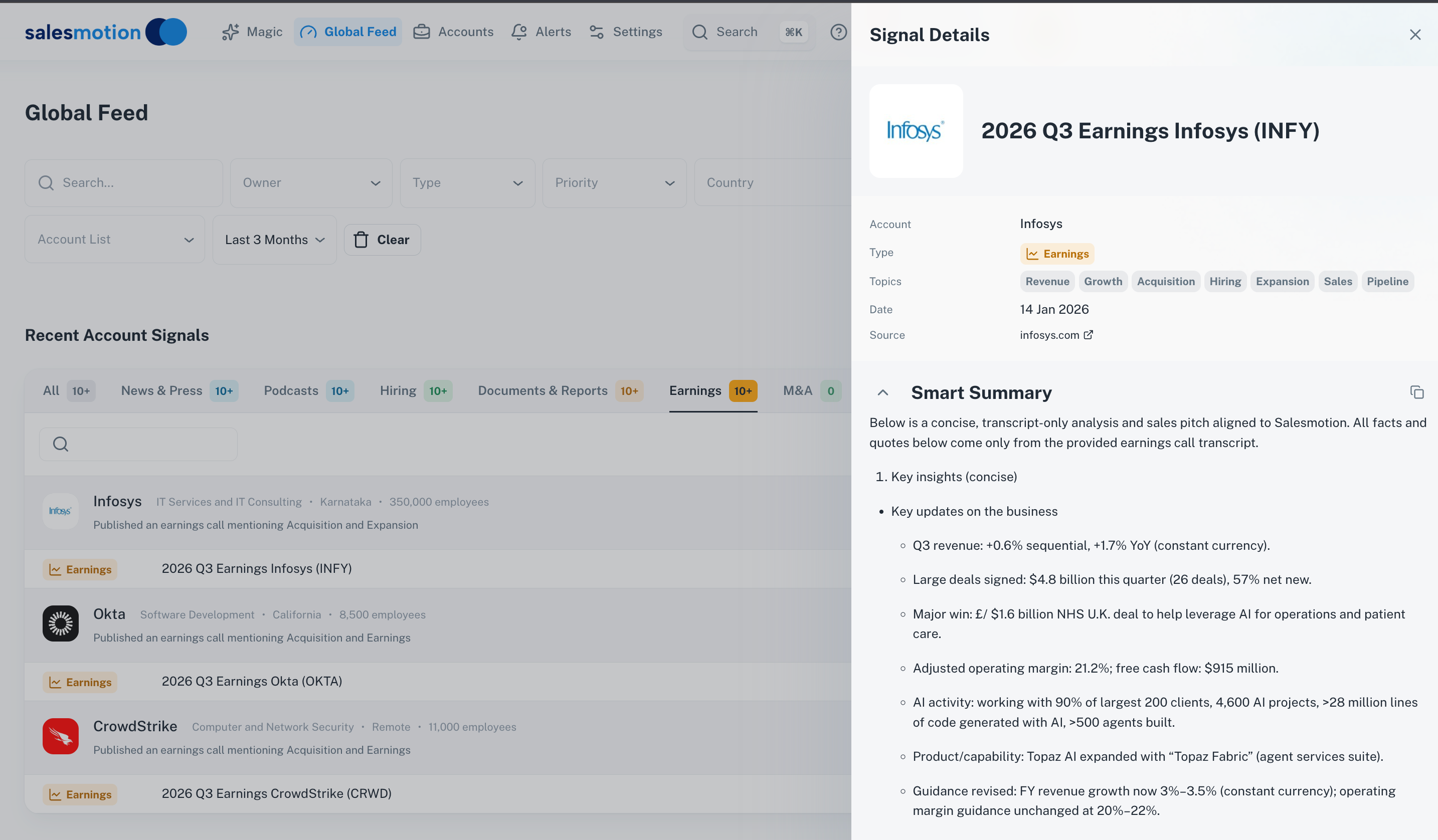 The Global Feed surfaces earnings signals in real time, showing exactly what executives said about strategic priorities, investment areas, and business challenges.
Step 2: Build the Context
Once you have a signal, you need context to make it relevant. A signal without context is trivia. A signal with context is an insight.
For example, if the signal is "new CRO hired at Target Account," the context layer adds:
- Where the CRO came from and what they accomplished there
- What the company's earnings call said about sales performance
- Whether the company is hiring aggressively in sales (growth signal) or restructuring (efficiency signal)
- How your solution connects to the likely priorities of a new CRO in their first 90 days
This context layer is what separates a "congratulations on the new role" email from a message that earns a meeting. The executive thinks: "This person understands my situation."
Step 3: Craft the Message
The message structure for executive outreach is different from standard outbound. Here is the formula:
Signal Reference + Insight + Connection + Ask
Signal Reference: "Your Q4 earnings call highlighted a $30M investment in consolidating your sales technology stack."
Insight: "We've worked with three enterprise teams navigating similar consolidation programs, and the biggest challenge is always maintaining signal coverage during the transition, because reps lose visibility into account activity when tools change."
Connection: "We built our platform specifically to solve that problem, and teams like Frontify saw a 42% increase in sales velocity during their first year."
Ask: "Would a 15-minute look at how we've helped similar teams maintain pipeline momentum during consolidation be worth your time?"
This is not a template. It is a framework. The signal reference changes with every account. The insight changes with every situation. That is why it works.
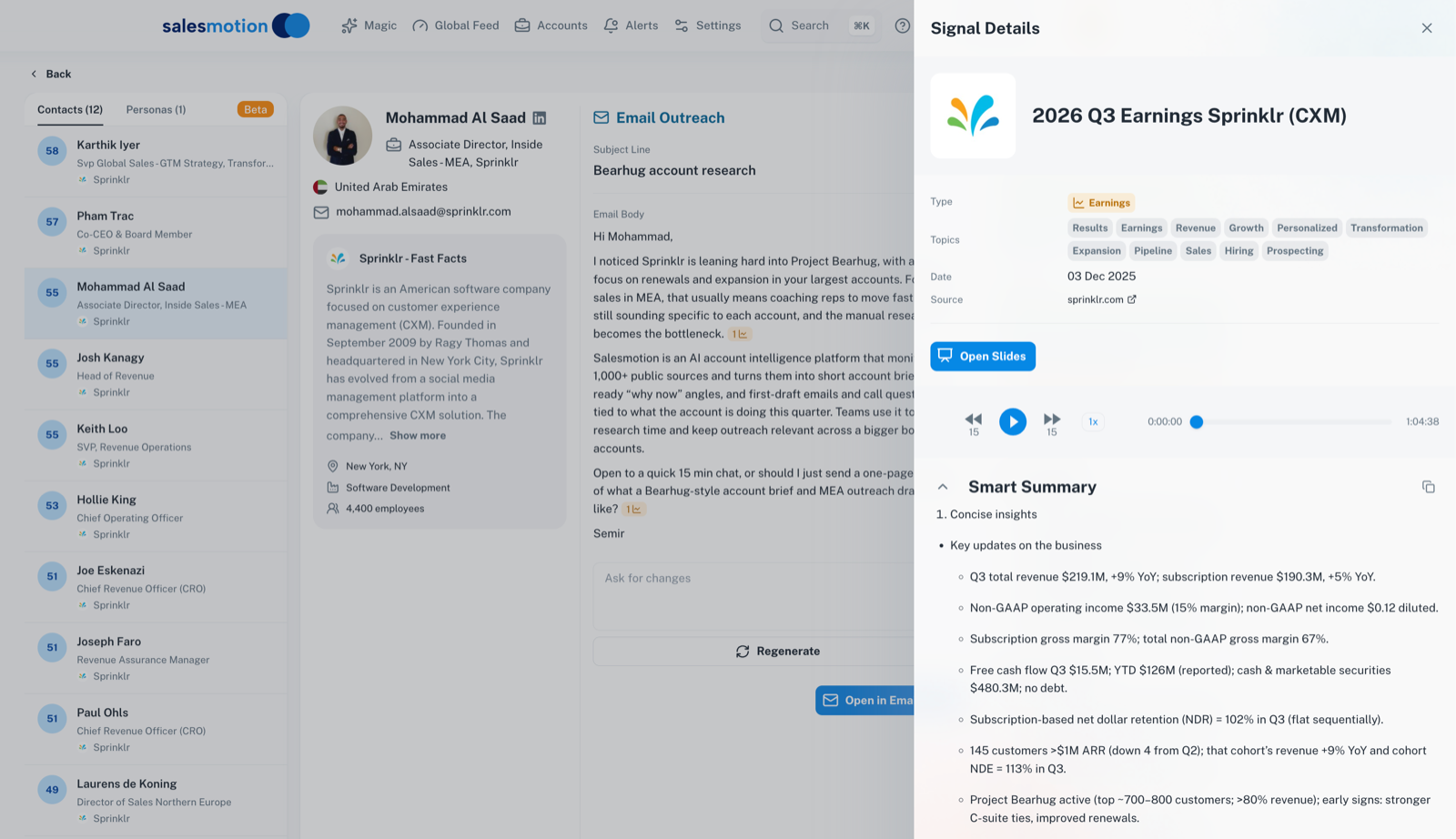 Signal-based outreach anchored to real earnings data. The message references what the CFO actually said, making it impossible to dismiss as generic spam.

“Salesmotion empowers me to cultivate a great buyer experience. I'm able to challenge prospects' thinking and be a trusted consultative seller. A major part of this is Salesmotion insights.”
Austin Friesen
Account Executive, FY25 #1 President's Club, Clari
Prioritizing Accounts by Executive Readiness
Not every account in your territory is ready for executive outreach. Sending a brilliant signal-based message to a CFO at a company with no active buying signals is still a cold email. The timing has to match.
You also rarely get a second attempt. My experience: with an executive you either hear "let's go ahead", or you hear "thanks, that was interesting, we'll review it". Then you go down two or three levels in the hierarchy and spend a year working your way back up.
The best AEs score their accounts on executive readiness before investing in high-touch outreach:
| Readiness Level | Signals Present | Approach |
|---|---|---|
| High | Earnings commentary + leadership change + hiring surge | Immediate personalized outreach to 2-3 executives |
| Medium | One strong signal (earnings or leadership) but no cluster | Add to watch list, prepare messaging, wait for confirming signal |
| Low | No recent signals, stable leadership, neutral earnings | Monitor passively, do not invest research time |
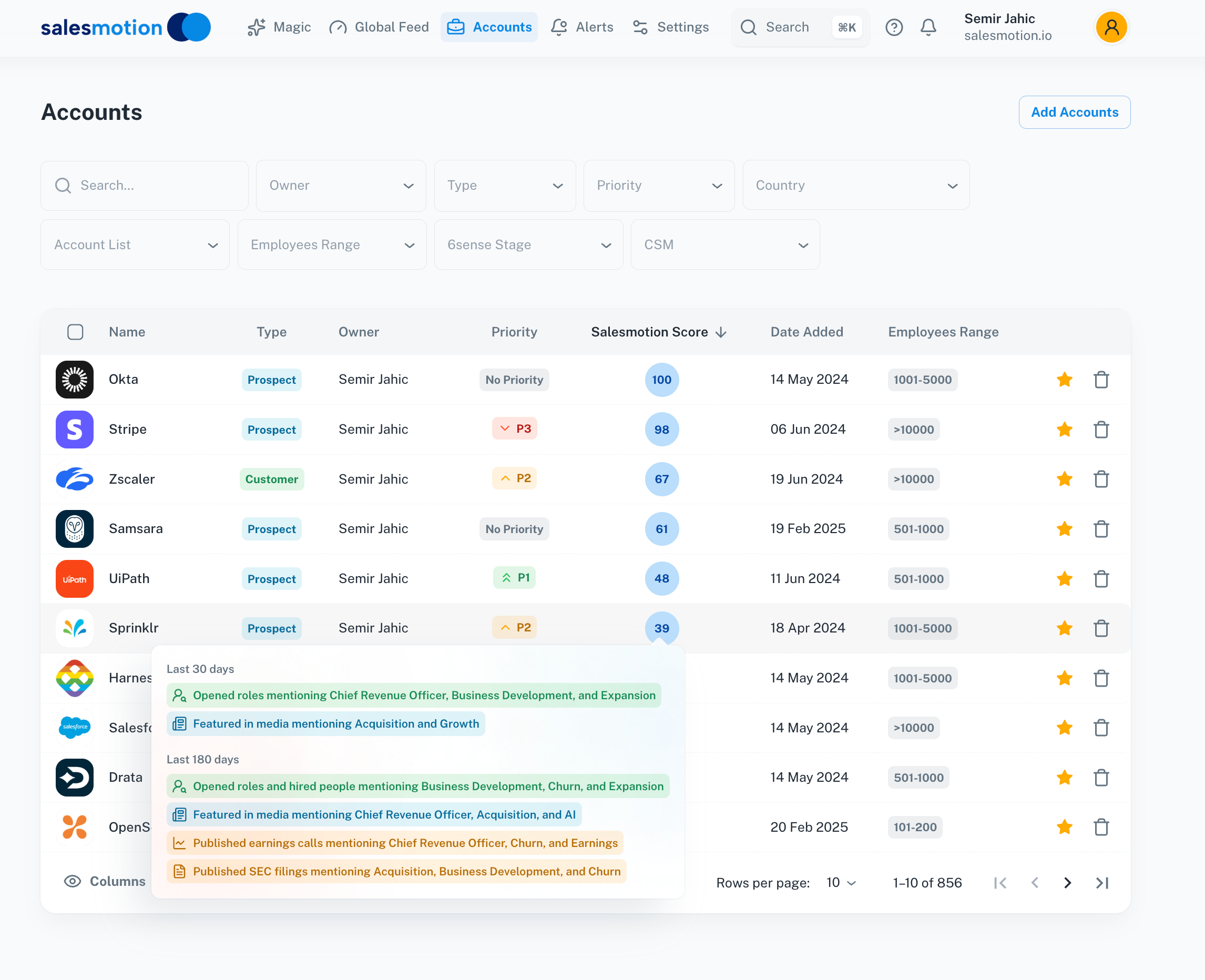 Score breakdown shows which signals are active on each account, helping AEs prioritize where to invest their executive outreach time.
This prioritization is what makes signal-based executive selling scalable. Instead of writing 50 personalized emails (impossible), you write 5-8 highly targeted messages to accounts that are actually ready (achievable and effective). According to Gong's analysis of 300,000+ sales interactions, deals where the seller demonstrated specific knowledge of the buyer's business close at rates 28% higher than those where the seller led with generic pitches.
Finding and Reaching the Right Executive Contact
Even with the perfect signal-based message, you need to reach the right person. In enterprise selling, the "right person" is not always the most senior title. It is the person whose current mandate most closely aligns with what your signal-based message addresses.
If your signal is about sales technology consolidation mentioned on an earnings call, the right contact might be:
- CRO if the commentary framed it as a growth initiative
- CFO if the commentary framed it as a cost reduction
- VP RevOps if the commentary was about operational efficiency
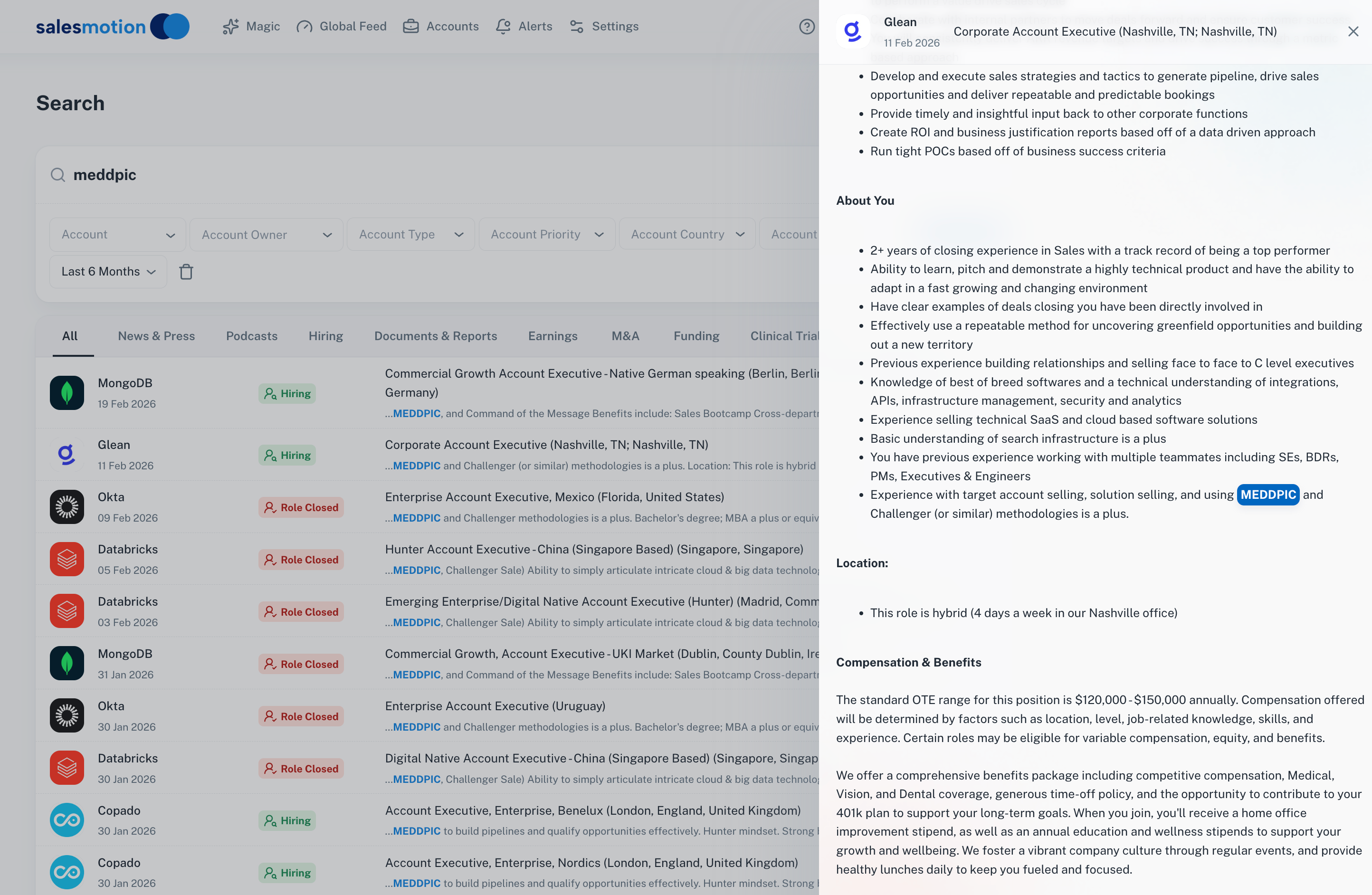 Search across your territory to find the right executive contacts, with role context and organizational data that helps you target the person whose mandate matches your signal.
The mistake is defaulting to the highest title. A CEO does not want to hear about your sales intelligence platform. The CRO does. Match the signal to the mandate to the person, and your message reaches someone who can actually act on it.
An enterprise account executive at an HR tech firm gave us the rule in one line: "Don't take a no from someone who can't give you a yes." Matching the signal to the mandate is how you find the person who can.

“My ultimate goal is to know more about the company than they know themselves. Before, that took hours across multiple tools. With Salesmotion, I can get there in 30 minutes or less and walk into a Fortune 500 conversation fully prepared.”
Jeff Dalo
Senior Director Business Development, Analytic Partners
A Real-World Workflow: From Signal to Meeting
Here is how this comes together in practice:
Monday morning. A signal fires: Target Account's CFO mentioned "consolidating our vendor landscape to reduce SG&A by 12%" on last week's earnings call. The account is in your territory.
Monday, 10 minutes of research. You pull up the account brief in Salesmotion. The CFO's exact quote is flagged. You see they hired a new VP of Sales Operations three weeks ago, likely tasked with the consolidation. The company is also posting for two sales enablement roles, confirming investment in the area.
Monday, 15 minutes of message crafting. You write a message to the VP of Sales Operations: "Your CFO's Q4 commentary on consolidating the sales tech stack caught my attention. Three of our enterprise customers navigated similar consolidation programs last year. The common pattern was moving from 5-7 point solutions to a single account intelligence layer. Teams like Analytic Partners grew qualified pipeline 40% while reducing research tool spend. Happy to share what worked and what did not in a 15-minute call."
Tuesday. The VP of Sales Operations responds. Meeting booked. The signal-to-meeting cycle took 25 minutes of total effort.
This is not hypothetical. It is the daily workflow of top-performing AEs who have built the signal-to-message muscle. The difference is having the buying signals surface automatically instead of discovering them accidentally.
Key Takeaways
- Executives filter on specificity and timing, not clever copywriting. Reference their own words and their company's announced priorities.
- Use the Signal Reference + Insight + Connection + Ask framework for every executive message. It replaces templates with relevance.
- Score accounts on executive readiness before investing in high-touch outreach. Prioritize accounts with clustered signals (earnings + leadership change + hiring) over those with none.
- Match the signal to the executive whose mandate it addresses. The right contact is not always the highest title.
- Signal-to-meeting workflows take 20-30 minutes total when signals surface automatically. Manual research for the same quality of personalization takes 3-4 hours per account.
- Top enterprise AEs like Austin Friesen at Clari credit signal-based preparation as the foundation of consultative selling that earns executive trust.
Frequently Asked Questions
How do you get a meeting with a C-suite executive?
The most reliable path is signal-based outreach that demonstrates genuine understanding of the executive's current priorities. Reference something specific from their earnings call, a recent strategic announcement, or a leadership change that creates urgency. According to ITSMA, 76% of executives will take a meeting with a seller who provides business insights they had not considered. The bar is not "interesting" but "useful." Lead with an insight about their business, not an introduction to yours.
What signals indicate an executive is open to a meeting?
The strongest signals are clustered events: an earnings call mentioning a strategic initiative you address, combined with a leadership change in the relevant department, combined with hiring activity that confirms investment. Single signals (like a leadership change alone) are worth monitoring but not always worth the outreach investment. The combination of 2-3 signals in a short timeframe indicates the account is actively working on something you can help with.
How many executive outreach messages should you send per week?
Quality over quantity. Five to eight highly personalized, signal-based messages to executives at accounts with active buying signals will outperform 50 template-based emails every time. Gong research shows deals where sellers demonstrated specific buyer knowledge close at 28% higher rates. Invest 20-30 minutes per message on the right accounts rather than 2 minutes per message on every account.
What is the best email structure for reaching senior executives?
Use the Signal Reference + Insight + Connection + Ask framework. Open with a specific reference to something the executive or their company said publicly (earnings call, press release, interview). Follow with an insight about what that signal typically means based on patterns you have seen. Connect it to a concrete outcome a similar company achieved. Close with a low-commitment ask (15-minute call, not a 60-minute demo). Keep the total message under 150 words.