Strategic account management (SAM) is a disciplined growth system for the accounts that matter most, with clear ownership, account intelligence, review rhythms, and a plan for expansion. It differs from routine account support because it decides where concentrated investment makes sense instead of treating every account the same.
TL;DR: A SAM program rests on three components: people, process, and technology. Implement it in four steps: segment accounts with a real standard, build each plan as a living roadmap, design proactive engagement around triggers, and put governance around the motion. Track leading indicators such as stakeholder coverage alongside net revenue retention and expansion revenue, so you see an account cooling off before the customer says it outright.
You can feel the problem before you can name it. A top account is still active, the renewal is months away, the relationship feels fine, and the team is busy. Then the buying group changes, a competitor gets in, or the customer's priorities shift, and the account that looked safe starts drifting.
That's the gap strategic account management is supposed to close. It's not just about keeping your best customers happy, it's about running a disciplined growth system around the accounts that matter most, with clear ownership, account intelligence, review rhythms, and a plan for expansion. Gartner's guidance makes that shift explicit, because selection has to go beyond “important customer” instincts and use both qualitative and quantitative criteria, including current revenue, cross-sell potential, customer willingness to partner, and switching costs, since common selection criteria alone often don't correlate with account growth (Gartner on account management and growth).
Why Your Most Valuable Accounts Are at Risk
Key account churn is usually an operational failure. The team still has cordial meetings, the account still looks active, and everyone assumes the relationship is in good shape until the buying group shifts, a new stakeholder takes control, or a competitor gets a foothold.
Relationships matter, but they do not replace a system. If account management depends on memory, individual judgment, and occasional check-ins, the team will miss early signs of change and only react after the customer starts to drift. That is how churn, downsell, and competitive displacement show up late, when the account is already harder to save.
The accounts that look fine often need the most structure
The accounts that seem stable often carry the heaviest cost to serve. They also tend to consume the most executive attention, the most coordination, and the most custom work, which is why account coverage has to be deliberate instead of accidental. Gartner notes that key accounts receive substantial, expensive resources, so the program has to align resource allocation, executive sponsorship, and mutual partnership expectations (Gartner on account management and growth). Without that discipline, teams spread effort across accounts that do not justify it, while the accounts with real expansion potential do not get the level of attention they need.
Practical rule: if your team cannot explain why an account belongs in the strategic tier, it probably should not be there.
Strong strategic account management protects revenue, and it also creates a path to the next layer of growth. That requires a live view of account movement, not just a renewal calendar, because retention and expansion depend on spotting buying group changes, usage shifts, and new risks early. If you are connecting account discipline to retention outcomes, this net revenue retention resource is a useful companion.
The model that fails most often is simple. The team has a good relationship, but no operating system. It feels efficient for a while, yet it leaves too much to memory, heroics, and rep intuition. A real SAM program gives you a way to see when an account is cooling off before the customer says it outright.
See Salesmotion in action
Take a self-guided interactive tour — no signup required.
What Strategic Account Management Really Means Today
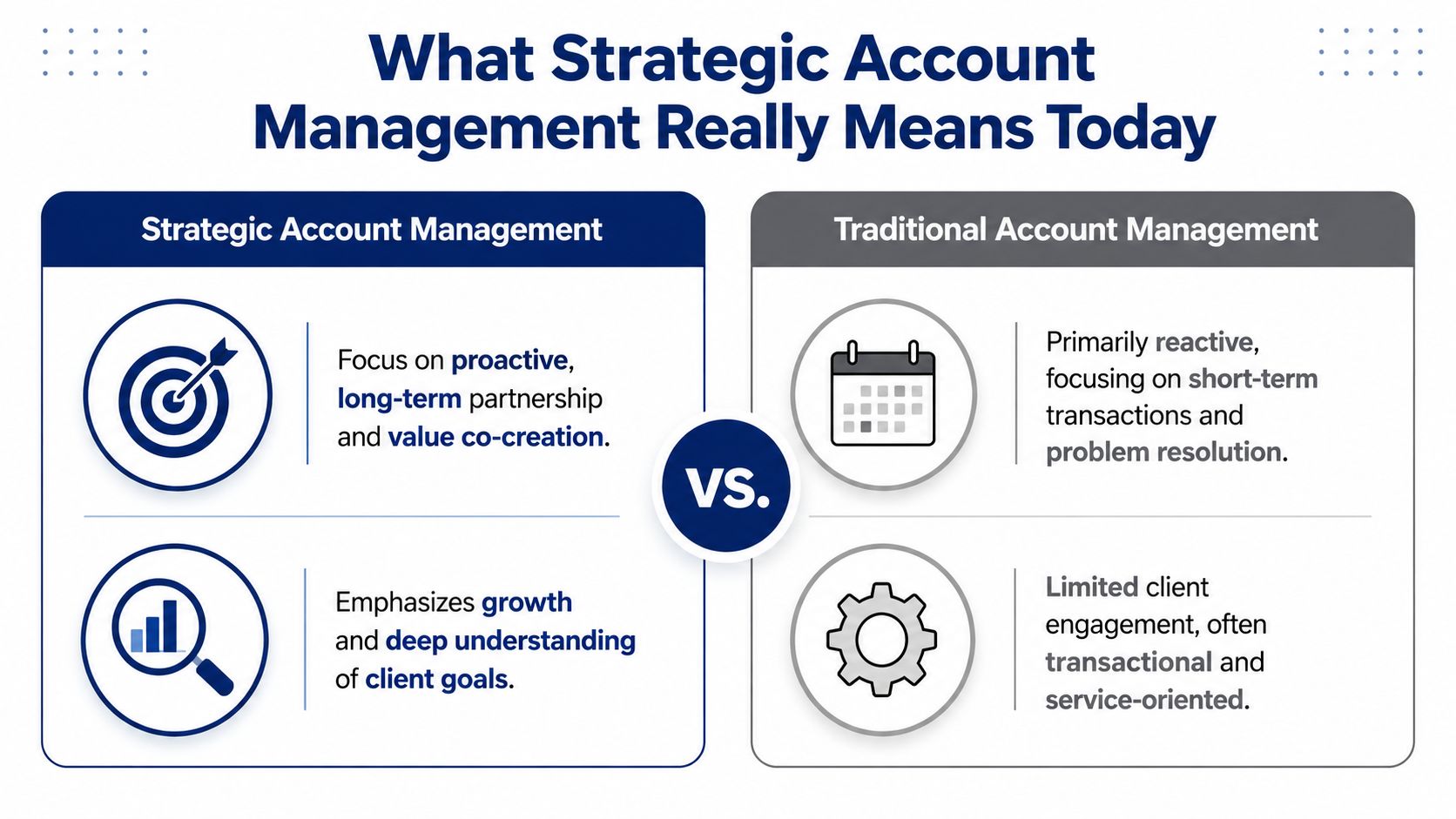
A strategic account program is closer to portfolio management than to customer service. The point is not to treat every account the same. The point is to decide where concentrated investment makes sense, where the upside justifies the effort, and what has to happen for growth to show up.
That is a different operating choice from routine account support, which often becomes reactive by default. A customer asks for help, and the team responds. A stakeholder raises a problem, and the team works it. That work matters, but it does not create growth on its own. The better approach is to tier accounts using both qualitative and quantitative signals, such as current revenue, cross-sell potential, willingness to partner, and switching costs, while avoiding the trap of choosing accounts based on obvious criteria alone.
The focus shifts from coverage to deliberate investment
A strategic account program starts with a simple question, which accounts deserve a specific level of attention because the upside is real. That changes how teams allocate time, executive access, and field resources. It also changes how they justify the work internally.
The strongest programs tie that decision to account plans, metrics, and regular review cycles. They do not treat account management as a static service function. They revisit the account, check whether the original thesis still holds, and adjust the plan when the market, the buying group, or the customer's priorities change.
In day-to-day execution, the difference is obvious. A traditional rep spends time where the customer is loudest. A strategic team spends time where fit, access, and growth potential line up. That takes discipline, because the work is less about responding quickly and more about choosing correctly.
The best accounts get a living strategy
A SAM plan should not sit in a folder until QBR season. It needs to change when the account changes. New executive, new funding priorities, competitor move, usage shift, all of those are triggers to revisit the plan and update the next move.
A practical account planning template helps teams do that work without improvising every time. Use this account planning template as a starting point if you need a structure that keeps the plan tied to real account movement.
Useful test: if an account plan does not change when the account changes, it is not really a plan.
Technology is what makes this model scalable. Manual account management can preserve relationships, but it cannot reliably track signals across a portfolio of accounts or surface the right moment for outreach. Modern strategic account management works as a technology-enabled operating system for growth. It uses automated sales intelligence to monitor buying signals, research accounts faster, and keep outreach tied to the activity within the account.

“The account and contact signals are key for reaching out at important times, and the value-add messaging it creates unique to every contact helps save time and efficiency.”
Daniel Pitman
Mid-Market Account Executive, Black Swan Data
The Core Components of a SAM Framework
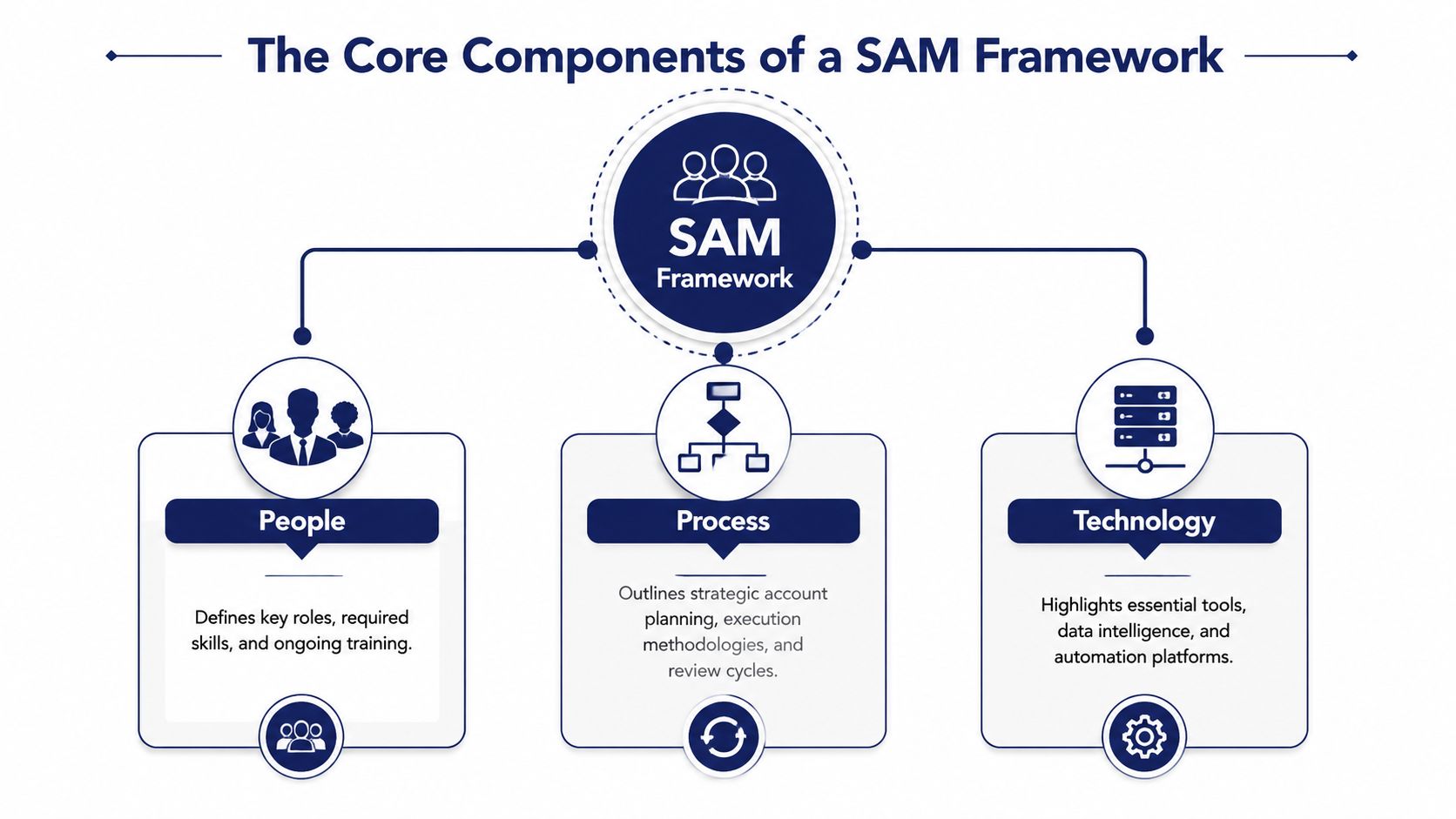
A SAM program breaks when one of three things is missing. The team lacks the right people. The process is too loose. Or the tech stack cannot keep up with the amount of research, monitoring, and follow-up the program demands.
People carry the account, but they cannot carry it alone
A strategic account manager is not just the person who keeps the relationship warm. The role has to connect customer understanding, internal coordination, and commercial growth. Executive sponsors matter because they can remove roadblocks, open senior conversations, and signal that the account deserves real attention. Without that senior air cover, even a strong plan can stall once the buying center gets complicated.
Role clarity is where many programs slip.
One person cannot be the analyst, relationship builder, project manager, and executive closer on every large account. If you do not define who owns what, the work gets duplicated in some places and ignored in others. That is a process problem, but it starts with people who are stretched too thin and left to improvise.
Process turns effort into repeatability
The process side is where many teams underinvest. A strong SAM motion needs account selection rules, planning cadences, stakeholder mapping, review habits, and a way to update the account when the market changes. A useful account-management process is action-oriented, not theoretical. If it does not produce decisions, meetings, and next steps, it is just documentation.
Process also has to reflect trade-offs. The team needs a clear way to decide which accounts get strategic coverage, which relationships need executive attention, and which opportunities are not worth the time. That discipline keeps the program from turning into a long list of accounts with no real prioritization.
If you want a practical template for building that structure, this account planning template is a good place to start.
Technology makes the framework scalable
Technology is what makes the framework usable across a portfolio, not just inside a few high-touch accounts. Manual account management can preserve relationships, but it cannot reliably track signals, surface research, or point a rep to the right moment for outreach across dozens of accounts. Modern strategic account management works like a technology-enabled operating system for growth. It uses automated sales intelligence to monitor buying signals, speed up research, and keep outreach tied to what is happening inside the account.
The market is moving in that direction. Strategic Revenue Insights says the strategic account management market is projected to reach approximately USD 12.5 billion by 2033, and the supporting software market is projected to reach USD 20.2 billion (Strategic Revenue Insights on the key account market). That matters because the market is no longer rewarding spreadsheets and memory. It rewards systems that can operationalize segmentation, planning, and execution at scale.
If you are mapping your internal process, an account management guide can help you compare roles, process, and system ownership without overcomplicating the design.
The practical takeaway is simple. People create judgment, process creates consistency, and technology creates scale. If one of those is weak, the whole framework becomes brittle.
How to Implement Your SAM Program Step by Step
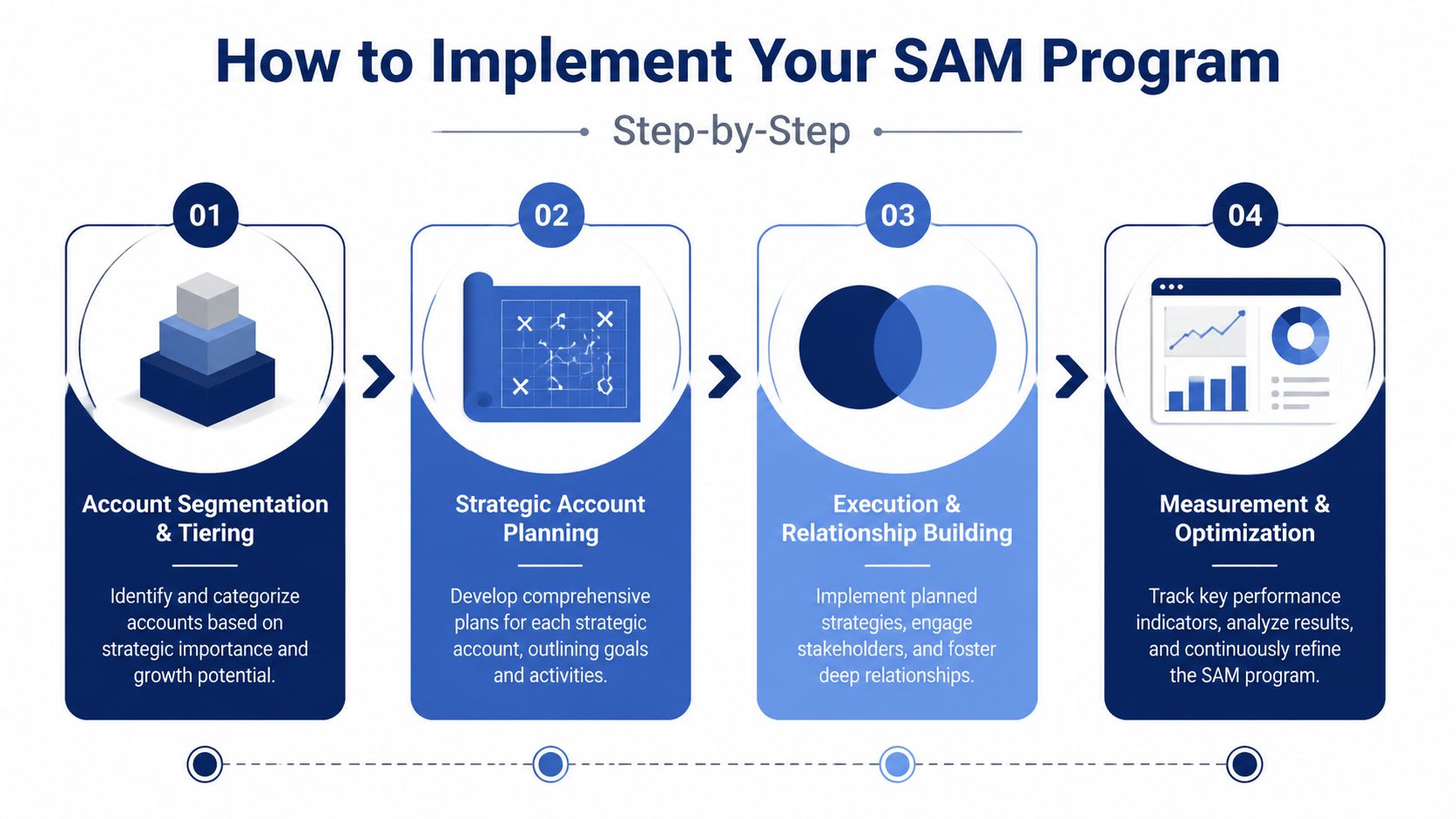
A SAM program fails fast when a team starts with account plans instead of account selection. The first job is to decide which accounts deserve strategic coverage and why. If the team tries to treat every account the same, the program becomes a larger list, a busier calendar, and a weaker revenue result.
1. Segment accounts with a real standard
Use current revenue as one input, but keep it only as one input. Accounts with strong expansion potential, a real willingness to partner, or high switching costs may deserve more focus than a larger account that is already fully worked. That is how you avoid spending strategic time on accounts that look attractive on paper but are already flat in practice.
A segmentation review should force trade-offs. If an account has obvious upside but the buying group is closed and the internal effort is high, it belongs in a lower tier until the situation changes. That keeps the program tied to reality instead of optimism.
2. Build the plan as a living roadmap
A high-performing strategic account plan is usually a 1-to-3-year roadmap with benchmarks, KPIs, and review cadences built into it (Janek on strategic account management). The plan has to reflect what has changed since the last review, not just what was true when the slide deck was created. New hires, funding events, and competitive moves should update goals and actions directly.
Practical rule: if the plan breaks the moment the account changes, it is too static.
Keep the planning process light enough that the team uses it. A plan that takes weeks to refresh usually goes stale before anyone acts on it. A plan that gets reviewed on a steady cadence stays useful, especially when the account data is current and easy to check.
3. Design proactive engagement around triggers
Proactive engagement is about timing and relevance. If a new executive is hired, the customer launches a new initiative, or a competitor shows up in the account, the outreach should reflect that change right away.
A lot of teams know they should be more proactive. They do not have the signal layer to make that practical. A useful resource for the planning side of that motion is resources for building a demand gen engine, because account work still needs a repeatable process behind it.
If you want a stronger operating layer, use a sales intelligence platform to surface buying signals, account changes, and research inputs before reps start drafting outreach.
4. Put governance around the motion
Good governance keeps the program from turning into opinion-based coverage. Quarterly reviews work well for strategic accounts, and some teams add monthly check-ins on leading indicators and risk. The point is control, not ceremony.
Decisions get better when account teams review the same facts on a predictable cadence.
The operating system matters here. A team needs to see who owns each next step, what changed since the last review, and what action follows from that change. Without that structure, the plan sits in a folder and the account motion drifts.

“All of the vendors that I've worked with, all of the onboarding that I have had to deal with, I will say, hands down, Salesmotion was the easiest that I have had.”
Lyndsay Thomson
Head of Sales Operations, Cytel
Fueling Your Program with Sales Intelligence
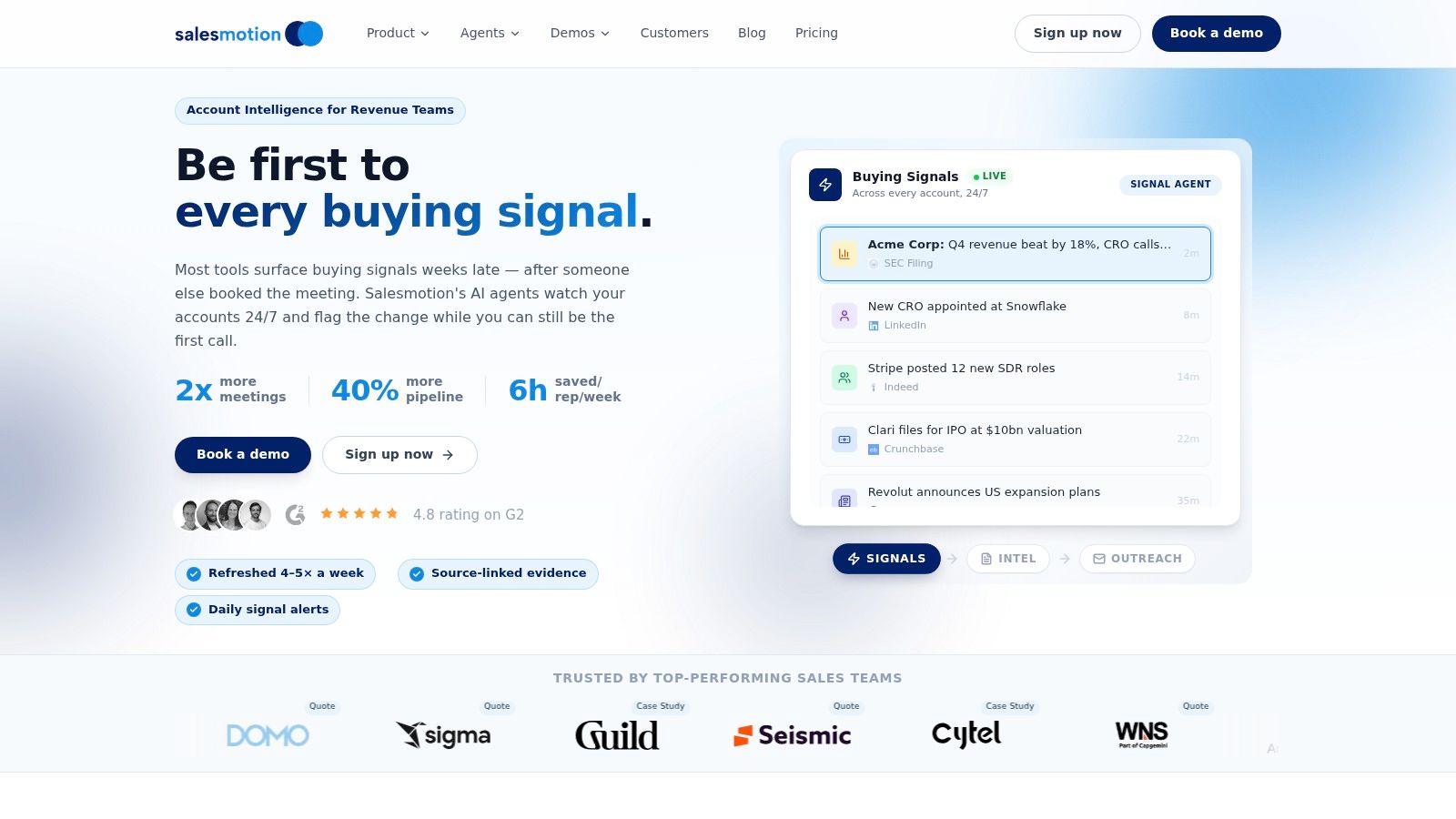
The biggest reason SAM programs stall is simple. The research load is heavy, the signals are scattered, and the outreach work never ends. Reps spend too much time stitching together account context by hand, which means the strategic work gets squeezed out by admin.
Manual account intelligence doesn't scale
A strong account plan needs real context, not guesswork. Someone has to monitor hiring, leadership moves, funding, product launches, press releases, and competitive shifts, then translate that into a reason to act. Doing that manually across a large portfolio burns time fast.
That's why sales intelligence matters. Salesmotion, for example, uses AI agents to automate research, detect signals, and turn those inputs into outreach workflows, which is useful in a SAM motion because the planning and execution work depends on timely context. Its research and signal tracking approach lines up with the kind of account planning work revenue teams already do, but it cuts down the manual prep that usually slows everything down.
Signals need to turn into action, not just alerts
A signal by itself is just noise until someone knows what it means. If a company adds a new CRO, opens a new office, or updates hiring in a relevant function, that event should influence the account plan and the next touchpoint. The same is true for account changes that show momentum or risk.
Automation proves its worth. Instead of waiting for a rep to notice the news, the system can surface the trigger and connect it to the account context. That gives the team a clear “why now” before the window closes.
Outreach works better when it's anchored to reality
Generic email sequences still waste time because they don't feel connected to the account. Good outreach starts with specifics, whether that's a hiring pattern, a strategic initiative, or a recent organizational change. The rep still needs judgment, but the draft should come from real account data, not a blank page.
If you want to explore the mechanics of modern sales intelligence more broadly, this sales intelligence platform overview is a useful reference. And for teams trying to connect intelligence to pipeline development, the workflow concept pairs well with resources for building a demand gen engine.
Modern SAM gets a lot easier when the machine handles the repetitive parts. That leaves the team free to do the part humans are still best at, which is interpretation, prioritization, and relationship building.
Metrics That Prove Your SAM Program Is Working
The right SAM dashboard should tell you whether the account engine is healthy before the quarter closes. Revenue matters, but by the time revenue moves, the underlying behavior has already happened. That's why the best programs use a mix of lagging and leading indicators.
Track outcomes and inputs together
For lagging indicators, look at net revenue retention, account growth, and expansion revenue. For leading indicators, track relationship depth, stakeholder coverage, and whether the plan is being executed on time. A mature program should also track program health itself, not just commercial results.
One practical benchmark set suggests programs should aim for 115-130% net revenue retention, 30-40% expansion revenue as a share of total revenue, and at least two C-level relationships per strategic account (Salesmotion on strategic account management). Those numbers are useful because they force the conversation beyond “we retained the account” and toward “we expanded it in a measurable way.”
Useful test: if the dashboard only shows revenue, it's too late.
Keep the scorecard tight
A good scorecard doesn't try to measure everything. One account-management guide recommends limiting the dashboard to eight to twelve core metrics that map directly to the account's objectives and the decisions the team needs to make (Umbrex performance measurement and reporting). It also recommends covering financial, growth, delivery, relationship, and strategic value so the view isn't one-dimensional.
That mix matters because a healthy account can still hide risk. A deal pipeline may look fine while executive coverage is weak, or the relationship may be strong while delivery issues gradually erode trust. The scorecard should expose that.
Use the metrics to drive action
Metrics only matter when they change behavior. If executive engagement is thin, the plan should show who needs to be added. If the plan is falling behind, the owner should know what gets dropped or reassigned. If the account is healthy but expansion is flat, the team should revisit the value story and the stakeholder map.
The strongest programs don't ask, “Did we hit the number?” first. They ask, “What's changing in the account, and are we responding fast enough?”
Common Pitfalls in Strategic Account Management
Most SAM failures start the same way. The team treats visibility as discipline. Big accounts get labeled strategic, plans get written, and nobody builds the operating habits that keep the program alive.
Don't make every large account strategic
Size alone isn't strategy. If every large account gets the same level of attention, the team spreads effort too thin, and the accounts with real growth potential miss out on timely coverage. Account selection needs standards, not instinct.
Don't let plans become shelfware
A plan that gets built once and never touched is a sign the program is drifting. The fix is a review rhythm that forces updates when the account changes. New information then turns into revised actions instead of dead notes.
Don't run the program without executive support
If leadership will not back the resource commitment, SAM turns into an extra task instead of a growth system. Executive sponsorship matters because strategic accounts often need cross-functional support, and the account team cannot create that by itself.
Arpedio's account management guidance is useful as a check on whether the program is being executed, not just discussed. It ties success to NRR, account growth, executive engagement, stakeholder coverage, account plan completion, and QBR adherence, which gives leaders a practical view of account health before revenue shows up (Arpedio on account management).
Don't ignore the tech layer
Manual research slows everything down. Reps lose time, signals get missed, and outreach gets generic. A practical look at how sales reps waste time on research shows why this becomes a scaling problem fast.
SAM works better when technology handles the repetitive work. Automated sales intelligence can surface account signals, speed up research, and give reps context for outreach before a human ever opens a task. That does not replace judgment. It gives the team the information it needs to spend time on the right accounts and the right moves.
A strong SAM program runs on account selection, live planning, accountable execution, and intelligence that keeps the system current. If you want to build that motion without drowning your team in manual work, connect with Salesmotion.