
Your team spent two weeks in January building account plans. By March, nobody opened them. By Q2, the plans were so disconnected from reality that reps treated them as artifacts of a planning exercise rather than tools for winning deals. If this sounds familiar, you are not alone. Most B2B sales organizations run account planning as an annual compliance exercise, not an operational discipline, and the results reflect it.
This guide presents a different approach. It is the framework that high-performing enterprise revenue teams use to build account plans that actually influence pipeline, deals, and expansion revenue. It is designed for the VP of Sales or CRO managing 50 to 200 strategic accounts who needs a system, not a template.
Why Most Account Plans Collect Dust
The typical account planning cycle follows a predictable pattern. Leadership mandates account plans at the start of the fiscal year. Reps spend days populating slides with backward-looking data: last year's revenue, current contract value, org charts scraped from LinkedIn. The plan gets reviewed once in a QBR, then sits untouched until the next planning cycle.
According to Gartner, account managers frequently find account plans burdensome and overlook them as a resource for customer insight and decision guidance. Forrester echoes this, noting that planning efforts often fail to yield desired results and devolve into an administrative chore rather than an integral part of the sales motion.
Three structural problems cause this:
1. Plans are backward-looking, not forward-looking. Most account plans document what has already happened: last year's bookings, current product footprint, existing contacts. They rarely capture the signals that predict what will happen next, such as leadership changes, strategic pivots announced in earnings calls, competitive displacements, or expansion triggers.
2. Plans are disconnected from daily selling. A 20-page PowerPoint deck does not integrate into a rep's workflow. If the plan lives in a shared drive rather than inside the tools where reps actually work, it will not influence behavior. Reps will continue operating from their CRM activity log and email inbox, not from a static strategy document.
3. There is no accountability loop. Plans are created and reviewed, but rarely updated. There is no cadence for revisiting assumptions, no trigger to refresh the plan when something changes at the account, and no measurement of whether the plan influenced outcomes. Only 28% of sales leaders say their existing account management channels regularly meet cross-selling and account growth targets, according to Gartner's account management research.
The result is predictable. Reps revert to relationship selling. Expansion revenue comes from inbound requests rather than proactive strategy. And strategic accounts get the same ad hoc treatment as any other deal in the pipeline.
See Salesmotion in action
Take a self-guided interactive tour — no signup required.
The Living Account Plan Framework
The framework that top revenue teams use is not a document. It is a system with five interconnected components, each designed to be updated continuously rather than built once and filed away.
1. Account Landscape
The Account Landscape is the foundational layer. It answers the question: what does this organization actually look like, and how do decisions get made?
This goes beyond the standard org chart. It maps:
- Organizational structure including business units, geographies, and P&L ownership. In a company with $500M+ in revenue, knowing which division controls the budget you are targeting matters more than knowing the CEO's name.
- Buying committee composition for your solution area. B2B deals now involve an average of 11 stakeholders according to Salesforce's State of Marketing report, and Gartner puts the number as high as 11 to 20 for complex enterprise purchases.
- Political dynamics including who has rising influence, who has been sidelined, and where internal rivalries create either opportunity or risk. This is the intelligence that separates strategic sellers from transactional ones.
- Technology environment covering the current stack, known pain points, contract renewal timelines, and integration dependencies that could accelerate or block your deal.
The Account Landscape should be updated whenever a structural change occurs: a reorg, an executive departure, an acquisition, or a new strategic initiative.
2. Value Map
The Value Map connects your solution directly to the account's published strategic priorities. It is not about your product's features. It is about the outcomes that matter to the executive team and how your solution enables them.
Sources for building a Value Map include:
- Earnings call transcripts where executives describe their priorities, challenges, and investment areas in their own words.
- Annual reports and 10-K filings that reveal capital allocation decisions, risk factors, and growth strategies. For methodology on extracting insights from these filings, see our guide on using DEF 14A for account research.
- Press releases and news coverage that signal new initiatives, partnerships, or market moves.
- Industry analyst reports that contextualize the account's position relative to competitors and market trends.
A strong Value Map translates these external signals into a clear narrative: here is what this company is trying to achieve, here is the obstacle they face, and here is exactly how our solution helps them overcome it. This narrative becomes the foundation for every executive conversation, proposal, and expansion pitch.
3. Signal Dashboard
Static account plans break down because the world changes and the plan does not. The Signal Dashboard solves this by establishing a continuous monitoring system for the triggers that should prompt action.
Critical signals to track include:
- Leadership changes. A new CRO, CIO, or CFO often brings new priorities, new vendor evaluations, and new budget allocations. This is both a risk to existing relationships and an opportunity to establish new ones.
- M&A activity. An acquisition signals integration needs, budget shifts, and organizational disruption. A company being acquired may freeze spending while the acquirer may accelerate it.
- Funding rounds and earnings. A strong earnings report or new funding round often precedes increased investment. A miss on revenue targets may trigger cost-cutting that affects your renewal.
- Competitive displacement. When a competitor loses a contract or exits a market, it creates immediate whitespace.
- Strategic announcements. A new product line, geographic expansion, or digital transformation initiative can create demand that did not exist six months ago.
Manually monitoring these signals across 50 to 200 strategic accounts is not feasible. This is where account intelligence platforms become essential. Tools that continuously scan thousands of public sources and synthesize signals into prioritized alerts allow teams to keep every account plan current without dedicating hours to manual research. Salesmotion, for example, monitors over 1,000 sources including SEC filings, earnings calls, news, and executive moves to generate real-time account signals and AI-synthesized briefs that feed directly into the planning process.
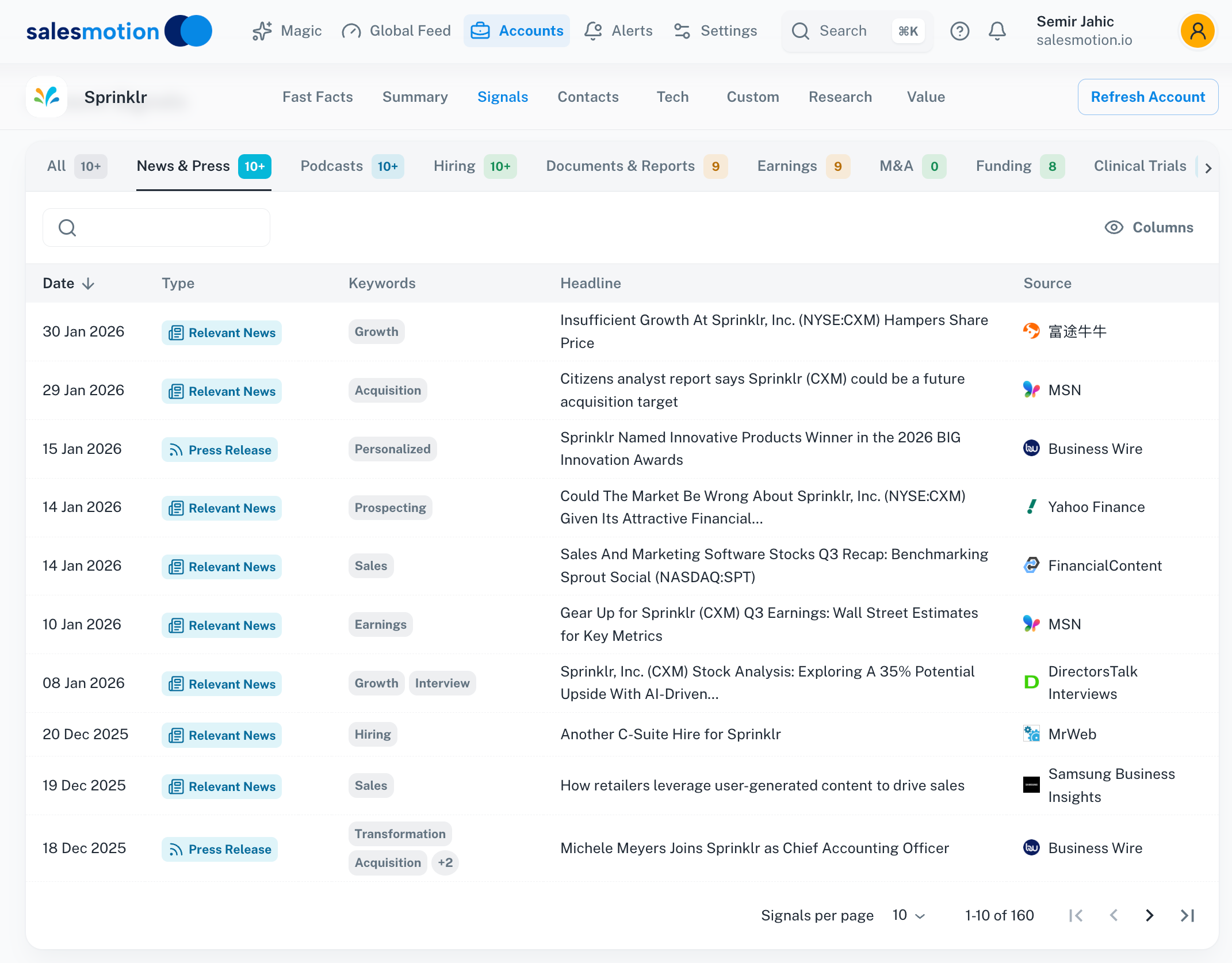 Salesmotion's signal dashboard continuously monitors strategic accounts for leadership changes, earnings events, and competitive moves -- keeping your account plans current without manual effort.
For a comparison of account planning tools and services, see our provider comparison.
4. Relationship Map
The Relationship Map is the political layer of your account plan. It answers the question: who has power, and who is on your side?
For each member of the buying committee, map four dimensions:
- Role in the decision. Are they the economic buyer (final sign-off), a technical evaluator, an end user, or an influencer who shapes opinion without holding budget authority?
- Disposition toward your solution. Classify each contact as a champion (actively advocates for you), a coach (provides inside information), neutral, or a blocker (actively resists your solution).
- Level of engagement. When did you last have a meaningful conversation? Is the relationship current or stale?
- Organizational influence. A director who has the CEO's ear may matter more than a VP who is on the way out.
The math on multi-threading is clear. Analysis of 500 B2B opportunities shows that single-threaded deals have roughly a 5% win rate, while deals with five or more engaged stakeholders reach 30%, a sixfold improvement. Cross-department threading can increase win rates by up to 56%. Yet 70% of opportunities remain single-threaded, relying on a single point of contact to champion the deal internally.
The Relationship Map makes this visible. When a rep has only one active contact on a seven-figure opportunity, the plan should flag that as a critical risk, and the action plan should address it.
5. Action Plan
The Action Plan is where strategy becomes execution. Unlike the generic action items that populate most account plans ("schedule QBR," "send case study," "follow up in Q3"), a good Action Plan ties specific actions to specific signals and specific people.
Each action should follow this structure:
- Trigger: What signal or event prompted this action?
- Owner: Which person on your team is responsible?
- Target contact: Which person at the account are you engaging?
- Objective: What specific outcome are you trying to achieve?
- Timeline: By when?
For example: "New CTO announced (trigger) — AE schedules introductory meeting through VP Engineering champion (action) — goal is to understand new technology priorities and position our platform before the 2026 budget cycle closes (objective) — within 21 days of announcement (timeline)."
This structure makes the plan actionable and auditable. In the weekly pipeline review, a manager can ask: what signals fired this week, and what actions did we take?

“My ultimate goal is to know more about the company than they know themselves. Before, that took hours across multiple tools. With Salesmotion, I can get there in 30 minutes or less and walk into a Fortune 500 conversation fully prepared.”
Jeff Dalo
Senior Director Business Development, Analytic Partners
How to Source Account Intelligence at Scale
The Living Account Plan framework depends on a continuous flow of external intelligence. Without it, the Signal Dashboard goes dark, the Value Map becomes stale, and the Action Plan loses its triggers.
For a team managing 10 strategic accounts, manual research might work. One experienced rep or analyst can monitor earnings, track leadership moves, and stay current on industry news for a handful of companies.
At 50 to 200 accounts, manual research breaks down completely. The math does not work. If each account requires two hours of research per month to stay current, that is 100 to 400 hours of analyst time monthly, more than two full-time headcount dedicated entirely to research.
This is where account intelligence platforms transform the economics of strategic account planning. Modern platforms automate the research layer by continuously scanning public sources, synthesizing information into executive-ready summaries, and delivering prioritized alerts when something changes.
The impact is measurable: teams that automate account research report significant reductions in prep time per meeting, higher signal-to-noise ratios in their pipeline, and more confident executive conversations because they arrive with context, not generic talking points.
When evaluating how to source intelligence for your account plans, prioritize platforms that provide transparent source tracing (so reps can verify claims before using them in conversations), integrate with your existing CRM workflow, and deliver synthesis rather than raw data dumps.
Account Planning Cadence for Enterprise Teams
A framework is only as good as the operational cadence that keeps it alive. Here is the rhythm that top enterprise teams follow:
Weekly: Pipeline and Signal Review (30 minutes per account team)
The account team reviews new signals from the past week, assesses any changes to the Relationship Map, and updates the Action Plan. This is not a full account review. It is a quick check: what changed, and what do we need to do about it?
Monthly: Account Health Assessment (60 minutes per strategic account)
A deeper review covering all five framework components. The account owner presents the current state of the account, highlights risks, identifies expansion opportunities, and requests resources or executive involvement where needed. The key question: is this account on track relative to our annual plan, and if not, what needs to change?
Quarterly: Executive Account Review (90 minutes for top 20 accounts)
The CRO or VP of Sales reviews the highest-value accounts with the full revenue leadership team. This is where resource allocation decisions happen: which accounts get executive sponsorship, where to invest in events or custom content, and which accounts need a different strategy entirely.
Trigger-Based: Immediate Response Protocol
Some signals cannot wait for the weekly review. A CEO departure, a major acquisition announcement, or a competitive loss at a strategic account should trigger an immediate response within 24 to 48 hours. Define in advance which signal types warrant immediate action and who is responsible for the response.
Ownership and Accountability
Every strategic account needs a single accountable owner, the Account Executive or Strategic Account Manager, who is responsible for keeping the plan current. But they should not work alone. Build a virtual account team that includes:
- Sales leadership for executive engagement and resource allocation
- Solutions or pre-sales engineering for technical positioning
- Customer success for adoption insights and expansion signals (on existing customers)
- Marketing for account-specific content and event coordination
The account owner runs the cadence. Leadership ensures the cadence actually happens.

“The Business Development team gets 80 to 90 percent of what they need in 15 minutes. That is a complete shift in how our reps work.”
Andrew Giordano
VP of Global Commercial Operations, Analytic Partners
Measuring Account Planning Impact
The ultimate test of an account planning framework is whether planned accounts outperform unplanned ones. Here are the metrics that connect account planning to revenue outcomes:
Deal Velocity
Compare the average sales cycle length for opportunities at planned accounts versus unplanned accounts. Organizations with optimized deal velocity achieve up to 28% higher win rates than industry averages according to Salesforce research. Strategic planning reduces friction by pre-mapping stakeholders, aligning messaging to known priorities, and identifying blockers before they stall a deal.
Win Rate on Planned Accounts
Track win rates separately for accounts where the team actively maintains a living account plan versus accounts that receive ad hoc coverage. The multi-threading data alone suggests the impact is substantial: multi-threaded deals with five or more stakeholders engaged see a sixfold improvement in win rates over single-threaded deals.
Expansion Revenue
Planned accounts should generate meaningfully more expansion revenue. Top-performing SaaS companies with strategic account expansion programs achieve net revenue retention above 120%, driven by systematic identification and execution of upsell and cross-sell opportunities. Reactive expansion, where you wait for the customer to ask for more, leaves significant revenue on the table.
Multi-Thread Depth
Measure the average number of engaged contacts per strategic account. If your planned accounts average three or fewer active contacts, the Relationship Map is not translating into action. Enterprise accounts should target 10 or more engaged contacts across multiple departments and levels.
Plan Freshness
Track when each account plan was last updated. If more than 30% of your strategic account plans have not been touched in 60 days, the cadence is breaking down. This is a leading indicator: stale plans precede missed expansion targets and surprise churn.
Account Planning ROI
Calculate the cost of your account planning program (tools, analyst time, meeting hours) against the incremental revenue in planned accounts. Delivering higher returns from key accounts is a priority for 70% of Chief Sales Officers according to Gartner. The organizations that can demonstrate a clear ROI from their planning investment earn continued executive support and budget.
Key Takeaways
- Most account plans fail because they are backward-looking documents disconnected from daily selling activity. Only 28% of sales leaders say existing account management approaches meet their growth targets.
- The Living Account Plan framework has five components: Account Landscape, Value Map, Signal Dashboard, Relationship Map, and Action Plan. Each is designed to be continuously updated, not built once a year.
- Multi-threading is the single highest-leverage activity in strategic account planning. Deals with five or more engaged stakeholders see a sixfold improvement in win rates versus single-threaded deals.
- Account intelligence at scale requires automation. Manual research does not work beyond 10 accounts. Platforms that synthesize external signals into prioritized alerts transform the economics of account planning.
- Operational cadence is what separates a framework from a filing exercise. Weekly signal reviews, monthly health assessments, quarterly executive reviews, and trigger-based response protocols keep plans alive and actionable.
- Measure what matters: deal velocity, win rate on planned accounts, expansion revenue, multi-thread depth, and plan freshness. These metrics connect account planning directly to revenue outcomes.
Frequently Asked Questions
Why do most account plans fail to drive results?
Most account plans fail because they are built as static documents during an annual planning exercise, then never updated or integrated into daily selling workflows. They focus on backward-looking data rather than forward-looking signals, and there is no operational cadence to keep them current. When plans live in a shared drive instead of inside the tools where reps work, they do not influence behavior.
What should a strategic account plan include?
An effective strategic account plan includes five components: an Account Landscape mapping organizational structure and political dynamics, a Value Map connecting your solution to the account's published strategic priorities, a Signal Dashboard for monitoring trigger events, a Relationship Map classifying stakeholder roles and dispositions, and an Action Plan tying specific activities to specific signals and contacts.
How often should account plans be updated?
Account plans should be updated continuously through a structured cadence: weekly signal and pipeline reviews, monthly account health assessments, quarterly executive reviews for top accounts, and immediate response protocols for critical trigger events like leadership changes or M&A announcements. If an account plan has not been updated in 60 days, it is effectively stale.
How does multi-threading improve account planning outcomes?
Multi-threading means engaging multiple stakeholders across the buying committee rather than relying on a single point of contact. Research shows that single-threaded deals have roughly a 5% win rate while deals with five or more engaged stakeholders reach approximately 30%. Cross-department threading can increase win rates by up to 56%. The Relationship Map component of the account plan makes single-threading visible as a risk so teams can address it proactively.
How do you measure the ROI of account planning?
Measure account planning ROI by comparing planned accounts against unplanned accounts across five metrics: deal velocity (cycle length), win rate, expansion revenue, multi-thread depth (average engaged contacts), and plan freshness. Top-performing organizations with strategic expansion programs achieve net revenue retention above 120%, and organizations with optimized deal velocity see up to 28% higher win rates.
What tools do enterprise teams need for strategic account planning?
Enterprise teams need three categories of tools: a CRM for workflow integration and deal management, an account intelligence platform for automated signal monitoring and research synthesis, and a collaboration system for running the planning cadence. The key criterion is whether the tool integrates into how reps actually work, not whether it produces impressive-looking plan documents. For a detailed comparison of platforms, see our guide to top strategic account planning companies.