TL;DR: Effective sales territory management is about strategically dividing your market to maximize revenue and team performance. A smart, data-driven plan balances workloads, points reps toward high-potential accounts, and can boost sales productivity by up to 20%.
Understanding Sales Territory Management
Think sales territory management is just about drawing lines on a map? Think again. It's really a strategic blueprint for organizing your sales force to be as efficient as possible and to truly penetrate your market.
At its heart, yes, it involves breaking down a market into distinct territories and handing them over to individual reps or teams. But it’s so much more than just geography these days. A modern territory plan also has to weigh things like:
- Customer potential and account size
- Industry verticals
- Historical sales data
- Rep workload and travel time
 Modern territory management goes beyond geography to balance opportunity and workload.
When you get this right, every single rep gets a fair shot at hitting their number, and you can rest easy knowing no high-value area is being ignored. It’s about creating focus and fairness.
Why Smart Territory Management Is a Game Changer
Let's move past the textbook definition and talk about real-world impact. Ineffective sales territory management is a silent killer of sales momentum. It leads to overworked reps in some areas and untapped goldmines in others, creating a cascade of problems that are hard to trace back to the source.
Imagine a team where reps constantly trip over each other's leads, argue about account ownership, and burn precious hours driving between appointments that are miles apart. This chaos isn't just frustrating; it’s expensive. It drains morale, creates customer confusion, and directly eats into your bottom line.

Now, picture the opposite: a team with clear, data-driven assignments. Each rep knows exactly which accounts are theirs, why they were assigned them, and the most efficient way to cover their patch. The difference in efficiency and results is staggering.
Drive Revenue and Boost Productivity
At its core, a strategic approach to territory planning is about maximizing your most valuable resource: your sales team's time and talent. When territories are balanced, reps can focus their energy on high-potential accounts instead of wasting time on logistical nightmares or low-value leads outside their expertise.
This focused effort translates directly into better performance. In fact, companies that get strategic with territory planning see around 15% higher revenue and a 20% increase in sales productivity compared to those using ad-hoc methods.
This isn't just about making reps busier; it's about making them more effective with every interaction. It ensures your best closers are on your biggest opportunities and your relationship-builders are nurturing key long-term accounts.
My view after years of working with salespeople: you can invest all the time and feel very efficient, and still be working the wrong accounts.
Enhance Team Morale and Retention
Nothing crushes a salesperson's spirit faster than feeling like they’ve been set up to fail. An imbalanced territory plan is a one-way ticket to burnout and high turnover. When one rep has a territory overflowing with ripe opportunities while another struggles with a barren landscape, it breeds resentment and kills motivation.
A well-designed territory plan creates a level playing field. It ensures that every rep has a fair and equitable chance to hit their quota. This fairness is critical for morale and fosters a healthy, competitive environment where success is based on skill and effort, not luck of the draw.
A sales leader at a software firm told us: "Not all territories are built equal, but we're quoting people as if the territories are built equal." The quota is where an unbalanced territory turns into a rep's personal problem.
A great territory plan gives reps clarity and confidence. They know their patch, understand its potential, and feel empowered to own their success, which is a powerful motivator.
For example, by balancing territories based on potential revenue rather than just the number of accounts, you prevent a situation where one rep is drowning in 50 small, low-value accounts while another nurtures 10 high-potential enterprise clients.
Sharpen Forecasts and Improve Customer Relationships
Beyond the internal benefits, smart territory management creates a more predictable and stable business. When territories are well-defined and performance is consistent, sales forecasting becomes far more accurate. You can confidently predict revenue, allocate resources, and make smarter strategic decisions.
This stability also benefits your customers. When reps have a manageable workload, they can build deeper, more meaningful relationships. They aren't just rushing from one call to the next; they have the bandwidth to understand customer needs, provide better service, and act as true strategic partners.
The strategic advantage of smart territory management lies in its ability to significantly improve sales performance, a goal often enhanced by utilizing efficient tools designed to boost sales and streamline funnels.

“There's been a big focus on hyper personalization and relevance in our outbounding efforts. Salesmotion has been a key partner in hitting our significantly increased meeting targets. What stands out is how simple it is. Reps can log in and get valuable account insights within 30 seconds to a minute.”
Joe DeFrance
VP of Sales, Incredible Health
The Building Blocks of a Winning Territory Plan
A winning sales territory plan is so much more than just drawing lines on a map. It's a multi-dimensional strategy built on a solid foundation of data and a deep understanding of your market. Getting these foundational components right is the difference between a sales team that’s constantly scrambling and one that executes with precision.
The core idea here is to move past simple geography and start building territories based on real, measurable opportunity. That means looking at where your customers are, who they are, and what they're actually worth. A territory in a dense urban area with hundreds of small businesses has a completely different dynamic than a sprawling rural territory with a handful of enterprise-level accounts.
Defining Boundaries and Segmenting Accounts
First things first, you need to establish clear boundaries. This could be by zip code, state lines, or even industry verticals. But the real magic happens when you layer account segmentation on top of those boundaries.
Let's be honest: not all accounts are created equal, and your territory plan has to reflect that reality.
This is where you categorize accounts into tiers based on their potential value:
- Tier 1: Your high-value, high-potential "whale" accounts that demand significant attention and resources.
- Tier 2: Solid, mid-market customers with good growth potential.
- Tier 3: Smaller accounts that are important for market coverage but require a more efficient, lower-touch sales motion.
This kind of segmentation ensures your top reps aren't bogged down servicing low-revenue accounts when they could be closing major deals. It's all about matching effort to opportunity.
This infographic breaks down the core process, from defining boundaries to balancing the final workload.
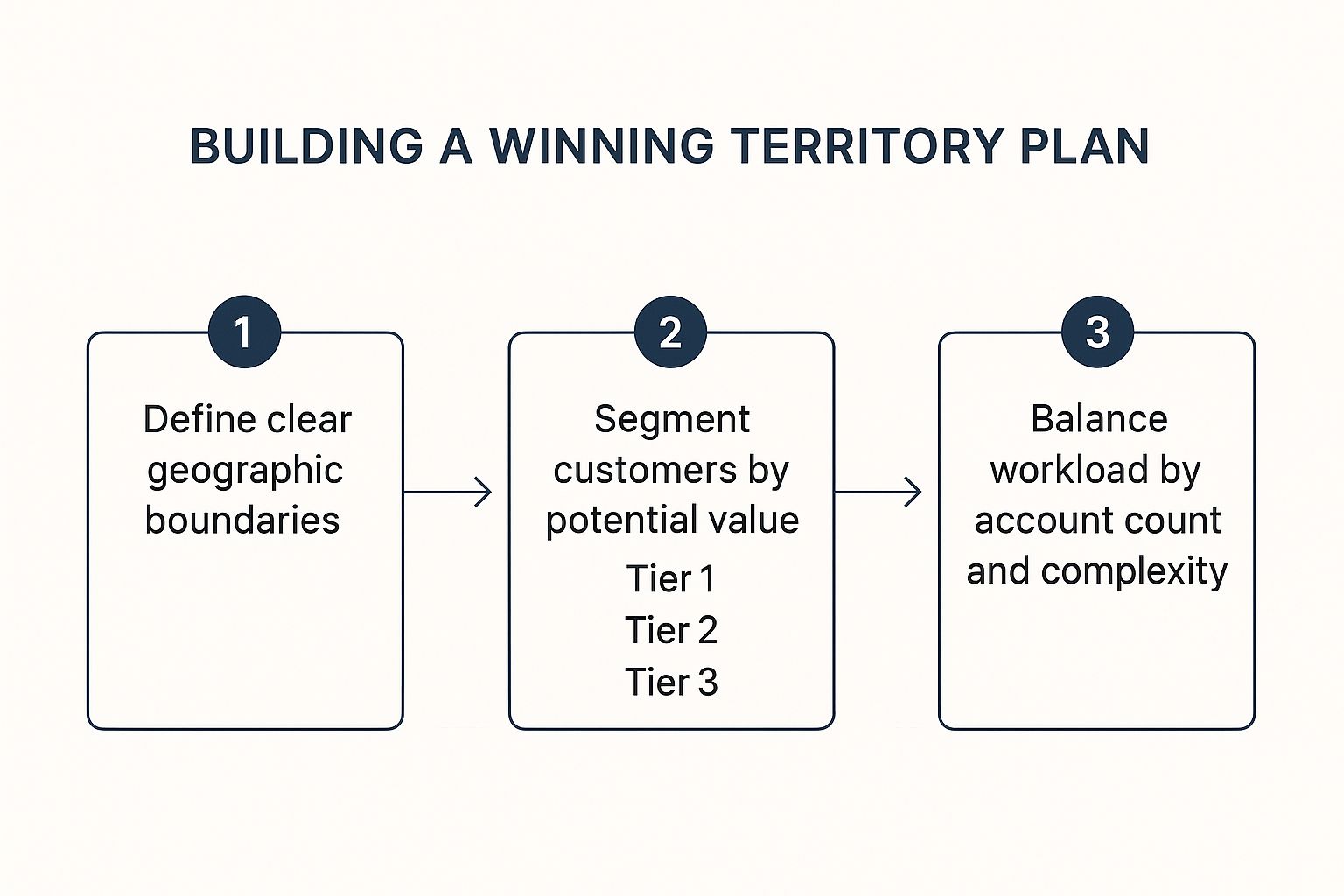 Effective territory management moves from broad geographic boundaries to nuanced, account-based workload balancing.
As you can see, the flow moves from a broad geographic definition to a more nuanced, account-based workload assessment—a critical step for creating equitable territories that actually motivate reps.
Analyzing Historical Data and Competitor Density
Your CRM is an absolute goldmine for this. Digging into historical sales data reveals which regions, industries, and account types have been most profitable. This data helps you spot trends, identify underperforming areas, and make data-backed decisions instead of just relying on guesswork.
At the same time, you can't plan in a vacuum. You need to know what you're up against. Is a territory saturated with competitors, requiring a more aggressive strategy? Or is it an underserved market ripe for the picking?
Understanding the competitive landscape helps you allocate resources effectively. To get this level of detail, you often need to go beyond basic CRM data. For a deeper dive, check out our guide on how B2B data enrichment can give you a much more complete picture of your accounts.
A great territory plan uses past performance to predict future success. It answers not just "Where are our customers?" but "Where will our next best customers come from?"
Balancing Workload and Sales Potential
This might be the most critical—and most often overlooked—component of a territory plan. A common mistake is to assign territories with an equal number of accounts, assuming the workload is the same. This approach completely ignores the vast differences in account complexity, sales potential, and travel time.
For those interested in the leadership driving this strategy, a robust Director of Sales job description often outlines key responsibilities related to building and executing these plans.
Modern territory design isn't one-dimensional; it’s a sophisticated blend of several factors that go far beyond just location.
Key Dimensions for Modern Territory Design
This table breaks down the multifaceted approach that top-tier sales teams use to design territories, ensuring they're balanced for both potential and effort.
| Dimension | Description | Example of Use |
|---|---|---|
| Geography | The physical location of accounts, which dictates travel time and regional market dynamics. | Assigning a dense metro area to one rep and a larger, multi-state rural area to another. |
| Account Potential | The total revenue opportunity within an account, often determined by size, industry, and historical spend. | Tiering accounts so that a rep's territory has a balanced mix of high-potential and smaller accounts. |
| Sales Workload | The estimated time and effort required to service the accounts within a territory. | Balancing a territory of 20 complex enterprise accounts with one of 100 SMB accounts. |
| Industry Vertical | Grouping accounts by industry to allow for specialized rep expertise and targeted messaging. | Creating a territory focused exclusively on healthcare providers in the Northeast. |
| Competitive Density | The concentration of competitors within a given area, influencing sales strategy and resource allocation. | Assigning more experienced reps to territories with heavy competition. |
By considering all these dimensions, sales leaders can create territories that are not just geographically convenient but strategically sound, equitable, and designed for maximum performance.
A truly balanced workload considers all of this. For instance, one rep might manage 20 high-potential enterprise accounts in a single city, while another handles 100 smaller accounts across three states. If the revenue potential and required effort are similar, these territories could be considered balanced, even with vastly different account numbers.
This is where platforms like Salesmotion come in. They help automate this by providing account intelligence that reveals the true potential and priorities within a territory, allowing for smarter, more equitable assignments from the get-go.
How to Design Your Sales Territories From Scratch
Building a sales territory plan from the ground up can feel like a massive task, but it’s really just a logical sequence of data-driven decisions. The goal isn’t just to divide and conquer; it’s to build a fair, balanced, and motivating environment where every sales rep has a clear shot at success. Let's walk through how to build a plan that actually works in the real world.
The whole process kicks off with gathering the right intelligence. Your first stop should be your CRM—it's a goldmine of historical sales data. Start digging for patterns: Which industries have the best close rates? What company sizes bring in the biggest deals? Where are your most profitable customers physically located? This isn't about guesswork; it's about letting your own history tell you where to go next.
But internal data is only half the picture. You also need a solid view of the market. This is where tools like Salesmotion become essential, giving you a real-time pulse on account potential. It helps you understand the total addressable market (TAM) in a specific region, spot companies showing growth signals (like a recent funding round or a hiring spree), and get a feel for the competitive landscape before you even think about assigning a rep.

Set Your Strategic Objectives
Before you draw a single line on a map, you have to define what winning looks like. Your territory design should be a direct reflection of your company's bigger sales goals. Are you trying to aggressively break into new markets, or is the plan to nurture and expand your most valuable existing accounts?
Your answer here will shape every decision that follows.
- For Market Penetration: You might carve out smaller, denser territories in new geographic areas. The aim is to maximize coverage and get your brand seen. Your reps will need the bandwidth for high-volume prospecting to land those new logos.
- For Client Nurturing: Territories might be built around existing key accounts, regardless of their location. A rep might handle fewer accounts, but the expectation is to drive deep engagement and find expansion revenue.
- For Product-Specific Growth: You could design territories based on industry verticals where a new product has the strongest fit. In this case, you'd assign specialists to lead the charge in those specific areas.
Being crystal clear on these objectives keeps you from creating a generic plan that doesn't really serve any specific purpose. It gives you a "north star" for the entire design process.
Carving Out Balanced Territories
This is where the art and science of territory management really come together. The key is to equalize opportunity, not just the number of accounts or the geographic area. A territory with 100 small businesses is worlds away from one with 10 enterprise giants.
Start by layering all the data you’ve gathered. Use a mix of factors to create your segments:
- Geography: Group accounts by zip code, state, or region. This minimizes travel time and creates logical clusters for your team to work.
- Account Potential: Use firmographics (like company size and industry) and your own sales history to estimate the potential revenue from each account. Tier them into A, B, and C categories.
- Workload: Think about the effort required. An "A" tier account might need 20 touchpoints a quarter, while a "C" tier account might only need three.
The way we design territories has evolved so much, moving from simple geographic splits to these more nuanced, multi-dimensional strategies. This modern approach is a massive driver of efficiency; it can boost sales productivity by up to 35% and slash customer acquisition costs by 20%. By layering in factors like industry, account size, and even where a customer is in their lifecycle, you create a far more strategic and effective plan.
Match the Design to Your Sales Motion
There is no universal territory model. Pick the one that fits how each team sells:
| Sales motion | Territory model | Balance on | Watch for |
|---|---|---|---|
| Field sales | Geographic | Density of ICP accounts, weighted by potential and signal activity | Territories that are large on the map but thin on good accounts, so reps drive more than they sell |
| Inside sales | Named accounts | Weighted pipeline potential per rep (ICP fit, deal size, current signals) | Balancing on account count instead of potential |
| Enterprise AEs | Strategic accounts | Contract value potential and planning complexity | Portfolios made only of long-cycle accounts with no near-term pipeline |
| Industry teams | Vertical | Segment potential and rep expertise | Narrow verticals that limit cross-industry learning |
| Hybrid | Two levels: which motion owns an account, then which rep | Deal size thresholds, account complexity, how the customer prefers to buy | Accounts routed to inside sales that need in-person selling, and the reverse |
Matching Reps to Territories
Once you have your balanced territories drafted, the next step is putting the right people in them. This isn't a random lottery. It’s a strategic matching game based on skills, experience, and even personality.
Think about the classic "hunter vs. farmer" analogy. Your best hunter—that rep who lives for closing new business—is the perfect fit for a territory focused on market penetration. Your best farmer—an expert at building deep relationships—should get the territory stacked with high-value existing clients. Understanding each sales rep's ideal territory profile is critical for helping them hit their full potential and making sure they feel set up to win from day one.
Think of it like casting for a movie. You wouldn't put a character actor in a leading action role. Likewise, you shouldn’t put a relationship-focused rep in a high-volume, transactional territory. Aligning skills with territory needs is non-negotiable.
Rolling Out the New Plan
How you introduce the new plan is just as important as the plan itself. A botched rollout can create resentment and confusion, completely undermining all your hard work. The key is transparency.
Before the official launch, share the methodology with your team. Walk them through the data you used and explain the "why" behind the new structure. Show them how the territories were designed to be fair and full of opportunity. When reps see the logic and understand the goal is to help everyone succeed, they're much more likely to get on board.
Finally, use software to play out different scenarios before you commit. For a comparison of the best options, see our roundup of sales territory mapping software. A platform like Salesmotion lets you model potential territory designs, see the immediate impact on workload and revenue potential, and make smart adjustments on the fly. This ensures a much smoother transition and a final plan that is truly optimized for performance.

“This is my singular place that very simply summarizes a company's top initiatives, strategies and connects them to my solution. Something I would spend hours researching manually, now it's automated.”
Derek Rosen
Director, Strategic Accounts, Guild Education
Keeping Your Sales Territories Optimized
Designing your sales territories is a huge accomplishment, but it’s the starting line, not the finish line. Markets shift, competitors make moves, your team evolves, and company goals change. Smart sales territory management is a living process, not a one-and-done project you can file away and forget.
The biggest mistake I see sales leaders make is treating their territory plan as a static document. A plan that was perfect in January can easily become imbalanced and inefficient by June. The key is to build an agile system for ongoing optimization, ensuring your territories never become stale or misaligned with where the business is heading.
This isn't about constant, chaotic reshuffling. It's about establishing a rhythm of regular reviews and health checks to keep your strategy sharp and your team firing on all cylinders.
Establish a Regular Review Cadence
Your territory plan needs consistent attention to stay relevant. If you don't have a set schedule for reviews, it's easy for small imbalances to quietly grow into major problems that crush morale and torpedo your revenue goals.
A solid best practice is to adopt a two-tiered review cycle:
- Annual Deep Dive: Once a year, block out time for a comprehensive review of your entire territory structure. This is your chance to realign territories based on the previous year's performance data, new market intelligence, and the upcoming year's strategic goals.
- Quarterly Health Checks: Every quarter, perform a lighter check-in. You're looking for the obvious red flags—like one rep consistently blowing out their quota while another struggles, or a sudden drop in activity in a once-productive area. These checks let you make minor tweaks without a full overhaul.
This rhythm keeps you proactive instead of reactive, letting you catch issues before they derail a rep’s quarter.
Use Performance Data to Spot Imbalances
Your CRM and sales dashboards are your best friends here. Data doesn't have an opinion; it just tells you the truth about what’s working and what isn't. During your reviews, dig into the key performance indicators (KPIs) to diagnose the health of each territory.
Look for outliers and odd patterns in metrics like:
- Quota Attainment: Are attainment levels relatively balanced across the team, or are there massive disparities? A territory hitting 180% attainment right next to one struggling at 40% is a huge red flag for imbalance.
- Sales Cycle Length: Is it taking significantly longer to close deals in one territory versus another? This could point to fiercer competition or even a poor territory-to-rep fit.
- Deal Size: Drastic differences in average deal size might mean one rep is working a goldmine of high-value accounts while another is stuck with low-potential prospects.
An optimized territory plan is a fair one. When reps see that assignments are based on real data and a genuine effort to equalize opportunity, they trust the process and stay motivated.
Gather Feedback from Your Reps on the Ground
Data tells you what is happening, but your sales reps can tell you why. They are your eyes and ears in the market, holding invaluable firsthand knowledge. A rep might know that a major new competitor just set up shop in their area, or that a key local industry is facing a downturn—insights that won't show up in a spreadsheet for months.
Make their feedback a core part of your review process. Ask direct questions:
- "Do you feel you have enough high-potential accounts to hit your number?"
- "What's the biggest obstacle you're facing in your territory right now?"
- "Are you spending too much time on travel versus actual selling?"
This qualitative feedback provides crucial context to your quantitative data, allowing you to make much smarter, more informed adjustments.
Leverage Technology for Dynamic Adjustments
Not long ago, making these kinds of adjustments was a painful, manual spreadsheet nightmare. Today, technology can help you model changes and automate huge parts of the process. For instance, you can get a better handle on your workflows by checking out our guide on sales process automation.
Using a platform like Salesmotion helps you see the real-time potential locked inside your accounts, making it far easier to rebalance territories based on current opportunity, not just past performance. It automates the research that uncovers growth signals, letting you make dynamic shifts—like moving a high-potential account into a rep’s territory where a new hire was just announced—with both confidence and speed. This ensures your territories are always aligned with the most current market realities.
Measuring the Success of Your Territory Plan
You've designed a brilliant sales territory plan, but how do you prove it’s actually working? A plan is only as good as its results, and that means looking beyond a single, top-line revenue number.
To really get the full story on your sales territory management strategy, you need to track a blend of metrics that reveal the health, efficiency, and fairness of your setup. Simply looking at total sales can be dangerously misleading—it often hides critical imbalances where one supercharged territory is masking poor performance everywhere else.
Let's dive into the KPIs that tell you what’s really happening on the ground.
Key Metrics to Track Territory Health
To get a clear, unbiased view of your plan's effectiveness, you need to focus on a handful of core metrics. Think of these KPIs as your diagnostic tools, helping you pinpoint both strengths and weaknesses across your entire sales organization.
I always recommend starting with these essentials:
- Quota Attainment Rate: This is your primary measure of fairness. If attainment rates are wildly different—say, one rep is hitting 180% while another struggles at 40%—it’s a massive red flag. Your goal should be relatively consistent attainment, which tells you that each rep has a fair shot at hitting their target.
- Sales Volume per Territory: This metric helps you understand pure productivity. Tracking the number of deals closed in each territory reveals activity levels and efficiency. If a territory has high potential but low volume, it might signal a rep needs more coaching or that the market is tougher than you initially thought.
- Average Deal Size by Territory: Are certain territories consistently producing larger deals? This insight can help you identify regions with a higher concentration of your ideal customers. It also helps you spot territories where reps might be settling for smaller, easier wins instead of pursuing more valuable accounts.
The goal of measurement isn't just to generate a report for leadership. It’s to gather actionable intelligence that helps you make smarter decisions and continuously refine your territory plan for peak performance.
Digging Deeper with Advanced KPIs
Once you have a handle on the basics, you can add more advanced metrics to get a more nuanced picture of performance. These KPIs often reveal the why behind your core numbers, helping you understand the true efficiency and profitability of each territory.
Consider adding these to your dashboard:
- Customer Acquisition Cost (CAC) by Region: This is a crucial profitability metric. Calculating CAC for each territory shows exactly how much you're spending to land a new customer in that area. A high CAC might mean travel costs are excessive or the competition is just fiercer, eating into your margins.
- Sales Cycle Length: How long does it take to close a deal in Territory A versus Territory B? A significantly longer sales cycle in one area could point to a poor product-market fit, a less experienced rep, or a territory that just needs more marketing support. For a comprehensive look at what to track, you can explore our detailed guide on lead generation key performance indicators.
- Lead-to-Opportunity Conversion Rate: This KPI is all about how effectively reps are turning initial interest into a qualified pipeline. If you see a low conversion rate in a specific territory, it might indicate a need for better training on qualification or that the leads being sent there are low quality.
To bring it all together, here's a quick look at the essential metrics you should be tracking to gauge the true performance of your sales territories.
Essential Metrics for Territory Performance
| Metric | What It Measures | Why It's Important |
|---|---|---|
| Quota Attainment Rate | The percentage of reps hitting or exceeding their quota. | Indicates the fairness and balance of territory potential. |
| Sales Volume | The total number of deals closed per territory. | Reveals rep productivity and market activity levels. |
| Average Deal Size | The average revenue generated per deal in each territory. | Highlights where your most valuable customers are located. |
| CAC by Territory | The cost to acquire a new customer in a specific region. | Uncovers the true profitability of each sales territory. |
| Sales Cycle Length | The time it takes from first contact to closing a deal. | Pinpoints efficiency bottlenecks or product-market fit issues. |
| Lead Conversion Rate | The percentage of leads that become qualified opportunities. | Measures the effectiveness of lead quality and initial outreach. |
By regularly monitoring this mix of metrics, you create a powerful feedback loop. You’ll have the hard data needed to spot red flags early, justify adjustments to leadership, and ensure your sales territory plan is a dynamic engine for growth—not a static map gathering dust.
Key Takeaways
- Effective sales territory management goes far beyond geography, factoring in account potential, industry verticals, sales workload, and competitive density.
- Companies with strategic territory plans see around 15% higher revenue and a 20% increase in sales productivity compared to ad-hoc methods.
- Balanced territories equalize opportunity, not just account count -- ensuring every rep has a fair shot at quota and reducing the morale-killing imbalances that drive turnover.
- Territory design should start with clear strategic objectives (market penetration vs. account nurturing) and be informed by both CRM historical data and real-time market intelligence.
- Matching reps to territories based on skills and strengths (hunters vs. farmers) is as critical as designing the territories themselves.
- Territories are never "done" -- annual deep dives, quarterly health checks, and ongoing rep feedback create the agile optimization loop needed to keep plans aligned with market realities.
Frequently Asked Questions
What is the primary goal of sales territory management?
The main goal is to maximize sales and ensure full market coverage by strategically assigning accounts and geographic areas to your sales team. A well-executed plan balances workload, aligns rep skills with opportunities, boosts morale, and ultimately drives revenue growth.
How often should sales territories be realigned?
A major, comprehensive review should happen annually to align with yearly business goals. However, it's crucial to conduct lighter quarterly "health checks" to address any clear imbalances. You should also be prepared to adjust territories after significant events like a new product launch or major market shift.
What is the biggest mistake to avoid in territory planning?
The most common mistake is creating territories based only on geography. This often leads to unfair imbalances where one rep has a dense, high-potential area while another has a sparse, low-potential one. Effective plans balance geography with account potential, workload, and historical sales data.
What data is most important for creating effective territories?
A solid territory plan relies on a mix of data sources. You need internal CRM data to understand historical performance, firmographic data (like company size and industry) to segment accounts, and third-party market data to gauge total addressable market (TAM) and competitive density.
Ready to stop guessing and start building data-driven territories? Salesmotion is an AI-powered account intelligence platform that uncovers real-time growth signals across all your target accounts. Equip your team with the insights they need to prioritize the right opportunities and craft messaging that resonates. Learn more and see how you can increase your pipeline by 40%.