When I was at Clari, I sat in on hundreds of pipeline reviews. The same pattern kept repeating: reps would present a deal, the VP would ask a sharp question about the account's priorities, and the room would go quiet. Not because the rep was lazy. Because the information either didn't exist in one place or took too long to find.
Those moments stuck with me. But the real turning points, the ones that shaped how we built Salesmotion, came from three specific conversations with sales teams after we'd launched our first version. None of them were formal feedback sessions. They happened in hallway chats, on demo calls, and during onboarding walkthroughs. And each one fundamentally changed what we built next.
TL;DR: Three unplanned conversations with enterprise sales practitioners revealed critical gaps in how account intelligence was being delivered. A RevOps leader exposed the "intent blackbox" problem, an Account Executive validated that novel account-level context matters more than contact data, and an SDR confirmed that the right framing is about doing the work reps already know they should be doing. Each insight directly shaped product decisions that still define the platform today.
The RevOps Leader Who Called Intent Data a Blackbox
This conversation happened about 18 months into building the product. We were talking with a RevOps leader at a mid-market SaaS company, maybe 200 sellers. They'd been running a well-known intent data provider for over a year.
The numbers looked fine on paper. They had "intent signals" flowing into Salesforce. Reps were getting notified when accounts showed buying behavior. The dashboards had green metrics everywhere.
Then the RevOps leader said something that stopped me: "My reps don't trust it. They see a score of 87 and they don't know what that means. Intent is a blackbox to them."
It wasn't that the data was wrong. The problem was transparency. When a rep sees a score, they need to know why the score changed. Was it because a VP at the target account searched for a competitor? Was it because someone downloaded a whitepaper? Was it because an intern browsed a product page once? Without that context, the score is just a number. And numbers without stories don't change behavior.
According to recent research from Forrester, 87% of B2B teams struggle with unreliable or opaque intent signals, and only 26% of those signals convert into real opportunities. The gap between "having intent data" and "knowing what to do with it" is enormous.
That conversation led to a fundamental design decision. Instead of building another intent scoring system, we focused entirely on what we call management intent: real, observable events that indicate strategic direction. Earnings call language about "digital transformation." A new VP of Revenue Operations hired. A competitor contract expiring. Job postings signaling a new initiative.
These aren't probabilistic scores. They're facts. A rep can read an earnings summary and walk into a meeting saying, "I noticed your CEO mentioned a $50M technology modernization initiative on the last earnings call." That's not a score of 87. That's a conversation starter grounded in reality.
The difference matters. Teams using signal-based approaches that surface specific events (not scores) report 2 to 4 hours saved per rep per week on account research, because reps spend less time trying to decode what a score means and more time acting on what they know.
The Account Executive Who Said "Nine Times Out of Ten, There's Something Novel"
The second conversation was with an AE at an enterprise company. They were one of our early design partners, and we were showing them a prototype of the account brief, basically a one-page summary of everything you need to know before a meeting.
At this point, we weren't sure how much detail to include. Should the brief be a full research report? A bullet-point summary? A five-page dossier? We were overthinking it.
The AE had been using the early version for about three weeks. They said: "Nine times out of ten, when I open one of these, there's something novel. Something I wouldn't have found on my own, or at least wouldn't have found in time."
That word, "novel," changed how we thought about the product's job to be done.
Sales reps are smart. They know how to Google a company. They can find a LinkedIn profile. They can skim a 10-K filing if they have to. The problem isn't that they can't do research. The problem is that manual research follows the same path every time: Google the company, check LinkedIn, maybe glance at news. It's a routine, and routines miss things.
What the AE was telling us is that the value wasn't in doing research faster (though that matters). The real value was in surfacing things that fall outside the normal research routine. A podcast appearance by the CEO discussing a problem that maps to your solution. A regulatory change affecting the prospect's industry. A board member who previously championed your type of solution at another company.
According to Gartner research, sales reps spend an average of six hours per week on prospect research. AI-powered automation can reclaim four to seven of those hours for revenue-generating activities. But the productivity gain is only half the story. The information quality gain, finding things you would have missed, is what changes win rates.
That conversation validated the one-page brief as the core product surface. Not a database you search. Not a dashboard you configure. A single, opinionated summary that tells you: here's what matters about this account right now, and here's what's new since you last looked. We designed it so the "novel" insight is impossible to miss.
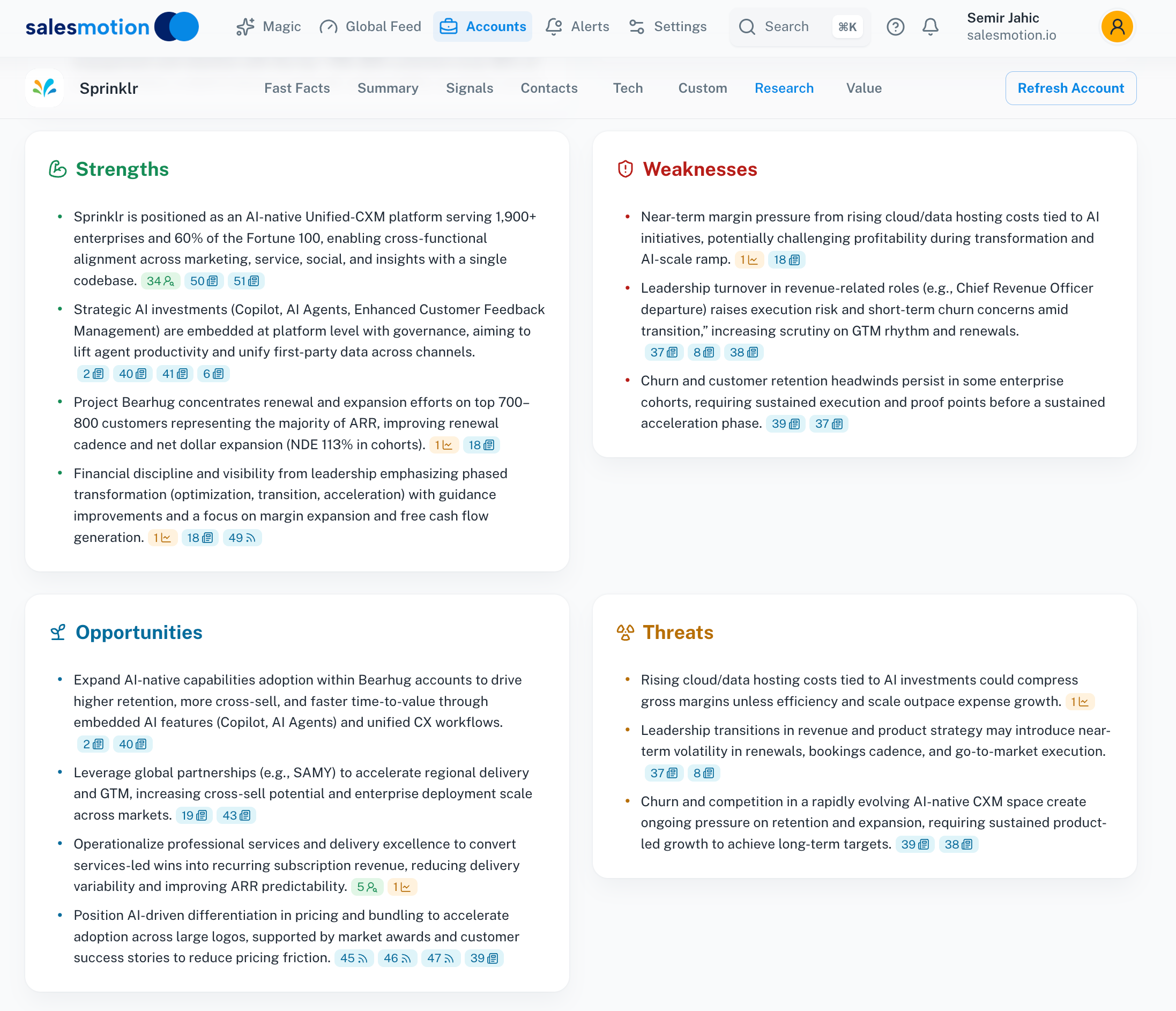 The one-page brief that emerged from conversation two: AI-generated SWOT analysis with competitive context, strategic priorities, and actionable insights.
Today, when teams describe the impact, the pattern is consistent. One team of 15 reps consolidated five separate research tools into a single workflow and recovered over 750 selling hours per year. But the number they care about more is the qualitative shift: reps walk into meetings with context their prospects don't expect them to have.

“Salesmotion empowers me to cultivate a great buyer experience. I'm able to challenge prospects' thinking and be a trusted consultative seller. A major part of this is Salesmotion insights.”
Austin Friesen
Account Executive, FY25 #1 President's Club, Clari
The SDR Who Said "It Does the Legwork for You"
The third conversation was the simplest, and maybe the most important for how we talk about what we do.
We were onboarding an SDR team at a growth-stage company. The SDRs were early in their careers, most less than two years of sales experience. They were used to working with a sequence tool and a contact database. That was their tech stack.
During the second week of the rollout, one of the SDRs described the platform to a colleague who hadn't been onboarded yet. They said: "It does the legwork for you."
Not "it provides account intelligence." Not "it aggregates multi-source data into a unified view." Not "it leverages AI to synthesize signals." Just: it does the legwork for you.
That phrasing was a gift. It told us exactly how practitioners think about the problem. They don't wake up wanting "account intelligence." They wake up knowing they should research their accounts before reaching out, and they either do it (spending 30 to 60 minutes per account) or they skip it (and send generic outreach that gets ignored).
This tracks with broader sales productivity data. Reps spend only 28% of their week actually selling. The rest goes to research, admin, internal meetings, and data entry. The gap between "knowing what good looks like" and "having time to do it" is where most sales effectiveness programs break down.
The SDR's framing reinforced something we'd been circling around: the product needed to feel like a teammate doing the prep work, not a database you query. That insight directly shaped the agent architecture we eventually built. Instead of "here's a tool, go search for what you need," the model became "here's everything you need, already prepared, before you asked."
It's the difference between giving someone a library card and handing them a briefing document. Both provide access to information. Only one respects the reality that a rep with 40 accounts and 15 meetings this week doesn't have time to be a librarian.
What Do These Three Conversations Have in Common?
Looking back, each conversation exposed the same underlying gap from a different angle.
The RevOps leader showed us that transparency beats sophistication. Sales teams don't need more complex algorithms. They need to understand why an account matters right now, in plain language they can use in a conversation.
The AE showed us that novelty is the real value. Speed is table stakes. What changes behavior is surfacing the insight a rep wouldn't have found through their normal routine. A platform that just does the same research faster is a nice-to-have. A platform that finds things you'd otherwise miss is essential.
The SDR showed us that framing matters as much as functionality. If you describe the product in terms the practitioner already uses ("does the legwork"), adoption happens naturally. If you describe it in vendor jargon ("multi-source account intelligence aggregation"), you're already losing.
These insights connect to a broader trend in B2B software. The sales intelligence market is projected to reach $10.25 billion by 2032, growing at 11.3% annually. But market size alone doesn't tell you much. What matters is which products within that market are actually getting used, by reps, every day, without being mandated. The products that win are the ones that match how practitioners already think about their work.
See Salesmotion on a real account
Book a 15-minute demo and see how your team saves hours on account research.
Why Does Product-Market Fit Live in Practitioner Language?
There's a pattern in B2B SaaS that I've seen play out across every company I've worked at, from Salesforce to Clari to building Salesmotion. The pattern is this: the closer your product description matches how practitioners describe their own problem, the faster you grow.
When reps say "it does the legwork," that's product-market fit speaking. When a RevOps leader says "intent is a blackbox," that's a market gap speaking. When an AE says "there's always something novel," that's a retention driver speaking.
The mistake most B2B companies make is translating these practitioner insights into marketing language that strips out all the texture. "Legwork" becomes "automation." "Blackbox" becomes "lack of transparency." "Novel" becomes "unique insights." Each translation moves you further from the language that resonated in the first place.
Sales enablement research backs this up. According to recent benchmarks, effective enablement programs increase selling time by 20%, giving reps back nearly a full day per week. But the programs that achieve those numbers are the ones built around how reps actually work, not how vendors wish they worked.
The best product decisions we've made came from listening to how practitioners describe what they need in their own words, then building exactly that. Not a bigger version. Not a more sophisticated version. The thing they described, at the speed they need it, in the format they'll actually use.
Key Takeaways
- Transparency beats complexity in account intelligence. Reps don't trust opaque intent scores. Observable events (earnings calls, leadership changes, hiring patterns) that they can reference in conversation drive more action than algorithmic scores.
- The highest-value insight is the one you would have missed. Speed matters, but surfacing novel context outside a rep's normal research routine is what changes win rates and deal quality.
- Product-market fit reveals itself in practitioner language. When users describe your product using their own words ("does the legwork"), pay attention. That language is more valuable than any positioning framework.
- Format shapes adoption more than features do. A one-page brief gets used daily. A full research database gets checked occasionally. Design for the workflow reps already have, not the one you wish they had.
- Customer conversations are product strategy. The three insights in this post didn't come from surveys, NPS scores, or feature requests. They came from unstructured conversations with practitioners doing real work.
Frequently Asked Questions
How do you collect product insights from customer conversations without formal feedback programs?
The most valuable insights rarely come from structured feedback. They emerge during onboarding walkthroughs, casual check-ins, and support interactions. The key is having product-oriented people present in those moments, not just customer success managers following a script. When a practitioner describes your product in their own language, write it down immediately. Those spontaneous descriptions reveal how your product fits into their mental model of their work.
What is the difference between intent data and management intent signals?
Traditional intent data tracks anonymous web browsing behavior and produces a propensity score. Management intent focuses on observable, public actions that indicate strategic direction: earnings call language, executive hires, job postings signaling new initiatives, regulatory filings, and competitive moves. The distinction matters because reps can reference management intent directly in conversations ("I saw your CEO mentioned a digital transformation initiative"), while intent scores offer no such conversational entry point.
Why does a one-page account brief drive more adoption than a full research platform?
Sales reps managing 30 to 50 accounts with 10 to 15 meetings per week don't have time to query a database before each interaction. A one-page brief delivers the essential context, recent news, strategic initiatives, key stakeholders, and relevant signals, in a format that takes under five minutes to review. Research shows reps spend only 28% of their time selling. Any tool that adds research overhead, even if the research is valuable, fights against the time constraints reps already face. The brief format respects that reality.