Most sales teams track triggers. Very few build the operational muscle to actually convert them into revenue. The difference between "we saw the signal" and "we closed a high six-figure deal" comes down to what happens in the 48 hours after a trigger fires, and whether your team has the discipline to run the full play.
This is the story of how one team spotted a corporate spin-off, tracked the resulting hiring wave, identified the right decision makers, and turned a single trigger into the biggest deal of their year. It took four months from first signal to signed contract. Every step was deliberate.
TL;DR: A corporate spin-off signal led to a high six-figure closed deal in under five months. The sequence: detect the trigger, track new hires to confirm budget allocation, identify the decision makers, personalize outreach around the new company's strategic priorities, and book a consultative first meeting. The lesson is not that triggers work. It is that operational rigor around trigger tracking, not just having the data, separates teams that close from teams that watch.
The Trigger: A Spin-Off No One Else Was Watching
In November 2024, a Fortune 1000 company announced it was spinning off a division into an independent entity. The new company would operate in a vertical where the selling team already had deep expertise and strong product-market fit.
Most reps on the team scrolled past it. Spin-offs generate noise: press releases, LinkedIn posts, industry chatter. But the SDR covering that territory did something different. She flagged the signal and asked a simple question: "If this new company is standing up its own operations from scratch, what will they need to buy in the next six months?"
That question turned out to be worth mid-six figures.
Corporate spin-offs are one of the most underrated buying triggers in B2B sales. Every spin-off creates a newly independent company that needs to build or replace infrastructure the parent company previously provided: CRM systems, analytics platforms, compliance tools, vendor relationships, and sales intelligence stacks.
The problem is that most sales teams do not have a systematic way to track spin-offs and connect them to buying behavior. They rely on reps noticing news articles, which means they notice some spin-offs and miss others entirely. A structured signal-tracking system changes this from luck to process.
Tracking the Hiring Wave: Confirming the Buying Window
The SDR did not immediately reach out. Instead, she set up monitoring on the new entity and watched what happened over the next three weeks.
What happened was a hiring wave. The new company posted roles for a VP of Revenue Operations, two enterprise account executives, a sales enablement manager, and a data analytics lead. All within 21 days of the spin-off announcement.
This pattern told a clear story. The new company was building a revenue function from the ground up. They were not inheriting the parent company's sales stack. They were going to evaluate and purchase their own tools.
Relationship-based triggers show how much timing and context matter: Champify reports a 39% average win rate on opportunities with former advocates, versus under 19% for the SaaS average.
The hiring data was the confirmation signal. The spin-off created potential opportunity. The hiring pattern confirmed that budget was being allocated and decisions were imminent. This distinction matters. Too many teams act on the first signal without waiting for confirmation, which leads to premature outreach and wasted cycles. Too many other teams wait so long for certainty that they miss the window entirely.
The operational discipline here was patience with a deadline. The SDR tracked hiring activity for three weeks, watching for the pattern to solidify, then moved to the next step before the new company started receiving inbound pitches from every vendor in the space.
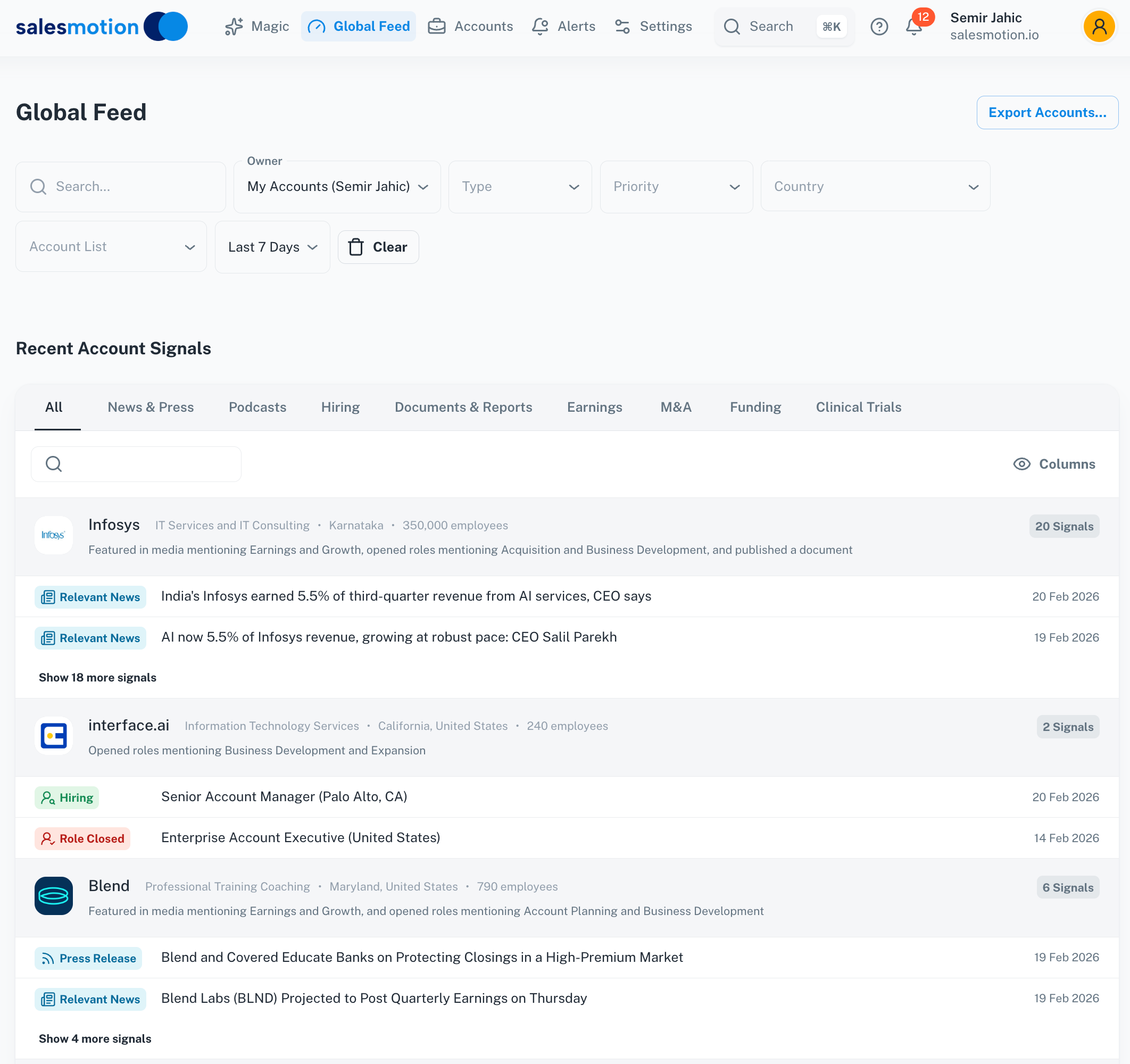 The signal feed that catches triggers like spin-offs, hiring surges, and leadership changes before your competitors notice them.

“We're no longer fishing. We know who the right customers are, and we can qualify them quickly. Salesmotion has had a direct impact on pipeline quality.”
Andrew Giordano
VP of Global Commercial Operations, Analytic Partners
Identifying the Right People: Mapping the Decision Unit
By mid-December, the SDR had a clear picture of the new company's leadership team. But knowing who was hired is not the same as knowing who to contact.
She mapped the decision unit by cross-referencing three data points:
- Title and function. The VP of Revenue Operations was the most likely economic buyer for a sales intelligence platform. The sales enablement manager was the most likely day-to-day user and internal champion.
- Background and prior tool experience. The VP of RevOps came from a company that had used a competitor's platform. That meant she understood the category, had opinions about what worked and what did not, and would evaluate alternatives rather than defaulting to what she knew. This was a buying signal in itself.
- Public activity. The VP had posted on LinkedIn about "building a modern revenue engine from scratch" at the new company. The sales enablement manager had commented on a post about account intelligence tools two weeks earlier.
This level of research would have taken hours if done manually across LinkedIn, company websites, press releases, and job boards. Salesmotion's Signal Agent automates this workflow, continuously monitoring hiring patterns, leadership changes, and public activity across accounts and surfacing the contacts most likely to be in a buying window. The platform connects trigger events to the right people, not just the right companies.
The SDR packaged all of this research into a concise briefing for the AE assigned to the account. The briefing included: the spin-off context, the hiring timeline, the decision unit map, each stakeholder's background and likely priorities, and the public signals indicating active evaluation.
The Handoff and the Outreach: SDR-AE Collaboration Done Right
In early January, the AE received the briefing and built a personalized outreach sequence. Not a template. Not a "Congrats on the new role" generic message. A message anchored to the specific reality of this prospect.
The first email to the VP of RevOps opened with a reference to her LinkedIn post about building a revenue engine, acknowledged the unique challenge of standing up a tech stack post-spin-off, and offered a specific perspective on what companies in similar situations prioritize first. No pitch. No product mention. Just a relevant point of view from someone who clearly understood her situation.
The VP responded within 24 hours.
The most effective SDR-to-AE handoffs include lead history, key stakeholders, challenges and objections already surfaced, important timelines, and competitor context. This team's handoff included all five. The AE walked into the first conversation knowing more about the prospect's situation than most reps know after a discovery call.
The first meeting happened in early February. It was not a discovery call. It was a consultative conversation where the AE could speak directly to the VP's stated priorities, reference the hiring signals that indicated where budget was being allocated, and present relevant case studies from companies that had gone through similar transitions.
By late February, the deal had moved to a formal evaluation. By mid-March, it was signed. High six figures. The biggest deal of the year for that team. For more on reading a deal beyond its stage, see deal insights that close revenue.
The total elapsed time from first trigger to closed contract: approximately four and a half months. The active selling time, from first outreach to signature, was under three months.
Why Is Operational Rigor the Real Lesson From Trigger-Based Selling?
It is tempting to look at this story and conclude: "Trigger-based selling works." That is true but incomplete. Every sales team has access to triggers. News alerts exist. LinkedIn notifications exist. Google Alerts exist. The difference is not access to information. It is what you do with it.
Here is what this team did differently:
- Systematic monitoring, not random scanning. The SDR was not browsing LinkedIn hoping to stumble on something useful. She had a structured process for monitoring accounts in her territory for specific buying signals: spin-offs, executive hires, funding rounds, and strategic announcements. Salesmotion automates this monitoring across 1,000+ public sources, but the principle applies regardless of tooling. You need a system, not a habit.
- Confirmation signals before outreach. The spin-off was the trigger. The hiring wave was the confirmation. Acting on triggers without confirmation leads to premature outreach. Waiting for confirmation without acting on triggers means you never start. This team balanced both.
- Research depth before first touch. The AE did not send a single message until he had a full decision-unit map, stakeholder backgrounds, and public activity signals. That investment of 90 minutes of research before outreach saved weeks of back-and-forth qualification later.
- SDR-AE handoff as a briefing, not a lead toss. The SDR did not just pass a name and company. She passed a narrative: here is the trigger, here is what it means, here are the people, here is why now. The AE could act on it immediately without re-doing the research.
- Speed with substance. The team moved quickly from trigger to outreach (about six weeks) but did not sacrifice quality for speed. It closed in under 90 days of active selling because the preparation front-loaded the deal progression; see how to shorten the sales cycle more broadly.
The pattern is replicable. The rigor is the hard part.
How Do You Build a Trigger-Tracking System That Scales?
One deal story is compelling. But the question every sales leader should ask is: can this process run across 50 accounts? 200? 500?
The answer depends on whether you build the system or rely on individual heroics. Here is the framework this team uses:
1. Define your trigger taxonomy. Not every event is a buying signal. This team tracks five specific trigger types for their market: executive hires in revenue/operations roles, corporate restructuring (spin-offs, mergers, divestitures), funding rounds above $20M, public strategic announcements mentioning their product category, and competitive displacement signals (new tech stack job postings).
2. Assign trigger ownership. Every SDR owns monitoring for their territory. Triggers are reviewed in a weekly 15-minute stand-up where the team shares what they are seeing and decides which signals warrant action.
3. Build a confirmation framework. A single trigger gets flagged. Two or more correlated triggers (spin-off + hiring wave, or funding + executive hire) get moved to active pursuit. This prevents wasting cycles on noise.
4. Standardize the research briefing. The SDR-to-AE briefing follows a template: trigger context, hiring timeline, decision-unit map, stakeholder backgrounds, public activity, and recommended angle. Consistency makes handoffs fast and reliable.
5. Measure trigger-to-meeting and trigger-to-close rates. This team tracks how many triggers convert to first meetings and how many convert to closed deals, and compares both with cold outbound and overall pipeline conversion. The comparison tells them which trigger types deserve SDR time; the signal-based outbound metrics guide shows how to set this up.
With Salesmotion, what used to require hours of manual monitoring per account surfaces automatically through alerts, with the context needed to act. Guild Education saves 30 minutes of research per account, according to Derek Rosen, Director, Strategic Accounts. To decide which accounts get this treatment, use an account prioritization framework.
Key Takeaways
- Corporate spin-offs are high-value trigger events because newly independent companies must build or replace infrastructure from scratch, creating compressed buying timelines and allocated budgets.
- Confirmation signals matter as much as the initial trigger. A spin-off plus a hiring wave is far more telling than a spin-off alone. Wait for confirmation before investing outreach effort.
- The SDR-AE handoff should be a narrative briefing, including trigger context, decision-unit mapping, stakeholder backgrounds, and recommended angles, not just a name drop.
- Speed with substance beats speed alone. Investing real research time before outreach compresses the sales cycle because discovery is half-done before the first meeting.
- Trigger-based selling at scale requires a system, not just awareness. Define your trigger taxonomy, assign ownership, standardize briefings, and measure conversion rates from trigger to meeting and trigger to close.
- Operational rigor around signal tracking is the differentiator. Every team has access to triggers. The teams that win are the ones with the discipline to monitor, confirm, research, and act on them systematically.
Frequently Asked Questions
What makes a corporate spin-off a strong buying signal?
A corporate spin-off creates a newly independent company that needs to evaluate and purchase its own technology stack, vendor relationships, and operational infrastructure. Unlike a company that already has entrenched tools, a spin-off is starting fresh with allocated budget and a compressed timeline. Spin-offs are among the strongest trigger types because the buying need is structural, not discretionary.
How long should you wait after a trigger before reaching out?
The most effective approach is to wait for a confirmation signal rather than acting on the initial trigger alone. In the deal described in this post, the team waited approximately three weeks after the spin-off announcement to confirm a hiring wave before initiating outreach. The key is balancing patience with urgency: too early and your outreach feels premature, too late and competitors have already engaged the prospect.
How do you scale trigger-based selling beyond individual reps?
Scaling requires three things: a defined trigger taxonomy (which specific events your team tracks), assigned ownership (each SDR monitors triggers for their territory), and a standardized handoff process (research briefings follow a consistent template). Weekly 15-minute stand-ups where SDRs share active triggers keep the team aligned. The manual bottleneck that prevents most teams from running this process across more than a handful of accounts is the monitoring and research step, which is why automating signal tracking and context gathering is one of the most valuable investments a revenue leader can make.
What is the difference between a trigger and a buying signal?
A trigger is an event that changes a company's situation: a spin-off, a new hire, a funding round, a product launch. A buying signal is evidence that the company is actively evaluating or ready to purchase a solution. Triggers create potential opportunity. Buying signals confirm it. The most effective sales teams treat triggers as the starting point for investigation and wait for correlated buying signals (like a hiring pattern or public statements about strategic priorities) before investing significant outreach effort. This confirmation-first approach improves conversion by focusing resources on accounts with genuine, time-bound buying intent.