Lead qualification is the make-or-break process of figuring out which leads are diamonds and which are just… rough. Think of it as the bouncer for your sales pipeline—it separates serious buyers from window shoppers, making sure your sales team focuses its energy on deals that can actually close.
TL;DR: Lead qualification is the process of evaluating prospects against fit, timing, and intent criteria so your sales team spends its time on deals that can actually close -- boosting win rates, shortening cycles, and making your forecast reliable.
What Is Lead Qualification?

Imagine a prospector sifting through tons of gravel to find a few nuggets of gold. That’s lead qualification in a nutshell. It’s the process of vetting potential customers against a set of criteria to see who’s a genuinely good fit for your product.
Without it, sales reps waste countless hours chasing dead ends. They call accounts that don’t have the budget, the authority, or even a real need for what you’re selling. To get started, it helps to understand the fundamentals of What Is A Qualified Lead. This isn't just about avoiding wasted effort—it's about proactively aiming your resources where they’ll make the most impact.
In modern B2B sales, qualification is no longer a simple checklist. It’s a dynamic assessment of a lead’s fit, timing, and intent—the three pillars that separate a winning deal from a lost opportunity.
Why Qualification Matters More Than Ever
In complex B2B sales, the volume of leads can be overwhelming. The challenge isn’t just generating leads; it’s finding the right ones at the right time. Poor qualification is the number one reason for pipeline leakage and painfully slow sales cycles.
The numbers tell the story. The average conversion rate from a Marketing Qualified Lead (MQL) to a Sales Qualified Lead (SQL) is around 12-18%. This means most leads marketing passes over just aren't ready for a sales conversation. Reps can waste 40-60% of their time on manual vetting, while businesses with strong qualification processes generate 50% more sales-ready leads.
Let's look at how a strong qualification process—or a weak one—can change your sales outcomes.
The Impact of Strong vs. Weak Lead Qualification
This table shows the stark difference between a business that qualifies leads effectively and one that doesn't. One drives predictable growth, while the other struggles with inefficiency and missed targets.
| Metric | Weak Qualification Process | Strong Qualification Process |
|---|---|---|
| Sales Rep Time | 40-60% spent on unproductive prospecting and manual vetting. | Reps focus on high-potential leads that are ready to engage. |
| MQL-to-SQL Conversion | Low, often below 10%, with high lead rejection rates. | Consistently high, with MQLs converting to SQLs at 20% or more. |
| Sales Cycle Length | Long and unpredictable, with many deals stalling indefinitely. | Shorter and more predictable, as reps engage with motivated buyers. |
| Forecast Accuracy | Unreliable, leading to missed revenue targets and uncertainty. | High, providing a clear and dependable view of future revenue. |
| Team Morale | Low, driven by frustration from chasing leads that go nowhere. | High, as reps consistently work on winnable deals and hit quotas. |
| Sales & Marketing | Constant friction over lead quality and mismatched expectations. | Aligned around a shared definition of a "good lead," fostering collaboration. |
As you can see, strong lead qualification isn't just a "nice-to-have." It’s the engine that drives an efficient revenue machine.
A solid qualification process directly boosts your bottom line by:
- Increasing Sales Velocity: Reps focus on deals with a higher probability of closing, which shortens the sales cycle.
- Improving Forecast Accuracy: A pipeline filled with genuinely qualified leads makes revenue predictions far more reliable.
- Boosting Team Morale: Nothing motivates a salesperson more than winning. Focusing on winnable deals creates momentum.
- Aligning Sales and Marketing: It forces both teams to agree on what a "good lead" actually looks like, creating a powerful feedback loop.
Ultimately, mastering lead qualification is how you turn a flood of interest into a predictable stream of revenue. It’s the foundational skill separating high-performing teams from the rest. To see how technology is changing the game, check out our guide on what is sales intelligence.
The Most Effective Lead Qualification Frameworks
Once you know why you need to qualify leads, the next question is how. This is where qualification frameworks come in. Don't think of them as rigid scripts. Instead, see them as flexible playbooks that give your sales conversations a clear purpose and structure.
These frameworks are collections of smart questions designed to uncover a prospect's needs, their authority to make a decision, and how urgently they need to solve their problem. Using a framework ensures your reps ask the right questions at the right time, guiding them toward a solid "yes" or "no" instead of a vague "maybe."
The Classic BANT Framework
Developed by IBM, BANT is one of the oldest and most straightforward qualification frameworks. It’s quick, simple, and helps reps cover the basics before sinking too much time into a deal.
BANT is an acronym for:
- Budget: Does the prospect have the money set aside to buy your solution?
- Authority: Is your contact the person who can sign the check, or do they need approval from someone else?
- Need: Do they have a clear business problem that your product can solve?
- Timeline: When are they planning to make a purchase?
BANT works well for high-volume sales or less complicated sales cycles. But its simplicity can be its biggest weakness. It often filters out promising opportunities too early just because a budget hasn't been officially approved yet.
The Problem-Focused CHAMP Framework
CHAMP is a more modern, customer-focused take. It puts the prospect's problems front and center, leading to a more consultative conversation.
CHAMP stands for:
- Challenges: What specific problems or pain points is the prospect facing? This is the best place to start a valuable conversation.
- Authority: Like BANT, this is about identifying the key players and decision-makers.
- Money: This still addresses the budget, but it’s framed around the financial impact of their challenges, not just a line item.
- Prioritization: How important is solving this challenge compared to everything else on their plate? This helps you gauge their urgency.
By starting with Challenges, your reps can immediately align your solution with the prospect's most pressing needs. This approach is perfect for consultative sales models where understanding the "why" is everything.
The Enterprise Gold Standard: MEDDICC
When you're dealing with complex, high-value B2B sales involving multiple stakeholders, MEDDICC is the champion. It’s more detailed than BANT or CHAMP, giving you a comprehensive checklist to de-risk big deals and improve forecast accuracy.
MEDDICC forces you to go beyond surface-level qualification. It’s a rigorous methodology for understanding every critical aspect of an enterprise deal, from the financial justification to internal politics.
The framework breaks down like this:
- Metrics: What measurable business outcomes does the prospect expect? (e.g., increase revenue by 15%, reduce costs by $2M).
- Economic Buyer: Who has the ultimate profit-and-loss responsibility for this purchase?
- Decision Criteria: What specific technical, financial, and vendor requirements will the company use to make its choice?
- Decision Process: What are the exact steps, timeline, and approvals needed to get the deal signed?
- Identify Pain: What is the core business problem driving the search for a new solution?
- Champion: Who is the influential person on the inside who will sell on your behalf when you’re not there?
While it demands more effort, MEDDICC is incredibly powerful for navigating complex enterprise sales, especially in industries like SaaS and Life Sciences. It provides the structure needed to confidently manage and close your most important deals.
A good framework is like a map for your sales conversations. While BANT offers a simple legend, MEDDICC provides the detailed topography needed for a long, complex journey.
Comparing Lead Qualification Frameworks
| Framework | Core Components | Best For |
|---|---|---|
| BANT | Budget, Authority, Need, Timeline | High-volume, transactional sales with shorter cycles. Ideal for SMBs. |
| CHAMP | Challenges, Authority, Money, Prioritization | Consultative sales where understanding the prospect's pain points is key to building value. |
| MEDDICC | Metrics, Economic Buyer, Decision Criteria, Decision Process, Identify Pain, Champion | Complex, high-value enterprise deals with multiple stakeholders and long sales cycles. |
Ultimately, the best framework is the one your team will actually use. Start with one that fits your typical sales cycle, train your team on it, and build it into your CRM.

“We're no longer fishing. We know who the right customers are, and we can qualify them quickly. Salesmotion has had a direct impact on pipeline quality.”
Andrew Giordano
VP of Global Commercial Operations, Analytic Partners
Translating Market Signals Into Qualified Leads
A qualification framework is your map, but market signals tell you when to start the journey. Modern lead qualification isn't about a static checklist. It's about listening to the market and picking up on dynamic buying signals that scream, "pay attention to this account now."
Think of these signals as breadcrumbs your prospects leave behind. They tell you about their needs, priorities, and how ready they are to talk. The best sales teams don’t wait for someone to fill out a form. They translate market activity into real intelligence, cutting through the noise to find what matters.
The Four Core Types of Buying Signals
To get from noise to insight, you have to know what you’re looking for. Every piece of information you gather about a target account fits into one of four buckets. Master these, and you can build a complete picture of an opportunity.
-
Firmographic Signals: This is the foundational data about a company—the "who they are" info. It tells you if they match your Ideal Customer Profile (ICP). We're talking company size, industry, annual revenue, and location.
-
Technographic Signals: This is all about the tech a company uses. It gives you a peek into their workflows, potential integration issues, and whether they’re using a competitor. Are they a Salesforce shop? Do they run on AWS or Azure? This is the "what they use" signal.
-
Behavioral Signals: These are the actions a prospect takes that show they’re interested in you. Behavioral signals are gold because they prove engagement. This could be anything from visiting your pricing page and downloading a whitepaper to attending a webinar. This is the "what they do" signal. If you want to get better at reading these, our guide on what is intent data is a great place to start.
-
Trigger Event Signals: These are the most powerful qualifiers because they answer the most important question: "why now?" A trigger event is a major change at a company that creates new needs, challenges, or openings—often sparking an urgent hunt for a solution.
A trigger event is the catalyst that turns a passive prospect into an active buyer. It’s a sudden shift in their business—like a funding round, an executive hire, or a new product launch—that creates a compelling reason for them to talk to you.
Turning Triggers Into Tangible Opportunities
Recognizing trigger events is what separates top-performing reps from those playing catch-up. These signals give you a timely, relevant reason to reach out, making your message stand out. The trick is to connect the event directly to a problem you can solve.
Here are a few industry-specific examples:
- For a B2B SaaS company: A target account announces a new integration partnership. That’s a trigger. The rep can reach out and show how their solution fits into this new ecosystem.
- For a Life Sciences CRO: A biotech firm announces a successful Phase II clinical trial and new funding. This is a massive trigger. It signals they have the cash and momentum for a larger Phase III trial, creating an immediate need for a research partner.
- For an IT Services firm: A manufacturing company's new CIO mentions "supply chain optimization" in an interview. That’s a clear trigger. The sales team can craft a message about their experience streamlining logistics for industrial clients.
- For a Cybersecurity provider: A financial services company posts five new job openings for "Cloud Security Engineers." This tells you they’re investing in cloud infrastructure and have a pressing need to secure it. That’s the perfect opening.
When you focus on these real-time events, you move beyond qualifying based on static attributes. You start qualifying based on timing and urgency—the two most potent ingredients in any successful deal. This signal-based selling approach ensures you're talking to the right people at the perfect moment.
Building a Modern Lead Qualification Process
Frameworks and signals are great, but they're just ingredients. To build a predictable revenue engine, you need a recipe—a repeatable process that turns interest into qualified opportunities. A modern lead qualification process is a clear, consistent workflow that bridges the gap between marketing noise and real sales conversations.
The goal is to map the entire journey a lead takes, from a curious visitor to a solid deal in your pipeline. This process removes guesswork and makes sure every rep knows which leads to prioritize and why. Using effective lead management software is the cornerstone of this system, helping you smooth out workflows and get the most from every lead.
From MQL to SQL: The Handoff That Matters
The most critical moment in a lead's journey is the handoff from marketing to sales. This is where the concepts of a Marketing Qualified Lead (MQL) and a Sales Qualified Lead (SQL) become essential. Defining these stages creates a common language and shared expectations between the two teams. It's a simple idea, but it's where most revenue engines break down.
-
Marketing Qualified Lead (MQL): An MQL is someone who has shown interest through marketing activities but isn't ready for a direct sales pitch. They’ve downloaded an ebook, attended a webinar, or visited key pages on your site. They fit some basic criteria, but their real intent and timing are still unknown.
-
Sales Qualified Lead (SQL): An SQL is an MQL that the sales team has vetted and confirmed is a legitimate opportunity. A sales development rep (SDR) or account executive (AE) has had a quick chat, confirming the prospect has a real need, the authority to buy, and a timeline in mind.
That jump from MQL to SQL is the first major checkpoint. Get this handoff right, and you stop valuable leads from falling through the cracks while ensuring your reps only spend time on prospects who are genuinely ready for a conversation.
If you want to dive deeper, check out our guide on how to optimize your lead routing strategy.
Introducing Lead Scoring: Your Prioritization Engine
So, how do you decide which MQLs are hot enough to send to sales? The answer is lead scoring.
Think of it as a point system for your prospects. You assign values to different attributes and actions. When a lead’s score hits a certain threshold, they’re automatically flagged as sales-ready.
This data-driven approach replaces gut feelings with a consistent method for spotting your best leads. It’s a powerful way to get sales and marketing aligned on what a "good lead" actually looks like.
Lead scoring is the automated process of ranking leads to determine their readiness to buy. By assigning points for things like company size, online behavior, and buying signals, you create an objective system that tells your sales team exactly where to focus.
Here's how this all comes together, turning raw signals into qualified leads for your team.
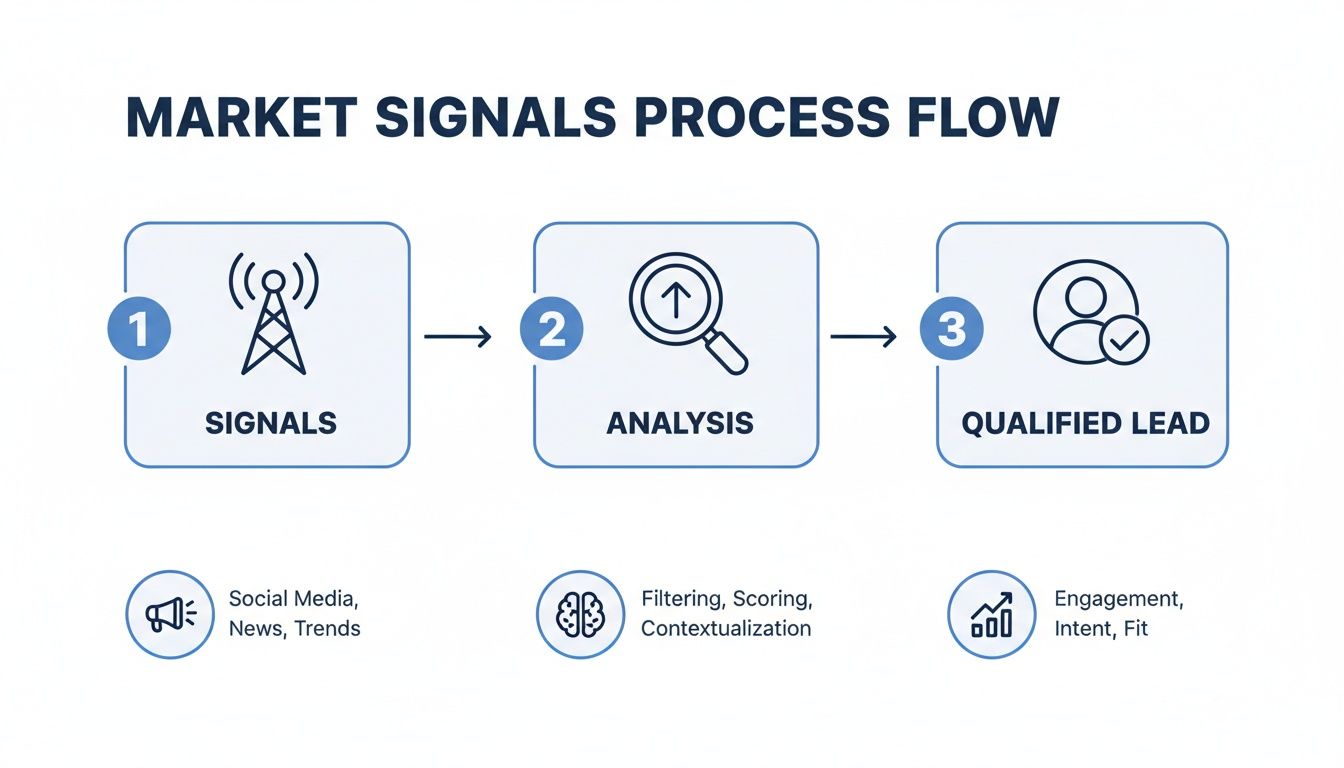
This visual breaks down the modern workflow: market signals are captured, analyzed, and then converted into a prioritized, qualified lead.
A Step-by-Step Qualification Workflow
Putting it all together, a modern lead qualification process follows a clear sequence designed to move a lead efficiently from initial interest to a closed deal.
-
Lead Capture and Enrichment: A lead enters your system from your website or a trade show. Your system automatically enriches their profile with firmographic data to quickly see if they match your Ideal Customer Profile (ICP).
-
Automated Scoring: The lead’s score updates in real-time as they interact with your brand. They might get +10 points for visiting the pricing page, +5 for being in a target industry, and +15 for requesting a demo.
-
MQL Threshold: Once the lead’s score crosses a predefined threshold (say, 100 points), they're automatically flagged as an MQL and routed to the right SDR.
-
Sales Qualification: An SDR reaches out to the MQL for a discovery call. They use a framework like BANT or MEDDICC to confirm the basics: budget, authority, need, and timeline.
-
SQL Conversion: If the SDR gives the green light, the lead is converted to an SQL in the CRM and handed off to an Account Executive. This is where the work of closing the deal begins.
This systematic approach is critical. Data shows that 68% of B2B marketers see lead quality as their top priority, yet 61% say they struggle to generate it. Contacting qualified leads within 24 hours can boost conversions by up to 5x, which can dramatically shorten your sales cycle.
“We have very limited bandwidth, but Salesmotion was up and running in days. The template made it easy to load our accounts and embedding it in Salesforce was simple. It was one of the easiest rollouts we've done.”
Andrew Giordano
VP of Global Commercial Operations, Analytic Partners
How AI Transforms Modern Lead Qualification

Even with the best frameworks, manual qualification eventually hits a wall. Sales reps spend too much time slogging through news feeds and LinkedIn profiles, trying to connect the dots and find a compelling reason to reach out.
It’s a constant battle against information overload and bad timing.
This is where AI and account intelligence platforms change the game. Instead of reps manually hunting for breadcrumbs, AI acts as an always-on monitoring system for your target accounts. It sifts through millions of data points, 24/7, pinpointing the trigger events that scream "buying opportunity."
The magic of AI in lead qualification isn't just data collection—it's the shift to genuine insight. It doesn't just find a signal; it analyzes its relevance and delivers the "so what?" directly to your sales team. This flips the dynamic from reactive qualification to proactive, signal-driven engagement.
Automating Signal Detection and Prioritization
Imagine trying to hear one conversation in a roaring stadium. That’s manual prospecting. AI, on the other hand, is like having thousands of microphones, each tuned to listen for key events across all your target accounts.
AI-powered platforms like Salesmotion continuously track a huge range of sources that matter in B2B sales:
- Financial & Corporate News: Earnings calls, funding announcements, and M&A activity that signal new budgets and strategic shifts.
- Personnel Changes: Key executive hires, promotions, and departures that often precede new initiatives.
- Company Communications: Press releases, new product launches, and investor presentations that reveal priorities.
- Digital Footprints: Stakeholder activity on LinkedIn, podcast interviews, and conference presentations.
But the system doesn’t just dump this information on a rep. It analyzes, scores, and prioritizes these signals, making sure reps only see events that are likely to turn into pipeline. A new VP of Engineering hire at a target account isn't just a notification; it's flagged as a high-priority opportunity to talk about scaling their infrastructure.
From Raw Data to Actionable Insights
Knowing a signal occurred is one thing. Knowing what to do with it is everything. This is where AI delivers its biggest advantage. Instead of just forwarding a news article, modern platforms generate actionable intelligence briefs and talking points for sales reps.
The biggest leap in modern qualification is AI's ability to connect a market signal directly to a sales playbook. It translates a trigger event into a clear "why you, why now" message, arming reps with the context to have a credible, relevant conversation from day one.
For example, if a target biotech company announces a successful clinical trial, the AI doesn’t just report it. It can generate a brief that includes:
- The Key Players: Identifying the Head of Clinical Operations and the new CFO who will manage the budget.
- The Immediate Pain: Highlighting the challenges of scaling from a Phase II to a Phase III trial.
- MEDDICC-Aligned Talking Points: Suggesting how your solution provides the Metrics for trial efficiency and helps the Economic Buyer justify the investment.
This process eliminates the manual research that can eat up 40-60% of a rep's time. It gives them the context needed for a hyper-relevant outreach that stands out. The conversation is no longer a generic pitch but a timely, informed discussion about a specific business need.
Ultimately, AI transforms qualification from something you do into a continuous, automated process that’s always running. It ensures your team engages the right accounts with the right message at the perfect moment.
Common Lead Qualification Mistakes to Avoid
Even with the best frameworks, lead qualification efforts can fall flat. It's usually small, overlooked habits that poison your pipeline and throw revenue goals off track.
Knowing these common pitfalls is the first step. A shocking 80% of new leads never result in a sale, and 79% of marketing leads fail to convert—often because they were poorly qualified from the start. As of 2026, only 56% of companies validate leads before a handoff. You can find more data on this in these lead generation and conversion statistics.
Let’s dig into the mistakes that trip up most sales teams and how to sidestep them.
Relying Too Heavily on a Single Framework
Frameworks like BANT or MEDDICC are fantastic guides, but they're not scripts. A classic mistake is treating them like a robotic checklist, forcing a BANT conversation when a prospect just wants to talk about their problems. This can kill a deal before it even starts.
The fix is simple: be flexible. Train your team on multiple frameworks, but empower them to adapt to the natural flow of a conversation. The goal isn't to tick boxes in your CRM; it's to have a genuine, value-driven discussion.
Ignoring Negative Signals and Disqualification
Sales reps are often so focused on finding reasons to qualify a lead that they develop a blind spot for red flags. A prospect might sound enthusiastic, but if they're a student with a university email or work for a tiny company outside your Ideal Customer Profile (ICP), they aren't a real opportunity.
One of the most valuable things a sales rep can do is disqualify a lead—fast. Wasting time on a poor-fit account doesn't just cost a few hours; it steals focus from deals that could actually close.
Set up clear disqualification criteria and celebrate when reps use it. A clean pipeline full of real opportunities is infinitely more valuable than a bloated one packed with dead ends. Maintaining strong CRM hygiene ensures your scoring and disqualification logic operates on accurate data.
Operating with a Vague Ideal Customer Profile
If your Ideal Customer Profile (ICP) is fuzzy, your qualification process has no anchor. Your reps will chase anything that moves, and marketing will have no idea what a good MQL looks like. This ambiguity is the root cause of most sales and marketing friction.
It's time to get specific. Dig into your best customers. What industries are they in? What’s their company size? What tech do they use? What trigger events happened right before they bought from you?
Codify these details into a specific, shared ICP that both sales and marketing live by. This alignment is the foundation of an efficient revenue engine.
Key Takeaways
- Lead qualification is the process of evaluating prospects against fit, timing, and intent criteria so your sales team focuses on deals that can actually close.
- Three popular frameworks serve different needs: BANT for high-volume transactional sales, CHAMP for consultative selling, and MEDDICC for complex enterprise deals with multiple stakeholders.
- Real-time buying signals like funding rounds, executive hires, and hiring surges are the most powerful qualifiers because they answer the critical "why now" question.
- AI-powered platforms transform qualification from a manual, time-consuming process into an always-on monitoring system that detects trigger events and delivers actionable insights to reps.
- Common qualification mistakes include relying too heavily on a single framework, ignoring negative signals that should disqualify a lead, and operating with a vague Ideal Customer Profile.
Got Questions About Lead Qualification? We've Got Answers.
Still have a few questions about what lead qualification really is and how it works in the real world? Let's clear up some of the most common ones.
What's the Real Difference Between a Lead and a Prospect?
Think of a lead as anyone who’s raised their hand. They might have signed up for your newsletter or downloaded an ebook. They've shown a flicker of interest, but that's about it.
A prospect, however, is a lead you've vetted. You've looked at them and confirmed they match your Ideal Customer Profile (ICP), making them a genuine potential customer. The journey from lead to prospect is the entire point of qualification.
How Can You Qualify a Lead Without Wasting Time?
The fastest way is to have a short, sharp set of questions ready. Don't overcomplicate it. Start with a simple framework like BANT—that’s Budget, Authority, Need, and Timeline.
This lets you quickly figure out if they have a real problem you can solve and the ability to buy a solution. It’s your best defense against spending hours on leads that were never going to close.
What Actually Makes a Lead "Sales-Ready"?
A lead becomes "sales-ready" (a Sales Qualified Lead, or SQL) when two things are true:
- They Fit: The lead lines up with your Ideal Customer Profile (ICP). This means the right industry, company size, and other firmographics.
- They Show Intent: They've done something that signals they're actively shopping. This could be requesting a demo, spending time on your pricing page, or asking to talk to your sales team.
A sales-ready lead isn't just a good match on paper. Their actions show they’re looking for a solution right now. It's this combination of fit and timing that makes them a top priority for your sales reps.
How Often Should We Update Our Qualification Criteria?
Your qualification criteria should never be set in stone. Treat it like a living document. Best practice? Review and tweak it at least once a quarter.
Markets shift, your product evolves, and you learn more about who your best customers are. As those things change, your definition of a perfect lead should change with them.
Ready to stop wasting time on manual research and start engaging the right accounts at the perfect moment? Salesmotion uses AI to monitor your target accounts for critical buying signals and delivers actionable insights directly to your reps. See how you can transform your qualification process and build a healthier pipeline. Get started with Salesmotion today.
Frequently Asked Questions
What is lead qualification and why does it matter?
Lead qualification is the process of evaluating potential customers against a set of criteria to determine whether they are a good fit for your product and likely to buy. It matters because without it, sales reps waste significant time chasing leads that lack the budget, authority, or genuine need for your solution. A strong qualification process directly improves win rates, shortens sales cycles, and makes revenue forecasting far more reliable.
What is the difference between an MQL and an SQL?
A Marketing Qualified Lead is someone who has shown interest through marketing activities like downloading content or attending a webinar but has not been vetted by sales. A Sales Qualified Lead is an MQL that a sales rep has personally confirmed as a legitimate opportunity with a real need, the authority to buy, and a reasonable timeline. The handoff from MQL to SQL is the most critical checkpoint in the lead journey.
Which lead qualification framework should my team use?
The best framework depends on your sales cycle complexity. BANT works well for high-volume, transactional sales where you need quick qualification on Budget, Authority, Need, and Timeline. CHAMP is better for consultative sales where understanding challenges comes first. MEDDICC is the gold standard for complex enterprise deals with multiple stakeholders and long sales cycles. Many teams benefit from training reps on multiple frameworks and adapting to each conversation.
How does lead scoring work in practice?
Lead scoring assigns numerical values to different prospect attributes and actions to rank their readiness to buy. A prospect might earn points for matching your Ideal Customer Profile, visiting your pricing page, or requesting a demo. When their cumulative score crosses a predefined threshold, they are automatically flagged as sales-ready and routed to the appropriate rep. This data-driven approach replaces gut feelings with a consistent, objective method for prioritizing leads.
What are the most common lead qualification mistakes?
The biggest mistakes include relying too heavily on a single framework and turning it into a robotic checklist, ignoring negative signals that should disqualify a lead, and operating with a vague Ideal Customer Profile that gives reps no clear anchor. Another critical error is failing to validate leads before handing them from marketing to sales, which creates friction between teams and wastes everyone's time on unqualified prospects.