62% of B2B teams were working to fold intent insights into their marketing and sales processes in 2021, and a year later 47% of marketers said they were already using intent data to assess prospects actively researching a buying decision, according to the Demand Gen Report research on intent-based strategies. Both figures describe appetite for the signal. Neither describes a rule for acting on it.
That's the gap most ABM programs still live in. The data arrives, someone forwards a spike, a rep sends a note about "growth", and nobody can say afterward whether the outreach was well timed or just timed. Intent data became mainstream years ago. The operating discipline around it didn't.
The rule I'd write on the wall: an intent signal is a hypothesis. It earns a rep a task only when fit, freshness and a second independent signal all agree. Speed isn't a separate goal sitting next to those three. It's part of the score.
Building that rule so it survives contact with a real book of business is the work.
What ABM Intent Data Actually Tells You
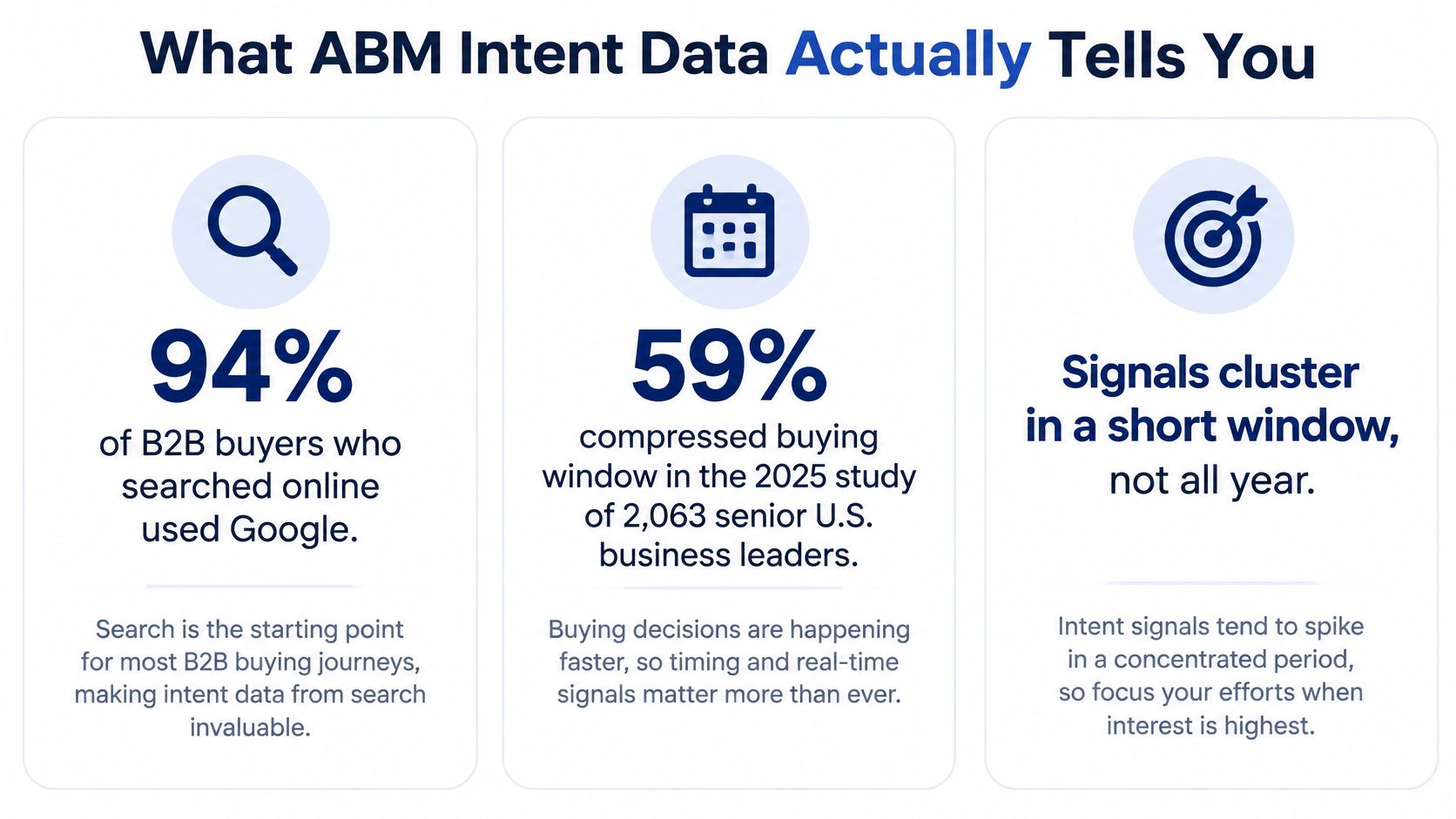
Google and National Research Group's 2025 buyer study, which surveyed 2,063 senior U.S. business leaders, found that 77% of respondents completed their buying journey within 12 weeks or less. The same study found 94% of B2B buyers who searched for a product online used Google Search, 59% used social media during the research stage, and 60% used AI tools during the purchasing journey.
Read those numbers together and the shape of the problem is obvious. The research happens before anyone raises a hand, it's spread across several surfaces, and it's over inside a quarter. If your first contact with an account depends on a demo request, you're arriving at the end of a conversation that already happened somewhere else.
ABM intent data is the observable trail of that research, plus the business events around it. Topic consumption on publisher sites. Page paths on your own. A job posting for a role that only exists because of a new initiative. Funding. An executive move. A priority the company states out loud in an earnings call or a press release.
Who could buy versus who is in motion
Firmographics answer the first question. Industry, headcount, geography, tech stack and revenue band tell you whether an account could ever write a check for what you sell. They say nothing about whether anything is moving this quarter, which is the only thing a rep can work with on a Tuesday morning.
Intent answers the second.
The ideal customer profile is the invitation list. Intent is the guest walking toward the kitchen.
That distinction is the whole payoff. You aren't trying to build a longer target list. You're trying to spend the first hour of Monday on the forty accounts where something changed, instead of the four hundred that fit.
And one anonymous topic spike is still a hypothesis. It isn't a buying committee with budget and a deadline attached. The trail tells you where to look. Which parts of that trail deserve credence at all is a separate judgement.
Where ABM Intent Signals Come From
Six families cover most of what an ABM team will see, and they don't carry equal weight. The comparison below is the version I'd hand a new SDR on day one, because the column that decides the work isn't confidence. It's what the signal earns.
| Source | What it shows | Typical confidence | Act when |
|---|---|---|---|
| Third-party topic surge | Anonymous content or keyword consumption | Often 30-65% account match; some sources about 81-92% | Watch unless a second independent signal agrees |
| First-party web and email | On-site or campaign behavior, known or anonymous | High only when a person is known | Use for stage, not as sole proof |
| Hiring and org build | A team staffing a capability | High when the role maps to the offer | Corroborate a topic or open a seven-day task |
| Earnings, filings, funding, M&A | Stated priorities or a forced change | High for public events | Same-day or seven-day task if the account fits |
| Executive move | A new economic or technical buyer | High and time-sensitive | Same-day coverage on named accounts |
| Reviews and events | Late comparison or peer activity | Medium and easy to overread | Late-stage corroboration only |
Third-party topic surges are where everyone starts and where most false alarms come from. Available evidence suggests a surge matches to the correct account only 30-65% of the time, while one independent DACH test reported accuracy ranging from about 81% to 92% depending on the data source, as The Growth Syndicate's review of intent data in B2B sets out. A surge is a reason to look, never a reason to call.
A surge tells you an account is reading. It doesn't tell you anyone there has a project, a budget or a deadline.
First-party behavior sharpens the moment a known person is attached. An anonymous visitor on your pricing page is an account-level clue. The same named person returning three times is a stage signal. Treat the anonymous version as context and nothing more.
Hiring and org build deserves its own rung on the ladder. A team staffing a capability is spending money on a problem, and a requisition that names your category is about as close to a stated priority as public data gets. It's strong when the role maps to what you sell. It's weak when the title is generic and the department is nowhere near your buyer.
Public business events and executive moves are the highest-confidence inputs you'll get, because someone signed their name to them. Reviews and event attendance sit later in the cycle and are the easiest to overread: a review-site comparison usually means a shortlist already exists, which changes the message rather than the timing.
Four checks before a signal leaves the queue
- Match confidence: is the record the account you think it is, or a similarly named subsidiary in another country?
- Age of the event: when did it happen, not when did it reach your inbox?
- Who might be consuming: students, competitors, existing customers, researchers and your own employees all generate topic surges.
- Second source: does anything independent agree, and can you link to it?
Park every single-source surge in a watch queue. The queue costs nothing and catches the ones that become something. Keeping a source-backed provenance trail on each alert is what lets a rep make that call in seconds rather than turning it into a research project.

“We're no longer fishing. We know who the right customers are, and we can qualify them quickly. Salesmotion has had a direct impact on pipeline quality.”
Andrew Giordano
VP of Global Commercial Operations, Analytic Partners
How to Score a Signal Before You Act
Intent data is a probabilistic account-prioritization feature, not proof that a committee is evaluating a purchase. Third-party signals fuzzy-match to company accounts at roughly 70-90% accuracy depending on the data source and industry, per multi-source research in the I-COM journal. That error rate makes identity resolution, deduplication and confidence scoring operational requirements rather than nice-to-have data hygiene.
Three layers go in before you touch a tool.
ICP fit is a gate, scaled 0 to 1: industry, geography, employee count, technology stack and revenue band. Behavioral intensity is repeated topic consumption or visits across several buying-stage pages, not a single hit on a single afternoon. Evidence diversity is the layer often skipped, and it stays at zero until a second independent source agrees. A relevant hiring pattern plus an earnings-call initiative counts. So does a named person replying to an email plus a high-value page visit.
The score I'd actually compute
In plain terms: fit multiplied by normalized intensity, multiplied by a recency factor, with diversity acting as a gate rather than a bonus. The three layers stack in that order.
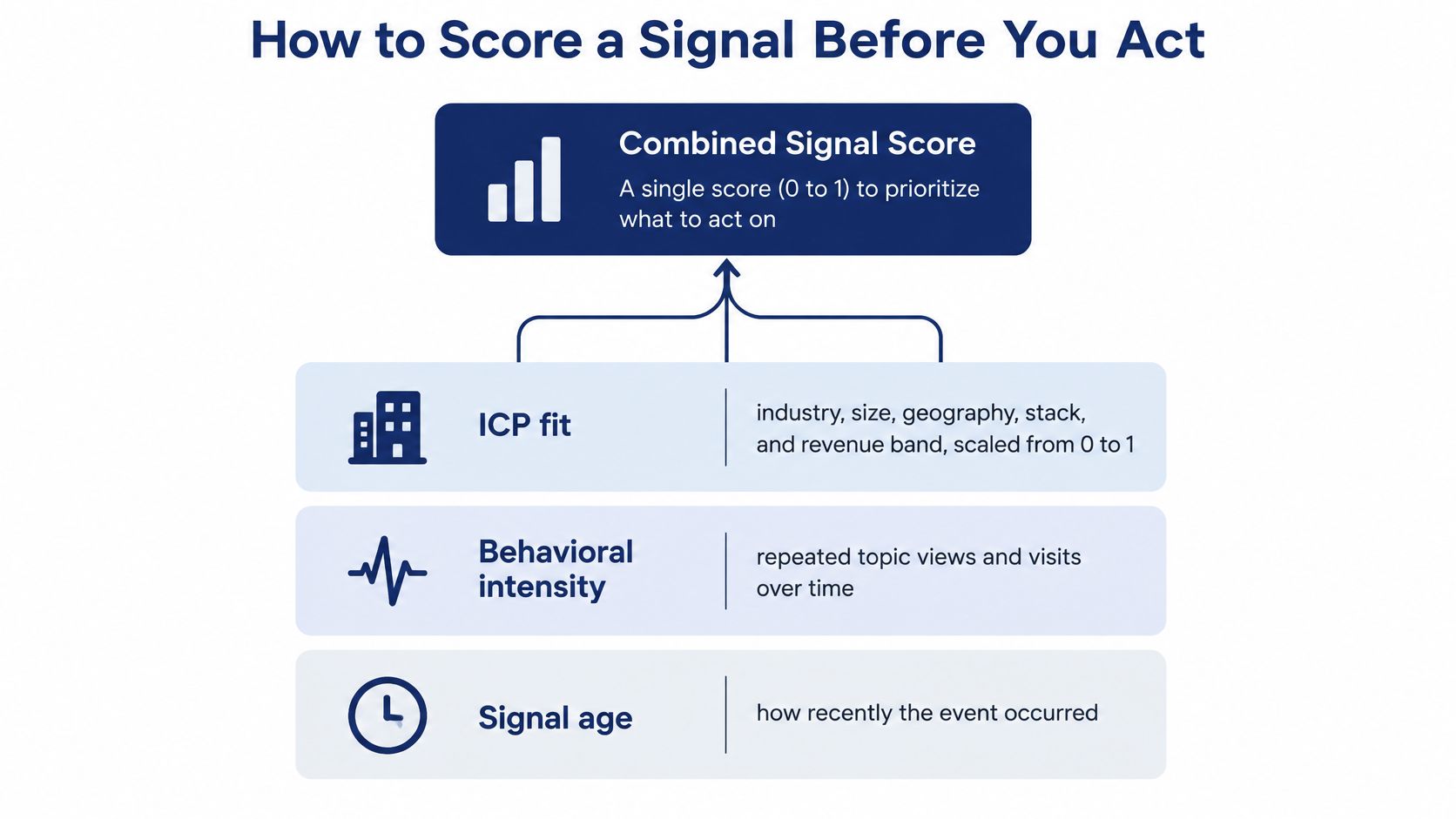
The recency factor is where money leaks. I'd halve it every seven days, because the same research event means something different on day two and day twenty. Fit alone, however perfect, produces no task: everyone on the list fits. Intensity alone produces noise.
| Pattern | What the team does |
|---|---|
| Fit only, no recent behavior | No task; account stays on the ICP list |
| Lone topic surge | Monitor queue, no cold call |
| Surge plus relevant hiring | Create a task inside seven days |
| Executive change on a fit account | Same-day task for the account owner |
| Same surge at 21 days | Do not treat it as active intent |
Read the rows as a classification exercise. A lone surge goes to a queue. Surge plus relevant hiring inside seven days is a task with an obvious opening line. An executive change on an account that already fits is same-day work for the owner, because a new buyer's first ninety days is exactly when internal re-evaluation happens.
Where the cutoff belongs: treat the threshold as a hypothesis to test against holdout accounts, not a universal number copied from somebody else's deck.
The false positives are boring and predictable. Students, competitors, existing customers, researchers and your own staff generate real content consumption with no purchase project behind it. Two independent signals filter most of them, and a confidence flag on every alert tells the rep how much to trust the reasoning. Validate with holdout accounts and compare opportunity creation, meeting rate and time-to-first-touch against matched non-alerted peers. Self-reported benefit isn't causal lift, and signal relevance beats volume every time a rep has eight hours in a day.
Consent and Data Rules Before You Activate
Keep two things apart. Account-level intelligence, meaning an intent score, a firmographic list or aggregated account activity, can drive prioritization. Contact-level personal data should come from people who gave it to you directly: a form fill, a product sign-up, an event badge. Pulling a third-party contact list into a first-party audience tool for advertising isn't a gray area.
Google's Customer Match rule is explicit. Advertisers may upload only customer information collected in a first-party context, such as a website, app or physical store where the customer shared information directly with the business. A file can be perfectly formatted and still be ineligible.
In the European Economic Area there's a second checkpoint. Since March 2024, both ConsentStatus fields must be set to GRANTED for Customer Match lists to be used for personalized advertising. Consent status has to survive every hop between CRM, marketing automation and ad platform. In most stacks, it doesn't.
Write it down: why the signal is needed, which fields you use, how long you retain them, and how someone opts out.
For sales outreach, legitimate interest under Article 6(1)(f) of the GDPR isn't automatic permission. The European Data Protection Board's guidance on legitimate interest requires a clear, precise, real and present interest, a necessity test, and a balance against the person's reasonable expectations, plus data minimization and a retention limit. Prioritize accounts on aggregated signals, reach people through channels where you hold a lawful basis, and document the decision.
“We have very limited bandwidth, but Salesmotion was up and running in days. The template made it easy to load our accounts and embedding it in Salesforce was simple. It was one of the easiest rollouts we've done.”
Andrew Giordano
VP of Global Commercial Operations, Analytic Partners
How to Route Alerts into Outreach
A score nobody acts on is a dashboard with extra steps. Routing is the part that decides whether intent changes seller behavior while the underlying initiative is still live, and the decay curve is unforgiving. Wire the flow below into the CRM before you tune a single weight.
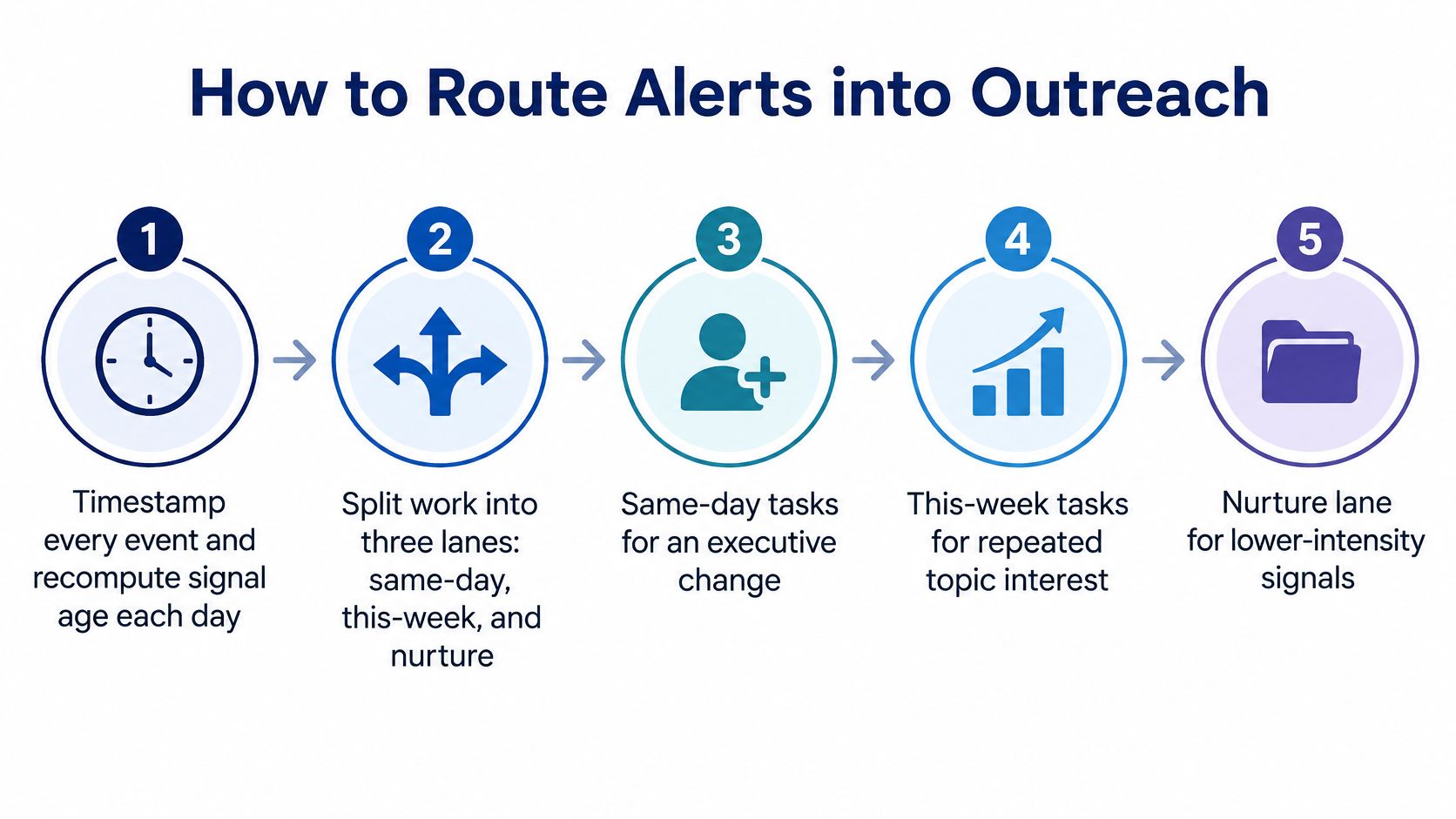
- Timestamp every event. Recalculate signal age daily, not at import. A surge from last month shown without a date reads as fresh and isn't.
- Split work into three lanes. Same-day tasks for an executive change, funding, an acquisition or a hiring burst that maps to the offer. A seven-day queue for corroborated topic activity. A monitor list for a lone surge.
- Route by owner. Account executives take live opportunities. An SDR or AE takes net-new accounts over the threshold. Marketing keeps the monitor list for light education rather than cold calls.
- Write the alert in three lines. One why-now sentence, one suggested action, one link to the source.
- Anchor the first touch to the corroborating event. A sentence from the earnings call. The job title in the requisition. If no new signal appears, stop the sequence.
- Review missed SLAs weekly. If reps are drowning, raise the threshold instead of hiring another body.
Available benchmark evidence reports 4-7% intent-to-meeting conversion when a surge is activated within seven days, against 1-2% when activation happens after 21 days, plus roughly 2.5x higher account engagement for the seven-day window, per 2025 ABM demand generation benchmarks.
| Activation window | Intent-to-meeting conversion | Account engagement |
|---|---|---|
| Within 7 days | 4-7% | About 2.5x higher |
| After 21 days | 1-2% | No comparable lift |
Treat those as directional. Published ABM metrics often come from vendor-sponsored surveys or small datasets, and there's no consistent independent standard. The direction is what matters: a week-old signal is a different asset from a three-week-old one, and the routing rules should say so out loud.
The seven-day lane exists because the window in which a rep can shape a shortlist is short. After it closes, the rep is negotiating against a decision someone else already made.
Pair the routing rules with a repeatable first-touch sequence so the alert becomes a conversation rather than a note in a CRM. This account-based outreach playbook covers the sequence end to end.
Three Accounts and the Call on Each
Three calls, three different answers. The first earns same-day outreach. The second earns nothing yet. The third needs routing to a different person entirely. Most of these decisions get made in a CRM record, in about ninety seconds, by a rep deciding whether the alert makes sense.

The infrastructure company with a new CRO and a consolidation plan
Say a public infrastructure-software company names a new chief revenue officer on Tuesday. On the latest earnings call, the CFO says the business will consolidate three billing tools onto one platform this year. Four open roles mention usage metering. The account already fits on industry, size and stack.
Two independent signals plus a new economic buyer. Same-day coverage, and the opener names the business event rather than the company's growth.
First line that earns a reply: The Q3 call flagged consolidating three billing systems before year end, and the metering roles you have posted point the same direction. Worth fifteen minutes on where migration sequencing usually breaks?
That line works because it can only be written by someone who read the call transcript and the job board. It also fails fast if the consolidation slipped a quarter, which is useful information.
The manufacturer with a spike and nothing behind it
A 400-person industrial manufacturer shows a three-day third-party spike on predictive maintenance. No matching job posts. No first-party visits. The same topic is surging around two universities and a trade school. Fit is good, so the temptation to act is real.
Leave it on the monitor list. Promote it only if hiring appears or a known engineer lands on the product page within two weeks. If neither happens, the spike was research, and research without a project is not a task.
The existing customer opening a module nobody sold them
An existing customer is 90 days from renewal. Three known users keep opening a new module they haven't bought. That's expansion timing, and it belongs to the account owner, not to an SDR working net-new pipeline. Same signal strength, different routing, because the relationship changes what the signal means.
The pattern across all three is the same. The rep acts on the business event that makes anonymous research believable, and the first sentence of the outreach names that event. Everything after it is just competent follow-through.
Measure Lift and Run a 30-Day Two-Signal Test
Most buying activity stays invisible. A widely cited 2025 buyer study summarized by 6sense on AI and buyer research reports that only 3% of website visitors self-identify through form fills, leaving roughly 97% anonymous, that buyers consume an average of 13 content pieces before engaging vendors, and that buying groups average about 10 members.
Put those three together and a hot account can still have nobody ready to buy.
That's why MQL counts undersell intent programs and alert volume oversells them. Neither measures lift.
The distinction that keeps budgets alive: intent can improve timing without causing the deal. Measure influence with a holdout, not with an attribution story assembled after the quarter closed.
The traps
- Alert volume as ROI: more alerts means a looser threshold, not more pipeline.
- Every spike treated as a buyer: a topic surge is the cheapest signal to generate and the easiest to overread.
- Stale treated as fresh: anything older than three weeks is history, not intent.
The 30-day test
- Pick one segment of about 25 target accounts where fit isn't in question.
- Write the two-signal rule into the CRM: no task unless fit is acceptable and a second, different source agrees.
- Log signal age on every task and compare meetings created inside seven days against the same motion after 21 days.
- Hold out a matched slice and measure opportunity rate, not replies.
- Where reps still hunt public triggers by hand, automate it. Account monitoring tracks every account every day across thousands of sources, including news, earnings calls, SEC filings, job postings, leadership changes, funding rounds, M&A and podcasts.
Watch what happens inside the account too, not just what comes out of it. Do signals recur? Does engagement accelerate? Do more than one role appear? An account moving from one reader to four is progressing before anyone books a call.
Time-to-first-touch is an operating check, not an outcome. A rep who answers in ten minutes flat on a false positive has moved quickly in the wrong direction. Speed belongs inside the score, where it gets multiplied by fit and corroboration, not bolted on as a service level after the fact.
At day 30, compare qualified meetings, opportunity creation, pipeline value and win rate against the holdout. If alerted accounts don't beat it on qualified meetings, tighten the rule instead of adding topics. This framework for account-based marketing metrics shows how to keep that chain readable when finance asks what the program returned.
Salesmotion runs three AI agents across your target accounts: the Research Agent builds cited account briefs from public sources, the Signal Agent watches for real-world triggers like earnings lines, funding, leadership moves and job postings, and the Outreach Agent drafts messaging anchored to each signal so a rep starts with the why-now already written. That's the two-signal workflow above running continuously instead of whenever someone has time to check. Add a handful of accounts at Salesmotion and see which ones are in motion this week.