A territory review is a quarterly look at your whole book of accounts that answers four questions: which accounts did you actually work, where did your pipeline come from, which accounts have a live reason to buy right now, and where will you spend the next quarter. It takes an afternoon with a spreadsheet and your CRM, and it usually shows that a large part of the book got no attention at all.
TL;DR: Export every account in your book with tier, last activity, open opportunities and the most recent buying signal. Measure four things: the share of accounts you touched this quarter, the share of top-tier accounts you touched, the share of pipeline that came from your assigned book, and the accounts with a live signal and no activity. Then tag one focus field per account (first focus, next focus, or untagged) and plan the next 60 days around the first-focus list. Download the template below.
What is a territory review?
A territory review is an account executive's or manager's periodic audit of an assigned book: how it was covered, what it produced and where the remaining potential sits. It is different from territory design, which decides who owns which accounts (the territory management guide covers that). A territory review starts after the book is assigned and asks whether you are working it well.
It matters because most books are bigger than one person can work evenly. Bridge Group's 2026 research found that 48% of reps reached annual quota, down from 51% in 2024 (Bridge Group, 2026). Some of that gap is territory: potential sits in accounts nobody touched, while time goes to accounts with no reason to buy.
Which territory metrics should you check each quarter?
Four measures, all computable from a CRM export. They are diagnostics, not targets.
| Measure | How to calculate | What it tells you |
|---|---|---|
| Accounts worked | Accounts with any logged activity this quarter ÷ accounts in your book | How much of the book you actually covered |
| Top-tier coverage | Tier-A accounts with activity this quarter ÷ tier-A accounts | Whether your time went where the potential is |
| Pipeline from your book | Pipeline created on your assigned accounts ÷ all pipeline you created | Whether the territory, or luck and inbound, is feeding you |
| Live signals, no activity | Accounts with a buying signal in the last 90 days and no activity in 60 | The missed openings, account by account |
The last line is the one to act on first. An account with a new executive, an acquisition or a cost program announced on the earnings call, and no outreach from you in two months, is the cheapest pipeline in your book.

“Salesmotion is instrumental in helping me prioritize net-new accounts, understand their strategic initiatives, and cover more ground. With a lot of green-field accounts, I'm heavily leaning on the AI insights to tier my accounts and focus my time. The platform is incredibly intuitive and easy to use.”
Rob Webster
Enterprise Account Executive, Synthesia
Why do priority flags stop working?
Most CRMs carry several overlapping priority fields: a tier set at the start of the year, a "strategic" checkbox, a target-account list from marketing, and the rep's own favorites. Few of them get updated. After two quarters the priority field describes January, not today, and pipeline starts arriving from accounts nobody flagged.
Two habits fix it:
- One focus field, owned by you, reviewed monthly. Every account in the book is fair game, but each carries one tag: first focus (most of your time: research, multi-threading, one-to-one outreach), next focus (lighter, one-to-many touches), or untagged (respond if they come to you). Compare where your pipeline came from against the tags each quarter.
- Score fit, need and timing separately. Fit is the profile: size, industry, technology, region. Need is whether the problem you solve exists there. Timing is whether something is happening now. A perfect-fit account with nothing happening belongs in next focus. A decent-fit account with a new executive and a public cost target belongs in first focus this month. The account prioritization framework goes deeper on scoring.
How do you run a territory review in an afternoon?
1. Export the book. Account, tier, owner since, last activity date, open opportunities with stage and amount, closed-won and closed-lost in the last year.
2. Add the signal column. For each account, the most recent meaningful event and its date: leadership change, acquisition, funding, earnings language about your problem area, hiring in the team you sell to. This is the column most reps leave blank, because collecting it by hand across 100 or more accounts takes days. The buying signals guide lists which events matter.
3. Calculate the four measures in the table above.
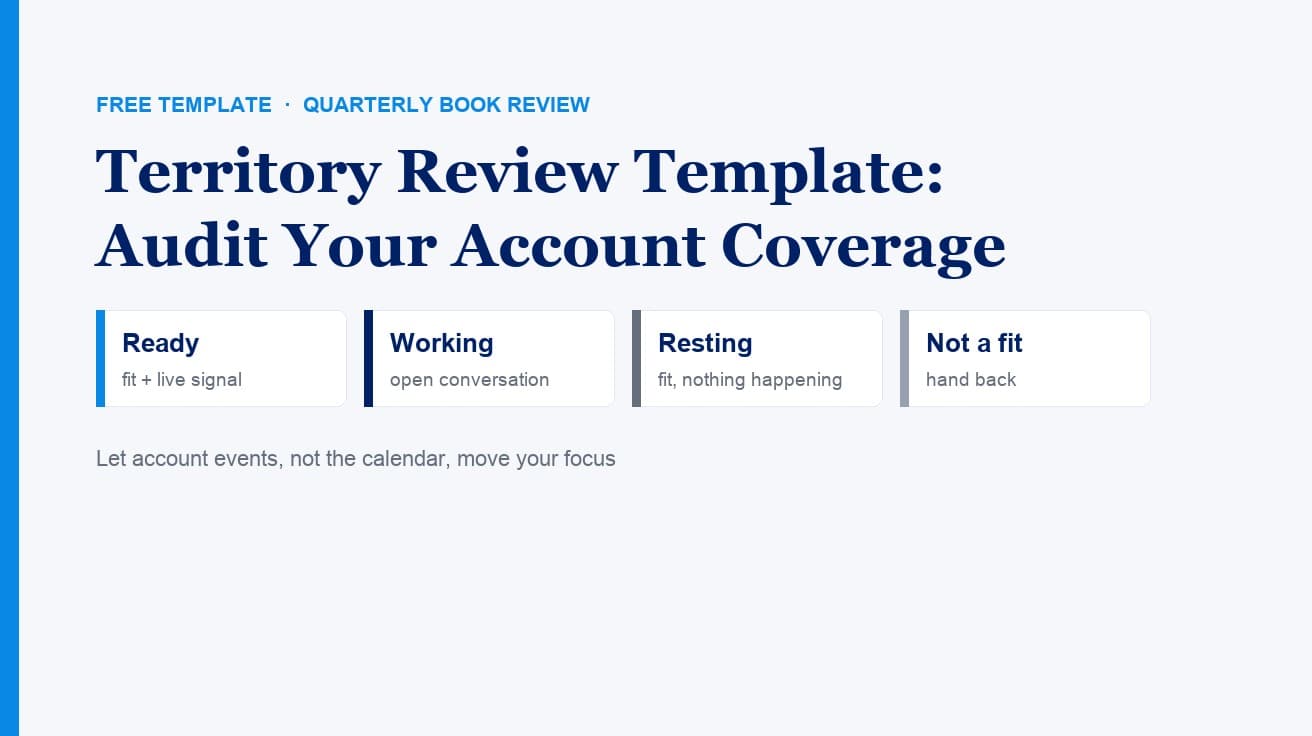
4. Give every account a state. Four work well:
| State | Means | What you do |
|---|---|---|
| Ready | Good fit and a live signal, not yet engaged | Research and reach out this month |
| Working | Active conversation or open opportunity | Advance it; keep the plan dated |
| Resting | Good fit, nothing happening now | Light touch; let the signal feed wake it up |
| Not a fit | Wrong profile, or disqualified with a reason | Hand back or stop spending time |
Accounts move between states when something happens at the account, not when the calendar turns. That is the difference between a static list and a territory that responds.
5. Tag first focus. Pick the short list you can genuinely work in the next 60 days with research and multiple contacts, usually the Ready accounts plus the Working accounts that matter most. Everything else is next focus or untagged.
6. Write three decisions. Which accounts you will open this cycle, which you will hand back or stop working, and what you need from your manager (an introduction, an executive sponsor, marketing air cover).
Free Territory Review Template
Account-by-account sheet with tier, fit, need and timing scores, last activity, latest signal, state and focus, plus the four coverage measures calculated for you.
No email required. The Excel version calculates the coverage measures as you fill it.

“Automatic account profile detail I can use to manage my territory. Using Salesmotion AI to generate value statements per persona, account, etc. Using Salesmotion to give me a starting point based on new hires, or news alerts is critical.”
Adam Wainwright
Head of Revenue, Cacheflow
What does a filled territory review look like?
An illustrative extract, with made-up accounts, showing how the signal column changes the focus decision:
| Account | Tier | Last activity | Latest signal (date) | State | Focus |
|---|---|---|---|---|---|
| Industrial group A | A | 74 days ago | New COO with an efficiency mandate (3 weeks ago) | Ready | First focus |
| Software company B | A | 6 days ago | None in 90 days | Working (stage 2) | First focus |
| Bank C | B | 120 days ago | Acquisition of a regional competitor (5 weeks ago) | Ready | First focus |
| Retailer D | A | 15 days ago | None in 90 days | Resting | Next focus |
| Distributor E | C | Never | Hiring a head of sales operations (2 weeks ago) | Ready | Next focus |
Without the signal column, the rep would have spent the quarter on accounts A, B and D because they are tier A. With it, Bank C, a tier-B account two months past its last touch, moves to first focus, and Retailer D drops to next focus until something happens there.
See which of your accounts have something happening
Salesmotion's Signal Agent watches every account in your book across 1,000+ public sources and flags the ones that just became Ready. See it on your own territory in a 30-minute demo.
How often should you review your territory?
Quarterly for the full review, monthly for the focus tags. Change the book itself rarely: every time accounts move between reps, relationships and research are lost, so most teams redraw territories once a year with the compensation plan. Inside the year, run focus in 60-day cycles instead of re-cutting the patch.
Two rules keep the review honest:
- Holds expire. If you claim an account and log no activity for 60 days, it goes back to the pool. A reserved account nobody works is the worst of both worlds.
- You rent accounts, you do not own them. If an account produced nothing for two quarters and has no signal, hand it back or move it to next focus. Your time is the scarcest resource in the territory.
Salesmotion's Take
It all starts with good territories, good account selection and the right timing. Most reps I talk to have the first two and guess at the third. The review is where you replace the guess with what actually happened at each account this quarter.

Semir Jahic
CEO & Co-Founder, Salesmotion
Key takeaways
- A territory review audits how you covered your book, what it produced and where to focus next; it is not territory design.
- Track four measures: accounts worked, top-tier coverage, pipeline from your book, and live signals with no activity.
- Replace stale priority flags with one focus field you own and review monthly; score fit, need and timing separately.
- Give each account a state (Ready, Working, Resting, Not a fit) and let account events move it.
- Work first focus in 60-day cycles; let holds lapse after 60 days without activity.
Frequently Asked Questions
What is a territory review in sales?
A territory review is a periodic audit of an assigned book of accounts. It checks which accounts were worked, where pipeline came from, which accounts have a current reason to buy, and where the rep will focus next. It is usually done quarterly by the account executive, often with their manager.
What should a territory plan include?
The accounts in the book with tier and fit, the potential in each segment, the rep's focus list for the next cycle, rules for holding and handing back accounts, and the measures used to review it. The free template on this page covers the account-level part and calculates the coverage measures.
How many accounts can an account executive cover?
It depends on deal size, cycle length and how much research each account needs, so there is no single number. A better test is the accounts-worked measure: if a large share of your book gets no activity in a quarter, the book is bigger than you can cover, and a focus list matters more than the total.
What is account coverage in sales?
Account coverage is how much of an assigned set of accounts a rep or team is actively working, usually measured as accounts with logged activity in a period divided by accounts assigned. Coverage of top-tier accounts and of accounts with recent buying signals matters more than coverage of the whole book.
How do buying signals help with territory planning?
Signals add timing to fit. A territory sorted only by tier sends reps to the same large accounts every quarter. Adding recent events, such as leadership changes, acquisitions, funding or hiring in the relevant team, shows which accounts have a reason to engage now, so the focus list changes as the accounts do.