
Global advertising revenue hit $1.19 trillion in 2025, according to WARC, and is projected to reach $1.30 trillion in 2026. Three companies, Alphabet, Amazon, and Meta, now capture 56% of that spending outside China. If you are selling into media and advertising accounts, every prospect on your list is navigating this concentration, fighting for a share of shrinking open-web budgets while simultaneously investing in CTV, retail media, and first-party data infrastructure. The reps who break through show up with intelligence about the prospect's specific revenue trajectory, measurement strategy, and platform dependencies rather than a generic pitch about helping them "optimize" their business.
Account research for media and advertising sales means understanding ad revenue trends, audience measurement shifts, programmatic and CTV dynamics, and the organizational signals that indicate a company is entering a buying window for new technology, data, or services.
TL;DR: Media and advertising account research depends on earnings call ad revenue data, industry reports from eMarketer, WARC, and Nielsen, platform announcements, and audience measurement transitions. Build a 10-minute framework that identifies revenue pressure points, platform shifts, and organizational investment signals. The strongest buying signals are ad revenue declines, measurement currency changes, new Chief Revenue Officer hires, and first-party data strategy announcements.
Why Media and Advertising Research Follows Its Own Rules
Standard B2B account research tools miss the data points that drive purchasing decisions at media companies. Here is what makes this industry different.
Ad revenue is the primary health indicator. For publishers, ad networks, and ad-supported platforms, advertising revenue drives every strategic decision. A company whose ad revenue grew 15% last quarter is making very different technology investments than one whose ad revenue declined 8%. eMarketer reported US ad spending grew 11% in 2025, but that growth concentrates heavily in a few channels. Knowing which segments are growing (retail media, CTV) versus contracting (traditional display, linear TV) for your specific prospect is the research edge that matters.
Platform dependency creates vulnerability. Media companies depend on a small number of distribution platforms for reach and revenue. When Google, Meta, or Amazon makes a policy change, algorithm update, or ad format requirement, it creates immediate operational and technology needs downstream. According to the IAB's 2026 Outlook Study, planned spend increases are most concentrated in CTV and digital video (63%), social platforms (61%), and AI-driven media (54%). A platform shift at this scale forces every publisher and agency that relies on those channels to re-evaluate their technology stack.
Audience measurement is in historic transition. Nielsen launched its Big Data + Panel methodology in 2025, combining panel data with set-top box and smart TV data from 45 million households. Meanwhile, Comscore, iSpot, and VideoAmp all received JIC certification as transactable currencies. This multi-currency reality means media companies are evaluating new measurement partners, rebuilding attribution models, and investing in data infrastructure at a pace not seen in decades.
Retail media and CTV are reshaping budgets. WARC projects global retail media ad spend will hit $196.7 billion by 2026, representing 16% of all ad spend. Over 90% of CTV ad spend is now transacted programmatically. These shifts create new vendor evaluation cycles at every media company deciding how to allocate and measure spend across emerging channels.
See Salesmotion on a real account
Book a 15-minute demo and see how your team saves hours on account research.
The Media-Specific Research Sources You Need
Effective account research for media and advertising requires sources that general sales intelligence platforms do not cover. Here is your source library, organized by research type.
Ad Revenue and Market Forecasts
These sources give you the financial and market context to understand a prospect's competitive position:
| Source | What It Provides | Update Frequency | Access |
|---|---|---|---|
| eMarketer/Insider Intelligence | Digital ad spending forecasts, platform market share, channel breakdowns | Weekly reports, quarterly forecasts | Subscription |
| WARC | Global ad spend forecasts, campaign effectiveness data, creative benchmarks | Quarterly Global Ad Trends, annual Marketer's Toolkit | Subscription |
| GroupM/WPP TYNY | Annual global ad revenue projections by channel and geography | Twice yearly | Free reports |
| Magna Global | Advertising market forecasts by media type | Quarterly | Free summaries |
| PwC Global Entertainment & Media Outlook | 5-year revenue forecasts across 14 segments and 53 countries | Annual | Subscription |
| IAB | Ad format trends, measurement standards, programmatic benchmarks | Multiple reports per year | Free and paid |
Before any meeting with a media executive, check the latest eMarketer or WARC forecast for their specific segment. Knowing that retail media ad spending grew 15.6% in 2025 while traditional display declined gives you immediate credibility and a conversation hook.
Audience Measurement and Ratings Data
The measurement landscape is the single most disruptive force in media right now, and it creates enormous research opportunities:
Nielsen remains the dominant TV measurement provider, covering an estimated 80-90% of national TV currency transactions. Their Big Data + Panel methodology, which received MRC accreditation in January 2025, combines panel measurement with data from set-top boxes and smart TVs across 45 million households. Nielsen ONE now includes outcomes capabilities alongside planning and measurement. If your prospect is a TV network or broadcaster, understanding their Nielsen relationship and whether they are experimenting with alternative currencies is essential context.
Comscore provides cross-platform audience measurement for publishers, advertisers, and agencies. Their digital audience data covers web traffic, app usage, and video consumption. In 2025, Comscore named Frank Friedman as chief data and analytics officer, signaling a new measurement era. Comscore's Top 50 rankings for digital properties give you a quick benchmark for where any publisher stands relative to competitors.
VideoAmp has emerged as the leading Nielsen alternative, with over $1 billion in media dollars guaranteed using their measurement tools in 2025. Their currency is now used in deals across major holding companies and top-tier publishers. If your prospect mentions VideoAmp in earnings calls or press coverage, they are likely in the middle of a measurement technology evaluation.
iSpot provides real-time TV ad measurement and attribution, connecting ad exposures to business outcomes. All three alternative providers (Comscore, iSpot, VideoAmp) passed the JIC's mid-term audit for the 2025-2026 broadcast season.
Programmatic, CTV, and Retail Media Intelligence
These channels are where the growth is, and where your prospects are making their biggest technology bets:
- The Trade Desk: Their quarterly earnings and product announcements (OpenSincera for supply quality signals, OpenAds for programmatic auction modernization) reveal where the open internet programmatic market is heading. Their UID2 identity solution is becoming an industry standard for cookieless targeting.
- AdExchanger: The leading trade publication for programmatic and ad tech news. Daily coverage of platform deals, measurement changes, and technology partnerships. Essential reading before any ad tech meeting.
- Digiday: Covers the business of digital media, with strong reporting on publisher revenue strategies, agency dynamics, and technology adoption.
- Retail media network announcements: Amazon, Walmart, Instacart, and other retailers regularly publish updates about their advertising platforms. eMarketer forecasts that US retail media ad spending will reach $69.33 billion in 2026, with Amazon and Walmart capturing over 89% of incremental dollars.
- Mediaocean: Their bi-annual Advertising Outlook Report surveys over 6,100 respondents across brands, agencies, and technology providers, providing a reliable temperature check on spending intentions and technology adoption.
Creative Performance and Agency Relationships
Understanding a media company's creative strategy and agency partnerships reveals both their priorities and their vendor ecosystem:
- Cannes Lions and Effie Awards databases show which agencies and brands are winning for creative excellence and marketing effectiveness. A company that recently won at Cannes is investing in creative differentiation, which often signals technology and measurement investment to prove ROI.
- Agency relationship changes: When a media company switches agencies, the new agency typically audits the existing technology stack and brings preferred vendors. Monitor trade press (Ad Age, Adweek, Campaign) for account moves.
- WARC Creative Effectiveness case studies connect creative work to business outcomes, giving you insight into what metrics a prospect values most.
Job Postings and Organizational Signals
Media and advertising job postings reveal technology priorities with unusual specificity:
- Ad operations and programmatic roles signal AdTech stack investment or migration
- Data science and analytics roles indicate measurement strategy evolution, especially when titles include "first-party data" or "identity resolution"
- Revenue operations roles suggest CRM and sales technology evaluation
- CTV-specific roles (VP of Streaming Sales, Head of CTV) signal investment in emerging video channels
- Retail media roles at publishers or agencies indicate clients are expanding commerce media capabilities

“The moment we turned on Salesmotion, it became essential. No more hours on LinkedIn or Google to figure out who we're talking to. It's just there, served up to you, so it's always 'go time.'”
Adam Wainwright
Head of Revenue, Cacheflow
How to Research Media Companies Before a Meeting
Here is a practical walkthrough of what to gather before sitting down with a media or advertising buyer. This is not a generic framework. Each data point maps to a specific conversation opener.
Step 1: Identify the Revenue Model and Competitive Position (3 minutes)
Determine whether the company is a publisher, ad network, agency, holding company, measurement provider, or ad-supported platform. Then identify their primary revenue model:
- Pure advertising: Revenue tracks directly with ad market health. Check eMarketer for their segment forecast.
- Subscription + advertising (hybrid): The balance between these streams reveals strategic direction. A company growing subscriptions while ad revenue declines is making fundamentally different technology decisions.
- Agency/services: Revenue depends on client retention and new business wins. Check Adweek and Ad Age for recent account wins and losses.
Pull their latest earnings summary or press release. Note total revenue, ad revenue breakdown by channel, and any commentary on programmatic versus direct sales mix.
Step 2: Map Their Measurement and Data Position (3 minutes)
This is the research step most sellers skip, and it is the most valuable for media accounts right now.
Check whether the company has made any public statements about measurement partners. Are they transacting on Nielsen Big Data + Panel, or experimenting with VideoAmp, iSpot, or Comscore? A publisher switching measurement currency is rebuilding infrastructure and evaluating new vendors across their entire data stack.
Look for press releases or blog posts about first-party data strategy. Companies announcing data clean rooms, customer data platforms, or identity graph partnerships are actively investing in privacy-era infrastructure.
Step 3: Assess Platform Dependencies and Channel Shifts (2 minutes)
For publishers, check Comscore or SimilarWeb for traffic source breakdown. A publisher getting 60% of traffic from Google Search is vulnerable to algorithm changes. One building direct newsletter audiences and app engagement is investing in owned channels.
For ad tech companies and agencies, identify which demand-side and supply-side platforms they partner with. Check for recent announcements about CTV, retail media, or commerce media expansion, which are the three fastest-growing channels in the market.
Step 4: Check Leadership and Organizational Changes (2 minutes)
Search LinkedIn for recent hires in revenue, advertising, data, or technology functions:
- New CRO or VP of Ad Sales: Revenue optimization and likely new technology evaluations
- New Chief Data Officer or VP of Data Strategy: Data infrastructure purchasing within the first two quarters
- New Head of Programmatic or VP of Ad Operations: AdTech stack evaluation
- New Head of CTV or VP of Advanced TV: Streaming and video technology investment
At agencies specifically, new Chief Digital Officer or Head of Performance hires signal service offering evolution and supporting technology needs.
Step 5: Synthesize Your Angle (1 minute)
Connect a revenue trend, measurement shift, or organizational change to your solution. Here is what a strong opening sounds like: "Your Q3 earnings showed programmatic ad revenue growing 18% while direct sales declined 5%. You also just hired a VP of Data Strategy from The Trade Desk. I would like to discuss how we help media companies that are shifting toward programmatic-first monetization build the account intelligence they need to sell effectively into that channel."
Salesmotion consolidates earnings data, leadership changes, news coverage, and strategic signals into a unified account view. For media sales, the earnings signal monitoring is particularly valuable because ad revenue shifts happen quarterly and directly correlate with technology purchasing urgency.
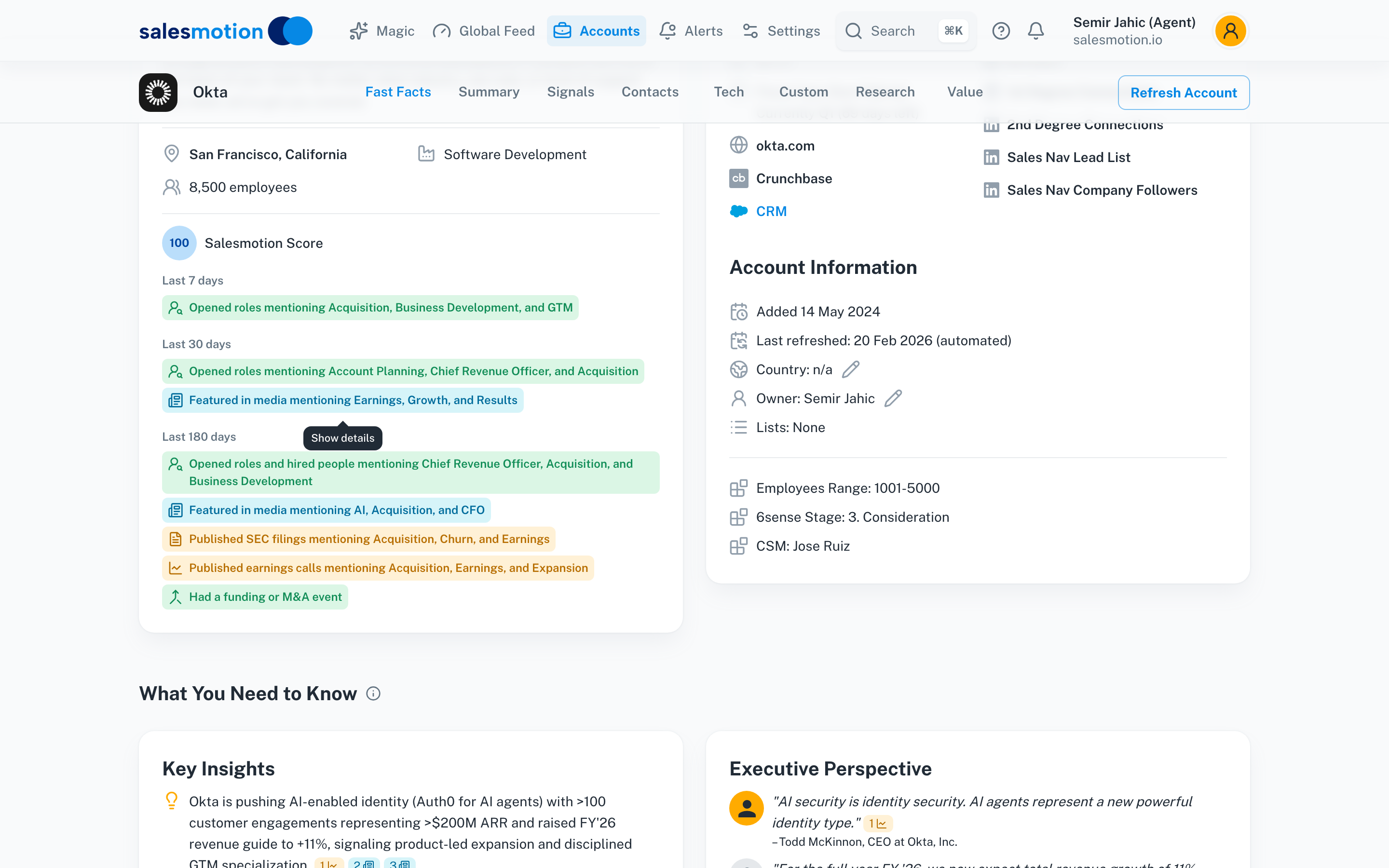 Salesmotion automates account research across 1,000+ sources — delivering key insights, executive commentary, opportunities, and competitive intelligence in a single brief.
Signals That Indicate Media and Advertising Purchase Readiness
The buying signals in media and advertising are driven by revenue trends, platform changes, measurement transitions, and emerging channel investment.
High-Intent Signals
- Ad revenue decline in quarterly earnings: Creates immediate pressure to optimize operations, diversify revenue, or invest in new monetization technology. Two consecutive quarters of decline almost guarantees active technology evaluation.
- Measurement currency change: A publisher or network adopting VideoAmp, iSpot, or Comscore alongside or instead of Nielsen is rebuilding data infrastructure and evaluating every connected vendor.
- New CRO, VP of Ad Sales, or Chief Data Officer: Revenue and data leadership hires trigger technology evaluations within the first 90 days. These executives arrive with mandates to modernize.
- First-party data strategy announcement: Signals active investment in data infrastructure, identity resolution, customer data platforms, and audience platforms. Often accompanied by technology RFPs within one to two quarters.
Medium-Intent Signals
- M&A announcement: Media mergers create technology consolidation needs and often unlock budget for integration projects. The 2024-2025 wave of CTV and ad tech acquisitions created thousands of integration-driven purchasing windows.
- Retail media or CTV expansion: A publisher launching a retail media network or an agency building a CTV practice needs new technology across measurement, targeting, and attribution.
- Subscription model launch or expansion: Transitioning from pure ad-supported to hybrid models requires new technology infrastructure for subscriber data, churn prediction, and monetization optimization.
Lower-Intent (Longer-Term) Signals
- Industry conference keynote on emerging topics: Signals strategic exploration 6-12 months ahead. Watch for CES, Cannes Lions, IAB NewFronts, and Advertising Week presentations.
- New content vertical launch: Expanding into new content areas signals growth investment and new audience acquisition needs.
- Privacy regulation compliance announcements: Indicates data strategy evolution, often triggering consent management and identity resolution investments.

“We're saving about 6 hours per week per seller on account research alone. That's time they can reinvest in actually selling.”
Derek Rosen
Director, Strategic Accounts, Guild Education
Research Walkthrough: Selling Into a Mid-Market Publisher
Here is how this research framework works in practice with a real scenario.
The account: A digital publisher with $200M annual revenue, primarily ad-supported, ranked in Comscore's Top 100.
Signal that fired: An account intelligence alert flagged a leadership change, a new VP of Data and Analytics hired from a major retail media network.
Earnings research (3 minutes): Q3 earnings showed total ad revenue up 4% but programmatic revenue up 22%, while direct-sold display declined 11%. Management commentary mentioned "investing in first-party data capabilities to improve yield" and "exploring commerce media partnerships."
Measurement and data check (2 minutes): Press release from two months ago announced a partnership with LiveRamp for identity resolution. Job postings include two data engineer roles focused on "audience data platform" and "clean room implementation."
Platform and channel assessment (2 minutes): SimilarWeb shows 45% of traffic from search, 20% from social, 35% direct. Recent blog post about launching a CTV app for their video content. No retail media presence yet, despite the new VP's background.
The outreach angle: "Your Q3 programmatic growth outpaced direct sales by 33 points, and your new VP of Data comes from a retail media background. It looks like you are building the data infrastructure to support higher-yield monetization. I work with media companies making exactly this transition, and I would like to share how teams in similar positions are using account intelligence to identify the right advertiser relationships to pursue as they shift toward programmatic-first and data-driven sales models."
That outreach demonstrates you understand their business better than 95% of the vendors in their inbox.
Tools Comparison: Researching Media and Advertising Accounts
| Approach | Coverage | Time per Account | Signal Freshness | Media-Specific Depth |
|---|---|---|---|---|
| Manual (earnings, eMarketer, trade press, platforms) | Comprehensive | 45-90 minutes | Varies | Very high with expertise |
| General sales intelligence (ZoomInfo, LinkedIn) | Contact data, firmographics | 5-10 minutes | Daily | Low, misses ad revenue and measurement data |
| Ad industry databases (eMarketer, WARC, Nielsen) | Ad spending, audience data, effectiveness benchmarks | 10-20 minutes | Monthly/quarterly | Very high for market and audience data |
| Programmatic intelligence (The Trade Desk, Jounce Media) | Supply quality, bid stream data, inventory signals | 10-15 minutes | Real-time | Very high for ad tech |
| Account intelligence platform (e.g. Salesmotion) | Earnings, leadership, news, strategic signals | Under 5 minutes | Continuous | High for financial and event signals |
The most effective approach layers automated signal monitoring for earnings events, leadership changes, and strategic news with targeted industry database research on active pipeline accounts. Use an account intelligence platform for continuous territory monitoring and the specialized media sources for deep preparation before high-value meetings.
For the complete guide to media and advertising buying signals, including workflows for publisher, agency, and ad platform sales, explore our companion resource.
Key Takeaways
- Media and advertising account research requires sources that general sales tools miss: eMarketer ad spending forecasts, WARC effectiveness data, Nielsen and Comscore audience measurement reports, and trade press from AdExchanger and Digiday.
- Ad revenue trends remain the primary health indicator. But in 2025-2026, the measurement currency transition (Nielsen Big Data + Panel vs. VideoAmp, iSpot, and Comscore) is creating an equally powerful research dimension.
- Retail media ($196.7 billion by 2026) and CTV (90%+ programmatic) are the two fastest-growing channels. Companies investing in these areas are actively evaluating new technology.
- Platform dependency research is essential. Know which platforms drive your prospect's traffic and revenue, and monitor those platforms for policy changes that create downstream technology needs.
- Build a 10-minute framework covering revenue model, measurement position, platform dependencies, channel shifts, and leadership changes. Each data point should map to a specific conversation opener.
- Layer automated account intelligence for territory monitoring with targeted industry research on active pipeline accounts. The combination of speed and depth is what separates the top sellers in media.
Frequently Asked Questions
What is the most important metric to research before calling a media company?
Ad revenue growth rate by segment is the single most important metric. A company growing total ad revenue 4% but seeing programmatic surge 22% while direct sales decline 11% tells a very different story than the headline number suggests. For public companies, this data is available quarterly in earnings reports. For private companies, eMarketer segment reports and press coverage provide directional indicators. A company whose ad revenue declined two consecutive quarters is under significant pressure to change something, making them receptive to solutions that improve monetization or reduce costs.
How does the TV measurement transition create buying opportunities?
The shift from Nielsen's panel-only methodology to the multi-currency landscape (Nielsen Big Data + Panel, VideoAmp, iSpot, Comscore) is forcing every TV network, streaming platform, and large agency to re-evaluate their measurement infrastructure. VideoAmp reported over $1 billion in media dollars guaranteed using their tools in 2025 alone. When a media company announces they are testing an alternative currency or transitioning measurement partners, every connected system, from data pipelines to attribution models to reporting dashboards, comes under review. This creates a technology purchasing window that typically lasts 6-12 months.
How do you research private media companies with limited financial data?
Focus on signals that do not require financial disclosures. Job postings are the most reliable indicator: ad ops, data science, and revenue roles reveal priorities with precision. Comscore and SimilarWeb provide directional audience and traffic data for publishers. Industry rankings (Comscore Top 50, IAB membership lists) give you relative market positioning. Trade press coverage in AdExchanger and Digiday often includes private company strategic announcements. Conference speaker lists from CES, Cannes Lions, and Advertising Week reveal which executives are positioning themselves as thought leaders, which often correlates with active technology investment.
What leadership changes signal technology buying at media and advertising companies?
New Chief Revenue Officer or VP of Ad Sales hires signal revenue optimization investment. Chief Data Officer or VP of Data Strategy hires indicate data infrastructure purchasing, particularly if the hire comes from a data-centric company (retail media network, ad tech platform, or measurement firm). Head of Programmatic or VP of Ad Operations hires indicate AdTech stack evaluation. CTV-specific hires (VP of Streaming Sales, Head of Advanced TV) signal emerging channel investment. At agencies, new Chief Digital Officer or Head of Performance hires signal service offering evolution and supporting technology needs. All of these roles typically evaluate and purchase technology within their first two quarters.
Where should I track retail media and CTV developments for account research?
For retail media, monitor eMarketer's retail media forecasts, individual retailer advertising platform blogs (Amazon Ads, Walmart Connect, Instacart Ads), and AdExchanger's commerce media coverage. For CTV, track The Trade Desk's quarterly earnings and product announcements, Mediaocean's bi-annual outlook reports, and the measurement developments from Nielsen, VideoAmp, and iSpot. Both channels are growing fast enough that quarterly check-ins on market data will surface new research angles for nearly every media account in your territory.