Global advertising revenue hit $1 trillion for the first time in 2024, according to GroupM's year-end forecast, with digital channels capturing the lion's share. But the real story for B2B sellers is what is happening underneath that number: U.S. programmatic display spending surpassed $180 billion in 2025 and was forecast to exceed $203 billion in 2026. CTV ad spending grew to $33 billion. Retail media networks were projected to hit $69 billion in U.S. spend by 2026. Each of these shifts creates technology purchasing decisions, vendor evaluations, and budget reallocations across thousands of media and advertising companies. For B2B sales teams selling into this ecosystem, the difference between a warm conversation and a cold outreach is whether you tracked the buying signal that preceded the purchase.
TL;DR: Media and advertising buying signals span programmatic platform changes, CTV adoption moves, retail media network expansion, agency account reviews, publisher monetization migrations, and brand in-housing decisions. The strongest signals are segment-specific: track agency pitch cycles and client wins, publisher ad tech stack changes, and brand roster shifts to time outreach when vendor decisions are actively being made.
Why Media and Advertising Buying Signals Are Uniquely Fast-Moving
Media companies operate on quarterly advertising cycles that create rapid budget shifts. A strong upfront season drives technology investment. A weak quarter triggers cost optimization. Platform changes at Google, Meta, or Amazon ripple through the entire ecosystem within weeks. The speed of change in media makes signal tracking more time-sensitive than in most industries.
The buying committee varies significantly by segment. At a TV network or publisher, technology decisions involve the CTO, VP of Ad Operations, VP of Data, and often the Chief Revenue Officer. At an ad agency, decisions involve the Chief Strategy Officer, Head of Programmatic, and client-facing teams. At a brand's in-house media team, the CMO and VP of Performance Marketing drive vendor selection. Each segment responds to different signals.
Media also has a unique budget dynamic: much of the spending is pass-through (media buying on behalf of clients), but the technology that enables that spending is a direct purchase. When an agency wins a major account, it may need new ad tech tools, measurement capabilities, and creative platforms to service that client. Client wins and losses are powerful buying signals specific to this industry.
See Salesmotion on a real account
Book a 15-minute demo and see how your team saves hours on account research.
Ad Tech and Programmatic Signals
Programmatic Buying Triggers
The programmatic advertising market is growing at roughly 13-15% year over year, and nearly 92% of all U.S. digital display ad spend now flows through programmatic channels. That means every shift in the programmatic stack creates vendor evaluation cycles.
Watch for these specific triggers:
- Open exchange to private marketplace migration. When a publisher or agency announces a shift from open RTB to curated PMPs or supply path optimization, they need new SSP relationships, deal ID management tools, and buyer-side curation technology. The move signals a commitment to premium inventory and higher CPMs, which means budget for supporting infrastructure.
- Attention-based buying adoption. Companies like Adelaide, Lumen Research, and Playground XYZ have pushed attention metrics into the mainstream. When an agency announces it is moving to attention-based optimization (rather than viewability alone), it needs measurement partners, creative testing tools, and revised attribution models.
- Supply path optimization (SPO) announcements. When a major holding company announces it is reducing SSP partners from 15 to 5, every SSP and ad tech vendor in the chain faces a vendor review. SPO announcements from GroupM, Publicis, or Omnicom reshape the sell-side ecosystem.
- AI-powered bidding rollouts. Google's Performance Max, Meta's Advantage+, and Amazon's AI bidding tools reduce the control agencies have over media execution. Each rollout triggers demand for independent verification, incrementality testing, and alternative optimization platforms.
CTV and Connected TV Adoption Signals
U.S. CTV advertising reached $33.35 billion in 2025 and was projected to hit $38 billion in 2026, with streaming capturing 47.5% of all U.S. TV viewing according to Nielsen. CTV is now the fastest-growing major advertising channel, and it is still heavily fragmented. That fragmentation is a buying signal goldmine.
Track these CTV-specific signals:
- Ad-supported tier launches. When a streaming service launches or expands an ad tier (Netflix's ad tier revenue exceeded $1.5 billion in 2025 and was expected to double in 2026), it needs ad serving, dynamic ad insertion, frequency capping, and measurement partners. Every AVOD launch is a 6-12 month vendor selection cycle.
- FAST channel expansion. Free ad-supported streaming TV channels grew 55% year over year. Publishers launching FAST channels need content syndication technology, ad monetization platforms, and cross-platform measurement.
- Cross-platform measurement adoption. The transition from panel-based to cross-platform measurement (Nielsen ONE, VideoAmp, iSpot) creates purchasing decisions for publishers, agencies, and advertisers. When a major advertiser switches its measurement currency, agencies and publishers need compatible tools.
- Live sports streaming investments. ESPN, Amazon Prime Video, and YouTube are pulling live sports from linear TV. Each rights deal creates demand for dynamic ad insertion, real-time bidding infrastructure, and high-volume ad serving at scale.
Retail Media Network Growth Indicators
U.S. retail media spending was projected to reach $69 billion in 2026, up from $59 billion in 2025. Amazon controls roughly 77% of the market, but the remaining 23% is where the buying signals are most active. Walmart, Instacart, Kroger, Target, and dozens of other retailers are building or expanding retail media platforms.
Signals to track:
- New retail media network launches. When a retailer announces a retail media offering (or expands beyond on-site into off-site and CTV), it needs ad serving technology, self-service advertiser platforms, clean room capabilities, and measurement infrastructure.
- Retailer hiring for media roles. A retailer hiring VP of Media, Head of Programmatic, or data partnership roles is building a retail media business. These hires precede technology vendor evaluations by 3-6 months.
- Brand advertiser budget shifts to retail media. CPG companies now allocate 39% of their ad budgets to retail media. When a brand announces increased retail media spending, it needs retail-specific creative tools, measurement, and cross-retailer campaign management platforms.

“The moment we turned on Salesmotion, it became essential. No more hours on LinkedIn or Google to figure out who we're talking to. It's just there, served up to you, so it's always 'go time.'”
Adam Wainwright
Head of Revenue, Cacheflow
Agency-Specific Signals
Agencies are going through one of the most disruptive periods in the industry's history. Forrester predicted that 85% of U.S. B2C marketing executives planned to review their media agencies in 2026, up dramatically from just 6 major brand reviews in 2021. The Omnicom-IPG merger, potential dentsu or WPP restructuring, and the rise of principal media (now approaching 33% of agency billings) are reshaping the landscape.
Account Reviews and Pitch Cycles
Agency account reviews are the single most concentrated buying signal in the media industry. When a major brand puts its media account in review, every agency pitching for that business evaluates its technology capabilities. The winning agency often needs new tools to service the account.
What to track: Ad Age's agency review tracker publishes active reviews weekly. When you see a $500M+ media review from a Fortune 500 brand, the 4-6 agencies pitching will all be evaluating ad tech capabilities. The winner will be purchasing new tools within 90 days of the award.
Outreach framework for agency reviews: Reference the specific review in your outreach. "I saw [Brand] is reviewing its $800M media account. Agencies pitching for that kind of mandate need [specific capability your product provides]. We helped teams at [similar agency] build exactly that capability for their [similar client] win."
Media Plan Shifts and Budget Reallocation
When an agency publicly discusses shifting media mix (linear to CTV, search to retail media, display to programmatic audio), it signals technology infrastructure changes. A 20% budget shift from linear to CTV requires new buying platforms, measurement tools, and creative versioning capabilities. Track holding company earnings calls for phrases like "accelerating digital capabilities" or "expanding CTV offerings."
New Capability Acquisitions
When a holding company acquires a specialty firm (data analytics, CTV-focused, or retail media), the integration creates 12-18 months of technology purchasing. The acquired firm's tech stack rarely survives integration. Track M&A from the six major holding companies and anticipate the vendor rationalization that follows.
Publisher-Side Signals
Ad Tech Stack Changes
Publishers make ad tech decisions that affect their entire revenue operation. A publisher changing its SSP, switching ad servers, or migrating header bidding wrappers is making a multi-quarter technology commitment. These decisions are rarely isolated: an SSP change often triggers changes in data management, yield optimization, and reporting tools.
What to track: Job postings mentioning specific ad tech vendors (Google Ad Manager, Prebid, Magnite, PubMatic) reveal the current stack. When those mentions shift from one vendor to another, or when a publisher posts roles for "ad tech migration" or "yield optimization," a vendor evaluation is underway.
Outreach framework for publishers: "I noticed your team recently posted a Senior Ad Ops role mentioning Prebid.js and header bidding optimization. Publishers making that investment typically also evaluate [your product category] at the same time. We worked with a similar publisher to [specific outcome]."
Monetization Platform Migrations
When a publisher moves from subscription-only to ad-supported, or from display-only monetization to programmatic video and native, it needs an entirely new technology stack. The most visible version of this signal is the AVOD launch: a publisher launching an ad-supported tier needs ad serving, dynamic ad insertion, frequency capping, audience segmentation, and measurement tools.
Track streaming strategy announcements, content investment decisions, and any public statement about "diversifying revenue" or "building ad-supported offerings."
First-Party Data Infrastructure Investments
With 40% of U.S. marketers now relying on first-party data as their primary targeting approach, publishers are racing to build first-party data capabilities. Signals include hiring data engineers, announcing data clean room partnerships (Snowflake, AWS Clean Rooms, LiveRamp), or publicly discussing their first-party data strategy. Each of these creates vendor evaluation windows for identity resolution, consent management, and data enrichment tools.

“We're saving about 6 hours per week per seller on account research alone. That's time they can reinvest in actually selling.”
Derek Rosen
Director, Strategic Accounts, Guild Education
Brand-Side Signals
In-Housing Trends
According to WFA and The Observatory International, 66% of major brands now have in-house agencies, and 21% are actively considering one. While worldwide ad spending grew 8.6% in 2025, holding company revenues fell 1.2%, a clear indicator that brands are pulling capability in-house.
In-housing is a buying signal because brands building internal media teams need the same technology that agencies use, but packaged for self-service. When a major brand announces an in-housing initiative, every vendor in its current agency's stack faces potential replacement.
What to track: CMO and VP of Media hiring at brands (not agencies). "Head of In-House Media" or "Director of Programmatic" roles at brands that previously outsourced everything. Public statements about "bringing media in-house" or "reducing agency dependency."
Agency Roster Changes
When a brand changes its agency of record, it creates a 6-12 month window of technology re-evaluation. The new agency brings its preferred vendor stack, and the outgoing agency's tools are typically replaced. But the transition period is when both the brand and the new agency are open to new vendor conversations.
Outreach framework for roster changes: "I saw [Brand] awarded its media business to [Agency]. Transitions like this are exactly when teams re-evaluate their [specific category] stack. We have helped teams at [similar agency/brand] get up to speed quickly during roster transitions."
New Product Launch Campaigns
When a brand announces a major product launch (a new vehicle, a consumer product, a pharmaceutical launch), the media plan behind that launch is often the single largest incremental budget of the year. Product launches require specialized measurement (brand lift studies, incrementality testing), expanded channel capabilities (CTV, retail media, programmatic audio), and creative versioning at scale.
Track product launch announcements from your target accounts and time your outreach to the 6-8 weeks before the launch, when media plans are being finalized and technology is being selected.
Organizational and Financial Signals
Leadership Changes
A new CTO at a publisher signals technology transformation. A new Chief Revenue Officer at a media company may reevaluate the ad stack. A new Head of Programmatic at an agency will review vendor partnerships. Salesmotion tracks these leadership changes alongside the company's recent strategic announcements, ad revenue trends, and competitive positioning to give reps the full picture of why the hire was made.
Earnings Ad Revenue Commentary
Public media companies discuss ad revenue trends in quarterly earnings. Mentions of "investing in programmatic infrastructure," "building first-party data capabilities," "expanding our retail media offering," or "rationalizing our technology stack" are direct buying signals. Search earnings transcripts from companies like Disney, Paramount, Comcast, and major agency holding companies (WPP, Publicis, Omnicom, IPG).
Technology Team Hiring
Hiring surges in ad operations, data engineering, or programmatic roles signal infrastructure investment. A publisher hiring 5 data engineers is building new data capabilities. An agency hiring a Head of Ad Tech is evaluating its technology stack. Track hiring patterns across your target accounts.
Signal-Based Outreach Frameworks by Segment
Most media sellers make the mistake of running the same playbook across publishers, agencies, and brands. Each segment requires a different signal-to-outreach mapping.
Publisher Outreach Framework
| Signal | Timing | Contact Target | Outreach Angle |
|---|---|---|---|
| AVOD or ad tier launch | 3-6 months before launch | CTO, VP Ad Ops | "Building ad infrastructure from scratch? Here is how similar publishers solved [specific problem]." |
| SSP or ad server migration | During evaluation (job postings signal this) | VP Ad Ops, Director of Yield | "Teams migrating from [old platform] to [new platform] typically also evaluate [your category]." |
| First-party data initiative | When data engineering hiring starts | VP of Data, CTO | "Publishers building first-party data infrastructure need [specific capability]. Here is what [similar publisher] implemented." |
| Earnings showing ad revenue decline | 2-4 weeks after earnings release | CRO, VP Strategy | "Your Q3 ad revenue commentary mentioned yield optimization. Teams in your position have recovered [X%] by [specific approach]." |
Agency Outreach Framework
| Signal | Timing | Contact Target | Outreach Angle |
|---|---|---|---|
| Major account win | Within 30 days of announcement | Head of Programmatic, Chief Strategy Officer | "Servicing a [category] account at that scale requires [capability]. We helped [similar agency] build that for their [similar win]." |
| Holding company M&A | 3-6 months post-close (integration phase) | CTO, SVP Media Technology | "Post-merger technology rationalization is when teams decide their stack for the next 3 years. Here is how we fit." |
| Client review / pitch season | While pitch is active (monitor Ad Age) | Chief Growth Officer, Head of New Business | "Agencies pitching for [Brand] need to demonstrate [capability]. We can help you show that in your pitch." |
| Budget shift announcement (linear to CTV) | Within 2 weeks of announcement | Head of Video, VP of CTV | "Shifting $[X]M from linear to CTV means you need [specific infrastructure]. Here is how we help." |
Brand In-House Team Outreach Framework
| Signal | Timing | Contact Target | Outreach Angle |
|---|---|---|---|
| In-housing announcement | Within 60 days | CMO, VP Media, Head of In-House | "Brands building in-house media teams need tools designed for self-service. Here is how we differ from agency-focused solutions." |
| Agency roster change | During transition (typically 90-day overlap) | VP Media, Director of Programmatic | "Roster transitions are the best time to rethink your stack. The new agency will bring preferences, but you control vendor strategy." |
| Product launch campaign | 6-8 weeks before launch | VP Marketing, Brand Director | "The media plan behind [product launch] needs [measurement / CTV / retail media capability]. Here is how we support launch campaigns." |
| Privacy compliance initiative | When consent tool RFP begins | DPO, VP Data, Legal | "New state privacy laws require [specific capability]. Brands in [industry] are choosing [approach] to stay compliant without losing targeting precision." |
Salesmotion helps media sales teams operationalize these segment-specific signals by aggregating industry announcements, leadership changes, financial data, and hiring trends into enriched account intelligence briefs that update automatically. Instead of checking Ad Age, Digiday, and Campaign separately, reps get a single account view with every signal contextualized.
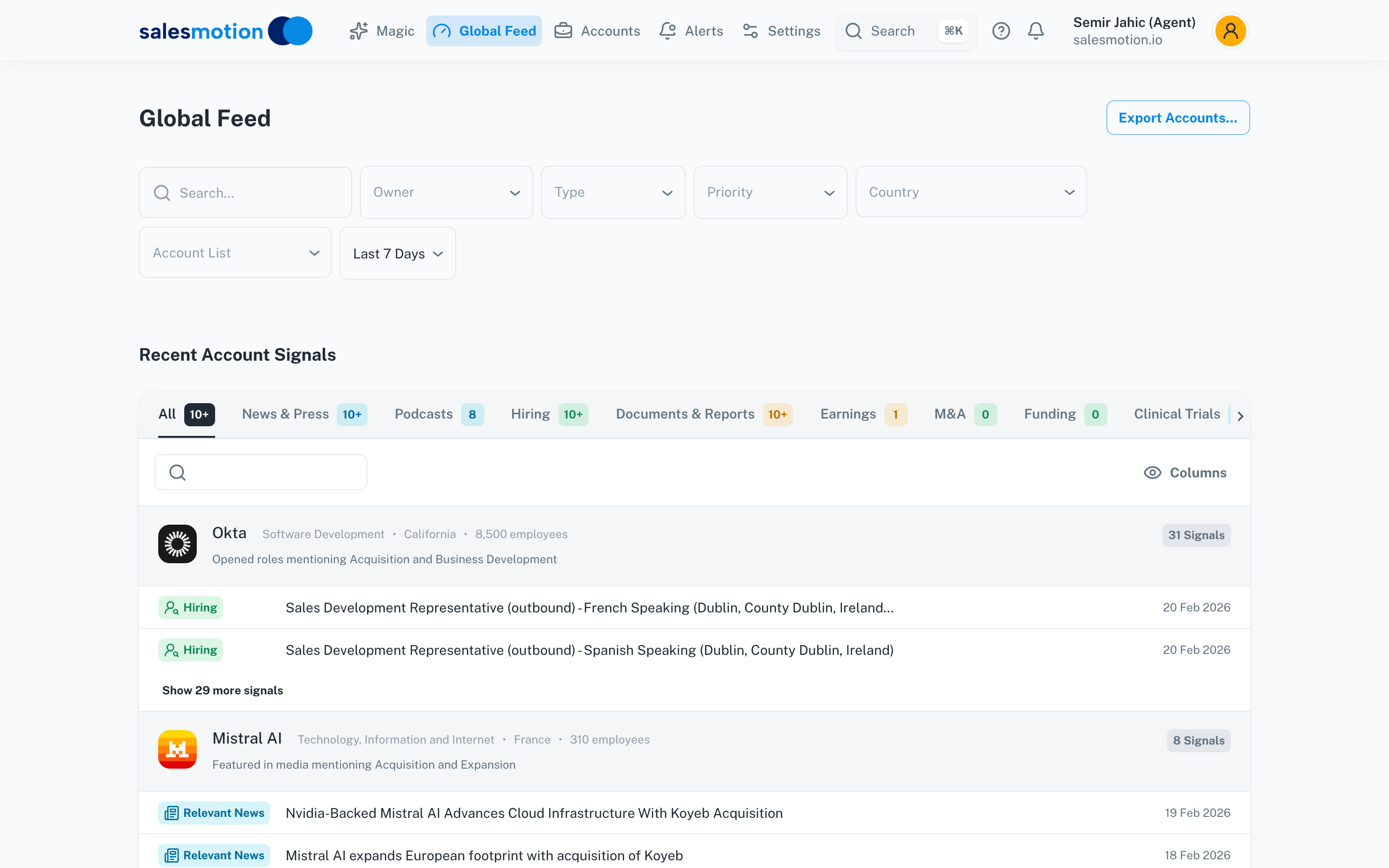 Salesmotion surfaces buying signals — hiring, earnings, news, M&A, funding — across your entire territory in a single feed, so reps act on the highest-value signals first.
Signal-Based Workflow: Media and Advertising Example
Trigger: A major retail chain announces it is launching a retail media network. In the same week, they post a VP of Retail Media role and a Head of Ad Technology role. Their latest earnings call mentioned "building an advertiser self-service platform" and "first-party data monetization."
Platform action: The account brief updates with the retail media launch, both leadership hires, the earnings commentary about self-service and first-party data, and the company's current technology partnerships based on job posting mentions and public integrations.
Rep action: The rep reaches out to the newly posted VP of Retail Media, referencing the company's announced retail media launch and the specific infrastructure challenge of building an advertiser self-service platform. The outreach positions their solution as enabling the exact capability the company's earnings call described, supported by a case study of how a similar retailer built their media network using the same technology.
Outcome: The conversation addresses the retailer's exact strategic moment: entering the $69 billion retail media market and building the technology to compete with Amazon, Walmart, and Instacart. The rep demonstrates understanding of both the revenue opportunity and the technical execution required.
For more on signal-driven selling to media companies, visit our sales intelligence for media page. Also explore our account research for media and advertising guide, our account research resources, and our intent data guide for additional context.
Key Takeaways
- Media and advertising buying signals move on quarterly ad cycles and platform changes. Programmatic spend alone was forecast to exceed $203 billion in the U.S. in 2026, and every budget shift creates vendor evaluation windows.
- CTV, retail media, and programmatic are the three fastest-growing segments. Track ad-supported tier launches, FAST channel expansion, and retail media network announcements as high-priority signals that trigger 6-12 months of technology purchasing.
- Agency account reviews are surging: Forrester predicted that 85% of U.S. B2C marketing executives planned to review their media agencies in 2026. Each review creates buying windows at every agency in the pitch and at the winning agency post-award.
- Publisher signals center on ad tech stack changes, monetization platform migrations, and first-party data investments. Job postings mentioning specific ad tech vendors reveal the current stack and upcoming transitions.
- Brand in-housing has become structural: 66% of major brands now have in-house agencies. When a brand brings media in-house, it needs self-service technology that was previously managed by its agency.
- Segment your outreach: publishers, agencies, and brand in-house teams respond to different signals, involve different decision-makers, and require different outreach angles. One playbook for all three will underperform.
Frequently Asked Questions
What are the strongest buying signals in media and advertising B2B sales?
The strongest signals depend on the segment you are selling into. For agencies, client wins and account reviews are the most concentrated triggers because they create defined budgets and immediate technology needs. For publishers, ad tech stack changes (SSP migrations, ad server switches) and AVOD launches signal multi-quarter vendor evaluations. For brands, in-housing announcements and agency roster changes open 6-12 month buying windows. Across all segments, earnings commentary mentioning "programmatic infrastructure," "first-party data," or "measurement capabilities" directly reveals investment priorities.
How do CTV and retail media growth create buying opportunities for B2B sellers?
CTV advertising was projected to reach $38 billion in 2026, and retail media $69 billion, the latest forecasts to plan 2027 against. Both markets are fragmented and growing rapidly, which means new entrants need technology infrastructure (ad serving, measurement, self-service platforms) and existing players are continuously upgrading. A retailer launching a media network or a publisher launching a FAST channel needs an entirely new ad tech stack, creating buying opportunities for vendors across the supply chain. Track launch announcements, related job postings, and earnings commentary for timing.
Why are agency account reviews such a strong buying signal?
Forrester predicted that 85% of U.S. B2C marketing executives planned to review their media agencies in 2026, driven by the Omnicom-IPG merger, potential holding company restructuring, and rising expectations around AI and data capabilities. Each review forces 4-6 competing agencies to evaluate their technology stacks, and the winning agency typically purchases new tools within 90 days of the award. Monitoring active reviews through Ad Age and Campaign gives B2B sellers a direct line to accounts with active budgets.
How should sales teams track media and advertising buying signals at scale?
Media signals come from trade publications, platform announcements, earnings transcripts, job boards, and regulatory databases. Manual monitoring across even 50 accounts is not feasible when you factor in the speed at which these signals expire. A sales intelligence platform that aggregates these sources and enriches them with organizational context (who was hired, what the earnings call said, which vendors appear in job postings) helps reps act on signals while they are still actionable. Teams using Salesmotion cut account research from hours to minutes, ensuring they reach media buyers during the evaluation window rather than weeks after budgets are committed.