An account sales plan is your team's roadmap for winning and growing your most important customers. It's a strategic playbook that goes beyond generic outreach, laying out specific goals, identifying the key players, and mapping a clear path to revenue.
Why Static Account Sales Plans Fail
Let’s be honest: the traditional account sales plan is a relic. It’s that static spreadsheet someone creates at the start of the quarter, filled with good intentions but practically useless by week two. In today’s fast-moving B2B world, that old approach just can't keep up.
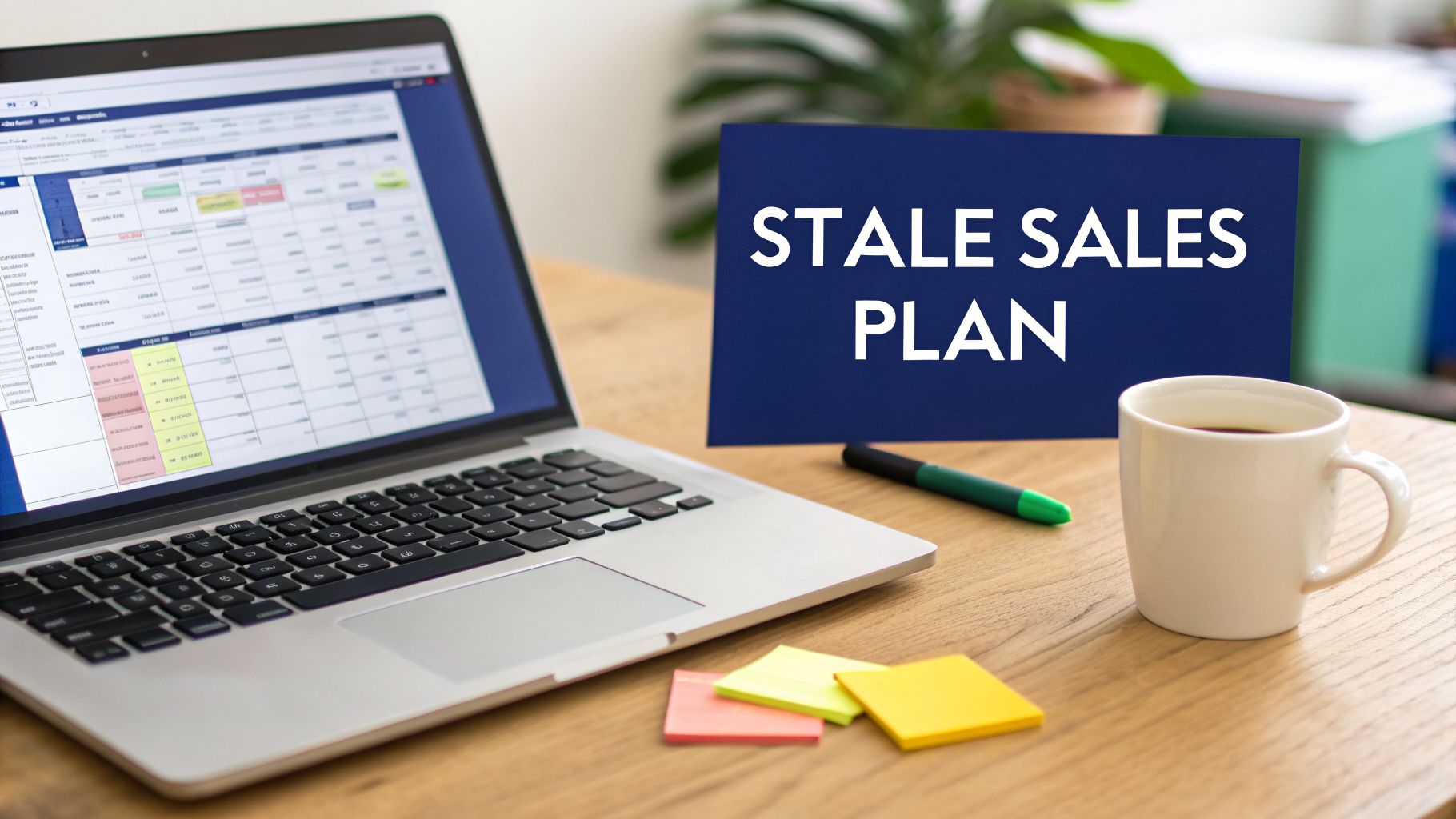
This outdated method saddles reps with a "manual research tax." They spend hours piecing together context from news articles, financial reports, and social media instead of actually selling. The result? Inconsistent planning and weak, generic outreach that falls flat.
A business development manager at a manufacturing software firm told us how this looks on their team: "The time that they put into putting together a PowerPoint for an account plan is insane. I mean, we're talking like, a hundred hours, you know what I mean? Collectively of time. And it's just. That's not scalable." That is one team's description, and it shows why the plan rarely gets rebuilt once it exists.
The Problem with Set-and-Forget Plans
Picture an enterprise SaaS rep who builds a great Q1 plan for a key target. By February, that company hires a new CRO, a competitor announces a major product update, and their main champion leaves. Suddenly, that beautifully crafted plan is completely irrelevant.
This isn’t a rare edge case; it’s the daily reality for sales teams. Market shifts, leadership changes, or new funding rounds can instantly derail a static plan. Modern sales approaches, like those in a solid lead generation playbook, have moved past these outdated tactics for a reason.
The core issue with static plans is their failure to reflect reality. They capture a single moment in time, while your buyers operate in a dynamic, ever-changing environment. This disconnect is where opportunities are lost.
The calendar makes it worse. What I see every year: people are still recovering from end of quarter, then the holidays, then kickoff, and all of a sudden half of Q1 is over. Then you are under pressure and you are not doing your homework.
The Shift to Data-Driven Execution
The industry is finally waking up. By 2026, a staggering 65% of B2B sales organizations are expected to ditch intuition-based planning for data-driven decision-making.
This shift is long overdue. Reps currently spend 2-3 hours per account on manual research, which severely limits how many accounts can get a meaningful plan. This broken system often caps effective planning at just 10 accounts before it collapses.
This forces a critical question: how can revenue teams build an account sales plan that is alive and responsive? The goal isn't just to point out flaws but to set the stage for a new, dynamic approach—one that uses timely intelligence to keep pace with your buyers.
A great way to start is by exploring a strategy centered on real-time buying indicators, also known as signal-based selling.
Building Your Foundation with Objectives and Account Tiers
A powerful account sales plan needs a clear destination. Before you think about tactics, you have to define what winning looks like. This means getting past vague goals like "grow revenue" and setting specific, measurable objectives that align with your company's sales targets.
Think of it this way: a generic goal is like wanting to "get in shape," but a specific objective is "run a 5k in under 30 minutes by July." That second one gives you a real target to build a plan around. Your account plan objectives need to be just as precise.
For instance, instead of "increase sales," your objectives could be:
- Land five new enterprise logos in the FinTech vertical this quarter.
- Expand our footprint into two new departments within our top 10 existing accounts.
- Increase contract value by 15% on all upcoming renewals in the Life Sciences portfolio.
These clear targets give your team direction and make it possible to measure progress accurately. They turn your plan from a document of good intentions into an actionable roadmap.
From Objectives to Account Segmentation
Once your objectives are locked in, focus your energy where it’ll have the biggest impact. Not all accounts are created equal, and treating every one with the same level of attention is a fast track to burnout and missed quotas. This is where strategic account segmentation comes in.
This isn't just about creating arbitrary lists. It's a structured way of categorizing accounts based on their potential and strategic value, guided by your Ideal Customer Profile (ICP). This ensures your best resources are aimed at the accounts most likely to move the needle.
A well-defined tiering system is the difference between a scattered sales effort and a focused, high-impact strategy. It empowers your team to prioritize ruthlessly and allocate their time and resources with precision.
For a practical approach, most high-performing teams use a simple three-tiered system. Each tier gets a distinct purpose and level of engagement.
A Practical Tiering Framework
A clear framework for tiering accounts helps revenue teams organize their focus and align effort with potential impact. It ensures that the most valuable accounts receive the attention they deserve, while other accounts are managed more efficiently.
Here’s a common structure that high-performing revenue teams use.
| Account Tier | Description | Focus Level | Example Criteria |
|---|---|---|---|
| Tier 1: Strategic | The crown jewels. Highest potential for revenue, either as a major new logo or a significant expansion. A perfect ICP fit. | High-Touch: Deep, multi-threaded planning, executive sponsorship, and custom-tailored engagement. | - Fortune 500 - Known budget >$250k - Clear strategic alignment |
| Tier 2: High-Potential | Strong potential and fit most ICP criteria. Might be fast-growing companies or customers with clear upsell paths. | Structured: Solid, templated plan with dedicated resources, but less intensive than Tier 1. | - Mid-market/Growth - Potential for >$100k ACV - Strong industry fit |
| Tier 3: Scalable | Fits the ICP but has smaller immediate potential or is early in their buying journey. | Tech-Assisted: Efficient engagement via scaled outreach and close monitoring for buying signals. | - SMB or emerging - Fits ICP but smaller deal size - Low current engagement |
This tiered approach provides a clear roadmap for resource allocation, preventing your team from spreading themselves too thin and ensuring every action is intentional.
For more hands-on guidance, check out a sales account planning template that helps put these concepts into practice.
By defining clear objectives and then segmenting your accounts into logical tiers, you build a solid foundation for your sales motion. This ensures your team's efforts are not just busy, but genuinely productive—driving toward the outcomes that matter most for business growth.

“We're no longer fishing. We know who the right customers are, and we can qualify them quickly. Salesmotion has had a direct impact on pipeline quality.”
Andrew Giordano
VP of Global Commercial Operations, Analytic Partners
Mapping Stakeholders and Identifying Buying Triggers
Winning complex deals isn’t just about having a great product. It's about knowing exactly who to talk to and, just as importantly, when to reach out.
This is the moment an account sales plan stops being a document and becomes a tactical playbook. You have to map the human landscape of your target account and learn to spot the signals that crack open a window of opportunity.
This goes beyond a simple org chart. An org chart shows reporting structures, but it says nothing about influence or political currents. Getting to the heart of the buying committee is what separates average reps from top performers.
From Org Charts to People Maps
Every B2B purchase involves a group of people, not a single contact. Your job is to understand the key players who form this buying committee.
- The Champion: This is your internal advocate. They get what you’re selling, believe it can solve a real problem, and are willing to guide you through their internal buying process.
- The Economic Buyer: This person holds the purse strings. They have the final say and are laser-focused on financial impact and return on investment (ROI). No signature, no deal.
- The Technical Buyer: This individual or team kicks the tires on your solution. They care about implementation, security, and how it plugs into their existing tech stack. They can kill a deal with a single red flag.
- The User Buyer: These are the people who will use your solution day-to-day. Their buy-in is crucial for adoption. Get them on your side, and they become powerful internal allies.
- Potential Blockers: These stakeholders can derail your deal for many reasons—loyalty to a competitor, resistance to change, or the classic "if it ain't broke, don't fix it" mentality. Spotting them early lets you build a strategy to win them over or work around them.
A well-mapped account isn't a static list of names and titles. It’s a dynamic web of relationships and motivations. Your success hinges on figuring out each person's individual "what's in it for me?"
Connecting Signals to Stakeholders
Mapping these individuals is only half the battle. The other half is knowing the perfect moment to engage. This is where buying triggers come in.
These are real-world events that signal an urgent need or a shift in priorities. Triggers transform your outreach from a cold interruption into a timely, relevant conversation.
A few powerful buying triggers include:
- Executive Moves: A new CRO or CIO is almost always hired to drive change. Their first 90-120 days are a prime window of opportunity as they assess everything—including current vendors.
- Funding Announcements: A fresh round of funding means the company has cash to spend on growth, technology, and fixing scaling problems.
- Mergers and Acquisitions (M&A): M&A activity often creates an urgent need for new systems to standardize processes and get newly merged teams on the same page.
- Negative Financials or Layoffs: While you have to be sensitive, these events often signal an intense focus on efficiency. This creates an opening for solutions that drive productivity or cut operational overhead.
- Hiring Sprees for Specific Roles: If a company suddenly posts jobs for dozens of data scientists, it’s a massive signal they're investing heavily in analytics. If you sell an analytics platform, that’s your cue.
To nail this, you need a deep understanding of the buying process, which is where a modern customer journey map B2B playbook comes in handy.
Today, account intelligence platforms can automate the work of spotting these signals. Instead of reps spending hours digging through news sites and LinkedIn, they get real-time alerts that give them the context for a sharp, value-first outreach. For more tips, check out our guide on how to find decision-makers in a company.
This turns signal overload into actionable intelligence, ensuring your team always knows who to talk to and exactly why now is the right time.
Turning Your Plan into Action with MEDDICC and Personalized Outreach
A great account plan is just a document until you nail the execution. This is where you connect your account intelligence directly to the messages your reps send, and MEDDICC is the perfect framework to make that happen.
Too many revenue teams do the research but then struggle to turn raw signals into talk tracks that resonate with buyers. Let's fix that.
Systematically Gathering Insights with MEDDICC
MEDDICC gives reps a proven structure to capture the right details about every account. It helps you move from high-level research to confident, targeted outreach.
Here’s a breakdown of what your reps should be digging for:
- Metrics: What does success look like for them? Is it cost savings, revenue growth, or something else? Get the specific numbers they care about.
- Economic Buyer: Who really signs the check? This is the person who holds the budget and is ultimately accountable for ROI.
- Decision Criteria: How will they compare vendors? Pinpoint the exact features and metrics they'll use for their evaluation.
- Decision Process: What are the steps and timelines for getting a deal approved internally? Who needs to sign off and when?
- Identified Pain: What is the core business problem you're solving? Support this with stats and anecdotes you've uncovered.
- Champion: Who is your internal advocate? This is the person who will help you navigate the organization and drive the project forward.
By embedding MEDDICC fields directly into your CRM, you ensure nothing falls through the cracks. Reps spend less time guessing and more time delivering real value.
Crafting Messages That Actually Land
Once you have this intelligence logged, the next step is turning it into crisp, value-driven outreach. This is where you connect the dots for the prospect.
For example, if you spot a new CFO hire through your account intelligence, that's a huge signal. New finance leaders are almost always focused on cost efficiency and tightening processes.
Your outreach can reference that change directly, tying your solution to the goal of streamlining financial operations. It immediately shows you've done your homework.
A timely reference to a recent company signal can boost reply rates by over 40%. It makes your outreach feel instantly relevant.
This level of personalization moves the conversation away from generic, product-focused pitches and toward a consultative discussion about their business.
Visualizing Your Stakeholder Map
A big part of this is understanding who's who in the account. Mapping your stakeholders helps you connect their individual pains and motivations to timely triggers.
The flow below shows how you can think about this systematically: identify the key players, understand their specific pains, and then watch for the triggers that signal a buying cycle.
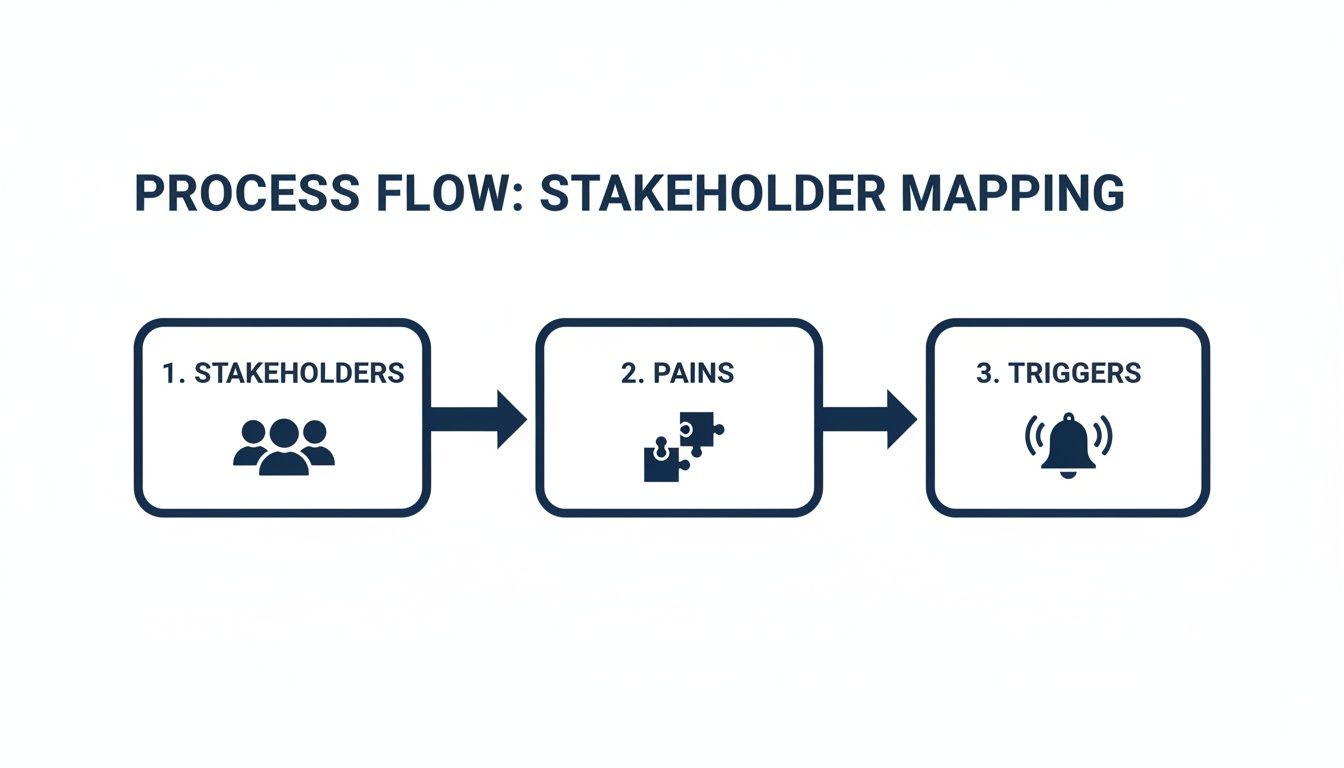
This process shows reps exactly where to focus their research efforts so they can craft outreach that is both timely and highly relevant.
For a deeper dive, check out our complete guide on MEDDICC qualification. It’s packed with real-world examples to help you put these concepts into practice across your top accounts.
Building Trigger-Driven Outreach Sequences
Now, let's translate this intelligence into a multi-touch sequence that feels natural and builds momentum.
Here’s a simple, three-part sequence your reps can use:
- Anchor with a signal: Start your outreach by referencing the most recent buying signal you’ve identified. This immediately establishes relevance.
- Connect pain to value: Tie the pain point you’ve uncovered to a quick stat or a specific outcome that matters to the Economic Buyer.
- Drive a clear next step: Your call to action should be precise. Is it a 15-minute discovery call, a proof-of-concept discussion, or something else?
This ensures every message builds on the last. You're not just "checking in"—you're advancing the conversation.
We've seen these tactics lift meeting acceptance rates by up to 50%.
- Start each message by naming the specific trigger event and why it matters to them.
- Use concise subject lines that mention the pain or metric you’ve uncovered.
- Include a one-sentence snippet referencing a previous interaction to build rapport.
When each rep adapts their messaging to the unique context of the account, you move away from spammy, one-size-fits-all outreach. Instead, prospects see a partner who understands their world.
How to Scale Your MEDDICC-Powered Outreach
To do this consistently, embed standard talk track templates directly into your sales playbook, organized by signal type.
This gives reps a solid foundation while still leaving room for personalization. When combined with continuous account intelligence alerts, your team can stay ahead of key changes and opportunities.
For instance, if a tier-one target account starts hiring for data analytics roles, your reps can launch a targeted sequence about data-driven decision-making within hours. That speed shows you’re paying attention.
Finally, integrate these talk tracks into your CRM templates and use AI-driven meeting briefs to arm reps with key context right before a call.
This approach can reduce prep time by as much as 60%, freeing up your team to focus on having high-quality conversations. It also makes your account plan a living part of their daily workflow, turning great execution into a habit.
“We have very limited bandwidth, but Salesmotion was up and running in days. The template made it easy to load our accounts and embedding it in Salesforce was simple. It was one of the easiest rollouts we've done.”
Andrew Giordano
VP of Global Commercial Operations, Analytic Partners
Measuring What Matters to Operationalize Your Plan
So, you've built your account sales plan. How do you know if it's actually working? A great plan is more than just a document; it's a living system that drives action. To make that happen, you need to measure what matters and weave your plan directly into your team's daily workflow.

This means getting past vanity metrics like call volume. Instead, focus on KPIs that show real progress toward winning and expanding your most important accounts. It's all about turning that static file into an indispensable tool for your entire revenue team.
KPIs That Truly Reflect Progress
Tracking the right metrics is everything. Generic dashboard widgets just won’t cut it. You need specific indicators that prove your targeted efforts are actually paying off.
Here are the key performance indicators I always watch:
- Pipeline Velocity: How quickly are deals moving through your sales cycle for your target accounts? If you see a faster velocity in your Tier 1 accounts, it’s a great sign your planning and outreach are hitting the mark.
- Multi-threading Engagement: Are you successfully connecting with multiple stakeholders? Track the number of unique contacts you’re adding and engaging per target account. This shows how deep and wide your relationships are getting.
- Meeting Conversion Rate: What percentage of your initial outreach to target accounts turns into a booked meeting? This KPI is a direct measure of how effective your trigger-based messaging is.
These metrics, tracked right within your CRM, give you a clear, real-time picture of your plan's performance. They show you what's working and where you need to adjust your approach.
The Ultimate Litmus Test: Win Rates
Ultimately, win rates are the definitive test. When you're using well-planned strategies that leverage timely intelligence, win rates for qualified opportunities can hover between 20-30%. Compare that to overall pipeline win rates, which often dip to a grim 15-25%. The gap highlights the cost of poor planning.
Tracking win rates by account tier is crucial. If your win rate for Tier 1 strategic accounts is significantly higher than your overall average, it’s a powerful sign that your account sales plan is delivering a strong return on effort.
Operationalizing Your Account Sales Plan
A plan only works if your team uses it. Operationalizing your account sales plan means turning it from a static document into an active system that guides daily actions. This is where modern account intelligence platforms become a game-changer.
Instead of reps manually sifting through news feeds, imagine this: a sales rep gets an instant Slack notification the moment a target account’s CIO mentions "cost optimization" in a podcast. The alert includes a direct link to the source and an AI-generated brief spelling out the "so what."
This turns a random event into an immediate, actionable opportunity. This is how you operationalize an account sales plan. It's not about creating more work; it's about enabling smarter work.
From Static Document to Living System
To make your plan an indispensable part of your team's toolkit, you have to integrate it directly into their workflows. It's all about using technology to automate the tedious parts and serve up context exactly when it's needed.
Here’s how you can make it happen:
- Automate Meeting Prep: Arm your reps with AI-generated briefs that deliver the latest signals, key stakeholder updates, and relevant talk tracks just before a call. This alone can slash prep time by 60% or more.
- Implement Signal-Based Scoring: Work with your RevOps team to create a scoring model that prioritizes accounts based on recent buying signals. An account with a brand-new CRO and a recent funding round should automatically shoot to the top of the list.
- Embed the Plan into Your CRM: Your account plan shouldn't live in a forgotten spreadsheet. Key elements like objectives, stakeholder maps, and MEDDICC fields should be native to your CRM, making them easy to update and reference on the fly.
By taking these steps, you transform your account sales plan from a quarterly exercise into a daily competitive advantage. It becomes a living system that helps your team focus on the right accounts, at the right time, with the right message.
Your Top Questions, Answered
Got questions about building and running a winning account sales plan? You're not alone. Let's tackle some of the most common questions from B2B revenue teams.
How Many Accounts Should Be in an Account Plan?
This is a classic, and the answer is always: it depends on your tiers. A single rep can't execute a deep, strategic plan for 50 accounts. It just doesn't work. The key is to match your effort to the account's potential.
Here’s a good rule of thumb for an individual rep:
- Tier 1 (Strategic Accounts): No more than 3-5 accounts. These are your crown jewels. They require intense, personalized focus, executive alignment, and a significant investment of time and resources.
- Tier 2 (High-Potential Accounts): Around 10-15 accounts. For these, you'll use a more structured, templated approach. The goal is consistent monitoring for crucial expansion triggers.
- Tier 3 (Scalable Accounts): Anywhere from 20-50+ accounts. You'll manage these more efficiently, often leaning on tech-assisted outreach and watching for buying signals that might justify moving them up a tier.
This tiered structure is your best defense against rep burnout. More importantly, it forces focus and ruthless prioritization, ensuring your most valuable accounts get the white-glove treatment they deserve.
What Is the Difference Between a Sales Plan and an Account Plan?
Getting this distinction right is crucial. A sales plan and an account plan operate at different altitudes, but they are deeply connected. One can't succeed without the other.
Think of it like this:
| Aspect | Sales Plan (The "Map") | Account Sales Plan (The "GPS Route") |
|---|---|---|
| Scope | Your entire territory or team's goals. | A single, specific customer account. |
| Goal | Hitting a broad revenue target (e.g., "$10M in new ARR"). | Nailing a specific objective in an account (e.g., "Win a $250k deal in Q3"). |
| Timeframe | Usually annual or quarterly. | Ongoing and dynamic, updated as you get new intel. |
| Content | High-level strategy, quotas, team structure, market focus. | Tactical details: stakeholder maps, pain points, outreach sequences, MEDDICC fields. |
Your sales plan sets the destination. Your account sales plan gives you the turn-by-turn directions to get there, one key account at a time.
How Do You Write an Account Plan?
Writing a powerful account plan isn't about filling out a static document once a year. The best reps build a living system based on continuous intelligence. The plan is built collaboratively and evolves as new signals pop up.
"The most effective way to drive cross-functional alignment with an account planning tool is to shift your account strategy from a static document to a living, visual source of truth."
Here’s a simplified, five-part flow for creating a plan that actually works:
- Define Clear Objectives: Start with the end in mind. What does a win look like for this specific account? Get specific (e.g., "Expand to the engineering department with a $100k pilot program").
- Gather Intelligence: Systematically collect data on the account's strategic priorities, recent business changes, financial performance, and key initiatives. What's keeping their execs up at night?
- Map Stakeholders: Identify your champion, the economic buyer, the technical buyer, and any potential blockers. You need to understand their individual pains and what motivates them personally.
- Connect Pains to Your Solution: Don't just list features. Formulate a clear hypothesis on how your solution solves their specific business pains, backed by the intelligence you've gathered.
- Build an Action Plan: Outline your trigger-based outreach strategy. Define the key messages for each stakeholder and map out the next concrete steps to move the conversation forward.
The secret is to keep this process dynamic. A great account plan is never really "done." It's a living guide to winning your most important deals.
With Salesmotion, B2B revenue teams can stop wasting time on manual research and start acting on timely, relevant intelligence. We turn signals into action, helping your reps focus on the accounts most likely to buy, right now. Discover how to operationalize your account sales plan by visiting https://salesmotion.io.