AI for sales prospecting gives your sales team a secret weapon, automating the time-consuming manual research that bogs them down. Instead of spending half their week digging for intel, reps get real-time, actionable alerts about their target accounts. This shift turns them from data gatherers into strategic advisors who always have the perfect reason to connect.
What Is AI for Sales Prospecting, Really?
Let’s cut through the hype. Using AI for sales prospecting isn’t about replacing your sales reps with robots. It’s about arming them with a dedicated research assistant that works 24/7, scanning endless data streams to find the perfect "why you, why now" moment.
Imagine an assistant that monitors every important signal across your target accounts. Instead of reps manually searching for news, this AI-powered system automatically surfaces critical events—the kind that create real openings for a conversation.
The Shift From Data Gathering To Strategic Engagement
The old way of prospecting was a grind. Reps would burn a huge chunk of their week piecing together information from scattered sources, just trying to find a decent reason to reach out. For a full breakdown of both traditional and modern approaches, see our guide to prospecting methods in sales. This "manual research tax" not only drained time but also led to inconsistent and often outdated outreach.
AI flips this model on its head. It automates the discovery process, freeing up reps to focus on what humans do best: building relationships and having meaningful conversations.
Here's a quick comparison of what this looks like in practice:
Manual Prospecting vs AI-Powered Prospecting
| Activity | The Old Way (Manual) | The New Way (AI-Powered) |
|---|---|---|
| Finding Triggers | Reps spend hours on Google News, LinkedIn, and press releases. | AI automatically scans millions of sources and delivers real-time alerts. |
| Lead Prioritization | Based on static firmographics (company size, industry). | Based on dynamic buying signals (new funding, leadership changes). |
| Message Relevance | Generic, one-size-fits-all templates. | Hyper-personalized outreach based on a specific, timely event. |
| Time Spent | 6-8 hours per week on research. | Under 1 hour per week managing alerts and acting on insights. |
This isn't just a small improvement; it's a fundamental change in how a sales team operates. The primary benefits are clear:
- Timely Triggers: AI finds real-time events like new product launches, funding rounds, or executive hires, giving your team a credible reason to engage immediately. For a deeper look at these events, see our complete buying signals guide.
- Deeper Relevance: Instead of generic messaging, reps can craft outreach based on a prospect's actual, current initiatives and pain points.
- Increased Efficiency: By eliminating hours of manual research, your team can spend more time actually selling and less time searching.
The core value of AI here is its ability to interpret data, not just find it. It connects the dots between a company's public announcement and a specific pain point your solution can solve, delivering a clear "so what" for the sales rep.
A Core Part of the Modern Sales Stack
This technology is no longer an experimental add-on. AI has become a core layer of the sales tech stack, especially for B2B markets. The industry's adoption reflects its impact; 81% of sales leaders believe AI will significantly reduce time spent on manual tasks, while 84% of salespeople already using it report improved and accelerated customer interactions.
This speed and relevance are critical at the prospecting stage, where your reply rates are almost entirely determined by your ability to stand out. Learn more about these powerful sales statistics on spotio.com.
Ultimately, AI for sales prospecting represents the leading edge of B2B lead generation best practices, offering advanced methods to identify and engage potential customers. It gives your team a critical competitive advantage by ensuring they are the first to know and the most prepared to act.
How AI Transforms Daily Sales Workflows
It’s one thing to talk about AI for sales prospecting in theory, but it’s another to see how it actually changes a rep’s day-to-day work. This isn't about slapping another dashboard onto your screen. It's about weaving intelligence directly into the tasks that eat up your time, turning reactive fire-fighting into proactive, strategic engagement.
This shift changes everything, from how you prep for a call to how you manage your most important accounts. The before-and-after picture is stark, moving workflows from manual, hope-based activities to sharp, insight-driven actions.
Think of AI as the central nervous system connecting your most critical sales activities—alerts, insights, and engagement—into a single, intelligent flow.
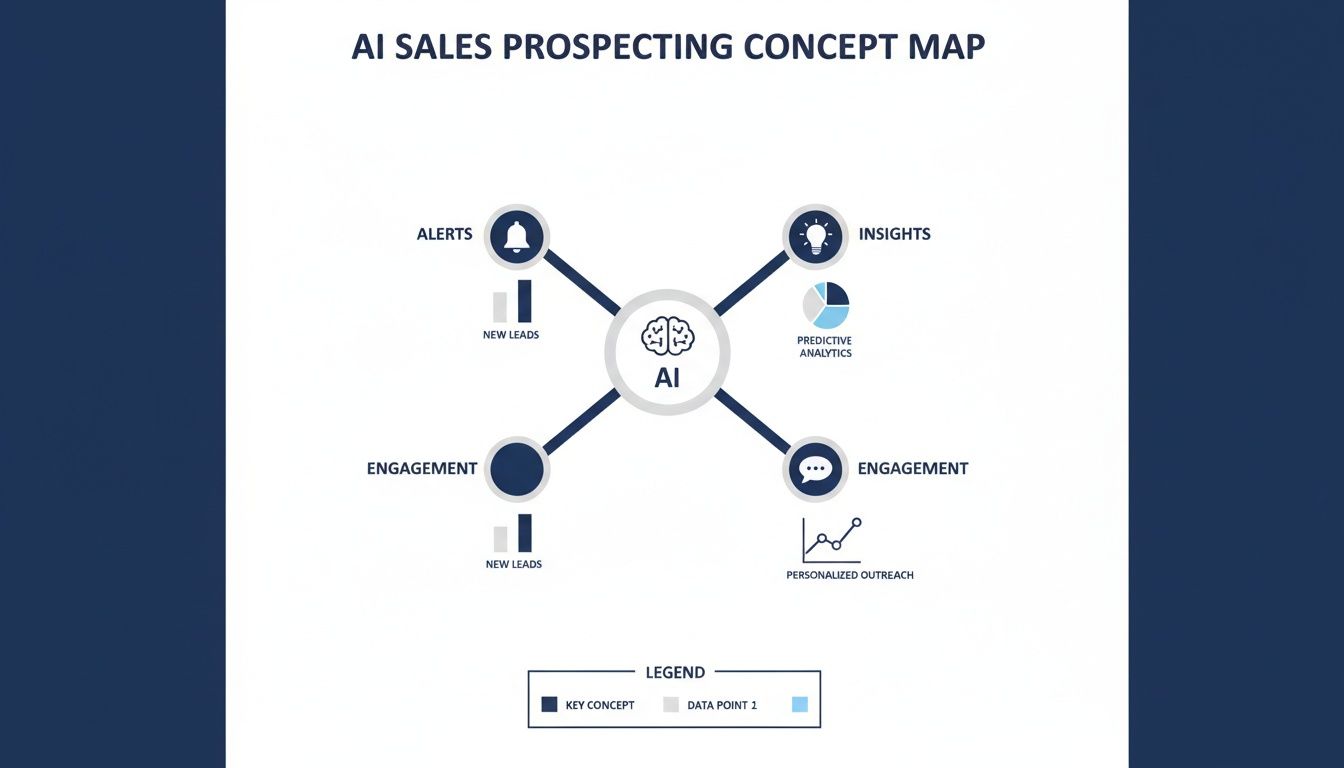
The image above shows it perfectly. AI doesn't just dump data on you; it interprets what’s happening and pushes actionable signals right into the tools where you can actually use them.
Proactive Account Monitoring
Before AI: An AE or SDR kicks off the week with a list of target accounts. They then burn hours manually scrolling through Google News, LinkedIn feeds, and industry sites, hunting for a relevant trigger. A new funding round, a C-suite shakeup, a product launch... anything. By the time they find something, it's often stale.
After AI: The AI platform is your tireless watchdog, monitoring every target account 24/7. The moment a company announces a key strategic partnership, the system instantly flags it, figures out why it matters, and sends a real-time alert to the rep's Slack or email. Now, you have a powerful "why you, why now" reason to reach out before your competition even knows what happened.
This isn't just a news feed. It’s a relevance engine. The AI connects the signal (the partnership) to a potential pain point (scaling operations), giving the rep the exact context needed to start a meaningful conversation.
Meeting Preparation in Minutes
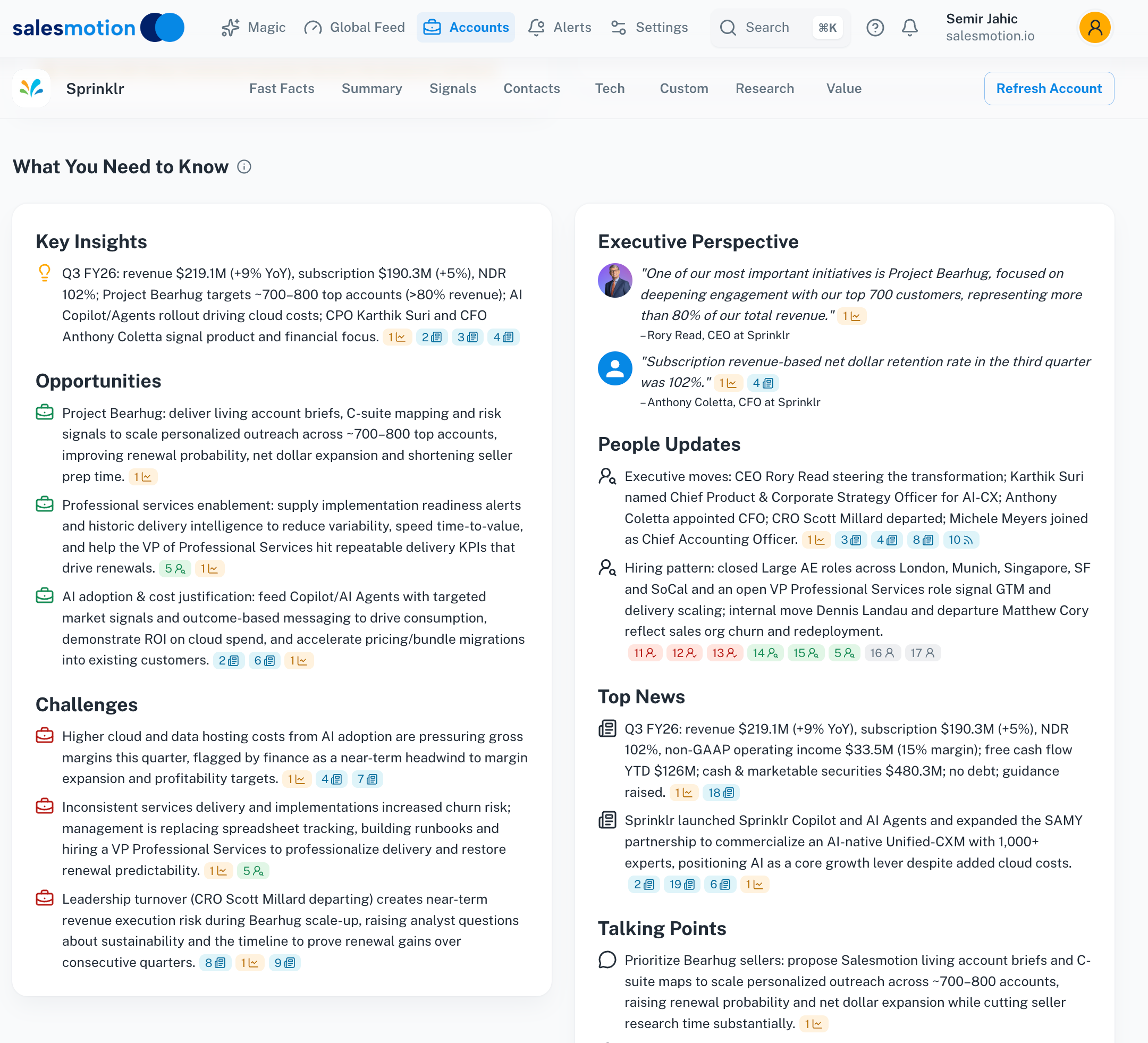 An AI-generated account brief consolidates company overview, strategic priorities, recent signals, and talking points — replacing an hour of manual research with a 5-minute scan.
Before AI: An AE has a big discovery call on the calendar. Prep means digging through messy CRM notes, searching for recent press releases, and trying to stitch together a coherent story about the company's current priorities. This slog can easily chew up an hour and still leave you with an incomplete picture.
After AI: The AI tool automatically prepares a consolidated account brief. In minutes, the AE gets a clean summary of recent company events, key strategic initiatives, potential risks, and a list of key players with their latest public comments. Prep time gets slashed by over 80%, and the AE walks into the meeting armed with deep context and confidence.
Value-Based Outreach
Before AI: An SDR hits "send" on a generic email sequence to a list of contacts. The message is built around a standard value prop, hoping it resonates with a tiny fraction of the list. The reply rate is, predictably, abysmal because the outreach lacks a timely, specific hook.
After AI: The AI spots that a target account is hiring aggressively for a new data science team. It surfaces this insight and helps the SDR craft a value-based message that centers on the prospect's real-time need to scale their data infrastructure. The email is now hyper-relevant, speaking directly to a visible, urgent pain point.
Dynamic Account Planning
Before AI: Strategic account plans are built once a quarter in a static PowerPoint or Word doc. They become obsolete almost immediately as markets shift and priorities change, turning them into historical artifacts rather than living guides.
After AI: The account plan is a dynamic, living asset inside the CRM. When the AI platform detects new signals—like a CFO mentioning supply chain issues on an earnings call—it automatically updates the relevant section of the account plan. This ensures the entire team is always on the same page, working with the most current intelligence. It's especially powerful when you understand what is intent data and how it reveals active buying behavior.
Stakeholder Mapping
Before AI: Figuring out who the real decision-makers are is a frustrating mix of guesswork and endless LinkedIn scrolling. Reps struggle to map out the influence hierarchy and what each person actually cares about, leading to multi-threading efforts that fall flat.
After AI: The system doesn't just map out the key stakeholders; it surfaces what each person is focused on by analyzing their recent interviews, podcast appearances, or LinkedIn activity. This allows the sales team to tailor their messaging to each individual's "win," building consensus and momentum far more effectively.

“Salesmotion has been a game-changer for me. I used to spend 12 hours a week on prospect research, now it's down to 4. Plus I'm finding stuff I was totally missing - podcasts, news mentions, the good bits.”
George Treschi
Account Executive, FY25 President's Club, Sigma
The Real-World Payoff: Why AI in Sales Actually Works
Let's get straight to the point. Connecting AI features to actual business results is where the rubber meets the road. It’s easy to talk about “increased efficiency,” but what does that really mean for your bottom line?
The true value of AI for sales prospecting isn't about futuristic robots; it's about solving the specific, expensive problems that drain modern sales teams.
The biggest win is getting rid of the "manual research tax." This is the hidden cost of reps burning hours every week digging through scattered sources just to find a compelling reason to reach out. AI completely automates this discovery, turning those lost hours directly into more selling time. This isn’t just a morale booster; it fundamentally changes the economics of your sales motion.
From Signal Overload to Actionable Intelligence
Another huge headache AI solves is signal overload. Your sales team is drowning in data—news alerts, social media updates, press releases, and market shifts. Most of it is just noise. The problem isn't a lack of information; it's a lack of interpretation.
AI acts as both a filter and an interpreter. It doesn't just tell you a target company hired a new executive; it explains why that hire is a big deal for you. It connects the dots, turning a random piece of news into a sharp, actionable sales trigger.
This is the critical difference between data and intelligence. Data tells you what happened. Intelligence tells you what to do about it. AI provides the "so what," giving your team the confidence to act decisively.
The economic case for AI is undeniable. Analysts estimate that AI can deliver time savings of over 40–50% in knowledge-heavy workflows. In the sales world specifically, 81% of leaders expect AI to slash time spent on manual tasks. That same percentage is already investing in AI to clean up and improve their data. You can find more stats on generative AI trends at Digital Silk.
Scaling High-Quality Account Planning Across the Team
Top-performing reps have always been masters of strategic account planning. They live and breathe their accounts. The problem? That level of excellence is incredibly hard to scale across an entire team.
AI democratizes this skill.
By delivering consistent, high-quality account intelligence for every single account, AI builds a standardized foundation for strategic planning. It ensures every rep—not just the top 10%—has the context they need to build a thoughtful, relevant point of view before they ever pick up the phone.
This creates a few powerful advantages:
- Uniform Quality: Every rep starts from the same high bar of account intelligence, which raises the performance floor for the entire team.
- Faster Onboarding: New hires can get up to speed on their territory in days, not months, because the critical context is handed to them on day one.
- Better Collaboration: When everyone is working from the same playbook, it's far easier for teams to collaborate on those complex, multi-stakeholder deals.
Ultimately, a powerful sales intelligence platform fueled by AI doesn't just save time—it multiplies your team's effectiveness. It provides a clear "why now" for every interaction and scales the best practices of your top reps, helping you build a healthier, more predictable pipeline. That’s what it takes to win today’s complex enterprise deals.
Putting AI Prospecting Into Practice
Theory is great, but seeing how AI for sales prospecting actually works in the real world is where it all clicks. Let’s walk through a few detailed scenarios across different industries to make these concepts tangible. These examples show—not just tell—how AI turns abstract data into real sales opportunities.
The goal isn't just to find information. It's about finding the perfect reason to start a conversation at the exact moment it will have the most impact.

Each of these examples spotlights how AI delivers a specific, timely, and relevant trigger that a sales rep can immediately act on.
Use Case One: B2B SaaS
Imagine an SDR named Alex who targets mid-market tech companies. One of her key accounts, a project management software firm, has gone dark for months. Manual research turns up nothing new, and her generic check-in emails are met with silence.
Then, Alex gets an AI-generated alert in Slack. It flags that her target account just announced a new integration with a major business intelligence platform. The AI doesn't just drop a news link; it gives her the "so what," explaining that this integration will likely create new headaches around data syncing and workflow automation for their customers.
Armed with this insight, Alex crafts a hyper-relevant email. Instead of the usual "just checking in," her subject line is "New BI Integration." The email congratulates them on the launch and directly addresses the operational pains likely to follow, positioning her company's solution as the perfect way to streamline their newly complex workflows. The result? She books a meeting within hours.
Use Case Two: Life Sciences
Now, let's picture Maria, an Account Executive selling clinical trial management software. One of her target biotech firms just wrapped up Phase II trials for a promising new drug. In the past, Maria might have missed this news for weeks, if she saw it at all.
Her AI prospecting tool, however, catches the press release the moment it goes live. It notifies her that the company got positive results and will probably need to scale its operations—fast—to gear up for Phase III. The AI even surfaces a recent interview where the Chief Medical Officer mentioned the importance of operational efficiency.
Maria immediately calls her key contact. She leads by congratulating them on the trial results and pivots to a strategic discussion about how their current systems will handle the increased complexity and patient volume of a larger trial. She’s not just selling software; she's providing a solution to an urgent, visible business challenge. For more insights on this topic, check out our complete guide on using AI in sales.
These scenarios highlight a critical shift. The conversation moves from "Here's what my product does" to "I see what you're doing, and here's how I can help you succeed." It’s a move from a generic pitch to a timely, value-driven consultation.
Use Case Three: Financial Services
Finally, let's look at David, a sales rep focused on large financial institutions. He's been trying to get a foot in the door at a major bank with zero success. His AI platform is set to monitor executive moves across his key accounts.
One morning, he gets an alert: the bank has hired a new Chief Technology Officer from a competitor known for its aggressive digital transformation initiatives. The AI-generated brief includes the new CTO's LinkedIn profile, links to articles about her past projects, and highlights her known focus on modernizing legacy systems.
David uses this intelligence to craft a personalized message on LinkedIn. He references her past work and connects it to the bank's publicly stated goals, offering to share insights on how similar institutions have navigated their own modernization projects. He gets a positive response, prying open a door that had been sealed shut for months.
For a deeper dive into practical applications for tailored outreach, you can explore resources covering personalized AI agents for small businesses to understand how this technology adapts to different scales. These real-world examples show that AI for sales prospecting is about being smarter, faster, and more relevant than the competition.

“The Business Development team gets 80 to 90 percent of what they need in 15 minutes. That is a complete shift in how our reps work.”
Andrew Giordano
VP of Global Commercial Operations, Analytic Partners
How to Choose the Right AI Sales Tool
Not all AI tools are created equal. With a sea of platforms all promising to change your world, picking the right one can feel like a shot in the dark. It’s a huge decision for sales and RevOps leaders, because the right tool acts as a genuine force multiplier, while the wrong one just becomes another expensive layer in your tech stack.
You need a way to cut through the marketing fluff. That means focusing on what actually matters to your team's daily work and long-term goals. This isn't about finding the tool with the longest feature list; it's about finding the one that serves up the most actionable, meeting-generating intelligence.

Evaluate Data Quality and Breadth
The engine behind any AI for sales prospecting tool is its data. If that data is incomplete, stale, or just plain wrong, then any insights it produces will be useless. Your first job is to look under the hood and see exactly where the platform is getting its information.
A top-tier tool will pull from a huge range of sources to give you a full 360-degree view of an account. This includes:
- Financial Data: Earnings calls, investor briefings, and SEC filings tell you a company's real strategic priorities and where the pain is.
- Company Announcements: Press releases about new products, partnerships, or expansions are clear buying signals.
- Personnel Changes: A new executive hire often means a new strategy—and a new budget to go with it.
- Third-Party Signals: Industry news, podcast interviews, and social media chatter give you priceless context on what key players actually care about.
The best tools don't just find data; they connect the dots. Modern AI prospecting platforms synthesize all that external context with the internal data in your CRM to create a compelling “why now” story for your reps. They effectively let a single rep manage dozens of hyper-specific micro-segments, each with messaging tied directly to a public signal.
Prioritize Seamless Integration and Adoption
A brilliant tool that no one uses is a failed investment. That's why easy implementation and high user adoption are non-negotiable. The platform has to slide right into your team’s existing workflow, not force them to learn yet another clunky system.
Look for a tool that plugs directly into the software your team already lives in. That means seamless connections with your CRM (like Salesforce) and your communication hubs like Slack or Microsoft Teams. Insights need to be delivered right where your reps are working, killing the friction of constantly switching between tabs.
The goal is to make intelligence feel like a natural part of the daily routine. If a rep gets a real-time alert in Slack with a clear "so what" and a direct link to the source, they are far more likely to act on it immediately.
Demand Actionable Intelligence, Not Just Data
Finally, here's the most important question you can ask: does this tool provide real intelligence, or just more data? A basic news alert can tell you a company hired a new CFO. An intelligent platform tells you why that matters, connecting that hire to a potential budget shift that opens up a perfect opportunity for your solution.
Your chosen tool must deliver clear, actionable insights a rep can use to start a conversation today. It has to filter out the noise and surface the "so what" for every signal it finds. This is the difference between an information dump and a genuine strategic advantage. When you’re evaluating potential AI prospecting tools, always push for real-world examples of how their alerts translate directly into booked meetings.
Your First Steps with AI-Driven Prospecting
Okay, you've read all about AI for sales prospecting. Moving from theory to practice can feel like a huge leap, but it’s more straightforward than you might think. This isn’t about ripping out your entire sales process overnight. It’s about taking a few smart, deliberate steps to weave intelligence into what you already do.
Think of it as building a smarter, more relevant prospecting engine one piece at a time. This simple framework will get you there.
Define Your Focus
Before you flip a single switch on any tool, you have to tell the AI what "good" looks like. That starts with a crystal-clear picture of your Ideal Customer Profile (ICP). Go deeper than just basic company size or industry—what are the specific, tell-tale signs of your absolute best customers?
Once you have that ICP locked down, build a focused list of your top target accounts. This isn’t a spray-and-pray list; it’s the foundation for your AI monitoring. It ensures every signal you get is actually relevant to your strategic goals.
Set Up Your Signal Alerts
With your target accounts loaded, it's time to set up your alerts. Think of this as creating a custom listening post for the triggers that genuinely matter to your business. You can't—and shouldn't—monitor everything. Prioritize the events that create real, actionable sales opportunities.
Start with a few high-impact signals:
- Funding Rounds: A fresh injection of cash often signals new budgets and a real willingness to invest in tools that drive growth.
- Executive Changes: A new leader, especially in the C-suite, almost always means a shift in strategy and a window of opportunity for new solutions.
- Product Launches: A new product can create a host of new operational headaches that your solution might be perfectly positioned to solve.
These alerts are the heartbeat of your AI prospecting system, delivering the crucial "why now" for your outreach.
The real power isn't just getting the alert; it's about using that specific event to frame a conversation. An alert about a new funding round allows you to move beyond a generic pitch to a discussion about scaling effectively.
Integrate Into Your Core Workflow
Here's a hard truth: if your AI tool requires reps to log into yet another platform, it will be ignored. For AI to actually work, it has to live where your team works. The magic is in seamless integration.
Make sure your AI tool can push alerts and insights directly into:
- Slack or Microsoft Teams: Get real-time notifications that spark immediate action and team collaboration.
- Your CRM: Automatically enrich account records with the latest intelligence, making meeting prep and account planning practically effortless.
This kind of integration removes friction and makes acting on insights a natural part of the daily routine.
Train for Compelling Conversations
Finally, remember that technology is only half the battle. The single most important step is training your team to turn these AI-powered insights into genuinely compelling, value-driven conversations. The goal isn’t to automate relationships; it’s to use intelligence to build smarter, more relevant ones.
Coach your reps on how to use a signal as a conversation starter, directly connecting the prospect’s recent activity to a specific pain point your solution solves. This simple shift elevates them from a generic salesperson to a trusted advisor who has clearly done their homework. This is how you build a smarter, more effective sales organization.
Key Takeaways
- AI for sales prospecting automates the manual research tax that costs reps 6-8 hours per week, turning them from data gatherers into strategic advisors with real-time account intelligence.
- The real value of AI is interpretation, not just data retrieval -- it connects public signals like funding rounds and executive hires to specific pain points your solution addresses.
- Proactive account monitoring, automated meeting briefs, and dynamic account planning transform daily sales workflows from reactive to strategic.
- When evaluating AI prospecting tools, prioritize actionable intelligence over raw data, seamless CRM and Slack integration, and broad signal coverage across financial, personnel, and third-party sources.
- Start implementation by defining your ICP and top target accounts, setting up high-impact signal alerts, integrating into existing workflows, and training reps to turn insights into compelling conversations.
Frequently Asked Questions
Even with the obvious upsides, bringing new tech into the sales process is going to stir up some questions. When it comes to using AI for sales prospecting, leaders and reps want to know what this shift really means for their teams, their workflows, and even their jobs. Let's tackle some of the most common questions head-on.
Will AI Replace My Sales Team?
Not a chance. Think of AI as an amplifier, not a replacement. Its job is to take over the time-consuming manual research that bogs down your best people. It's like giving every single rep their own dedicated research analyst.
By automating the hunt for company signals and buying triggers, AI frees up your team to do what humans do best: build relationships, have strategic conversations, and navigate complex deals. It handles the "what" and "when" so they can master the "why" and "how."
How Is This Different from a News Alert Service?
This is an important distinction. A standard news alert service is mostly a noise machine. It blasts your team with a firehose of raw information, leaving them to waste precious time figuring out what actually matters.
An AI prospecting platform is a completely different beast because it’s built for B2B sales. It doesn’t just find a random piece of news; it qualifies the signal, understands its relevance to your business, and delivers the "so what"—the actionable insight you need to start a real conversation. It’s a filter, not a firehose.
This means that instead of getting a generic headline, your team gets a crystal-clear reason to reach out, perfectly tailored to the challenges and opportunities you can help with.
How Much Training Does My Team Need?
The best AI prospecting tools are built to slide right into your existing workflow, not disrupt it. A modern platform should feel intuitive from day one with minimal technical setup. The magic happens when it pushes insights directly into the tools your team already lives in—like Slack, email, and your CRM.
This approach makes adoption almost effortless. The "training" isn't about learning a complicated new piece of software. It's about coaching reps on how to use these high-quality insights to sharpen their outreach and walk into meetings better prepared. The technology should feel like a natural extension of their sales process, not another hurdle.
Stop wasting time on manual research and start having more meaningful conversations. Salesmotion delivers the actionable intelligence your team needs to find the "why now" for every account and close deals faster. See how our AI-powered account intelligence platform can transform your prospecting efforts.