In B2B sales, hitting your quota often comes down to one thing: effective prospecting. The old playbook of high-volume, low-relevance outreach just doesn't work anymore. Buyers are more informed, inboxes are crowded, and generic pitches get deleted instantly.
To build a predictable pipeline, sales teams need a modern, multi-faceted strategy. This means blending timeless relationship-building with data-driven intelligence. This guide covers 10 proven prospecting methods in sales to give you a versatile and powerful playbook.
We'll break down not just the 'what' but the 'why,' 'when,' and 'how' for each technique. You'll get actionable tactics, practical examples, and notes on essential tools for every method, from leveraging real-time buying signals to running sophisticated, multi-threaded account campaigns.
This article is your blueprint for moving beyond the cold call and mastering modern B2B prospecting. Let's dive in and explore the methods that will redefine your sales pipeline.
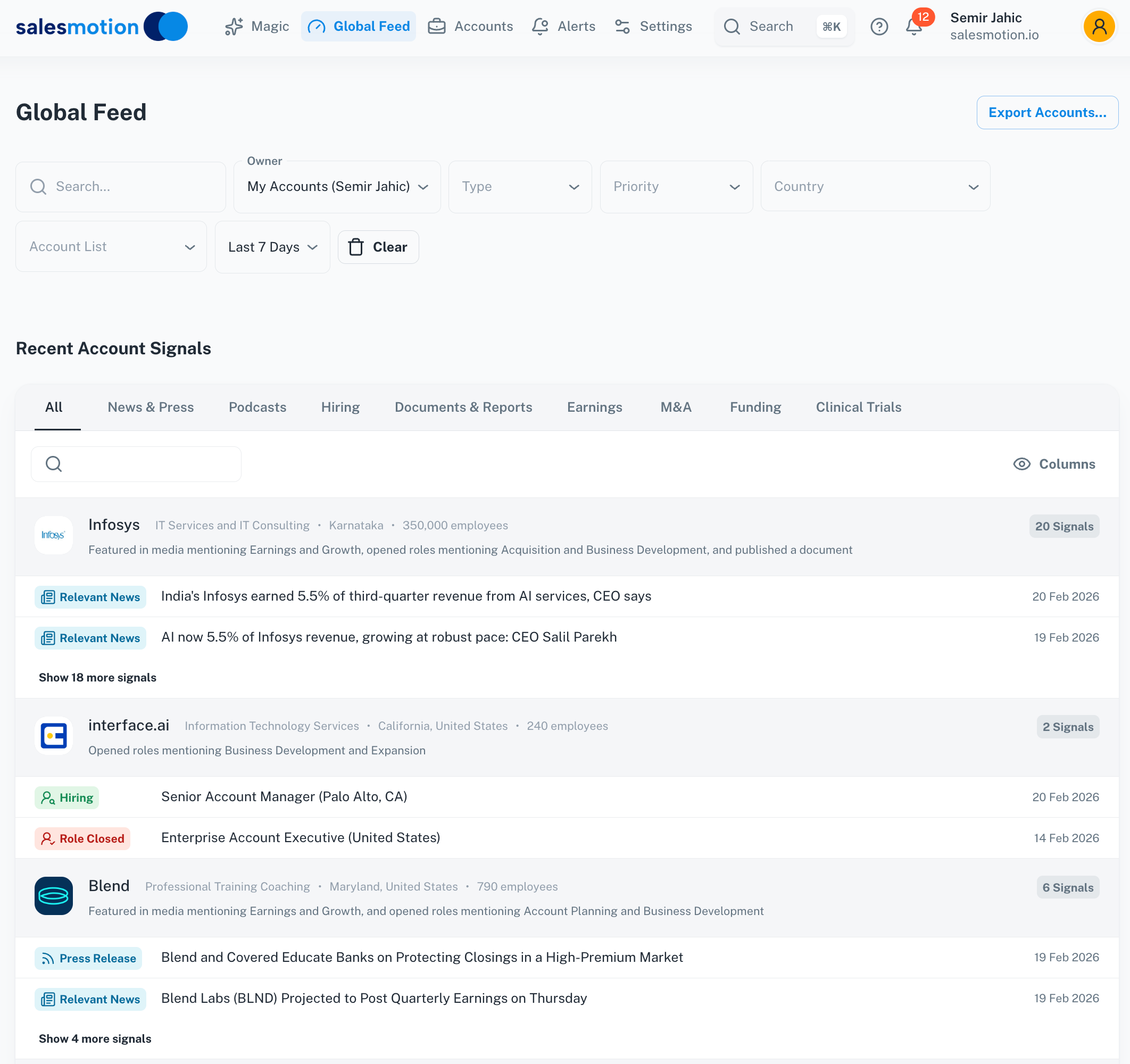 A real-time signal feed delivers buying triggers — funding rounds, executive hires, earnings mentions, hiring surges — as they happen, so reps can act on each event with a tailored outreach play.
1. Signal-Based Prospecting (Trigger-Based Selling)
Signal-based prospecting, or trigger-based selling, shifts your outreach from reactive to proactive. Instead of guessing who might be a good fit, this method focuses on acting on real-time events that signal an immediate need or buying intent. These triggers create a window of opportunity where your solution is most relevant.
This is one of the most effective prospecting methods in sales because it ensures your first touchpoint is timely and addresses a prospect's current situation. You're no longer just another salesperson; you're a problem-solver showing up at the perfect moment.
How It Works
This method involves monitoring specific business events or "signals" at your target accounts. When a predefined trigger occurs, it activates an outreach playbook tailored to that specific event.
Key signals include:
- Funding: A company secures a new funding round, signaling plans for rapid growth and investment in new tools.
- Executive Hires: A new VP of Sales or CMO joins, often bringing a fresh budget and a mandate to overhaul existing tech stacks.
- Hiring Sprees: Job postings for specific roles (e.g., hiring 10 new sales reps) suggest a need for tools to support team expansion.
- Product Launches: Announcing a new product line often creates a need for new marketing, sales, or operational support.
- Regulatory Changes: New compliance rules force companies in sectors like finance or healthcare to seek new solutions quickly.
Actionable Tips for Implementation
- Layer Multiple Signals: Don't rely on a single trigger. An account announcing funding is good, but one that also hires a new executive and launches a new product is a high-priority target.
- Create Trigger-Based Playbooks: Develop templated email sequences and call scripts for your top 10-15 most common signals. Our signal-driven sales playbook templates provide ready-to-use frameworks. The outreach for a new CTO hire should be very different from one triggered by a facility expansion.
- Automate Your Alerts: Use tools like Salesmotion, ZoomInfo, or 6sense to push real-time signal alerts directly into your team's Slack channels or CRM. Speed is crucial for capitalizing on these opportunities.
Focusing on these buying signals helps you align your outreach with the prospect's business journey. This method is key for teams that need to analyze market trends and turn that intelligence into revenue.
See Salesmotion in action
Take a self-guided interactive tour — no signup required.
2. Account-Based Marketing (ABM) Prospecting
Account-Based Marketing (ABM) prospecting flips the traditional sales funnel. Instead of casting a wide net, ABM focuses sales and marketing resources on a select list of high-value accounts, treating each one as its own market. This coordinated approach delivers personalized, relevant experiences to key decision-makers within those accounts.
This is a powerful addition to your prospecting methods in sales because it aligns your entire revenue team around your most important targets. ABM ensures every touchpoint, from an ad to a sales call, is orchestrated to address the specific needs of the organization you're pursuing.

How It Works
ABM is a collaborative strategy that involves identifying named accounts, mapping the key stakeholders within them, and executing orchestrated, multi-channel campaigns. The goal is to engage the entire buying committee at once with messaging that resonates with their unique challenges.
Key components include:
- Account Selection: Sales and marketing jointly pick a list of ideal customer profile (ICP) accounts with the highest revenue potential.
- Stakeholder Mapping: The team identifies and researches the key players in the buying committee, like the CFO, VP of Sales, and RevOps leaders.
- Personalized Campaigns: Coordinated campaigns are launched across channels like email, LinkedIn, targeted ads, and direct mail, all tailored to the account's specific needs.
- Orchestrated Outreach: SDRs, AEs, and marketers align their activities to ensure a consistent and persistent message.
- Account-Level Measurement: Success is measured by account engagement and pipeline progression, not just individual lead metrics.
Actionable Tips for Implementation
- Start Small and Focused: Begin with a tight list of 20 to 30 named accounts you can execute flawlessly. Quality over quantity is key to early ABM success.
- Create Account-Specific Playbooks: Develop detailed playbooks that outline the messaging, content, and outreach sequences for each account and buying stage.
- Align Sales and Marketing: Set up a weekly sync between sales and marketing to coordinate outreach, share account feedback, and adjust the strategy as needed.
- Combine with Buying Signals: Supercharge your ABM by integrating trigger-based selling. Activate your personalized campaigns the moment a target account shows a buying signal, like a new executive hire.
By treating high-value prospects as partners, not just leads, ABM builds deeper relationships and drives bigger deals. This method is crucial for teams that need a strategic framework for target account management.

“Consolidation of prospect company information that I can use frequently to be way better informed when I'm doing my outbound, preparing for a meeting, or building relationships. Ease of use and Customer Support is excellent.”
Werner Schmidt
CEO & Co-Founder, Lative
3. Intent-Based Prospecting
Intent-based prospecting shifts the focus from who you should contact to when you should contact them. This method uses behavioral data to find accounts actively researching solutions like yours. It pinpoints prospects who are already in a buying cycle, letting you engage them with relevant messaging when their interest is highest.
This is a powerful entry among prospecting methods in sales because it replaces guesswork with data. Instead of cold calling a long list of potential fits, you prioritize outreach to companies already showing they need what you sell.

How It Works
This method tracks online behaviors that signal purchase intent. These signals can come from your own properties (like your website) or from across the web via intent data providers like Bombora or 6sense.
Key intent signals include:
- Topic Research: An account's employees are consuming lots of content (articles, webinars) related to a business challenge you solve.
- Keyword Searches: Multiple people from a company are searching for terms like "best analytics platforms."
- Competitor Engagement: The account is visiting competitor websites or review platforms like G2 and Capterra.
- Website Visits: Key decision-makers from a target account visit high-value pages on your site, like pricing or case studies.
- Product Reviews: The target account is actively reading reviews of your product and competitor solutions.
Actionable Tips for Implementation
- Combine Data Sources: Correlate your own intent data (e.g., a pricing page visit) with third-party data (they are also researching your competitors). This layered approach provides a much stronger confirmation of buying intent.
- Create Intent Thresholds: Not all signals are equal. Define what level of activity triggers a specific action. For example, a low intent score might trigger an automated email nurture, while a high score could activate a full, personalized outreach campaign.
- Map Intent to the Buying Stage: Tailor your messaging. An account researching broad topics needs educational content, while one comparing vendors is ready for a competitive battlecard or a free trial.
By tapping into intent data, you can prioritize accounts that are actively in-market. You can learn more about this strategy by exploring B2B intent data and how it fuels efficient sales pipelines.
4. Multi-Threading Prospecting
Multi-threading moves your deal from a fragile single point of contact to a resilient, consensus-driven opportunity. Instead of betting everything on one champion, this method involves systematically engaging multiple stakeholders within a target account. It acknowledges the reality of modern B2B sales: decisions are made by committees, not individuals.

This is one of the most crucial prospecting methods in sales for complex deals because it insulates your opportunity from risk. If your champion leaves the company, a multi-threaded deal has other advocates to keep it moving forward. You're not just selling to a person; you're embedding your solution within the organization.
How It Works
This method involves mapping the key players in a buying decision and executing a coordinated outreach plan. The goal is to engage the economic buyer, technical buyer, and user champion at the same time with value propositions tailored to their specific roles.
Key stakeholder roles include:
- Economic Buyer: The person with final budget authority (e.g., CFO, VP) who focuses on ROI.
- User Champion: The end-user who will directly benefit from your solution and can advocate for it.
- Technical Buyer: The person who evaluates your solution's feasibility and security (e.g., CIO, Head of IT).
- Influencers & Blockers: Other stakeholders who can support or derail the deal, like legal or procurement.
Actionable Tips for Implementation
- Create Role-Specific Value Propositions: The message for a CFO (cost savings, ROI) must be different from the one for a CIO (security, integration). Tailor every interaction to what that stakeholder cares about.
- Map Stakeholders Before Outreach: Use tools like LinkedIn Sales Navigator or ZoomInfo to build an organizational chart before your first call. Identify the economic buyer and map the influencers around them.
- Coordinate Internally: Use shared channels in Slack or your CRM to track who is talking to whom. This prevents crossed wires and ensures a unified team approach.
- Tie Multi-Threading to Signals: A new executive hire is a signal to build a new relationship. A company restructure is a trigger to re-map the stakeholder landscape and find new entry points.

“This is my singular place that very simply summarizes a company's top initiatives, strategies and connects them to my solution. Something I would spend hours researching manually, now it's automated.”
Derek Rosen
Director, Strategic Accounts, Guild Education
5. LinkedIn-Based Prospecting
LinkedIn-based prospecting turns the world's largest professional network into a powerful lead generation engine. It moves beyond simple connection requests to a strategic process of identifying, researching, and engaging decision-makers directly on the platform where they are most professionally active.
This is one of the most essential prospecting methods in sales today because it gives you direct access to your ideal customer. It lets you build credibility and establish rapport before ever sending a cold email or making a call.
How It Works
This method involves using LinkedIn's tools, particularly Sales Navigator, to pinpoint high-value prospects. The goal is to warm up the outreach by engaging with their content, then initiating a conversation that is both personalized and relevant.
Key activities include:
- Targeted Search: Using Sales Navigator to filter prospects by role, industry, company size, and recent job changes.
- Content Engagement: Authentically commenting on or sharing a prospect's posts to build familiarity and show expertise.
- Personalized Messaging: Crafting InMail or connection requests that reference a specific detail, like a mutual connection or a recent post.
- Stakeholder Mapping: Identifying and engaging multiple decision-makers within a target account to build consensus.
- Thought Leadership: Posting valuable content to attract inbound interest and establish yourself as a trusted advisor.
Actionable Tips for Implementation
- Invest in Sales Navigator: The advanced search filters and account alerts in Sales Navigator are non-negotiable for serious B2B prospecting. The free version is too limited.
- Engage Before You Connect: Warm up your outreach by thoughtfully commenting on a prospect's posts for a few weeks before you send a connection request. This builds name recognition and drastically increases acceptance rates.
- Personalize Your First Line: Never use a generic template. Start every message by referencing something specific, like "I saw your recent post on sales strategy..." or "Congratulations on the new CISO role."
- Combine with Other Data Sources: Once you've identified prospects, understanding how to find someone's email from LinkedIn programmatically can streamline your outreach for multi-channel sequences.
6. Referral and Network-Based Prospecting
Referral and network-based prospecting turns cold outreach into a warm, trust-based introduction. Instead of starting from scratch, this method leverages the credibility of existing relationships with happy customers, partners, and personal contacts to get introductions to high-value prospects.
This is one of the most powerful prospecting methods in sales because it taps into the biggest factor in a buying decision: trust. A referral from a respected source bypasses initial skepticism, shortens sales cycles, and leads to higher conversion rates because the prospect arrives pre-qualified.
How It Works
This method involves systematically asking people in your network for introductions to potential buyers. It's a proactive strategy built on nurturing relationships and creating a repeatable process for managing referrals.
Key referral sources include:
- Satisfied Customers: Your happiest clients are your best advocates. Their endorsement carries significant weight.
- Partner Ecosystems: Channel partners and technology allies often serve the same customer base and can introduce you to their clients.
- Personal and Professional Networks: Contacts from past jobs, industry associations, or professional communities can open doors.
- Industry Events: Conferences and trade shows are fertile ground for building relationships that can lead to future referrals.
Actionable Tips for Implementation
- Build a Systematic Referral Program: Don't leave referrals to chance. Create a formal program that identifies ideal referrers, gives them easy-to-share value props, and tracks outcomes. Reward successful introductions.
- Train and Empower Your CSMs: Your Customer Success team has the strongest client relationships. Train them to spot referral opportunities during check-ins and equip them with the right way to ask.
- Provide Clear Qualification Criteria: To get high-quality leads, give your referrers a clear profile of your ideal customer. This focuses their efforts on the right-fit prospects.
- Follow Up and Report Back: When you receive a referral, act on it promptly. Keep the referrer informed of the outcome, whether it results in a sale or not. This simple act builds loyalty.
7. Outbound Email Prospecting (Sequences & Campaigns)
Outbound email prospecting remains a core part of modern sales, using targeted campaigns and multi-touch sequences to generate interest. This method moves beyond single emails to a strategic cadence of 3-7 touches over several weeks, designed to educate, build credibility, and get a response.
This is one of the most scalable prospecting methods in sales because it allows teams to engage a large, segmented audience with personalized messaging. When done well, it's not about spamming inboxes; it's about delivering value and starting conversations.
How It Works
This method involves creating a series of pre-written emails (a sequence) that are automatically sent to a targeted list of prospects. Each email builds on the last to tell a compelling story about how your solution solves a specific pain point.
Key components include:
- Segmentation: Grouping prospects by industry, role, company size, or a recent trigger event.
- Personalization: Using merge tags and custom snippets to reference specific details about the prospect's company or background.
- Value-Driven Messaging: Focusing each touchpoint on providing insight or a relevant resource rather than just asking for a meeting.
- Clear Call-to-Action (CTA): Guiding the prospect on the next step, whether it's replying with a question or booking a call.
- Cadence Logic: Spacing out emails appropriately (days, not hours) and varying send times.
Actionable Tips for Implementation
- Keep the First Email Short: Aim for 2-3 sentences. Reference a specific insight about their company or role to show this isn't a generic blast.
- Create Trigger-Based Sequences: Tie your email campaigns to specific buying signals. A sequence for a company that just downloaded a whitepaper should be different from one targeting a business with a new CFO.
- Test Your Subject Lines: A/B test different formats. Try a direct approach like "[Company Name] + [Challenge]" versus a curiosity-driven one like "[Insight] I think you'd find valuable."
- Segment by Engagement: Your playbook should adapt based on prospect actions. A reply should trigger a manual follow-up, while no-opens might enter a different cadence.
8. Cold Calling and Conversation-Based Prospecting
Cold calling involves initiating phone conversations with potential customers to generate interest and secure meetings. While seen as traditional, modern cold calling has evolved into a strategic, conversation-based discipline that remains one of the most direct and effective prospecting methods in sales.
This method works because it allows for real-time dialogue, letting reps handle objections, build rapport, and uncover pain points in a way that email can't. When done with proper research, it transforms a cold outreach into a warm, consultative conversation.
How It Works
This method pairs pre-call research with a structured conversational framework. Instead of pitching, the goal is to lead with a relevant, research-backed observation that opens the door to a genuine discovery conversation. The call focuses on asking insightful questions to qualify the prospect's needs.
Key outreach scenarios include:
- Enterprise Software: An AE calls a CFO at a recently funded startup, opening with, "I noticed you just hired a new Chief Analytics Officer. Is finance modernization on your radar this year?"
- Life Sciences: A rep calls a clinical operations director after a funding announcement, focusing the conversation on challenges with scaling clinical trials.
- Consulting: A consultant calls a COO after their earnings call mentioned margin pressure, aiming to discover specific operational pain points.
- IT Services: A sales leader references a company's digital transformation initiative when calling the CIO, immediately establishing relevance.
Actionable Tips for Implementation
- Lead with Relevance, Not a Pitch: Never call without research. Your first sentence should prove you understand their role, company, or a recent trigger. "I saw your press release on the Series B funding..." is far more effective than a generic intro.
- Listen More Than You Talk: Aim for a 60/40 listen-to-talk ratio. Your main goal is discovery, not pitching. Ask open-ended questions.
- Prepare for Objections: Expect common objections like "not interested." Have conversational, not defensive, responses ready. For example: "I understand. Most people I speak with say the same thing. What typically holds back modernization efforts on your end?"
- Pair Calls with Other Channels: A multi-channel approach is often most effective. When deciding on your strategy, it's helpful to consider resources that compare different methods, like an analysis of Cold Email vs. Cold Call, to optimize your outreach.
9. Vertical and Niche Market Prospecting (Wedge Strategy)
Vertical prospecting, or the "wedge strategy," is a powerful approach that prioritizes depth over breadth. Instead of targeting a broad market, this method involves focusing your entire go-to-market motion on a specific industry or business function where you can establish a dominant position.
This is one of the most strategic prospecting methods in sales because it allows you to build deep domain expertise, create hyper-relevant messaging, and become the go-to solution within a defined niche. By owning a vertical, you build a foundation of success that can be used to expand into adjacent markets.
How It Works
This method centers on identifying a narrow market segment, or "wedge," where your solution solves a unique, high-value problem better than anyone else. Your sales, marketing, and product efforts all align to address the specific pain points and challenges of that single vertical.
Key examples include:
- Healthcare Tech: Focusing exclusively on regional hospital systems with messaging and features specific to HIPAA compliance.
- Manufacturing: Targeting mid-market manufacturers with a supply-chain optimization solution, building strong case studies within that sub-industry.
- Financial Services: Building a compliance-first offering for asset managers with deep integrations into popular portfolio management systems.
Actionable Tips for Implementation
- Start with a Narrow Wedge: Begin with a highly specific segment (e.g., Series B fintech companies in the UK) to build early momentum and secure reference customers.
- Invest in Marquee Customers: Prioritize landing a few well-known clients in your target vertical. Capture detailed case studies and ROI metrics to build social proof.
- Align All Narratives: Ensure your product roadmap, marketing content, and sales outreach are tightly aligned with the vertical's unique language and challenges.
- Hire or Train Domain Experts: Bring on team members who have direct experience and credibility within the vertical. Their insider knowledge is invaluable for building trust.
10. Events and Conference-Based Prospecting
Events and conference-based prospecting uses in-person and virtual gatherings to find leads, build relationships, and accelerate pipeline. By engaging attendees at conferences, trade shows, and webinars, sales teams can forge more meaningful connections than digital-only interactions allow.
This is one of the more powerful prospecting methods in sales because it provides direct access to a concentrated group of target buyers. It replaces cold outreach with warm, face-to-face (or live virtual) conversations, shortening the path from introduction to qualified opportunity.
How It Works
This method involves a three-phase approach: pre-event outreach, at-event engagement, and post-event follow-up. Success depends on strategic planning to connect with the right people at the right time.
Key event types include:
- Industry Conferences: Large-scale gatherings like Dreamforce or SaaStr where you can meet prospects at a booth or in sessions.
- Trade Shows: Sector-specific expos where companies showcase products, making it easy to identify buyers with high purchase intent.
- Virtual Summits & Webinars: Digital events that attract a global audience and provide rich engagement data.
- Hosted Roundtables: Intimate, curated discussions with a select group of high-value prospects to address specific pain points.
Actionable Tips for Implementation
- Execute Account-Based Event Outreach: Don't wait for prospects to find you. Identify target accounts attending the event and proactively schedule meetings with key decision-makers beforehand.
- Coordinate a Cross-Functional Follow-Up: A speedy, relevant follow-up is critical. Have a plan for AEs, BDRs, and marketing to execute a coordinated sequence within 48 hours of the event.
- Capture and Log Clear Next Steps: During any conversation, define a concrete next step, like booking a demo. Immediately log this information in your CRM.
- Leverage Speaking Opportunities: Hosting a workshop or speaking on a panel establishes credibility and draws in high-intent prospects. Promote the session to your target accounts ahead of time.
Top 10 Sales Prospecting Methods Comparison
| Prospecting Method | Implementation complexity | Resource requirements | Expected outcomes | Ideal use cases | Key advantages |
|---|---|---|---|---|---|
| Signal-Based Prospecting (Trigger-Based Selling) | Medium-High -- integrations + filtering logic | Real-time signal feeds, CRM/Slack integration, analyst time, rep training | Higher response rates; timely outreach; faster qualification | Event-driven outreach (funding, hires, M&A); broad account lists needing relevance | Timely, contextual outreach; scales personalization |
| Account-Based Marketing (ABM) Prospecting | High -- cross-functional orchestration | CRM, marketing automation, intent/firmographic data, content, coordinated teams | Larger deal sizes; higher conversion; longer ramp to ROI | Enterprise/high-value named accounts with long cycles | Deep personalization; sales/marketing alignment; multi-threaded campaigns |
| Intent-Based Prospecting | Medium -- scoring & data integration | First- & third-party intent providers, analytics, CRM workflow | Higher conversion from active researchers; shorter cycles | Accounts actively researching category or competitors | Identifies active buyers; strong prioritization signal |
| Multi-Threading Prospecting | Medium-High -- stakeholder mapping & coordination | Org data (LinkedIn/ZoomInfo), CRM relationship tracking, SE/AE collaboration | Reduced deal risk; higher win rates; larger deals | Complex B2B deals with many decision-makers | Builds consensus; resilient to single-contact loss |
| LinkedIn-Based Prospecting | Low-Medium -- platform-driven workflow | Sales Navigator, content strategy, time for engagement, premium features | Warm outreach; moderate response; relationship growth over time | Executive outreach, social selling, reputation building | Direct access to decision-makers; social proof and credibility |
| Referral & Network-Based Prospecting | Low-Medium -- process and culture to scale | Customer success, partner programs, incentives, tracking in CRM | Highest conversion; short cycles; high deal value | Companies with satisfied customers or strong partner ecosystems | Warm introductions; high trust and conversion |
| Outbound Email Prospecting (Sequences & Campaigns) | Low-Medium -- sequence design and testing | Email sequencing tools, clean lists, copy/testing, deliverability ops | Scalable pipeline generation; low reply rates but measurable | High-volume top-of-funnel, targeted cadences tied to signals | Scalable, measurable, low cost per touch |
| Cold Calling & Conversation-Based Prospecting | Medium-High -- skill-dependent, research-heavy | Trained reps, calling tools, account research, CRM logging | Real-time qualification; variable connect rates; strong meetings when connected | Executive outreach, follow-ups after signals, complex sales | Immediate qualification; builds rapport and uncovers nuance |
| Vertical & Niche Market Prospecting (Wedge Strategy) | High -- domain expertise and tailored GTM | Vertical specialists, tailored product/content, analyst/partner relationships | Higher win rates; premium pricing; strong references | Startups or sellers focusing on a single industry/sub-vertical | Deep credibility; defensible positioning and repeatability |
| Events & Conference-Based Prospecting | Medium-High -- planning and timely follow-up | Event budget, staff, booth/presentation assets, pre/post outreach | Concentrated meetings; high engagement; variable ROI | Product demos, thought leadership, account-based meeting scheduling | Face-to-face engagement; rapid relationship building and qualification |
Key Takeaways
- Modern B2B prospecting requires a multi-method approach. The most successful teams blend signal-based selling, ABM, intent data, and multi-threading rather than relying on a single channel.
- Signal-based prospecting transforms cold outreach into timely, relevant engagement by tying every touchpoint to a verifiable business event like a funding round, executive hire, or competitive shift.
- Multi-threading across the buying committee, engaging the economic buyer, user champion, and technical buyer simultaneously, reduces deal risk and increases win rates in complex sales cycles.
- Referral and network-based prospecting consistently delivers the highest conversion rates because trust is pre-established through a credible third-party introduction.
- Integration is the multiplier. Connecting signal intelligence to outbound sequences, ABM campaigns, and LinkedIn outreach creates a compounding effect that makes every method more effective.
Building Your Integrated Prospecting Engine
We've covered ten powerful prospecting methods in sales, from the precision of signal-based selling to the impact of referral networking. Each technique offers a unique way to generate pipeline. But true mastery doesn't come from choosing just one. It comes from building an integrated, multi-channel engine where each method amplifies the others.
The most successful revenue teams understand that these strategies are interconnected parts of a cohesive go-to-market motion. They layer different approaches to create overwhelming value and relevance for their target accounts.
From Silos to Synergy: The Power of Integration
The real breakthrough happens when you stop seeing these methods as a menu and start seeing them as a recipe. A powerful prospecting engine is dynamic. Signal-based intelligence from a platform like Salesmotion, for instance, doesn't just create a new list; it makes your existing outbound efforts exponentially more effective. A trigger event, like a competitor's price increase, transforms a cold email into a timely, relevant message that demands attention.
Consider these integrated workflows:
- Signal-Driven ABM: An intent signal showing an account is researching your category triggers a highly personalized, multi-threaded ABM campaign targeting the entire buying committee.
- LinkedIn to Multi-Threading: You connect with a key decision-maker on LinkedIn, and once you have a conversation, you immediately ask for an introduction to their colleagues in engineering and finance.
- Events to Vertical Wedge: You meet a new contact at a conference and discover a challenge specific to their niche. You then use that insight to refine your messaging and target similar companies in that sub-sector.
Key Takeaway: The goal is not to execute ten different prospecting methods in isolation. It's to build a unified system where your efforts compound, creating a surround-sound effect that makes your outreach feel less like a sales pitch and more like a helpful, timely intervention.
Your Actionable Path Forward
Moving from theory to execution is the critical next step. Don't try to implement all ten methods at once. The key is to start small, master the fundamentals, and then layer on complexity.
- Assess and Prioritize: Review your current process. Where are the biggest gaps? If your outreach is generic, start with Signal-Based Prospecting. If you struggle to reach senior decision-makers, focus on Referral and Network-Based Prospecting.
- Master One, Then Add Another: Dedicate a quarter to mastering one or two new prospecting methods in sales. For example, focus on building a robust LinkedIn prospecting routine and a disciplined cold calling script. Track your KPIs.
- Integrate and Automate: Once you have confidence in a few methods, start connecting them. Use a workflow to feed trigger events directly into your outbound email sequences. Use insights from conversations to fuel your ABM content strategy.
Ultimately, the most effective prospecting methods in sales are those executed with discipline, intelligence, and a deep understanding of the customer's context. By moving from a reactive, volume-based approach to a proactive, signal-driven system, you transform prospecting from a chore into a strategic advantage. It's about stopping the scattergun approach and starting the surgical process of engaging the right accounts, with the right message, at the exact moment they are ready to listen.
Frequently Asked Questions
What is the most effective prospecting method in B2B sales?
No single method is universally most effective. Signal-based prospecting and referral selling consistently deliver the highest response and conversion rates because they are rooted in relevance and trust. However, the best results come from integrating multiple methods, such as combining intent data with outbound email and LinkedIn outreach, to create a multi-channel approach tailored to your target accounts.
How many prospecting methods should my team use?
Start by mastering two or three methods that align with your ideal customer profile and sales motion. For example, a team selling to enterprise accounts might combine ABM with multi-threading and signal-based outreach. Once those are running smoothly, layer in additional methods like referral programs or event-based prospecting to expand your pipeline sources.
What is the difference between intent-based and signal-based prospecting?
Intent-based prospecting uses behavioral data, such as content consumption and keyword searches, to identify accounts actively researching solutions in your category. Signal-based prospecting focuses on specific business events, such as funding rounds, leadership changes, or product launches, that create a timely need. Both are powerful, and combining them provides the strongest indicator of purchase readiness.
How do I prioritize which accounts to prospect?
Use a combination of fit and timing. First, filter for accounts that match your ideal customer profile based on firmographic, technographic, and behavioral criteria. Then prioritize based on signals: accounts showing active buying triggers, high intent scores, or recent organizational changes should move to the top of your outreach list. This ensures your team focuses on the accounts most likely to convert.
Ready to turn these methods into a repeatable revenue engine? Salesmotion provides the real-time company signals and intent data you need to make every outreach timely and relevant, powering the modern prospecting strategies discussed in this guide. See how you can build a pipeline based on action, not guesswork, at Salesmotion.