Traditional prospect list building is a manual, time-consuming process that produces static output. Sales teams spend hours filtering databases, exporting CSVs, deduplicating records, and verifying contact information, only to end up with a list that starts decaying the moment it is created. AI is transforming this workflow from batch list pulls to dynamic, signal-driven targeting that continuously identifies and prioritizes the right accounts. Building targeted prospect lists with AI is no longer a future capability. It is the standard practice for high-performing sales teams today.
TL;DR: AI-powered prospect list building goes beyond static database exports. It uses signal monitoring, enrichment workflows, and AI-driven prioritization to build dynamic lists that update automatically as accounts enter and exit buying windows. The result is higher-quality lists that convert at significantly better rates than manually built alternatives.
Why Static Prospect Lists Fail
Before examining how AI improves list building, it is worth understanding why the traditional approach falls short.
Lists decay immediately. B2B contact data decays at 25-35% annually. A list of 1,000 contacts built in January will have 250-350 invalid entries by December. Emails bounce, phone numbers disconnect, contacts change roles, and companies restructure. Every day your list sits unused, it gets worse.
Volume replaces quality. When building lists manually, the default is to cast a wide net. Pull every VP-level contact at companies with 500+ employees in your target industry. The result is a large list with low signal: most contacts are not in a buying window, not the right person, or not at a company that fits your ideal customer profile.
No timing intelligence. A static list tells you who might buy, but not who is buying right now. You have 200 accounts on your list, but you treat them equally because you have no information about which ones are showing buying activity. The rep sends the same cadence to everyone and hopes that 2-3% happen to be in-market.
Research is disconnected from targeting. Reps build lists in one tool, research accounts in another, and send outreach in a third. The account context they gather during research does not flow back into the list or the outreach. Each step is a separate manual effort.
How AI Changes Prospect List Building
AI transforms list building across four dimensions: targeting, enrichment, prioritization, and maintenance.
Signal-Based Targeting
Instead of filtering by static firmographic criteria (industry, size, location), AI-powered tools identify accounts based on real-time buying signals. Leadership changes, hiring surges, funding rounds, earnings call commentary, and technology adoption patterns all indicate potential buying interest. The list is not a snapshot of companies that fit your ICP. It is a dynamic view of companies that fit your ICP and are showing activity that suggests they might be ready to buy.
Automated Enrichment
AI enriches prospect data automatically. When a new account matches your targeting criteria, the platform pulls firmographic data, technographic data, recent news, leadership information, and contact details without manual research. Teams using automated enrichment report 85% less time spent on account research, because the platform does in minutes what used to take hours per account.
AI-Driven Prioritization
Not all accounts on your list deserve equal attention. AI models score accounts based on signal strength, ICP fit, engagement history, and propensity to buy. High-priority accounts with multiple active signals get immediate rep attention. Lower-priority accounts stay on the list but receive automated nurture until their signal profile changes.
Dynamic List Maintenance
AI-powered lists are not static exports. They update continuously as signals fire and decay. An account that showed strong buying signals last month but has gone quiet drops in priority. An account that was dormant for six months but just hired a new CTO and posted five engineering roles gets surfaced immediately. The list reflects current reality, not last quarter's data pull.

“The Business Development team gets 80 to 90 percent of what they need in 15 minutes. That is a complete shift in how our reps work.”
Andrew Giordano
VP of Global Commercial Operations, Analytic Partners
Building AI-Powered Prospect Lists: A Practical Workflow
Here is a step-by-step approach to building better prospect lists with AI.
Step 1: Define Your Signal-Based ICP
Go beyond firmographic criteria. Define not just what companies look like (industry, size, geography) but what they are doing when they are ready to buy. Common buying signals for B2B technology include:
- Leadership changes in your target function
- Hiring surges (5+ roles posted in a specific department within 30 days)
- Funding announcements (Series B+ for startups, capex announcements for enterprises)
- Technology adoption or migration projects
- Earnings call mentions of relevant strategic priorities
Step 2: Set Up Signal Monitoring
Configure your intelligence platform to monitor these signals across your total addressable market. Salesmotion monitors 1,000+ public and private sources to detect signals as they happen, surfacing accounts that match your signal-based ICP criteria automatically.
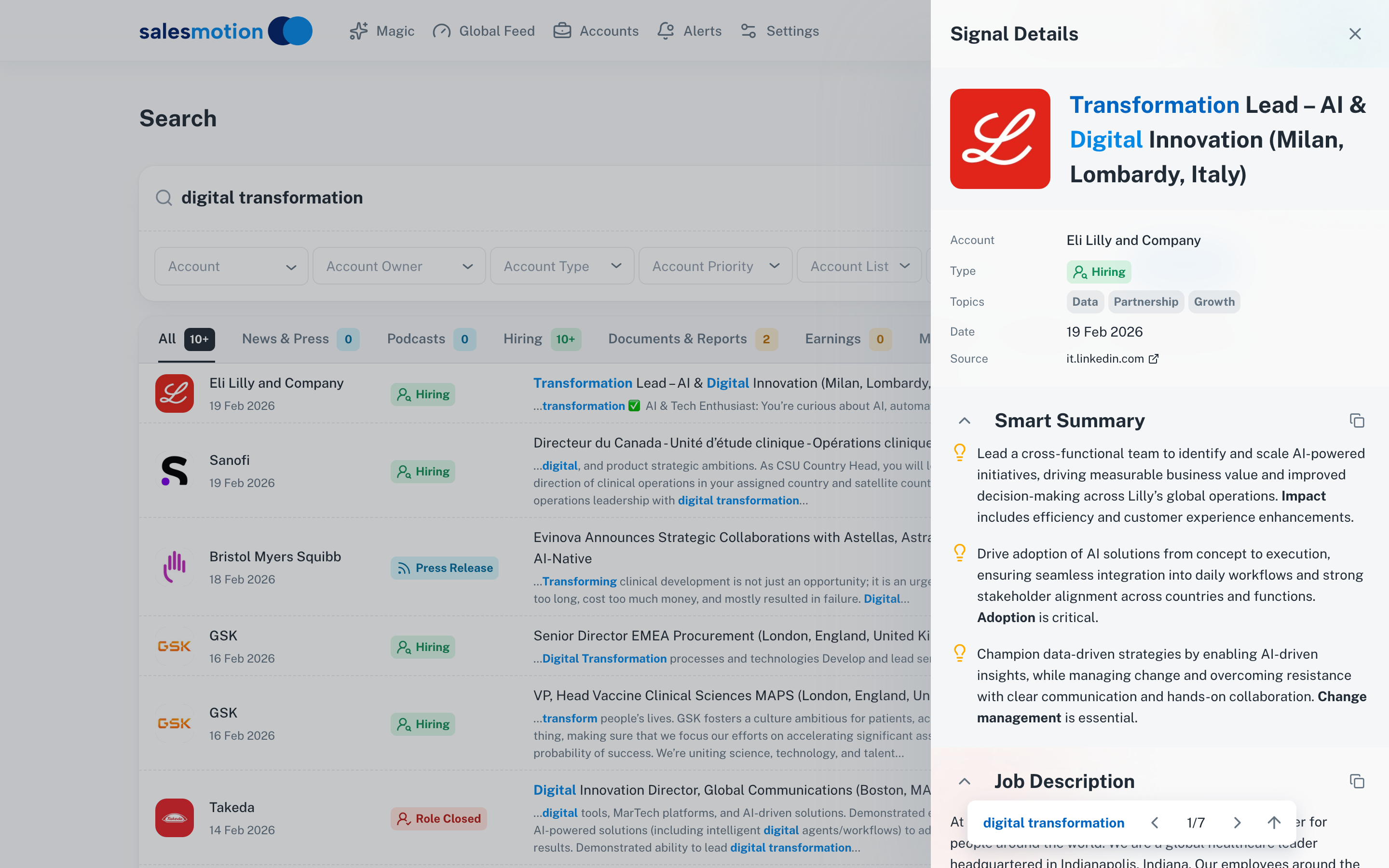 Salesmotion lets you search any keyword across all accounts and all data sources — building prospect lists based on real signals instead of static firmographics.
Step 3: Enrich and Score
As accounts surface, enrich them with account intelligence: company overview, recent news, leadership team, technology stack, strategic priorities, and relevant contacts. Score each account based on signal strength (how many signals, how recent, how relevant) and ICP fit (firmographic match, industry alignment, company size).
Step 4: Assign and Personalize
Route high-scoring accounts to reps based on territory, industry expertise, or relationship history. Provide each rep with the account brief and the specific signals that triggered the match. The rep uses this context to craft personalized outreach that references the company's specific situation, not generic pain points.
Step 5: Monitor and Refresh
The list is never "done." New signals fire daily. Accounts move up and down in priority. Contacts change roles. The AI-powered system handles this refresh automatically, surfacing new high-priority accounts and deprioritizing accounts where signals have cooled.
AI Prospect Lists vs Traditional Lists: A Comparison
| Dimension | Traditional Lists | AI-Powered Lists |
|---|---|---|
| Building time | 4-8 hours per list | Minutes (signal-triggered) |
| Freshness | Stale within weeks | Updated daily/continuously |
| Targeting basis | Firmographics only | Firmographics + signals + intent |
| Prioritization | Equal treatment or gut feel | Signal-scored, data-driven |
| Enrichment | Manual, per-account | Automated, all accounts |
| Maintenance | Quarterly rebuild | Continuous refresh |
| Rep research time | 30-60 min per account | Under 5 min per account |
| Conversion rate | 1-3% meeting rate | 3-8% meeting rate (signal-targeted) |

“Salesmotion has been a game-changer for me. I used to spend 12 hours a week on prospect research, now it's down to 4. Plus I'm finding stuff I was totally missing - podcasts, news mentions, the good bits.”
George Treschi
Account Executive, FY25 President's Club, Sigma
Common Mistakes in AI-Powered List Building
Three mistakes undermine even the best AI-powered prospecting tools.
Over-relying on a single signal type. Job changes alone, or funding alone, or intent data alone, each gives a partial picture. The most accurate targeting combines multiple signal types. An account with a leadership change AND a hiring surge AND an earnings call mention is significantly more likely to buy than an account with just one of those signals.
Ignoring negative signals. AI should also deprioritize accounts showing negative signals: layoffs, leadership departures, budget freezes, or strategic pivots away from your category. Continuing to pursue accounts with strong negative signals wastes rep time and damages credibility.
Skipping the personalization step. AI builds the list and provides the context, but the rep must use that context in their outreach. Sending templated emails to a signal-enriched list defeats the purpose. The value of AI-powered targeting is that it gives reps the information to be genuinely relevant, not just broadly targeted.
For more on B2B contact data providers, see our full comparison. For a broader look at AI tools for sales, see our AI sales tools guide.
Key Takeaways
- Static prospect lists decay 25-35% annually and lack timing intelligence; AI-powered lists update continuously based on real-time signals
- Signal-based targeting identifies not just who fits your ICP but who is actively showing buying behavior right now
- Automated enrichment reduces account research from 30-60 minutes to under 5 minutes per account
- AI-scored prioritization ensures reps focus on the highest-probability accounts instead of treating all prospects equally
- Combine multiple signal types (leadership changes, hiring, funding, earnings) for the most accurate targeting
- The AI builds the list and provides context, but personalized outreach from the rep is what converts the opportunity
Frequently Asked Questions
How is AI prospect list building different from using a B2B database?
B2B databases provide static contact data filtered by firmographic criteria. AI-powered list building adds dynamic signal monitoring, automated enrichment, and predictive scoring. The database tells you who works at a company. AI tells you which companies are worth pursuing right now based on real-time buying activity and account intelligence.
What signals should I use to build prospect lists?
The most reliable signals vary by industry, but common high-value signals include: leadership changes in your target function, hiring surges in relevant departments, funding rounds, technology adoption, earnings call mentions of relevant strategic priorities, and competitive displacement indicators. Combining 3+ signal types produces the most accurate targeting.
How much time does AI prospect list building save?
Teams using signal-based list building report saving 4-8 hours per week per rep on list building and account research. Salesmotion users specifically report 85% less time on account research and significantly higher meeting conversion rates from signal-targeted outreach compared to manually built lists.
Can AI prospect lists integrate with my CRM?
Yes. Most AI-powered prospecting platforms integrate with Salesforce, HubSpot, and other major CRMs. The integration pushes enriched account data, signal alerts, and contact information directly into the CRM, ensuring reps can act on intelligence without switching tools. Native CRM integration also enables tracking which signals produce the best pipeline outcomes over time.