Most B2B sales teams have adopted AI tools by now. Few are actually prospecting better because of it. According to Sopro, 81% of sales teams have deployed or experimented with AI, yet only 21% of commercial leaders report full enterprise-wide adoption of generative AI in their sales process, per McKinsey's B2B Pulse Survey. The gap between "we have AI" and "AI prospecting actually works for us" is where pipeline lives or dies.
TL;DR: AI prospecting heading into 2027 is less about generating more emails and more about finding the right accounts at the right time with the right message. Signal-based targeting, automated account research, and context-anchored outreach are the three capabilities that separate teams closing 30% more deals from teams just sending 30% more emails.
The State of AI Prospecting Heading Into 2027
AI prospecting has moved past the hype cycle. The early adopters who bolted ChatGPT onto their outreach stack in 2023 learned a painful lesson: AI-generated volume without AI-generated relevance just creates more noise. Buyers are now trained to spot templated AI outreach, and response rates on generic sequences have declined steadily.
The shift happening now is from AI as a content generator to AI as an intelligence layer. Teams using AI effectively today are not asking it to write emails. They are asking it to answer three questions before any outreach happens: Which accounts are showing buying signals right now? What specific context makes this the right moment to engage? And what message would a well-prepared human write if they had 30 minutes to research this account?
The numbers back this up. Cirrus Insight reports that 73% of sales professionals say AI helps them uncover insights they would never have found manually. Meanwhile, Outreach's 2025 data shows that sellers using AI-powered research tools cut personalization time by 90% while improving response rates by 28%. The productivity gain is real, but only when AI is deployed against the right targets.
See Salesmotion on a real account
Book a 15-minute demo and see how your team saves hours on account research.
What AI Prospecting Actually Means (Beyond Templates)
When most teams say "AI prospecting," they mean one of three things: automated list building, AI-written cold emails, or chatbot-based lead qualification. All three have their place, but none of them represent the full picture.
Real AI prospecting connects three layers that traditional tools keep separate:
Layer 1: Signal detection. AI monitors hundreds of data sources continuously, tracking leadership changes, funding rounds, earnings commentary, job postings, product launches, and competitive moves. This is not the same as buying intent data from a third-party provider. Signal detection watches what companies are actually doing, not just what topics they are researching.
Layer 2: Account context. Once a signal fires, AI synthesizes everything known about that account into a coherent brief: strategic initiatives, key stakeholders, recent news, competitive landscape, and technology stack. This context is what turns a cold outreach into a warm conversation.
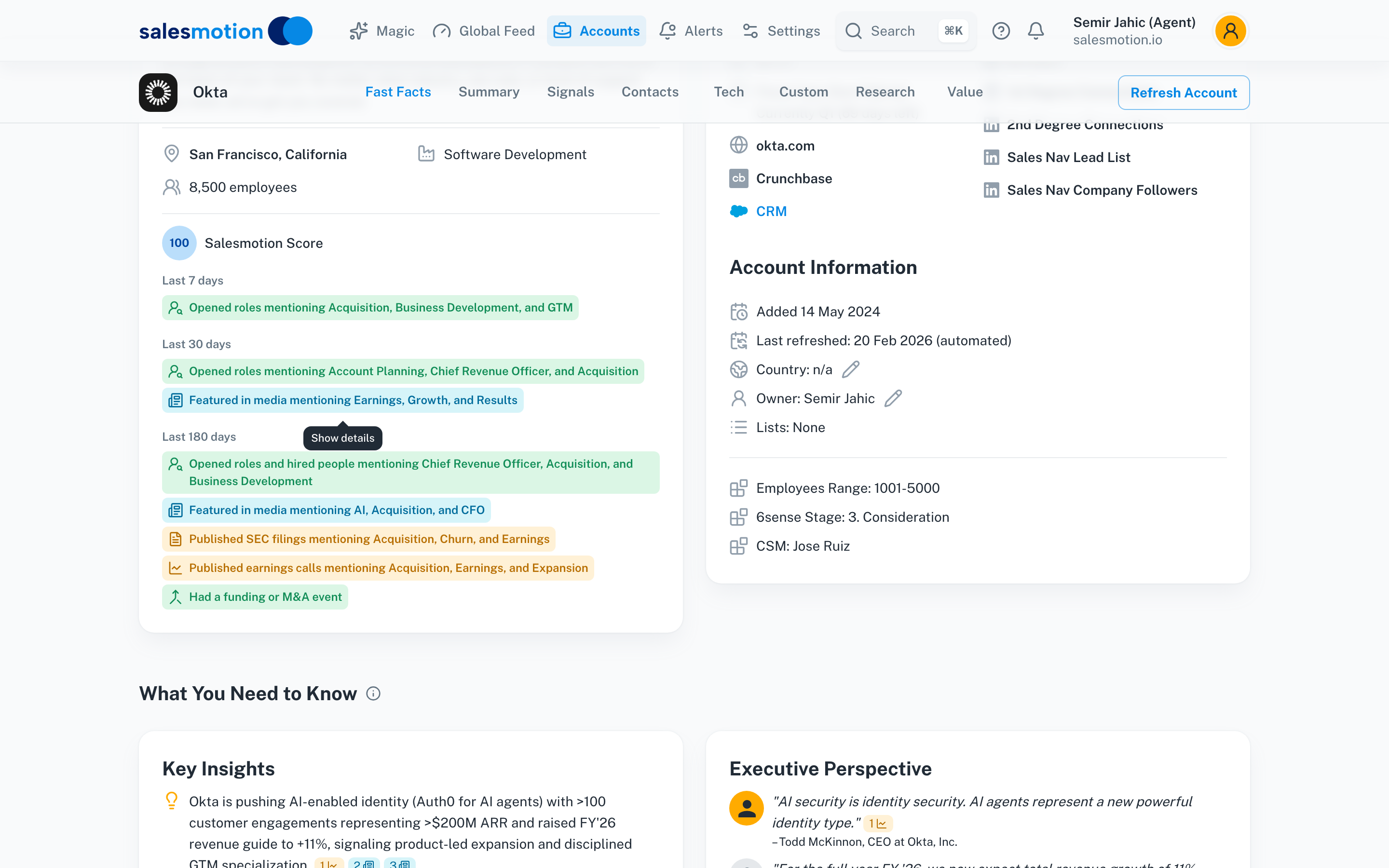 Layer 2 in action: Salesmotion synthesizes account context into a structured brief — key insights, executive commentary, opportunities, and stakeholder changes — so AI-generated outreach is anchored to real intelligence.
Layer 3: Message generation. Only after layers 1 and 2 are complete does AI draft outreach. And because the message is anchored to real signals and real context, it reads like a thoughtful rep who did their homework, not a template with mail-merge fields.
The difference matters. Bain & Company reports that early AI deployments in sales that combine intelligence with outreach have boosted win rates by more than 30%. Teams that only use AI for message generation, without the signal and context layers, see modest gains at best.

“The moment we turned on Salesmotion, it became essential. No more hours on LinkedIn or Google to figure out who we're talking to. It's just there, served up to you, so it's always 'go time.'”
Adam Wainwright
Head of Revenue, Cacheflow
How Signal-Based Targeting Changes Who You Call
The traditional prospecting model works like this: build a list based on firmographics (industry, revenue, employee count), enrich it with contact data, and sequence everyone. AI improved the speed of this workflow but did not fix the fundamental problem. You are still guessing which accounts are ready to buy.
Signal-based prospecting flips the model. Instead of starting with a static list, you start with live signals that indicate an account may be entering a buying window. Then you prioritize outreach to those accounts.
Here is what this looks like in practice:
A target account posts a VP of Sales role on LinkedIn. That hiring signal suggests the company is investing in revenue growth and likely evaluating their sales tech stack. A rep who reaches out with a perspective on how other companies in the same stage have scaled their prospecting, backed by a relevant case study, has a fundamentally different conversation than one who sends a generic intro.
An earnings call mentions "sales productivity initiative." That language signals budget allocation and executive attention. A rep who references that specific initiative in their outreach demonstrates that they understand the company's priorities, not just their job title.
A competitor announces a price increase. Every customer of that competitor is now evaluating alternatives, whether they admit it publicly or not. Teams monitoring this signal can engage while the frustration is fresh.
The data shows why this matters. 6sense research found that the average B2B buyer makes first contact with sales 61% of the way through their decision process, and four out of five deals are won by the vendor already on the buyer's shortlist before that first conversation. If you are not monitoring signals to get on that shortlist early, you are competing for scraps.
Salesmotion monitors buying signals across 1,000+ public sources, including leadership changes, earnings calls, strategic initiatives, funding rounds, job postings, and competitive moves. These signals surface which accounts are entering a buying window before reps ever open a discovery call.
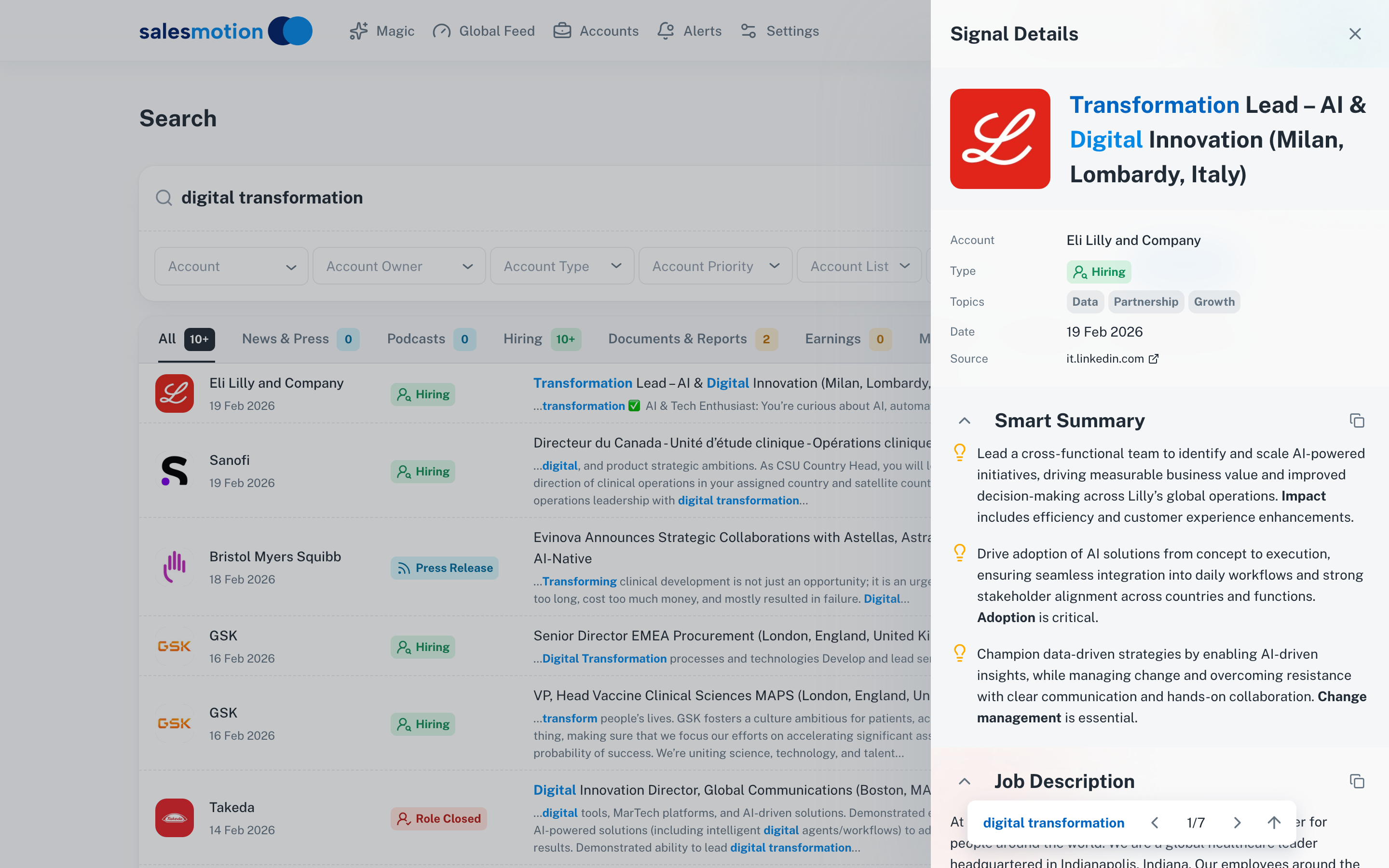 Salesmotion monitors signals across 1,000+ sources — search any keyword across all accounts and all data types to find accounts entering buying windows.
AI-Generated Outreach That Does Not Sound AI-Generated
Here is the uncomfortable truth about AI outreach today: buyers can tell. A ZoomInfo survey found that 63% of buyers believe AI-powered outreach is more relevant to their needs, but that number only holds when the AI has real context to work with. Generic AI emails, the ones that open with "I noticed your company is growing" or "Congrats on the recent funding," have become background noise.
The difference between AI outreach that works and AI outreach that gets deleted comes down to one word: anchoring. Every effective AI-generated message is anchored to something specific: a signal, a strategic initiative, or a piece of account context that proves the sender did their research.
Compare these two approaches:
Generic AI outreach: "Hi Sarah, I noticed your company is hiring for several sales roles. We help companies like yours improve sales productivity. Would you be open to a 15-minute call?"
Signal-anchored AI outreach: "Hi Sarah, I saw that Acme posted three BDR roles last week, and your Q3 earnings call mentioned a 'go-to-market expansion in EMEA.' We worked with a similar-stage SaaS company expanding into EMEA who cut their ramp time from 6 months to 10 weeks by giving new reps AI-generated account briefs on day one. Happy to share what worked for them."
The second message references two real signals (hiring and earnings commentary), ties them to a specific initiative (EMEA expansion), and offers a concrete, relevant example. It reads like a knowledgeable peer, not a sequence.
Teams at Frontify saw this play out directly. After deploying signal-anchored outreach through Salesmotion, their growth team saw a 400% increase in self-sourced meetings and a 42% year-over-year increase in sales velocity. The outreach worked because every message was grounded in real account intelligence, not templates.

“The account and contact signals are key for reaching out at important times, and the value-add messaging it creates unique to every contact helps save time and efficiency.”
Daniel Pitman
Mid-Market Account Executive, Black Swan Data
Building an AI Prospecting Workflow (Step by Step)
Here is a practical workflow you can implement, whether you are a team of 5 or 50.
Step 1: Define your signal map
Before touching any tool, decide which signals matter most for your business. Start with three to five high-intent signals:
| Signal Type | What It Indicates | Priority |
|---|---|---|
| Leadership change (VP+ hire) | New leader evaluates vendors, brings new budget | High |
| Earnings call language | Executive priorities, budget allocation | High |
| Job postings (relevant roles) | Growth investment, potential pain points | Medium |
| Funding round or M&A | New capital, integration needs | Medium |
| Competitor mention/switch | Active evaluation or dissatisfaction | High |
Step 2: Connect signals to account context
A signal alone is not enough. When a signal fires, pull the full account brief: strategic initiatives, key stakeholders and their backgrounds, recent news, competitive landscape, and technology stack. This context is what makes outreach specific.
For example, a VP of Revenue hire at a target account is interesting. A VP of Revenue hire at a target account that mentioned "consolidating sales tools" in their last earnings call, just raised a Series C, and has three open SDR roles, is a high-priority, well-understood opportunity.
Step 3: Score and prioritize
Not every signal deserves immediate outreach. Build a simple scoring model:
- Hot (act within 24-48 hours): Leadership change + earnings language alignment, competitor churn signal, direct intent signal (pricing page visit, demo request)
- Warm (act within 1 week): Single high-intent signal, multiple medium signals stacking
- Monitor (add to nurture): Single medium signal, early-stage indicators
Step 4: Generate context-anchored outreach
Use AI to draft outreach that references the specific signals and context from Steps 1-2. The prompt to your AI should include the signal that triggered the outreach, the relevant account context, and the specific outcome or case study you want to reference.
Step 5: Measure signal-to-meeting conversion
Track which signals convert to meetings at the highest rate. After 90 days, you will likely find that two or three signal types drive 80% of your booked meetings. Double down on those and deprioritize the rest.
Teams at Analytic Partners followed a similar signal-based workflow and saw a 40% increase in qualified pipeline year over year, with their BD team getting 80-90% of what they need for prospecting in just 15 minutes per account.
AI Prospecting vs Traditional Prospecting
| Dimension | Traditional Prospecting | AI-Powered Prospecting |
|---|---|---|
| Account selection | Firmographic filters (industry, size, revenue) | Signal-based prioritization (who is showing buying intent now) |
| Research | Manual: LinkedIn, Google, SEC filings, news (2-3 hours per account) | Automated: AI synthesizes 1,000+ sources into account briefs (minutes) |
| Timing | Batch-based: work the list sequentially | Event-driven: engage when signals fire |
| Outreach | Template sequences with light personalization | Signal-anchored messages referencing specific account context |
| Qualification | Rep judgment after discovery call | Pre-qualified by signal strength and account fit before first touch |
| Scalability | Linear: more accounts = more rep hours | Compounding: AI handles research at scale, reps focus on conversations |
| Data freshness | Point-in-time snapshots that decay within weeks | Continuous monitoring with real-time updates |
The core difference is not speed. Traditional prospecting can be fast with good tools. The difference is relevance. AI prospecting ensures that every outreach is backed by current intelligence, not stale data and assumptions.
Common AI Prospecting Mistakes
Mistake 1: Using AI for volume instead of precision. The easiest trap is automating what was already broken. If your sequences were getting 2% reply rates, sending 10x more of them with AI will not fix the underlying problem. Fix the targeting and context first.
Mistake 2: Skipping the signal layer. Many teams jump straight to AI-written emails without investing in signal detection. The result: polished messages sent to the wrong accounts at the wrong time. AI outreach without signal-based selling is just faster spam.
Mistake 3: Over-automating the human touch. AI should draft, not send. The best-performing teams use AI to generate a starting point, then have reps add a personal observation or connection before hitting send. The 30 seconds of human editing is what separates a 5% reply rate from a 15% reply rate.
Mistake 4: Ignoring signal decay. A leadership change from three months ago is old news. A funding round from last quarter has already been acted on. Signals have a shelf life, and your workflow needs to account for freshness. Prioritize signals from the last 7-14 days for outreach.
Mistake 5: Not measuring signal-to-meeting conversion. If you cannot tell which signals actually produce meetings, you are flying blind. Track signal type, time-to-outreach, and conversion rate for every prospecting motion. Most teams discover that a small number of signal types drive the majority of their pipeline.
Tools for AI Prospecting in 2027
The AI prospecting tool landscape has matured significantly. Here is how the major categories break down:
Signal monitoring and account intelligence: Platforms that track buying signals and synthesize account research. These replace the manual work of monitoring news, earnings, job postings, and competitive moves. Salesmotion falls squarely in this category, combining signal detection across 1,000+ sources with AI-generated account briefs and outreach.
Contact data and enrichment: Tools like ZoomInfo and Apollo provide the contact layer, giving you verified emails, phone numbers, and org charts. They answer "who" but not "why" or "when." For a deeper comparison, see our ZoomInfo alternatives guide.
Sequencing and outreach automation: Platforms like Outreach, Salesloft, and HubSpot handle the delivery layer, managing multi-step sequences across email, phone, and social. They are the execution engine for your outreach.
AI SDR agents: A newer category where AI handles end-to-end prospecting, from signal detection through outreach and follow-up. These work best for high-volume, lower-ACV motions. For enterprise deals, the hybrid model (AI research + human outreach) still outperforms. See our guide on evaluating AI outbound agents.
Conversational intelligence: Tools like Gong and Chorus analyze sales calls to extract insights about buyer priorities, objections, and competitive mentions. These feed back into your signal map and outreach templates. Check our Gong alternatives roundup for the full landscape.
The most effective stack to plan 2027 around combines signal monitoring (to know when to engage), contact data (to know who to reach), and outreach automation (to execute consistently), all connected through your CRM.
Key Takeaways
- AI prospecting is moving from volume-based automation to signal-based precision. The teams winning now are not sending more emails. They are sending better-timed, better-researched messages to accounts actively showing buying signals.
- Signal detection is the foundation. Without knowing which accounts are in-market right now, even the best AI-written outreach is a guess. Start by defining and monitoring three to five high-intent signal types.
- Context-anchored outreach outperforms templates by a wide margin. Messages referencing specific signals, strategic initiatives, and account context see 28-30% higher response rates than generic personalization.
- The winning workflow is: detect signal, pull account context, generate anchored outreach, measure conversion. Teams following this pattern, like Analytic Partners (40% more qualified pipeline) and Frontify (42% higher sales velocity), are seeing measurable results.
- AI should augment reps, not replace the human touch. Use AI for research and drafting; keep humans in the loop for editing, relationship-building, and strategic decisions.
- Measure signal-to-meeting conversion. After 90 days, you will know which signals drive your pipeline. Double down on those and cut the rest.
Frequently Asked Questions
What is AI prospecting and how does it differ from traditional prospecting?
AI prospecting uses artificial intelligence to automate account research, detect buying signals, and generate personalized outreach. Unlike traditional prospecting, which relies on static lists and manual research, AI prospecting continuously monitors data sources to identify which accounts are showing buying intent right now. This shift from batch-based list work to event-driven engagement means reps spend less time researching and more time having relevant conversations with qualified buyers.
How much time does AI prospecting actually save sales teams?
The time savings vary by implementation, but verified results are significant. Teams using signal-based AI prospecting platforms report saving 2-6 hours per rep per week on account research alone. Analytic Partners reduced research time by 85%, from 3 hours to 15 minutes per account. Sopro's research found that 100% of AI-powered SDR users reported time savings, with nearly 40% saving 4-7 hours per week.
Does AI-generated outreach actually get better response rates?
Yes, when the AI has real context to work with. According to LinkedIn research, AI-personalized messages see 29% higher open rates and 41% higher click-through rates. The key distinction is between generic AI outreach (which performs similarly to manual templates) and signal-anchored AI outreach (which references specific account events and context). The latter consistently outperforms because buyers can tell the sender understands their situation.
What are the most important buying signals for AI prospecting?
The highest-converting signals for B2B prospecting are: leadership changes at the VP+ level (indicating new budget and vendor evaluation), earnings call language mentioning relevant initiatives (indicating executive priority and budget), competitor churn signals (indicating active evaluation), and role-specific hiring patterns (indicating investment in a function your product supports). The specific signals that matter most will vary by your product and ICP. Track signal-to-meeting conversion rates for 90 days to identify your top performers.
How do I get started with AI prospecting without overhauling my entire sales process?
Start small. Pick your top 50 accounts and define three high-intent signals to monitor (leadership changes, earnings language, and hiring patterns are good starting points). Use a platform that automates signal detection and account research, then have reps use that intelligence to personalize their existing outreach sequences. You do not need to replace your entire stack. Most teams see measurable results within the first 90 days by simply adding a signal layer on top of their current workflow. The interactive demo shows how this works in practice.