
The best AI SDR tool depends on which part of the SDR job you want software to own. For autonomous outbound that prospects, writes and sends on its own, the leading options are 11x (Alice), Artisan (Ava) and AiSDR, and AiSDR is the one of the three that publishes its prices, from $250/mo. For inbound, Qualified's Piper works the traffic already on your website. If the gap is relevance, Salesmotion does the account research and signal detection and drafts outreach a rep reviews and sends, from $85/mo.
An AI SDR is software that automates sales development work: researching accounts, finding contacts, and drafting or sending outreach. This guide compares eight AI SDR tools by approach, what each is strongest at, published pricing, and fit. For how the AI-assisted model works step by step, from signal to brief to draft, see Salesmotion's AI SDR software.
TL;DR: Pick by the job. 11x is for teams that want a fully autonomous outbound agent working a large market across email and calls. Qualified is for teams with website traffic that want an AI SDR agent on inbound. Salesmotion is for teams whose reps need account research and buying signals with a drafted message to review, not autonomous sending. On price, AiSDR starts at $250/mo, Salesmotion at $85/mo, and Unify, Regie.ai and Clay each have a free plan. 11x, Artisan and Qualified do not publish pricing.
| Top pick | Best for | Starting price |
|---|---|---|
| 11x (Alice) | Fully autonomous outbound at volume | Custom, quote-only |
| Qualified (Piper) | Inbound pipeline from website traffic | Does not publish pricing |
| Salesmotion | Account research and signals with drafts a rep reviews | $85/mo |
Why Trust This Guide?
Every price and product fact below was checked against the vendor's own website on 10 October 2026. Where a vendor does not publish a price, this guide says so and gives no estimate. Figures that come from a third party are named where they appear.
The guide is also shaped by what buyers say. We sat in 55 sales and customer calls between August and October 2026. In 22 of them the question was not who to contact but which accounts to work this week, and when. Two of them put it this way:
"I'm looking more for surveillance on my accounts to pick up the stuff that I might miss."
Regional sales manager, cybersecurity
"I just feel like we have a lack of visibility into ... what accounts are actually hot"
Sales leader, healthcare technology
Salesmotion publishes this guide and is one of the eight tools in it, at number 5. It is not an autonomous AI SDR: it is a research and signals platform that drafts outreach for a rep to review. The list is ordered by how much of the SDR job the tool runs on its own, starting with fully autonomous agents, then tools a rep or operator runs, then the build-your-own option. The order is not a score.
Our agents do the research before the first email
Salesmotion's agents find the signal, write a cited brief and draft the email for a rep to review. Book a 30-minute demo and see it on your own accounts.
Book a demo →AI SDR Tools Compared at a Glance
| Tool | Best for | Standout capability | Pricing | Free plan or trial |
|---|---|---|---|---|
| 11x (Alice) | Fully autonomous outbound at volume | Autonomous prospecting across email and calls in over 105 languages | Custom, quote-only | Demo by request |
| Artisan (Ava) | All-in-one autonomous outbound | One AI BDR that finds leads, sends outreach, handles replies and books meetings | Does not publish pricing (credit-based plans) | Demo by request |
| AiSDR | Autonomous outbound on a published price | Emails and LinkedIn messages written and sent by its AI agent | Solo $250/mo, Explore $900/mo, Scale $2,500/mo | Three paid plans |
| Qualified (Piper) | Inbound pipeline from website traffic | AI SDR agent for inbound marketing channels | Does not publish pricing (Premier, Enterprise, Ultimate) | Demo by request |
| Salesmotion | Research and signals with drafts a rep reviews | Cited account briefs from 1,000+ public sources | $85/mo for individuals. Custom pricing for teams & enterprise. | Interactive demo |
| Unify | Outbound agents for each rep | Signal-triggered plays with multi-channel sequencing | Free forever (3 seats); Base $20, Pro $60/seat/mo | Free forever plan; 14-day trial on Pro |
| Regie.ai (RegieGO) | Self-serve outbound with calling | Signals, messaging and a power dialer in one workspace | Free; Pro $49/mo; Team $150/seat/mo | Free plan |
| Clay | Build-your-own outbound workflows | Enrichment from 150+ providers with Claygent research agents | Free; Launch $185/mo, Growth $495/mo | Free plan; 14-day trial on paid plans |
The split that matters is who presses send. 11x, Artisan and AiSDR are built to run outbound on autopilot. Qualified does the same job for inbound. Salesmotion, Unify, Regie.ai and Clay put research, signals and drafts in front of a rep or an operator. Read the "Best for" column with that in mind: the tools solve different problems, and the cheapest one for your team is the one that matches the problem you have.

“The moment we turned on Salesmotion, it became essential. No more hours on LinkedIn or Google to figure out who we're talking to. It's just there, served up to you, so it's always 'go time.'”
Adam Wainwright
Head of Revenue, Cacheflow
What Is an AI SDR?
An AI SDR automates the work a human sales development rep does before a conversation starts: account research, list building, contact discovery, message drafting, and sequencing.
Autonomous AI SDR vs. AI-augmented rep
This is the distinction that matters when you shortlist. Autonomous tools take over top-of-funnel: they pick targets, write, and send on their own. Augmentation tools take over the rep's preparation: they monitor the market, research accounts, prepare a point of view, and draft the message, and a human reviews and sends. We compared the two philosophies in depth in AI SDRs vs human SDRs.
Neither is the better design in general. Autonomy buys coverage: more accounts touched, around the clock, in more languages than a team can staff. Augmentation buys relevance: fewer messages, each tied to something that changed at the account. The right one depends on deal size, how large your addressable market is, and how much a poor first touch costs you.
Where volume alone stops working
Volume alone has stopped working as a strategy. In a Gartner survey of 632 B2B buyers, 73% said they actively avoid suppliers who send irrelevant outreach, and Instantly's 2026 cold email benchmark credits elite senders' 2-4x reply rates to segmentation and relevant messaging rather than volume. Buyers are not reading more email. They are filtering it.
That is a statement about how a tool is run, not about any one product. An autonomous agent pointed at a well-chosen segment with a real reason to write performs very differently from the same agent pointed at a purchased list. Whichever tool you choose, the inputs decide the result: who it targets, what it knows about them, and what triggered the message.
How We Evaluated the AI SDR Tools
- Research and personalization quality. Does the message show evidence of real account understanding, or token personalization on a template?
- Signal awareness. Does the tool know why to reach out now: a leadership change, funding, an earnings statement?
- Deliverability safeguards. Volume caps, warm-up, and whether a human gate protects your domain.
- Integration and rep adoption. Does it fit how reps already work, or create a parallel machine nobody trusts?
- Pricing transparency and time-to-value. Published pricing and setup measured in days, not quarters.
Criteria 1 to 4 are questions to put to each vendor in a demo, on your own accounts. For the claims that most need checking, see what buyers should verify in AI SDR claims. Criterion 5 is the one this guide can settle for you: each entry below states exactly what the vendor publishes about price.

“Salesmotion empowers me to cultivate a great buyer experience. I'm able to challenge prospects' thinking and be a trusted consultative seller. A major part of this is Salesmotion insights.”
Austin Friesen
Account Executive, FY25 #1 President's Club, Clari
The Best AI SDR Tools, Reviewed
1. 11x (Alice)
What it is: 11x sells "digital workers". Alice is its AI SDR for outbound, and Julian is its AI phone agent for inbound calls.
Best for: Teams with a large addressable market that want outbound to run autonomously across channels and languages.
What it is strong at: Alice engages buyers across email, calls and more with tailored sequences, handles replies and books meetings, and works in over 105 languages. 11x has built its own signal and research layer: Alice acts on high-intent leads who visit your website, change jobs or search for solutions like yours, and the platform lists Signals and Triggers, Deep Research and Website Visitor Tracking, drawing on 50+ data sources. Julian covers speed to lead and inbound lead qualification by phone. Integrations include Salesforce, HubSpot and Slack. Alice is built to act on signals autonomously at volume, where Salesmotion is built to put the research in front of a rep. Our 11x vs Salesmotion comparison covers that difference in detail.
Pricing: 11x does not publish list pricing; its site is demo-gated and contracts are quoted.
Choose it if: You want an autonomous agent to own outbound end to end, and you have the market size and the budget for a quoted contract.
2. Artisan (Ava)
What it is: Artisan describes itself as an all-in-one, AI-first outbound platform powered by AI employees. Ava is its AI BDR.
Best for: Teams that want autonomous outbound in one platform instead of stitching a data vendor to a sending tool.
What it is strong at: Ava covers the whole outbound cycle in one product: she finds and enriches B2B leads, writes and sends personalized outreach, handles replies, and books meetings. The appeal is the bundle. Lead data, writing, sending and reply handling sit with one vendor and one agent.
Pricing: Artisan does not publish pricing. Its pricing page describes credit-based pricing with plan tiers for startups through enterprise, and directs buyers to request a demo.
Choose it if: You want one AI BDR to run prospecting through booking, and you are comfortable buying on a quote.
3. AiSDR
What it is: AiSDR is an AI sales development platform. Its AI agent finds and researches leads, then writes and sends emails and LinkedIn messages.
Best for: Smaller teams that want autonomous outbound on a published monthly price.
What it is strong at: Price transparency in a category where most vendors quote. AiSDR lists three plans with dollar figures, and the platform also handles mailbox setup and CRM sync, so a small team is not assembling the sending infrastructure itself.
Pricing: AiSDR publishes its pricing on its pricing page: Solo at $250/mo, Explore at $900/mo and Scale at $2,500/mo, or $2,400, $8,640 and $24,000 a year on annual billing.
Choose it if: You want to know the cost before you talk to sales, and email plus LinkedIn outbound is the job.
4. Qualified (Piper)
What it is: Qualified built Piper, an AI SDR agent for inbound. Salesforce owns Qualified, which is still sold under its own name.
Best for: Teams with meaningful website traffic that want inbound visitors engaged and converted.
What it is strong at: A different job from the three tools above. Piper generates inbound pipeline across your marketing channels, alongside AI chatbots and website conversion tools. It works demand you have already created, so the value grows with your traffic.
Pricing: Qualified does not publish pricing. Its Premier, Enterprise and Ultimate plans are quoted through sales.
Choose it if: Your paid and organic traffic is healthy and too few of those visitors turn into meetings.
5. Salesmotion
What it is: Salesmotion is an account intelligence platform with three AI agents: Signal Agent, Research Agent and Outreach Agent. It is not an autonomous AI SDR. The agents do the research and draft the message, and a rep reviews and sends it.
Best for: AEs and SDR teams whose problem is relevance and prioritization, not raw sending capacity.
What it is strong at: The work before the message. Salesmotion monitors 1,000+ public sources for 50+ signal types, builds cited account briefs so a rep can trace each point to its source, and drafts outreach anchored to whatever just changed at the account. It has a native Salesforce integration and a HubSpot integration, pushes outreach drafts to lemlist, and offers a REST API and an MCP server for Claude, ChatGPT and other assistants. Customers report the effect on prep time and meetings: Guild Education reps save 6 hours per week on research, and Incredible Health increased meetings booked by 50%, with implementation in 3 days.
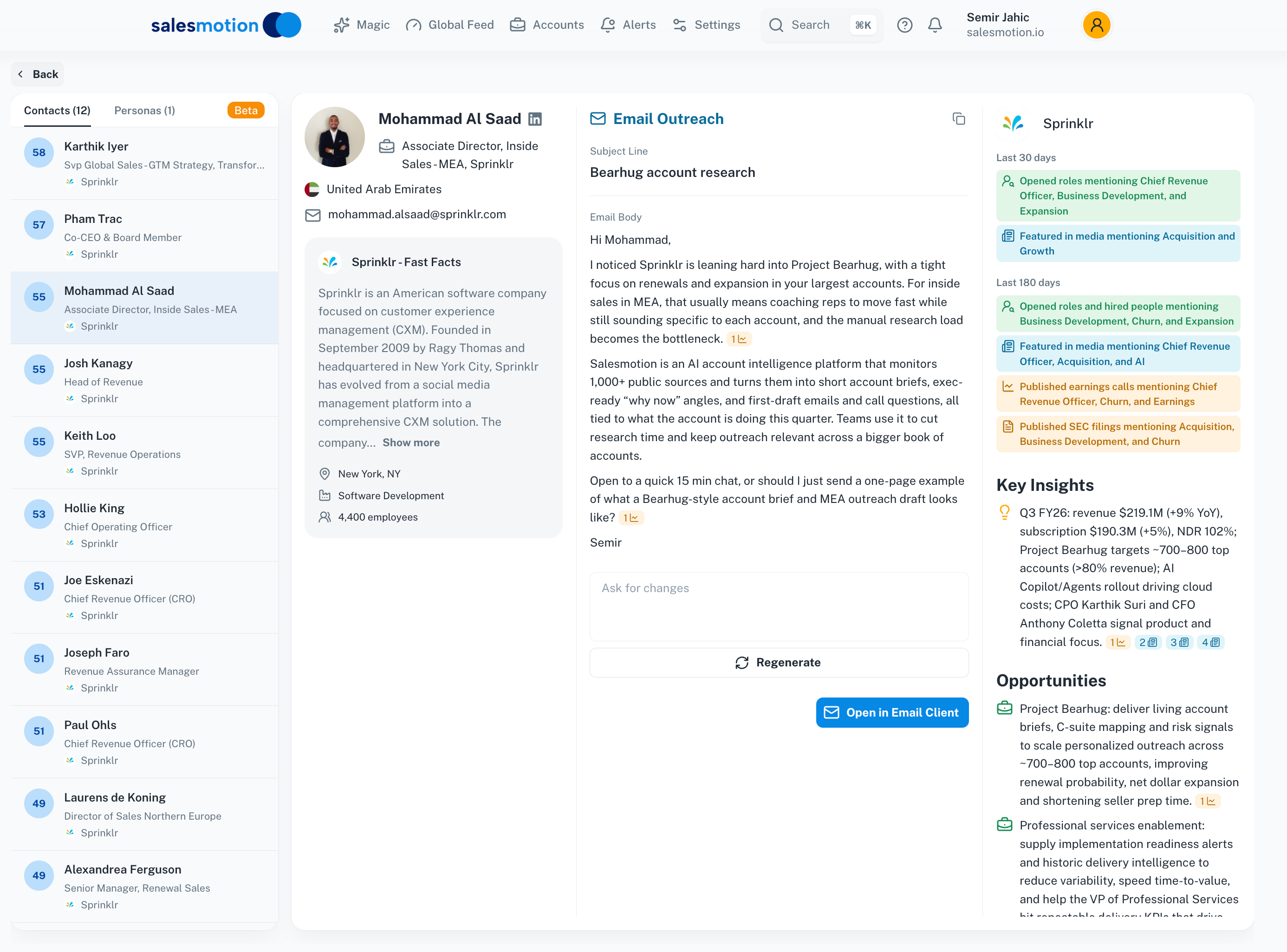 The outreach agent drafts a message tied to a specific signal; the rep reviews and sends.
Pricing: $85/mo for individuals, covering up to 100 accounts and 200 contact credits a month, on a monthly contract with no annual commitment. Custom pricing for teams and enterprise. See pricing.
Choose it if: Your reps send generic outreach because research takes too long, and you want a person to approve every message. If your model depends on unattended sequences to thousands of contacts, the autonomous tools above are the better fit.
See it: the AI SDR page shows how the three agents split the SDR job, or book a 30-minute demo to see them on your own accounts.
6. Unify
What it is: Unify describes itself as "outbound agents for every rep": one platform for prospecting, research and sequencing.
Best for: Teams that want signal-triggered outbound with a low-cost way to start.
What it is strong at: Turning signals into sends. Unify combines agents, automated plays, signals and intent, multi-channel sequencing, B2B data and deliverability in one product, drawing on 40+ data sources for signals such as job changes, funding, hiring, web visits and tech stack. It integrates with Salesforce and HubSpot and sells managed Gmail and Outlook mailboxes at $25 per mailbox per month.
Pricing: Unify publishes its pricing: a free forever plan for up to 3 seats, Base at $20 and Pro at $60 per seat per month, then custom Business. Pro includes a 14-day free trial with no credit card required.
Choose it if: You want reps running agent-built outbound plays from one tool, and you want to try it on a free plan first.
7. Regie.ai (RegieGO)
What it is: Regie.ai now sells RegieGO, a self-serve outbound workspace that combines AI agents, relevant messaging, channel orchestration and a power dialer.
Best for: Prospecting reps, founders and small teams that want signals, messaging, sequencing and dialing in one place.
What it is strong at: Calling is part of every paid plan instead of an add-on. RegieGO surfaces why-now signals such as funding rounds, leadership changes and hiring, pairs them with AI-drafted messaging, and syncs with Salesforce, HubSpot and Monday CRM.
Pricing: Regie.ai publishes its RegieGO pricing: a free plan for up to 10 people sharing one credit pool, Pro at $49 per month for one person ($41 on annual billing), Team at $150 per seat per month ($125 on annual billing) with a two-seat minimum, then custom Enterprise.
Choose it if: Phone is a real channel for you and you want email, signals and a dialer on one self-serve plan.
8. Clay
What it is: Clay is the build-your-own option: a workbench that connects 150+ data providers, AI research agents (Claygent), native signals and a native sequencer.
Best for: Ops-heavy teams with a GTM engineer who want control over every step of the workflow.
What it is strong at: Flexibility. Teams build specific plays: catch a signal, enrich the account, generate copy, send through Clay's sequencer or push to another one. Clay has added Account Agents that monitor a book of business, and an MCP that brings its data and workflows into ChatGPT, Claude and Codex. Seats are unlimited on every plan, and usage is metered in Actions and Data Credits. Full breakdown in our Clay pricing guide.
Pricing: Clay publishes its pricing: a free tier, Launch from $185/month and Growth from $495/month (about $167 and $446 on annual billing), then custom Enterprise on an annual commitment. Paid plans start with a 14-day trial.
Choose it if: You have someone to build and maintain the workflows and your plays are too specific for a packaged tool.
AI SDR vs. Human SDR: Do You Still Need Reps?
AI is better at three things: research at scale, round-the-clock signal monitoring, and first drafts. Humans remain better at judgment, relationships, and complex objection handling. The teams getting results have stopped treating this as a choice.
The working setup is not AI or human. It is AI agents doing the research and signal detection at scale, then handing a prepared, signal-anchored draft to a rep who adds judgment and sends. Volume without relevance burns domains; relevance at scale is what works.
Here is that hybrid loop in practice:
- Trigger: A target account's CFO mentions "consolidating our sales tools" on an earnings call.
- Platform action: The account is flagged, and a brief assembles the quote, the affected business unit, and three likely stakeholders.
- Rep action: The rep gets a drafted email referencing the CFO's exact language, adjusts the tone, and sends within hours of the call.
- Outcome: Discovery starts on the buyer's agenda instead of yours. At Cacheflow, Head of Revenue Adam Wainwright reports 60% less prep time and 3x larger deals working from prepared intelligence instead of blank pages. For the wider stack this feeds, see our personalized cold email tools comparison.
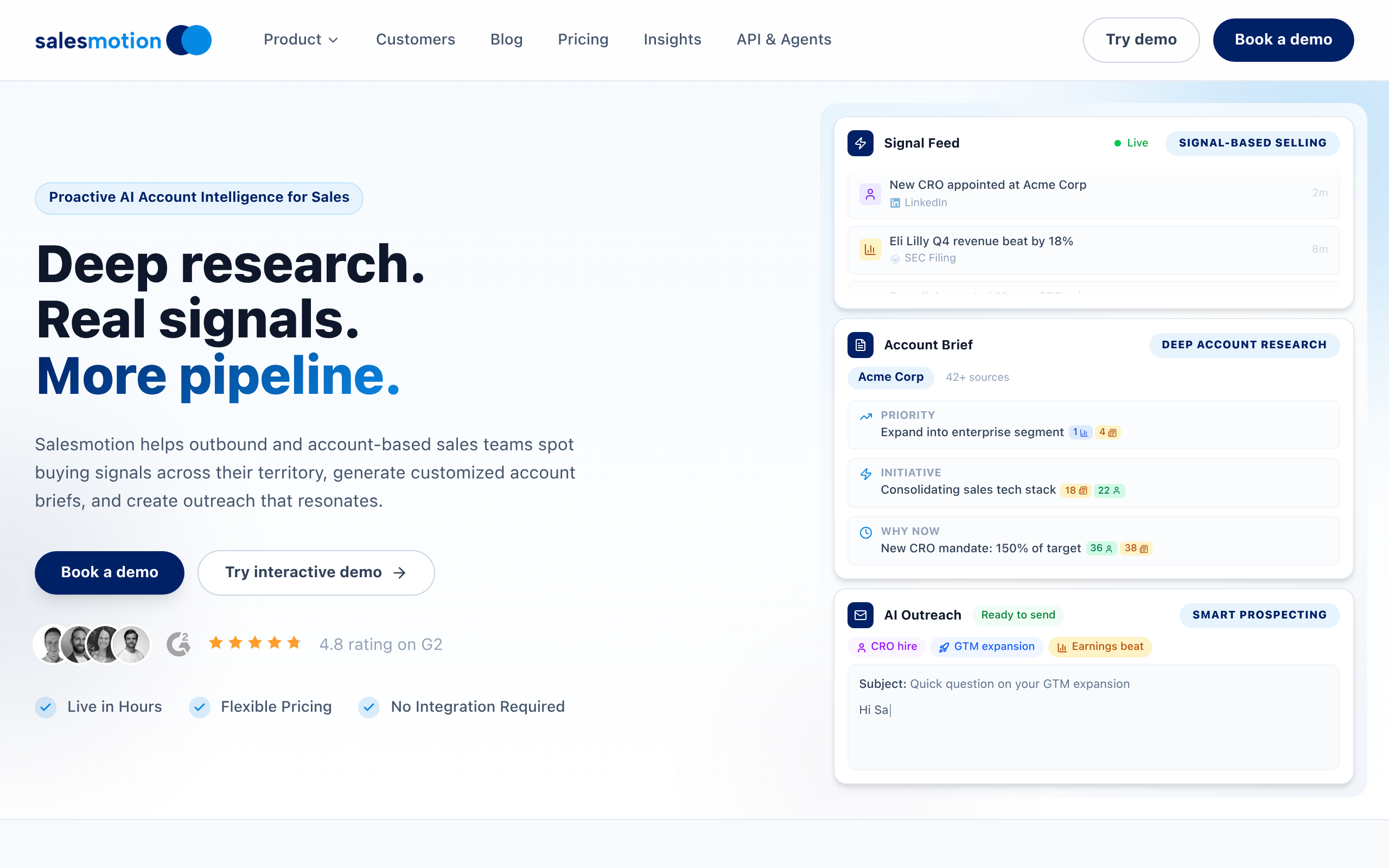 Augmentation-first: agents prepare, reps decide.
How to Choose an AI SDR Tool
Match the tool to the problem you have:
- Your pipeline is empty and your market is huge: autonomous outbound (11x, Artisan, AiSDR) is built for coverage.
- You need a price before a sales call: AiSDR, Unify, Regie.ai, Clay and Salesmotion publish theirs. 11x, Artisan and Qualified quote.
- Reps send generic outreach because research takes too long: Salesmotion fixes the input problem by putting cited research and a drafted message in front of the rep.
- Your website leaks demand: Qualified converts the traffic you already paid to attract.
- Phone is a core channel: 11x covers calls with Alice and Julian, and Regie.ai includes a power dialer in every paid plan.
- You want reps running agent-built plays from one tool: Unify.
- You have engineering capacity and unique plays: build it in Clay.
Decision shortcut:
Choose 11x or Artisan if you need autonomous volume. Choose AiSDR if you want autonomous outbound on a published price. Choose Qualified if your priority is inbound web traffic. Choose Unify or Regie.ai if you want a self-serve outbound workspace with a free plan. Choose Clay if you want to build custom workflows. Choose Salesmotion if you want AI-researched, signal-anchored outreach your reps review and send.
For the broader automation picture beyond SDR work, see our guide to sales process automation.
Key Takeaways
- AI SDR tools split into autonomous senders (11x, Artisan, AiSDR, and Qualified for inbound) and tools that keep a rep or operator in the loop (Salesmotion, Unify, Regie.ai, Clay).
- Buyers filter irrelevant outreach: 73% of B2B buyers in a Gartner survey actively avoid suppliers who send it. More sending is not more pipeline.
- The deciding question is signal awareness: does the tool know why to reach out now, or only who to email next?
- Five of the eight publish prices. AiSDR starts at $250/mo and Salesmotion at $85/mo; Unify, Regie.ai and Clay have free plans. 11x, Artisan and Qualified quote each contract.
- Salesmotion is a research and signals platform, not an autonomous sender: its agents prepare the research and the draft, and the rep applies judgment and sends.
Frequently Asked Questions
What is the best AI SDR tool for 2027?
It depends on the job. For fully autonomous outbound, 11x and Artisan are the leading options, with AiSDR as the choice with published pricing from $250/mo. For inbound conversion, Qualified's Piper. For account research and buying signals with a drafted message a rep reviews and sends, Salesmotion, from $85/mo.
How much does an AI SDR cost?
Published prices run from free plans to $2,500 a month. AiSDR lists Solo at $250/mo, Explore at $900/mo and Scale at $2,500/mo. Unify has a free forever plan, then Base at $20 and Pro at $60 per seat per month. Regie.ai's RegieGO has a free plan, then Pro at $49 per month. Clay has a free tier, then Launch from $185/month. Salesmotion is $85/mo for individuals. 11x, Artisan and Qualified do not publish pricing.
What does an AI SDR actually do day to day compared to a human SDR?
An AI SDR does the repeatable part of the job continuously: it monitors accounts for triggers, researches companies and contacts, builds lists, and drafts or sends outreach and follow-ups. A human SDR does those same tasks in batches and adds what software does not: judgment about which accounts deserve effort, live conversations, and objection handling. In an augmented setup the AI prepares the research and the draft, and the rep decides and sends.
Will an AI SDR replace human sales reps?
Not in complex B2B sales. AI handles research, monitoring, and drafting better than humans; judgment, trust, and multi-stakeholder navigation remain human work. The replacement risk is real only for pure list-and-blast activity, which was already low-value before AI automated it.
Are fully autonomous AI SDRs safe for email deliverability?
They can be, if volume is controlled. Spam complaints count against your domain, not the vendor's. If you run autonomous volume, enforce warm-up, sending caps, and separate sending domains from day one, and ask each vendor how its deliverability tooling works.
What is the difference between an AI SDR and a sales engagement platform?
A sales engagement platform (Outreach, Salesloft) is built around executing sequences, with AI agents now assisting on research and drafting. An AI SDR decides or drafts the content itself: research, targeting, and messaging. Many teams run both, with the AI SDR feeding prepared drafts into the engagement platform for delivery.
Can an AI SDR research accounts and find buying signals?
Many do. Autonomous senders such as 11x act on signals like website visits and job changes at volume. Unify and Regie.ai surface signals such as funding, hiring and leadership changes for their outbound workflows. Salesmotion puts the research in front of the rep: it monitors 50+ signal types across 1,000+ public sources, builds a cited brief, then drafts outreach anchored to the specific signal.
Which AI SDR tools have a free plan?
Three of the eight. Unify has a free forever plan for up to 3 seats, Regie.ai's RegieGO has a free plan for up to 10 people sharing one credit pool, and Clay has a free tier. Salesmotion has no free plan and offers an interactive demo instead. 11x, Artisan and Qualified sell through a demo.
How Salesmotion works as an AI SDR
Three agents watch 1,000+ public sources for buying signals, research the account and draft the outreach. A rep reviews every message before it goes out.