In B2B marketing, it's easy to get lost in the wrong metrics. Clicks, impressions, and follower counts look good on a report, but they don't answer the one question your C-suite cares about: How does this drive revenue? This guide cuts through the noise. We’ll cover the essential B2B marketing KPIs that directly connect your team's efforts to real pipeline growth, faster sales cycles, and higher win rates.
Forget surface-level data. Let's look at how modern revenue teams use these metrics to not just measure success, but create it. For each KPI, you'll get a clear definition and practical steps to put it to work. To track these KPIs effectively and move beyond vanity metrics, you need a solid marketing measurement framework that ties every activity to a business outcome.
This list is for sales and revenue leaders who need to show the real impact of their marketing investments. We'll cover metrics like:
- Account Engagement Score (AES)
- Pipeline Influence & Velocity
- Win Rate by Trigger Type
- Sales Cycle Compression Rate
You'll learn not just what to track, but how to use this data to make strategic decisions that accelerate growth. It’s time to stop reporting on activity and start reporting on impact. Let's get started.
1. Account Engagement Score (AES)
The Account Engagement Score (AES) goes beyond simple lead scoring. It’s a combined metric that gives you a complete picture of an entire target account's activity. Instead of tracking one person, AES gathers every interaction from all known stakeholders in a company—email opens, webinar attendance, website visits, and content downloads. This gives you a single score that signals an account’s buying intent. For B2B revenue teams, this is one of the most crucial b2b marketing kpis because it shows which accounts are heating up and which are going cold.

This score helps your team focus its efforts. For example, a cybersecurity firm might see a target account has a high AES of 78, driven by website traffic but zero recent sales activity. That tells the sales rep it’s the perfect time to re-engage with a relevant message, bridging the gap between marketing interest and a sales conversation. Account intelligence platforms like Salesmotion are built to calculate these scores, turning raw data into a clear signal for action.
How to Implement and Use AES
To get the most from this KPI, you need to set it up correctly and train your team to read the signals.
- Set Segment-Specific Baselines: Don't use a one-size-fits-all approach. What counts as "good" engagement for an enterprise account will be different from a mid-market one. Set different thresholds based on segment, industry, or strategic value.
- Layer with Real-Time Signals: A high AES is good. A high AES combined with a recent funding announcement or a key executive change is a powerful trigger event. This combination is the strongest sign that a buying committee is active and it's time for outreach.
- Set Up Alerts: Configure your system to send Slack or email alerts when an account's AES crosses a certain threshold. This lets reps act immediately while the account is showing peak interest. For more ideas, you can review different strategies on how to enhance customer engagement with timely data.
Key Takeaway: An AES is more than a number; it’s a reflection of an entire buying committee’s journey. Use it to spot multi-threading gaps (is only one person engaging?) and to see if your marketing efforts are directly fueling deal progression.
2. Pipeline Influence & Velocity
Pipeline Influence & Velocity are two KPIs that show the direct revenue impact of your account intelligence. Influence measures the percentage of your pipeline that came from accounts you're actively monitoring. Velocity tracks how quickly those accounts move from first outreach to a qualified opportunity. Together, these are powerful b2b marketing kpis that prove the ROI of a signal-driven sales strategy.

These KPIs connect your account monitoring budget directly to closed deals. For instance, a fintech platform might find that monitored accounts generate $2.3M in ARR, compared to just $800K from non-monitored accounts. That gives them a clear pipeline influence of 74%. When they also see that deals triggered by executive hire signals close 28% faster, they can confidently double down on that strategy.
How to Implement and Use Pipeline Influence & Velocity
To track these metrics, your CRM must be the source of truth for all signal-driven activities. This requires disciplined data entry.
- Tag Opportunities with Signal Origins: Make it mandatory to tag every new opportunity in your CRM with its trigger signal (e.g., funding event, executive hire). This lets you build reports that attribute pipeline directly to your intelligence efforts.
- Measure Both Engagement and Qualification Speed: Track velocity in two parts: "days to first meeting" and "days to opportunity creation." The first shows how quickly signals generate engagement; the second shows how effectively they lead to qualified pipeline. You can learn more about calculating and improving your sales cycle speed by exploring different pipeline velocity models.
- Run Quarterly Cohort Analysis: Compare the performance of accounts activated in Q1 versus Q2. This helps isolate the impact of your signal-driven strategies over time and shows how your team is improving. To improve your pipeline influence, consider implementing proven B2B Lead Generation Strategies.
Key Takeaway: Pipeline Influence isn’t just about marketing attribution; it's about proving which GTM signals generate the most valuable opportunities. Use this data to justify investment in account intelligence and train your sales team to prioritize the triggers that accelerate deal cycles.

“We're no longer fishing. We know who the right customers are, and we can qualify them quickly. Salesmotion has had a direct impact on pipeline quality.”
Andrew Giordano
VP of Global Commercial Operations, Analytic Partners
3. Win Rate by Trigger Type
Knowing which deals close is important. Knowing why they started is a game-changer. Win Rate by Trigger Type is a KPI that segments your closed-won deals based on the specific account signal that kicked off the outreach. This moves beyond generic lead sources to pinpoint the real-world events—like funding rounds or executive hires—that signal true buying readiness. For revenue leaders, this is one of the most insightful b2b marketing kpis because it reveals which events produce the highest-probability pipeline.
This KPI connects market movements to sales success. For example, a managed services firm might discover that opportunities sparked by an "ISO certification announcement" have a 73% close rate. This insight allows them to prioritize regulatory news monitoring and arm reps with compliance-focused messaging, concentrating effort where it has the greatest impact. This metric helps teams stop guessing and start building a predictable, signal-based GTM strategy.
How to Implement and Use Win Rate by Trigger Type
To use this metric effectively, you must consistently capture trigger data and analyze the results to guide your sales and marketing alignment.
- Standardize Trigger Capture: Create a mandatory, pick-list field in your CRM on the Opportunity object called "Opportunity Trigger." Populate it with the specific events you track (e.g., Funding Round, M&A Activity, New Office).
- Create a Visual Dashboard: Build a simple bar chart in your BI tool or CRM that displays the win rate for each trigger type. Review this monthly with sales and marketing to spot trends and align messaging with the most effective signals.
- Analyze Win/Loss by Trigger: Go deeper than just the win rate. Why do "funding round" deals close? Because there is fresh, unallocated budget. This insight should be baked directly into sales messaging for that trigger. You can explore a variety of sales buying signals to see which ones are most relevant to your business.
Key Takeaway: Win Rate by Trigger Type isn't just a reporting metric; it's a strategic compass. Use it to focus your resources on the events that consistently produce revenue, ensuring your team is always fishing in the most profitable ponds.
4. Sales Cycle Compression Rate
Sales Cycle Compression Rate measures the percentage reduction in the average time it takes to close a deal. This KPI quantifies how much faster you win deals when using account intelligence, comparing monitored accounts against a control group. It directly measures the productivity gain from signal-driven selling, proving that knowing the exact moment of peak buying readiness lets teams move faster. This is one of the most powerful b2b marketing kpis for showing a direct impact on revenue velocity.
This metric translates directly to ROI. An enterprise software company might find its average sales cycle was 118 days before adopting account intelligence and 84 days after. That 29% compression can be quantified into millions in revenue impact from faster cash collection alone. It answers a critical question: are our investments in data and technology actually making our sales process more efficient?
How to Implement and Use Sales Cycle Compression
To measure this KPI accurately, you need to establish clear definitions and controls to ensure the data is reliable.
- Define Your 'Cycle' Consistently: Does the clock start at pipeline creation, the first meeting, or the discovery stage? Make sure marketing, sales, and operations all use the same start and end points.
- Control for Key Variables: Segment your analysis by deal size, industry, and complexity. A 40% compression on small deals has a different revenue impact than a 20% compression on enterprise accounts.
- Build a Trend Dashboard: Create a chart showing your rolling average sales cycle trend monthly or quarterly. This visual report keeps the team motivated and helps leadership see the long-term value. Explore other ways to visualize success by reading about sales process optimization.
- Validate the Quality of Fast Deals: Do a win/loss analysis on compressed-cycle deals. Are they leading to higher customer satisfaction, or are reps just using heavy discounts to close them faster? Make sure speed isn't coming at the expense of deal quality.
Key Takeaway: Sales Cycle Compression is the ultimate proof of your revenue engine's efficiency. Use it to coach reps, justify tech investments, and forecast revenue with greater accuracy.
Move beyond vanity metrics — track the signals that drive pipeline
Combine your marketing KPIs with account intelligence so revenue leaders see the full picture: not just engagement scores, but the buying events that turn engagement into deals.
Book a demo →5. Account Penetration Depth (Multi-threading Success Rate)
Modern B2B deals are rarely won by a single champion. Account Penetration Depth, or multi-threading success rate, measures how broadly you've engaged the buying committee. It’s the percentage of target accounts where you have successfully engaged three or more distinct stakeholders. This KPI focuses on adding new stakeholders across different functions and seniority levels, which is a powerful indicator of deal health. For sales and marketing, this is one of the most essential b2b marketing kpis because relying on a single point of contact is a major risk.
This KPI directly correlates with win rates and deal size. An enterprise SaaS company might find that reps engaging five or more stakeholders achieve 68% win rates with a $150K average deal size, compared to a 35% win rate and $62K average for reps with only two or three contacts. This data provides a clear mandate to invest in stakeholder mapping and multi-threaded outreach. Platforms like Salesmotion use stakeholder detection to flag opportunities with single-contact risk, prompting reps to broaden their engagement.
How to Implement and Use Account Penetration Depth
Tracking this KPI requires a systematic approach to identifying and engaging key players within a target account.
- Create Visual Stakeholder Maps: Use your CRM or an account intelligence platform to build a simple visual map for each key account, identifying the champion, budget holder, and key influencers. Review these maps in forecast meetings to spot single-contact risks.
- Set Role-Based Multi-threading Targets: Establish clear goals for engagement. A common target is to connect with a champion, a sponsor, and an influencer before an opportunity moves to the proposal stage.
- Track Stakeholder Velocity: Don't just count contacts; measure the rate at which you add new, relevant stakeholders to an opportunity. A steady pace indicates growing internal momentum, while a stall can signal a deal is losing steam.
Key Takeaway: Account Penetration Depth is a direct reflection of how embedded you are within a buying committee. A low penetration rate is a red flag for deal risk, while a high rate signals strong consensus and a much higher probability of closing.
6. Conversion Rate by Account Stage & Intent Signal
This advanced KPI moves beyond a simple, blended funnel conversion rate. It breaks down the percentage of accounts advancing from one pipeline stage to the next, but with a critical filter: separating accounts that show high-confidence buying signals from those that are cold. By measuring these two groups independently, you can directly quantify the impact of timing and relevance on your sales funnel's efficiency. It's one of the most important b2b marketing kpis for seeing if your efforts are working.
This metric reveals the true value of signal-driven targeting. For instance, an enterprise software company might find that high-intent accounts (those with 3+ signals in 30 days) convert from prospect-to-qualified at 64%. In contrast, low-signal accounts convert at only 22%. This data provides a clear mandate to reallocate resources toward farming high-signal accounts instead of prospecting into a void. It's the difference between fishing in a stocked pond versus the open ocean.
How to Implement and Use This KPI
Tracking this requires a disciplined approach to data segmentation to ensure your GTM teams are focusing their energy where it matters most.
- Create a "Signal Score": Combine multiple triggers like funding rounds or new executive hires into a single intent rating. Use this score to segment your funnel analysis based on high-scorers versus low-scorers.
- Establish Baselines and Track Trends: Measure your signal-based conversion rates monthly. An improving rate at the top of the funnel is a strong sign that your targeting and messaging are becoming more effective.
- Compare Performance: Analyze conversion rates by rep, territory, and vertical. If top performers primarily work high-signal accounts, it validates the strategy and provides a clear coaching model for others. Platforms like Salesmotion are built to surface these signals for reps.
- Conduct Win/Loss Analysis: If a specific stage shows poor conversion even for high-signal accounts, it points to a process problem. For example, a low qualified-to-opportunity rate might mean your qualification criteria are too loose.
Key Takeaway: Tracking conversion rates by intent signal moves your team from a volume-based mindset to a precision-based one. It proves that who you contact and when you contact them is far more important than how many dials you make.
7. Deal Risk Scoring & Coverage
Deal Risk Scoring is a predictive metric that moves revenue forecasting from guesswork to data-driven science. It assigns a risk score to each active opportunity by analyzing factors like multi-threading gaps, engagement quality, and competitor mentions. The "Coverage" part of this KPI tracks what percentage of these at-risk deals are getting proactive help from sales or leadership. This makes it one of the most vital b2b marketing kpis for pipeline health and forecast accuracy.
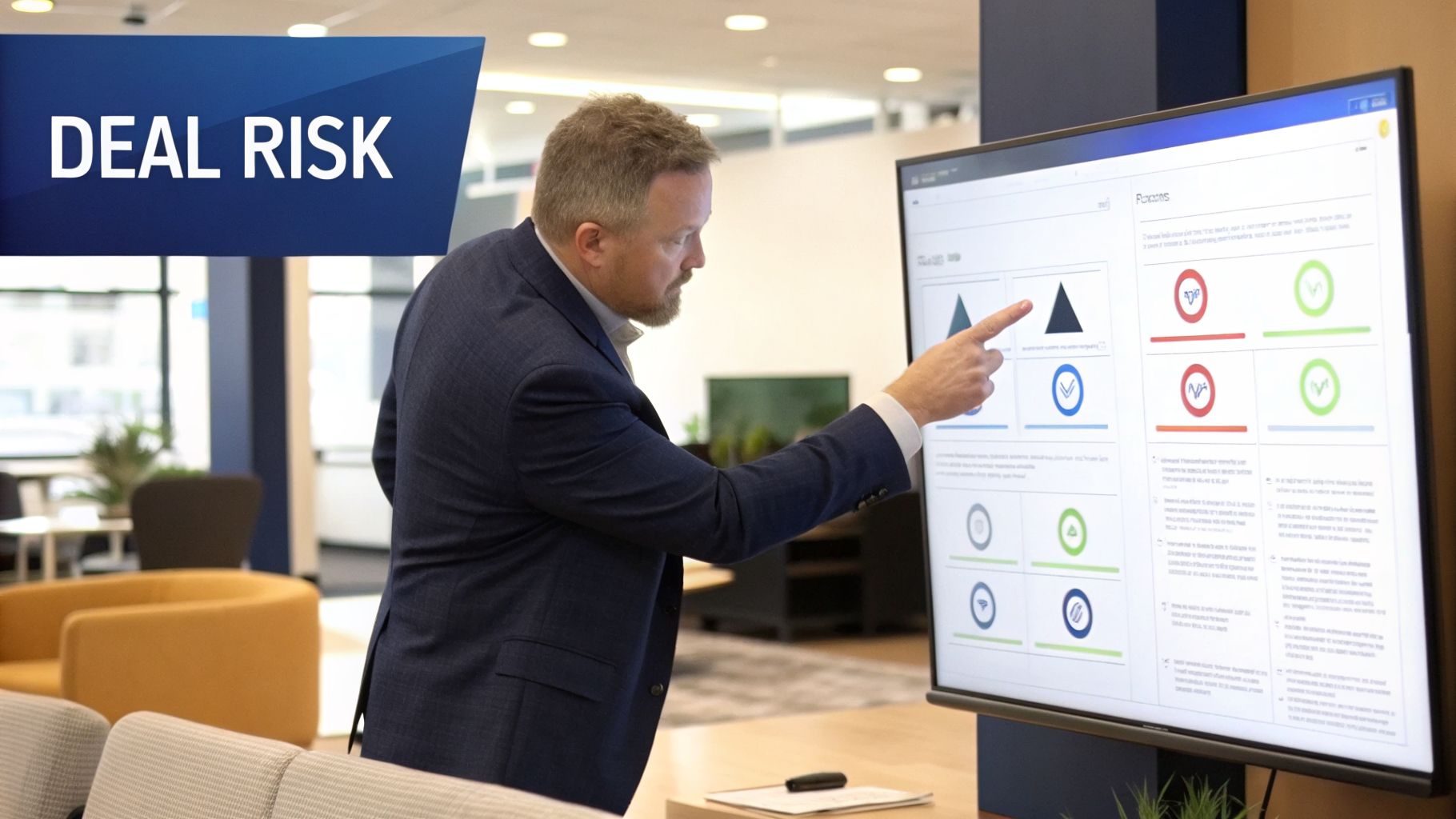
This KPI lets revenue leaders spot deals likely to slip before it's too late. For example, a biotech firm might find that 40% of its forecast is at high risk due to single-threaded relationships. Leadership can then assign executive sponsors to the top 10 at-risk deals and launch a multi-threading campaign. This proactive focus helps rescue deals that would have otherwise been lost.
How to Implement and Use Deal Risk Scoring
A successful deal risk model requires input from sales leadership and a clear process for taking action on the insights.
- Build a Collaborative Model: The best risk models are built with direct input from experienced sales leaders. Ask them, "What makes a deal feel risky to you?" and incorporate their real-world experience into your scoring.
- Weight Factors by Historical Impact: Analyze closed-lost deals from the past year. If a lack of multi-threading is correlated with a 50% higher loss rate, that factor should be weighted more heavily.
- Establish Clear Escalation Protocols: Define what happens when a deal is flagged as high-risk. For example, any deal over $100K marked "red" might trigger an automatic weekly review with a sales director. Platforms like Clari and Gong are designed to surface these risks.
Key Takeaway: Deal Risk Scoring isn't just about spotting problems; it's about driving a specific, timely response. Use this KPI to focus your most valuable resources on the deals where they can have the biggest impact on closing revenue.
8. Revenue Influence from Named Account Strategy (ABM ROI)
Account-Based Marketing (ABM) requires a higher investment of time and budget. ABM ROI is the metric that proves whether this focused strategy is paying off. It compares the revenue generated from your named accounts against the total cost of the marketing and sales resources dedicated to them. For any company running a targeted account strategy, this is one of the most critical b2b marketing kpis to justify the investment.
This KPI moves beyond vanity metrics, tying specific account-based actions directly to closed-won deals. For example, a fintech company might calculate that its ABM program cost $150,000 for the quarter. If those accounts generated $900,000 in new Annual Recurring Revenue (ARR), the ABM ROI is 6:1. This powerful figure shows leadership that the focused approach is a significant revenue driver, not just a cost center.
How to Implement and Use ABM ROI
Calculating this KPI accurately requires meticulous tracking of both costs and revenue attribution.
- Define "Influence" Clearly: Establish firm rules for what counts as marketing influence. Is it a meeting booked from a targeted ad? A demo request after a personalized email? Your CRM and marketing automation platform must be configured to capture these multi-touch points.
- Calculate Fully Loaded Costs: Go beyond just ad spend. Include the cost of ABM-specific software, creative development, event expenses, and even a portion of the salaries for the team members dedicated to the named account list.
- Segment Your ROI Analysis: Don't just look at the overall ROI. Analyze it by account tier or industry. You might find that high-value content drives a 10:1 ROI for enterprise accounts, while virtual events perform better for mid-market targets, allowing you to reallocate budget effectively.
Key Takeaway: ABM ROI is your ultimate proof point. Use it to compare the performance of your named account strategy against your traditional inbound or outbound funnels. A superior ABM ROI validates the strategy and builds the business case for expanding your target account list.
9. Salesmotion Application — Account Engagement Score (AES)
While a standard Account Engagement Score (AES) tracks digital interactions, Salesmotion enriches this metric by layering it with real-world buying signals. This approach correlates basic engagement data with contextual triggers like leadership changes, funding announcements, or key LinkedIn activity. By combining an account's digital footprint with these events, it creates a high-confidence signal that pinpoints the perfect moment for outreach. This makes it one of the most actionable b2b marketing kpis because it tells you not just who is interested, but why they are likely receptive right now.
This combined intelligence ensures sales teams act at the precise moment of opportunity. For example, a SaaS company might see a target account’s AES spike due to website visits. On its own, that’s a decent signal. But Salesmotion flags that this spike coincides with the company announcing a new C-level executive. This transforms a warm lead into a priority outreach opportunity, armed with specific context for a much more relevant conversation. The platform connects the dots between marketing data and real-world business intelligence.
How to Implement and Use a Trigger-Enhanced AES
To make the most of this KPI, you need to operationalize the signals and ensure your team knows how to act on them.
- Define and Prioritize Key Triggers: Not all triggers are equal. A Series C funding round is a much stronger buying signal than a minor press release. Work with sales and marketing to identify and weigh the specific events that most often precede a purchase.
- Create Trigger-Specific Playbooks: Equip your sales team with clear next steps for each type of signal. An outreach sequence following a funding announcement should be different from one responding to a competitor mention. Provide email templates and talk tracks for each context.
- Integrate Signals into Your Workflow: The best intelligence is useless if it lives in a silo. Ensure these trigger alerts are pushed directly into the tools your reps use every day, like your CRM or Slack. This makes it easy for reps to act on time-sensitive information. Platforms like Salesmotion are designed to feed these insights directly into a team's existing workflow.
Key Takeaway: A trigger-enhanced AES is the bridge between marketing automation and sales intelligence. It validates marketing-generated interest with real-world business context, giving revenue teams a clear, data-backed reason to believe that now is the time to engage.
10. Salesmotion Application — Pipeline Influence & Velocity
While traditional KPIs measure what happened, modern revenue teams need to know why it happened and how to repeat that success. This is where pipeline influence and velocity, as tracked by a platform like Salesmotion, become critical. This KPI directly measures the time between a significant buying signal (like a key hire) and the creation of a sales opportunity. It provides a clear link between market events and pipeline generation, answering the question: are we capitalizing on the right triggers at the right time?
This metric moves beyond vanity metrics to focus on the real-world impact of account intelligence. For B2B revenue teams, this is one of the most actionable b2b marketing kpis because it reveals the direct ROI of signal-based selling. It pinpoints which signals consistently lead to opportunities and which reps are most effective at converting them.
For example, a fintech company might find that alerts for a "new Chief Information Security Officer" convert to an opportunity within 14 days, while "Series B funding" alerts take 45 days. This insight allows them to reallocate SDR resources to prioritize the CISO signal for faster pipeline creation. The platform automates this tracking by timestamping a detected signal and correlating it with CRM opportunity creation dates, providing a clear view of what’s working.
How to Implement and Use Pipeline Influence & Velocity
To make this KPI effective, you must establish clear processes for tracking and acting on the data it provides.
- Define and Categorize Key Signals: Not all signals are equal. Work with your marketing and sales teams to identify the top 5-10 buying signals most relevant to your ideal customer. Examples include leadership changes, tech stack updates, or funding rounds.
- Establish Baselines for Velocity: Once you start tracking, establish an average "signal-to-opportunity" velocity for each signal category. This baseline becomes the benchmark you measure against. Your goal is to shorten this window through better messaging and faster follow-up.
- Correlate with Rep Performance: Analyze velocity data on a per-rep basis. You might discover that certain reps excel at converting specific types of signals. Use this information for coaching and sharing best practices.
Key Takeaway: Pipeline influence and velocity directly connect market intelligence to revenue outcomes. Use this KPI to refine your GTM strategy, prove the value of your intel sources, and coach your team on how to act decisively on the triggers that matter most.
Top 10 B2B Marketing KPI Comparison
| Metric / Item | Implementation complexity | Resource requirements | Expected outcomes | Ideal use cases | Key advantages |
|---|---|---|---|---|---|
| Account Engagement Score (AES) | Medium — scoring rules, multi-source integration, baseline setup | CRM hygiene, multi-channel data feeds, analytics, account intelligence tool | Leading indicator of account intent; prioritized accounts; early warning of disengagement | ABM, named account prioritization, engagement-quality coaching | Multi-channel, account-level view; detects buying committee momentum early |
| Pipeline Influence & Velocity | High — attribution modeling, timestamp correlation, cohort analysis | CRM tagging, signal tagging, analytics, cross-team alignment (Sales & RevOps) | Measured revenue impact from signals; faster pipeline creation and qualification | Proving ABM ROI, optimizing signal-driven outreach, forecasting improvements | Direct revenue attribution; identifies highest-value signals; velocity insights |
| Win Rate by Trigger Type | Medium — tag trigger types and correlate with outcomes; historical comparison | Signal taxonomy, opportunity tagging, sufficient deal volume, analytics | Identifies which triggers lead to higher close rates and better deal quality | Signal prioritization, messaging optimization, monitoring trigger effectiveness | Granular insight by trigger; informs targeting and message strategy |
| Sales Cycle Compression Rate | Medium–High — cohort controls, consistent stage definitions, time-series analysis | Clean stage entry/exit dates, cohort segmentation, analytics tooling | % reduction in cycle length; faster close times; productivity gains | Demonstrating revenue acceleration, rep coaching, cash-flow forecasting | Directly links intelligence to faster revenue realization; measurable productivity |
| Account Penetration Depth (Multi-threading Success Rate) | Medium — stakeholder mapping and engagement tracking | Org charts, stakeholder data, relationship intelligence, CRM contacts | Increased deal probability; reduced single-point failure risk; faster stakeholder addition | Complex enterprise deals, consensus-driven purchases, account planning | Correlates multi-threading with win rates; highlights stakeholder gaps; reduces risk |
| Conversion Rate by Account Stage & Intent Signal | Medium — stage-to-stage tracking with signal stratification | Signal scoring, disciplined stage hygiene, analytics, cohort controls | Visibility into funnel efficiency; higher conversion for high-signal accounts | Funnel optimization, lead scoring, marketing-sales alignment | Stage-level validation of signal impact; prioritizes high-intent accounts |
| Deal Risk Scoring & Coverage | High — predictive multi-factor model, regular validation, escalation rules | Historical win/loss data, continuous signal feeds, CRM updates, governance | Early identification of at-risk deals; improved forecast accuracy; targeted interventions | Forecast reviews, executive triage, large/complex pipelines | Proactive triage of risky deals; focuses management attention; reduces leakage |
| Revenue Influence from Named Account Strategy (ABM ROI) | High — full revenue attribution and cost allocation across teams | Cross-functional cost tracking, long-term cohort analysis, robust analytics | Quantified ROI of ABM; informed budgeting and resource allocation | Executive reporting, budgeting, validating ABM investments | Bottom-line ROI clarity; guides resource allocation and strategy decisions |
| Salesmotion Application — Account Engagement Score (AES) | Low–Medium — add trigger layering to existing AES model | Salesmotion integration, alerting rules, rep workflow adjustments | More timely, high-confidence outreach aligned with real-world triggers | Teams using Salesmotion to improve timing of outreach and prioritization | Combines contextual triggers with AES; increases signal confidence and timing |
| Salesmotion Application — Pipeline Influence & Velocity | Low–Medium — automates signal-to-opportunity tracking within platform | Salesmotion + CRM integration, automatic timestamps, analytics setup | Transparent, auditable path from signal to pipeline; optimized signal focus | Teams proving signal impact or automating attribution workflows | Automated attribution and timestamping; simplifies velocity measurement |
From Data Points to Deal Wins: Activating Your KPIs
We've covered a powerful set of B2B marketing KPIs designed to move your teams beyond vanity metrics. The journey from tracking data to closing deals requires a shift in mindset. These KPIs aren't just numbers for a quarterly review; they are active signals that should direct your every move.
The metrics covered, from Account Engagement Score (AES) to Deal Risk Coverage, give you a complete view of your go-to-market health. They reveal the true story behind your pipeline, showing you not just how much you have, but how healthy it is. By dissecting Win Rates by Trigger Type or measuring Sales Cycle Compression, you stop guessing and start making informed decisions based on what actually works.
Shifting from Reactive to Proactive
The real value of these advanced B2B marketing KPIs is their ability to turn your teams from reactive responders into proactive strategists. Instead of waiting for a lead to raise their hand, an Account Engagement Score tells you which accounts are warming up before they make contact. Rather than being surprised by a stalled deal, Deal Risk Scoring and Account Penetration Depth give you an early warning system.
This proactive stance changes the dynamic of sales and marketing alignment. Marketing isn't just generating leads; it's providing actionable intelligence. Sales isn't just closing deals; it's engaging the right buying committee at the perfect moment, armed with context.
Putting Insights into Action
Knowledge without action is just trivia. The true test is how you integrate these KPIs into the daily workflows of your SDRs, AEs, and marketing managers.
- For AEs and SDRs: Use Account Engagement Scores to prioritize your outreach. Focus your time on accounts showing real buying intent, not just those that fit a static profile.
- For Marketing Leaders: Analyze Pipeline Influence and ABM ROI to double down on the campaigns and channels that deliver real results.
- For Revenue Operations: Build dashboards that connect these KPIs. Show how a rising AES on a target account leads to a faster Pipeline Velocity and a higher Win Rate. This creates a clear link between activity and outcomes.
Key Takeaway: The most successful revenue teams don't just track KPIs; they operationalize them. They build plays, alerts, and processes triggered by changes in these metrics, ensuring that valuable insights are never missed.
Ultimately, mastering these B2B marketing KPIs is about gaining control over your revenue engine. It's about replacing uncertainty with predictability and transforming your go-to-market strategy from an art into a science. By focusing on metrics that reflect account-level progress and buying committee engagement, you build a resilient, efficient path to winning more, larger deals. The goal isn't just to measure success; it's to manufacture it.
Ready to stop guessing and start acting on real-time buying signals? Salesmotion is the account intelligence platform that turns these advanced B2B marketing KPIs into your team's daily playbook. See how to activate your data and guide your reps to the right accounts at the right time at Salesmotion.