The best enterprise sales tools for 2027 are a stack, not a single product: an account intelligence tool such as Salesmotion for research before the call, Gong for conversation intelligence, Clari Forecast (now part of Salesloft) for forecasting, ZoomInfo or LinkedIn Sales Navigator for people data, 6sense for intent, Salesforce Sales Cloud as the CRM, and Outreach for engagement. Which one to buy first depends on where your enterprise deals stall today.
Enterprise deals run long and involve many stakeholders. They don't close because a rep sent a clever email. They close because someone did the work: mapping decision-makers, tracking strategic initiatives, understanding the account's fiscal pressures, and timing outreach to moments of change. The right enterprise sales tools make that work possible at scale. The wrong ones add tabs to toggle between.
TL;DR: For research before the call on complex deals, Salesmotion (from $85/mo). For call analytics and coaching across a large team, Gong. For the system of record every other tool plugs into, Salesforce Sales Cloud. Then fill the gap that costs you the most deals: forecasting, people data, intent or engagement.
Top Picks for Enterprise Sales Teams
| Tool | Best for | Starting price |
|---|---|---|
| Salesmotion | Account research and buying signals before every call | $85/mo for individuals. Custom pricing for teams & enterprise. |
| Gong | Conversation intelligence and coaching at scale | Custom (per-user licence + platform fee) |
| Salesforce Sales Cloud | CRM and system of record with built-in AI | Starter Suite $25/user/mo; Max $550/user/mo |
For full reviews of all 10 tools, keep reading. Or compare pricing directly.
Why Trust This Guide?
I'm Semir Jahic, CEO of Salesmotion. I've sold enterprise deals at Salesforce, built Clari's EMEA business, and now run a company that sells to enterprise sales teams every day. Salesmotion publishes this guide and appears in it as #1. It is first because the list follows the order of an enterprise deal, and account research comes before the first call, not because it does every job on this list. We say where each other tool is the better choice.
How we evaluated each tool:
- CRM depth. Does it write into Salesforce or HubSpot, or does it live in its own tab?
- Buying-committee support. Does it help a rep find, map or engage more than one stakeholder?
- Verifiable claims. Every price, product and ownership fact on this page was checked against the vendor's own website on 22 October 2026. Where a vendor does not publish a price, we say so, and third-party figures are named inline.
- Pricing transparency. Published rate card, quote only, or a named third-party median.
- Current ownership. Several enterprise tools merged or renamed in the last year (Clari into Salesloft, People.ai to Backstory). We list each under the name it sells under today.
We removed third-party review scores for other vendors because we could not verify them on the day we checked.
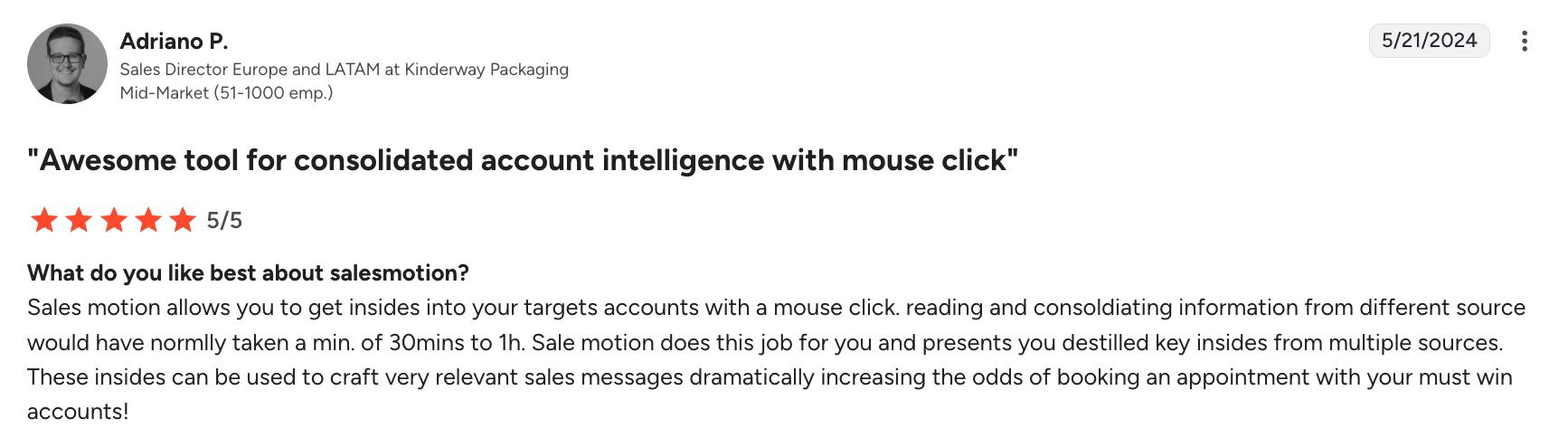 Real G2 review of Salesmotion from an enterprise Sales Director.
What Enterprise Deals Actually Require From Your Tech Stack
Mid-market tools strain when applied to enterprise selling. A contact database that works well for SMB outreach is only the start when you need to understand a Fortune 500 company's strategic initiatives, track C-suite changes across divisions, and map a buying committee spanning four departments.
Enterprise deals require three capabilities most sales tools weren't built around:
Deep account context. Not firmographics. Real context: What did the CEO say on the last earnings call? What strategic initiatives did the 10-K reveal? Who just joined the leadership team, and what mandate did they bring? Reps who walk into discovery with this context skip the "tell me about your business" warmup and start a consultative conversation from minute one.
Signal-based timing. Buying signals like leadership changes, hiring surges, earnings commentary and competitive moves indicate when an account enters a buying window. Enterprise sales cycles are long enough already. Reaching out before a trigger event means you're educating. Reaching out after it means you're selling.
Multi-stakeholder navigation. Single-threaded enterprise deals die quietly when the one contact changes roles or loses the budget argument. Your tools need to help you map, track and engage the full committee, not just the initial champion.
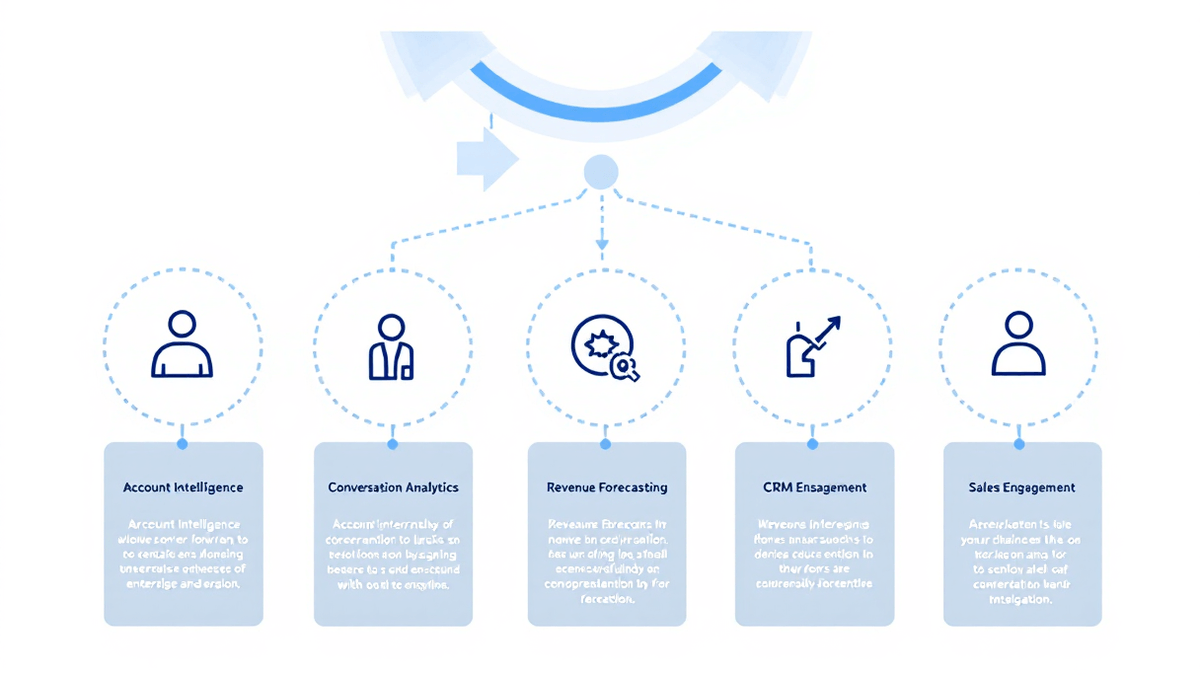 The five layers of an enterprise sales tech stack.

“The moment we turned on Salesmotion, it became essential. No more hours on LinkedIn or Google to figure out who we're talking to. It's just there, served up to you, so it's always 'go time.'”
Adam Wainwright
Head of Revenue, Cacheflow
Enterprise Sales Tools Comparison
The list is ordered by where each tool sits in an enterprise deal: research before the call, then conversations, forecasting, people data, intent, the CRM, the professional network, engagement, qualification and activity capture.
| Tool | Category | Best for | Starting price | Free plan or trial |
|---|---|---|---|---|
| Salesmotion | Account intelligence | Research and buying signals before every call | $85/mo for individuals. Custom pricing for teams & enterprise. | Interactive demo |
| Gong | Conversation intelligence | Call analytics and coaching | Custom (per-user licence + platform fee) | Quote request |
| Clari Forecast (Salesloft) | Forecasting | Forecast calls and pipeline inspection | Custom, quote-only | None listed |
| ZoomInfo | Data + AI sales agent | Contact data, org charts and buyer signals | Custom, consumption-based | ZoomInfo Lite free tier (10 credits a month) |
| 6sense | ABM + intent | Predictive account prioritization on intent data | Custom, quote-only | Demo request |
| Salesforce Sales Cloud | CRM + AI | System of record with Agentforce | $25-$550/user/mo | 30-day free trial |
| LinkedIn Sales Navigator | Professional network | Relationship mapping and social selling | Core $119.99/mo; Advanced $159.99/mo | Free trial for eligible members |
| Outreach | Sales engagement | Sequences, deal management and AI agents | Custom (per user, no platform fees) | None listed |
| MEDDICC and Ebsta | Deal qualification | MEDDPICC training and pipeline inspection | Not published | Not listed |
| Backstory (formerly People.ai) | Revenue intelligence | Activity capture and stakeholder engagement | Not published | Quote request |
The 10 Best Enterprise Sales Tools (Detailed Reviews)
1. Salesmotion: Best for Account Research on Complex Deals
Salesmotion replaces the research tabs enterprise AEs toggle between before a meeting. Instead of stitching together SEC filings, LinkedIn, news sites and CRM notes, a rep gets a cited account brief in minutes: earnings call summaries, strategic initiatives, leadership changes, competitive moves and hiring patterns in one view, with a source on every point.
Three AI agents do the work. The Signal Agent monitors 1,000+ public sources for 50+ signal types. The Research Agent builds the account brief. The Outreach Agent drafts messages anchored to the trigger, for the rep to review and send.
For enterprise deals where preparation quality drives deal velocity, this changes the math. Cacheflow's Head of Revenue Adam Wainwright cut meeting prep time by 60%, and Cacheflow's average deal size grew from $5-7K to $18-20K within six months. Cytel's sales team reduced research time by 50% and consolidated five research tools into one.
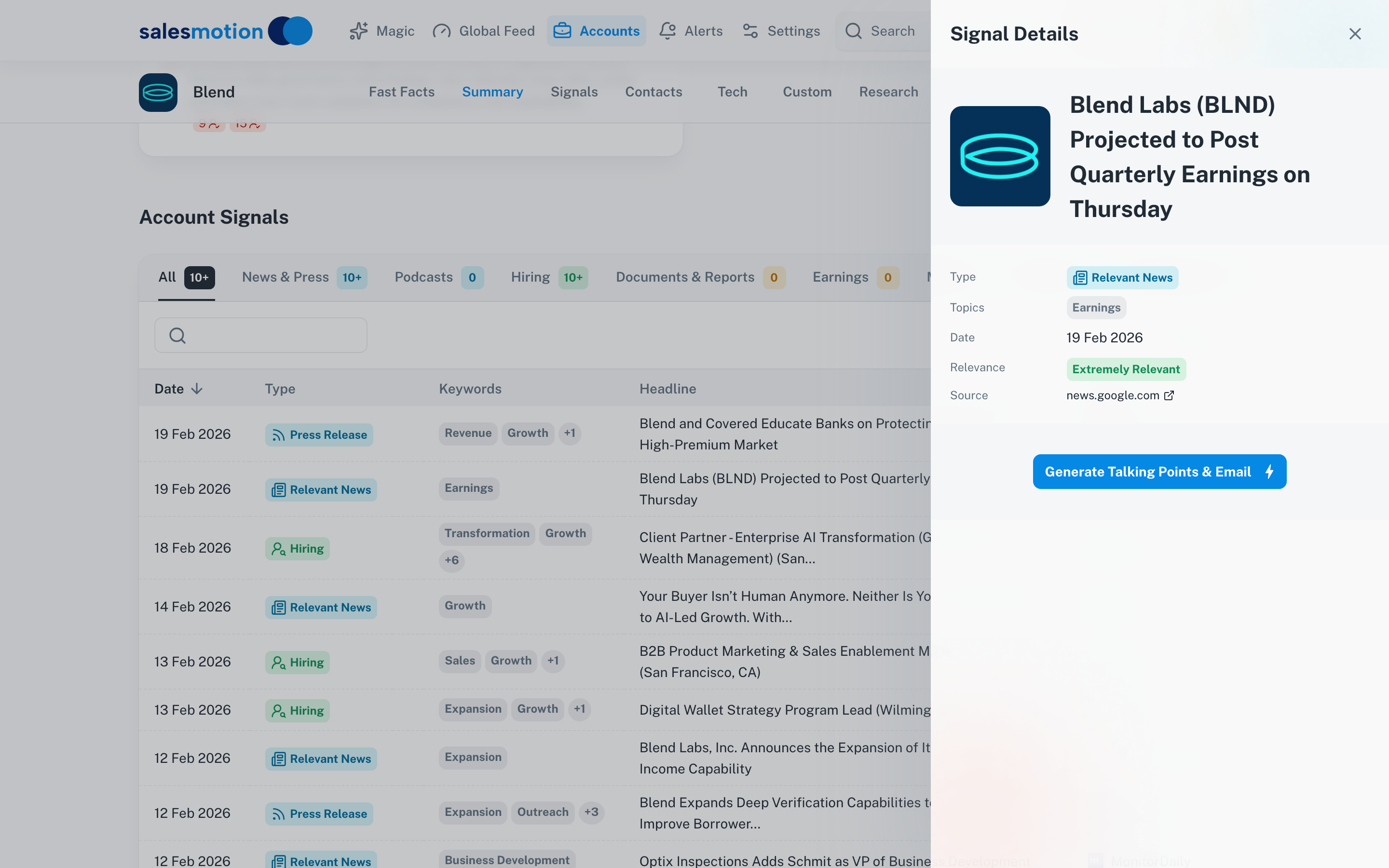 Salesmotion tracks earnings calls, hiring patterns and strategic signals so enterprise AEs walk into every meeting prepared.
Key Features:
- Account monitoring. The Signal Agent watches 1,000+ public sources for 50+ signal types, including leadership changes, earnings calls, hiring and funding.
- Cited account briefs. One-click summaries of strategic initiatives, fiscal pressures and buying signals, with the source linked on each point.
- Contacts on every account. The Individual plan includes 200 contact credits a month for verified emails and phone numbers.
- CRM and AI assistants. Native Salesforce integration, a HubSpot integration on the Enterprise plan, outreach drafts pushed to lemlist, and a REST API and MCP server for Claude, ChatGPT and other assistants.
Pricing: $85/mo for individuals on a monthly contract (up to 100 accounts, 200 contact credits a month). Custom pricing for teams and enterprise. There is no free trial; you can try the interactive demo.
Best for: Enterprise AEs managing a book of strategic accounts who need current, cited account intelligence before every conversation.
✅ Pros
- Replaces several research tabs with one cited brief per account
- Signal alerts surface timing before a rep would find it manually
- Published price on a monthly contract
- Fast start: Cacheflow reports a 24-hour time to value
❌ Cons
- Built for research and signals: pair it with Gong for call analytics and a forecasting tool for the number
- Drafts outreach for a rep to review; high-volume sequencing stays in your engagement platform
- No free plan; evaluation runs through the interactive demo or a call
Salesmotion's Take
Enterprise deals don't close because you had better contacts. They close because someone did the work: mapped the buying committee, understood the strategic priorities, and timed outreach to a moment of change. Salesmotion automates that research layer. Gong handles conversation intelligence. Clari Forecast handles the number. You need all three, but start with intelligence. Everything downstream performs better when reps are prepared.

Semir Jahic
CEO & Co-Founder, Salesmotion
2. Gong: Best for Conversation Intelligence and Sales Coaching
Gong records, transcribes and analyzes every customer-facing conversation to surface patterns managers miss. For enterprise teams running hundreds of calls a week, Gong shows which talk tracks correlate with closed deals, where reps lose momentum in multi-stakeholder discussions, and how top performers handle objections.
Gong describes itself as the "#1 AI OS for Revenue Teams" and says it has more than 5,000 customers. In 2026 it entered enablement with Gong Enable and, on 30 September 2026, announced Gong Enrich, a sales enrichment layer, as part of its Mission Callisto release (Gong press).
Key Features:
- Talk track analysis. Identifies which language patterns correlate with closed deals across many calls.
- Deal execution. AI agents recommend next steps and flag deal risks.
- Multi-stakeholder tracking. Shows where reps lose momentum in conversations with several decision-makers.
- Coaching at scale. Data-driven coaching for large teams, now extended with Gong Enable.
Pricing: Gong publishes no pricing. Its pricing page confirms licences are priced per user with a platform fee based on the number of users supported, and that integrations are included.
Best for: Enterprise sales organizations with 50+ reps where coaching at scale and deal visibility across the pipeline matter.
✅ Pros
- A standard for conversation analytics, with 5,000+ customers
- Correlates language patterns with deal outcomes, not just transcription
- AI agents extend into deal execution, not just call review
- Enablement and enrichment now sit in the same platform
❌ Cons
- Built around your own customer conversations, so external account research before the call is a separate layer
- No published pricing: every number comes from a quote
- Pattern analysis gets more useful as call volume grows
3. Clari Forecast (Salesloft): Best for Revenue Forecasting and Pipeline Visibility
Clari Forecast is now sold by Salesloft. Clari and Salesloft completed their merger on 3 December 2025, and clari.com now redirects to salesloft.com (Salesloft newsroom). The combined company sells Clari Forecast alongside Cadence, Conversation Intelligence, Deals, Inspect, Rhythm, Analytics, Signals, AI agents and an MCP server.
For enterprise RevOps teams, that means forecast calls, pipeline inspection and deal management sit in the same vendor as prospecting cadences. Salesloft's AI agents include Account Research, Buyer Identification, Deal Summaries and Stalled Deals Insight.
Key Features:
- Clari Forecast. Forecast rollups and calls for revenue leaders.
- Inspect and Deals. Pipeline inspection and deal management in one view.
- Unified revenue platform. Prospecting cadences through forecasting from one vendor.
- AI agents. Sixteen named agents, including Stalled Deals Insight and Deal Summaries.
Pricing: Salesloft does not publish list pricing. Its pricing page lists products, including Clari Forecast, without dollar figures.
Best for: VP-level revenue leaders who need forecast discipline and pipeline visibility across complex, multi-quarter deals.
✅ Pros
- Forecasting and pipeline inspection built for RevOps
- The Salesloft merger puts prospecting and forecasting under one vendor
- AI agents for deal summaries and stalled-deal detection
- MCP server for AI assistants
❌ Cons
- Forecasts are only as good as the CRM data and activity behind them
- No published pricing, so cost comes from a quote
- Teams on another engagement platform should ask how Clari Forecast is packaged on its own
4. ZoomInfo: Best for Contact Data and Buyer Signals
ZoomInfo offers verified data on 500M+ contacts and 100M+ companies, including 120M+ direct-dial phone numbers. For enterprise teams the value extends beyond contacts: ZoomInfo Copilot, which ZoomInfo calls "Your AI Sales Agent", surfaces buyer signals and assembles contacts, org charts, account history and company updates into deal briefs.
Around the data, ZoomInfo sells GTM Workspace (agents for account research, meeting prep and deal prioritization), GTM Studio for workflows triggered by buying signals, Streaming Intent and Engage as add-ons, and API and MCP access.
Key Features:
- Large contact database. 500M+ contacts across 100M+ companies, with 120M+ direct dials.
- Org charts and deal briefs. Copilot assembles contacts, org charts and company updates for complex accounts.
- Buyer signals and intent. Copilot signals, plus Streaming Intent as an add-on to base plans.
- Technographic data. Shows what technology accounts use, for displacement plays.
Pricing: ZoomInfo publishes no list pricing; its own pricing page says so, because the model is consumption-based. Vendr reports a median contract of $33,500 a year based on 1,576 purchases. ZoomInfo Lite is a permanent free tier with 10 credits a month.
Best for: Enterprise teams that need contact discovery volume, org charts and buyer signals from one vendor.
✅ Pros
- Database breadth: 500M+ contacts, 100M+ companies and 120M+ direct dials
- Org charts and technographic data for mapping complex accounts
- Copilot adds buyer signals and deal briefs on top of the data
- A free tier (ZoomInfo Lite) for individual evaluation
❌ Cons
- Built around contact and company data, with Copilot adding buyer signals. Pair it with account intelligence for earnings analysis and initiative tracking
- Quote-only: Vendr reports a median contract of $33,500 a year based on 1,576 purchases
- Intent and engagement are add-ons to base plans
5. 6sense: Best for ABM Orchestration and Intent
6sense prioritizes accounts on its own intent network, which it says draws on "13 years of proprietary Signalverse intent". Its products span Revenue Marketing, Sales Intelligence, Predictive Modeling, advertising, AI email agents and an MCP server, and its RevvyAI assistant offers account research, meeting prep and sales strategy.
For enterprise ABM programs, 6sense's predictive account prioritization helps marketing and sales agree on which accounts are in market before they fill out a form. 6sense says it was named a Leader in The Forrester Wave: Revenue Marketing Platforms for B2B, Q1 2026.
Key Features:
- Predictive account prioritization. Ranks accounts on Signalverse intent data.
- RevvyAI. Account research, meeting prep and talking points grounded in account activity.
- Data credits. Reveal and export emails, phone numbers and enriched contact and company records.
- Multi-channel activation. Advertising, AI email agents and audience building from the same platform.
Pricing: 6sense publishes no pricing. Vendr's marketplace data reports a median annual contract value of $62,220 across 386 purchases, with a range of $11,234 to $176,511.
Best for: Enterprise organizations with dedicated ABM teams and the budget to put intent data to work across marketing and sales.
✅ Pros
- Predictive prioritization on a large proprietary intent network
- Marketing and sales work from the same account scores
- RevvyAI adds account research and meeting prep
- A Forrester Wave Leader for revenue marketing (Q1 2026)
❌ Cons
- A large commitment: Vendr's median 6sense purchase is $62,220/year, with a range up to $176,511
- Getting value requires marketing and sales to act on the same scores
- Intent says an account is researching; reps still need account context for the conversation
6. Salesforce Sales Cloud: Best for CRM and Ecosystem Integration
Salesforce Sales Cloud remains the enterprise CRM standard. In September 2026 Salesforce renamed its editions to Starter Suite, Pro Suite, Core, Advanced and Max. Core includes pipeline management and forecasting, opportunity scoring and conversation intelligence; Max adds Agentforce for Sales and the full AI suite.
For enterprise deals, Salesforce's value is its extensibility. Custom objects for buying committees, approval workflows for enterprise pricing, CPQ and the AppExchange make it the operational backbone most enterprise sales organizations build around.
Key Features:
- Built-in AI. Opportunity scoring, forecasting and conversation intelligence from Core upward.
- Agentforce. AI agents for sales on the Max edition, and available to add from Core.
- Deep extensibility. Custom objects for buying committees, approval workflows and CPQ.
- AppExchange. Nearly every other tool on this list integrates with Salesforce.
Pricing: Starter Suite at $25, Pro Suite at $100, Core at $195, Advanced at $395 and Max at $550 per user per month (Starter billed monthly or annually, the rest annually). Sales Engagement is listed at $50/user/month as an add-on. Salesforce offers a free 30-day trial.
Best for: Any enterprise sales team that needs a system of record with deep customization, workflow automation and integrations.
✅ Pros
- Industry standard, with integration support across the sales tool landscape
- Agentforce adds AI agents inside the CRM
- Extensibility with custom objects, workflows and AppExchange apps
- Handles pricing, CPQ and approval flows for enterprise deals
❌ Cons
- A platform, not a point solution. In my years selling it, its breadth was always the pitch and its depth in any single category never was
- Enterprise teams usually layer specialized tools on top for research, engagement and forecasting
- Costs add up at scale: $395/user/month on Advanced and $550 on Max
For teams evaluating engagement tools within the Salesforce ecosystem, see our Salesforce Sales Engagement alternatives guide.
7. LinkedIn Sales Navigator: Best for Relationship Mapping and Social Selling
LinkedIn Sales Navigator is the standard for enterprise social selling. 50+ advanced search filters, lead recommendations, InMail and relationship mapping help reps find and engage stakeholders across complex buying committees.
For enterprise AEs, TeamLink reveals warm paths into accounts through colleagues' connections, and Relationship Explorer highlights potential champions and decision-makers. Account IQ and Lead IQ add AI summaries of accounts and leads, and Buyer Intent on Advanced shows which companies are showing interest.
Key Features:
- TeamLink. Warm paths into accounts through colleagues' connections.
- Relationship Explorer and Relationship Map. Map stakeholders and plan multi-threading.
- Account IQ and Lead IQ. AI research summaries drawn from LinkedIn data.
- InMail. 50 InMail credits a month on every plan.
Pricing: Core at $119.99/user/month or $1,079.88/year. Advanced at $159.99/user/month or $1,799.88/year. Advanced Plus (enterprise, with CRM sync) is priced on request. All three include 50 InMail credits a month.
Best for: Enterprise AEs who rely on relationship-driven selling and need to map buying committees across large organizations.
✅ Pros
- LinkedIn's professional network is the freshest source of job and career data
- TeamLink reveals warm introduction paths
- Relationship Explorer helps identify champions and decision-makers
- Account IQ and Lead IQ add AI research inside LinkedIn
❌ Cons
- Built on member-maintained profile data, with Account IQ adding AI account insights drawn from LinkedIn
- Signals come from LinkedIn data (job changes, buyer intent, engagement). Pair with account intelligence for earnings calls and strategic initiatives
- Advanced Plus (with CRM sync) is priced on request
For a detailed comparison of alternatives, see our LinkedIn Sales Navigator alternatives guide.
8. Outreach: Best for Sales Engagement and Sequence Management
Outreach manages the engagement lifecycle from prospecting sequences to deal management. For enterprise teams, its value now goes beyond email automation: it lists AI agents including a Revenue Agent that identifies high-intent accounts, a Research Agent, a Meeting Prep Agent, a Deal Agent and a Personalization Agent, plus Agent Studio and an Outreach MCP.
Its Research Agent combines Outreach conversation and engagement data with public sources such as company websites and news, so research and sequencing sit in one platform.
Key Features:
- AI agents. Revenue, Research, Meeting Prep, Deal and Personalization agents.
- Multi-channel sequences. Structured outreach across email, phone and social.
- Deal management. Deal Agent and pipeline views beyond sequences.
- Conversation intelligence. Kaia records, transcribes and analyzes calls.
Pricing: Outreach publishes no dollar figures. It sells four tiers (Amplify Essentials, Core, Plus and Pro), differentiated by AI credit allotments, on per-user pricing with no platform fees.
Best for: Enterprise SDR and AE teams that need structured outreach workflows, testing and engagement analytics at scale.
✅ Pros
- Full engagement lifecycle, from sequences to deal management, in one platform
- Revenue Agent identifies high-intent accounts from engagement data
- Research and Personalization Agents add context to messages
- Per-user pricing with no platform fees
❌ Cons
- Strongest on how you engage. Its Research and Personalization Agents add context, and deeper account intelligence sharpens what to say
- No published pricing: every plan is quoted
- Sequences pay off when the account context behind them is current
9. MEDDICC and Ebsta: Best for Enterprise Deal Qualification
MEDDICC (Metrics, Economic Buyer, Decision Criteria, Decision Process, Identify Pain, Champion, Competition) is the dominant enterprise deal qualification framework, and MEDDPICC adds Paper Process. Two vendors turn it into an operating process:
- MEDDICC sells the MEDDPICC Masterclass with certification, plus software: Deals ("sales pipeline inspection and opportunity scoring built on MEDDPICC") and Calls, which connects customer conversations to opportunities in your CRM.
- Ebsta is a revenue intelligence platform with conversation, relationship and revenue intelligence, an Ebsta for Salesforce integration, and pipeline review and top-deals review playbooks.
Key Features:
- Opportunity scoring on MEDDPICC. MEDDICC's Deals product scores and inspects pipeline against the framework.
- Certification. The MEDDPICC Masterclass trains and certifies the team.
- Relationship scoring. Ebsta scores relationships with customers, opportunities and prospects.
- CRM-embedded reviews. Ebsta works inside Salesforce and HubSpot for pipeline reviews.
Pricing: Neither MEDDICC nor Ebsta publishes prices on its website. Training and software are quoted separately.
Best for: Enterprise sales organizations with $100K+ ACV deals where deal qualification discipline separates winners from time-wasters.
✅ Pros
- Turns a training concept into an operating process managers can inspect weekly
- Structured scoring keeps reps from spending cycles on unqualified opportunities
- Options from training and certification (MEDDICC) to CRM-embedded intelligence (Ebsta)
- Surfacing deal gaps early makes forecast calls more honest
❌ Cons
- Qualification fields are only as current as the last update
- Champion and economic-buyer changes happen outside the CRM, so pair qualification with signal monitoring
- Two vendors, two purchases, if you want both training and software
10. Backstory (formerly People.ai): Best for Activity Capture and Stakeholder Engagement
Backstory, the new name for People.ai, captures sales activity automatically (emails, meetings and calls) and matches it to the right accounts, opportunities and contacts in Salesforce, Microsoft Dynamics or Oracle. For enterprise organizations where CRM hygiene is a constant problem, Backstory provides the activity data that forecasting and coaching depend on.
It maps every stakeholder on a deal and offers stakeholder engagement analysis and multi-threaded deal tracking, so managers can see where coverage is thin. It also offers revenue forecasting, a Backstory Assistant and an MCP server for Claude, ChatGPT, Gemini and Copilot.
Key Features:
- Automatic activity capture. Emails, meetings and calls matched to accounts, opportunities and contacts without manual logging.
- Stakeholder engagement analysis. Shows which stakeholders are engaged on a deal.
- Multi-threaded deal tracking. Coverage across the buying committee, deal by deal.
- Forecasting and MCP. Revenue forecasting, plus answers inside your AI assistant through its MCP server.
Pricing: Backstory does not publish pricing; its pricing page offers a tailored quote and says everyone gets the full product.
Best for: Enterprise RevOps teams focused on CRM data quality, activity-based pipeline management and buyer engagement analytics.
✅ Pros
- Removes manual CRM logging: activity captured and matched automatically
- Stakeholder engagement analysis shows multi-threading gaps
- Provides the activity data forecasting and coaching depend on
- One product for everyone, with no feature tiers
❌ Cons
- Built on your own activity data. Pair it with account intelligence for what is happening at the account outside your conversations
- No published pricing, so cost comes from a quote
- Value grows with how much of your team's email and calendar it connects to

“All of the vendors that I've worked with, all of the onboarding that I have had to deal with, I will say, hands down, Salesmotion was the easiest that I have had.”
Lyndsay Thomson
Head of Sales Operations, Cytel
Building the Enterprise Sales Stack: What Goes Where
No single tool covers everything enterprise selling demands. The question isn't which tool to buy. It's how they fit together.
Layer 1: Foundation (CRM). Salesforce Sales Cloud as the system of record. Every other tool feeds into or pulls from it.
Layer 2: Intelligence. This is where enterprise deals are won or lost. An account intelligence platform for earnings analysis, strategic initiative tracking and signal monitoring. ZoomInfo or LinkedIn Sales Navigator for people data. 6sense for intent data if your ABM program is mature enough to act on it.
Layer 3: Engagement. Outreach for structured sequences and deal management. LinkedIn Sales Navigator for relationship-driven outreach.
Layer 4: Analytics. Gong for conversation intelligence and coaching. Clari Forecast for forecasting and pipeline visibility. Backstory for activity capture and CRM data quality.
Layer 5: Process. MEDDICC or Ebsta to enforce deal qualification discipline inside the CRM.
The most common mistake is over-investing in Layers 3 and 4 (engagement and analytics) while under-investing in Layer 2 (intelligence). Teams that send more emails faster without better account context just create more noise.
Key Takeaways
- The best enterprise sales tools for 2027 form a stack: account intelligence, conversation intelligence, forecasting, people data, intent, CRM, engagement, qualification and activity capture. No single tool covers all of them.
- Account intelligence is the highest-leverage layer for complex deals. Cacheflow cut prep time by 60% and Cytel cut research time by 50% once reps had cited account context before every conversation.
- Clari and Salesloft completed their merger on 3 December 2025, and People.ai now sells as Backstory. Check what your current vendors are called and how they are packaged before you renew.
- Build your stack in layers: CRM foundation, intelligence, engagement, analytics and process. Most teams over-invest in engagement and analytics and under-invest in intelligence.
- Multi-threading is non-negotiable. Choose tools that help you map and engage the full buying committee, not just the initial champion.
- Evaluate tools on enterprise criteria: CRM integration depth, security posture you can verify, buying-committee support, and whether the tool was designed for a book of strategic accounts or for high-volume prospecting.
Frequently Asked Questions
What are the best B2B sales tools for enterprise teams?
For enterprise B2B sales, the best tools cover different stages of the deal: Salesmotion for account research and buying signals, Gong for conversation intelligence, Clari Forecast (Salesloft) for forecasting, ZoomInfo or LinkedIn Sales Navigator for people data, 6sense for intent, Salesforce Sales Cloud as the CRM, and Outreach for engagement. Start with the stage where your deals stall most often.
What is the most important sales tool for enterprise deals?
Account intelligence is the highest-leverage investment for enterprise sales. CRM and engagement platforms are necessary infrastructure, but the quality of account research determines how well reps run discovery with a large buying committee. Teams using dedicated account intelligence report 60% less prep time because reps enter every meeting with strategic context, not generic talking points.
Which sales tools have the best CRM integration for complex, multi-stakeholder deals?
Salesforce Sales Cloud is the system of record most enterprise tools integrate with. Among the tools here, Backstory captures emails, meetings and calls into Salesforce, Microsoft Dynamics and Oracle automatically; Ebsta works inside Salesforce and HubSpot for pipeline reviews; ZoomInfo Copilot connects to Salesforce, HubSpot, Outreach, Salesloft and Gong; and Salesmotion has a native Salesforce integration and a HubSpot integration. For multi-stakeholder deals, check that the tool writes contacts and activity onto the opportunity, not just the account.
What pipeline management tools do enterprise AEs use for large deals?
Enterprise AEs on multi-million-dollar deals usually combine a CRM (Salesforce Sales Cloud), a forecasting and inspection tool (Clari Forecast and Inspect from Salesloft), a qualification method embedded in the CRM (MEDDICC's Deals product or Ebsta), and an account intelligence tool that flags changes at the account, such as a new executive or an earnings-call priority, before they show up in the pipeline.
What is enterprise sales AI software?
Enterprise sales AI software applies AI to a specific job in a complex deal. Examples on this list: Salesmotion's agents monitor accounts and write cited briefs, Gong analyzes calls, ZoomInfo Copilot assembles deal briefs from its data, Salesforce Agentforce runs AI agents inside the CRM, Outreach's agents research and personalize sequences, and 6sense's RevvyAI supports meeting prep. Choose by the job, not by the AI label.
How do I evaluate whether a sales tool is enterprise-ready?
Look for five indicators: native Salesforce or HubSpot integration, security certifications you can check on the vendor's site, SSO/SAML support, flexible user provisioning, and customers of your size. Also test whether the tool handles the complexity of enterprise accounts (multi-division organizations, global presence, large buying committees) or was designed mainly for high-volume selling.
Can conversation intelligence replace account intelligence?
No. They serve different stages of the deal. Conversation intelligence such as Gong analyzes what happened on your calls. Account intelligence surfaces what is happening at the account before the call: leadership changes, earnings commentary, strategic initiatives, competitive moves. The most effective enterprise teams use both. Conversation data tells you how the last meeting went. Account intelligence tells you what to prepare for the next one.
What signals matter most for enterprise deal timing?
The highest-value buying signals for enterprise timing include leadership changes (a new CRO, VP of Sales or CIO often brings new vendor evaluations), earnings call language about transformation initiatives or budget, hiring surges in relevant departments (postings for Salesforce admins suggest a CRM overhaul), competitive displacement signals, and M&A activity. Monitoring these continuously, rather than checking before each call, is what separates proactive enterprise selling from reactive pipeline management.