Only 16% of B2B sales reps hit their annual quota in 2024, according to Salesforce research. Pipeline generation is the root cause. Reps spend just 28% of their week actually selling, sales cycles have stretched 32% longer since 2021, and cold email reply rates hover between 1-5%. The old playbook of blasting more emails to more contacts produces diminishing returns every quarter.
The pipeline generation tools you choose directly determine whether your team builds high-quality, signal-informed pipeline or drowns in low-conversion busywork. This guide compares the 10 best pipeline generation tools for B2B sales teams planning 2027, broken down by approach: signal-driven intelligence, prospecting automation, sales engagement, ABM, and high-volume outreach.
Looking for pipeline generation tools?
Pipeline generation tools sell volume. Salesmotion sells precision — the right account, the right moment, the right message.
AI agents that work every account 24/7 so your reps know who to target, why now, and what to send. From $85/mo.
TL;DR: The best pipeline generation tools for 2027 combine real-time buying signals with account intelligence and automated outreach. Volume-based tools still have a place for early-stage teams, but mid-market and enterprise sellers increasingly need signal-driven platforms that surface the right accounts at the right time. Apollo.io, Clay, and ListKit win on affordability and flexibility.
Why Pipeline Generation Is Harder Than Ever
Three structural shifts have made pipeline generation fundamentally different from five years ago.
Buyers arrive pre-decided. Corporate Visions research shows 94% of buying groups rank their shortlist before they ever contact sales. The vendor ranked first wins about 80% of the time. If you are not in the conversation early, you are not in it at all.
Buying committees have expanded. The average B2B deal now involves 11 stakeholders, according to SiriusDecisions. That means more approvals, longer cycles, and more chances for deals to stall. Enterprise teams report sales cycles of 6-12 months routinely.
Outreach volume no longer compensates. The average enterprise SDR now requires 4x more outreach activities to book meetings compared to 2022, per Insight Partners. Generic outreach lacks the contextual relevance that drives executive engagement. Sending more emails to the same list is not a pipeline strategy.
These shifts explain why the most effective pipeline generation tools today are not the ones that help you send more, but the ones that help you know more before you send anything.
How to Evaluate Pipeline Generation Tools
Before comparing specific tools, here is a framework for what actually matters in a pipeline generation platform.
Signal Quality Over Contact Quantity
Contact databases give you names. Signal platforms tell you timing. The difference is enormous. Champion migration signals (a former buyer changing companies) generate opportunities with 114% higher win rates and 54% larger deal sizes, per Cognism. New executive appointments compress evaluation windows because incoming leaders deploy 75% of budgets within their first two quarters.
The tools that surface these signals before your competitors see them are the ones that generate real pipeline, not just activity metrics.
Integration With Existing Workflows
A tool that lives outside your CRM creates friction. Reps already toggle between 5-8 applications daily. The best pipeline generation tools push intelligence into Salesforce or HubSpot natively, so reps act on signals without switching tabs.
Time-to-Value and Total Cost
Enterprise platforms with six-month implementations and five- to six-figure annual commitments make sense for large organizations with dedicated RevOps teams. But most mid-market teams need tools that deliver value in weeks, not quarters. Factor in not just license cost, but onboarding time, admin burden, and how quickly reps actually use it.

“We're no longer fishing. We know who the right customers are, and we can qualify them quickly. Salesmotion has had a direct impact on pipeline quality.”
Andrew Giordano
VP of Global Commercial Operations, Analytic Partners
The 10 Best Pipeline Generation Tools for 2027
Here is how the top pipeline generation tools compare across key dimensions.
| Tool | Best For | Approach | Starting Price | Ideal Team Size |
|---|---|---|---|---|
| Salesmotion | Signal-driven pipeline | Account intelligence + signals | From $85/mo | 5-200 reps |
| Apollo.io | Prospecting + sequences | Contact database + outreach | Free; $49-$119/user/mo | 1-50 reps |
| ZoomInfo | Enterprise data + engagement | Contact + intent data | Quote-only, consumption-based | 20-500+ reps |
| Outreach | Sales engagement at scale | Sequence automation | Quote-only | 20-500+ reps |
| Salesloft | Revenue workflow platform | Engagement + conversation intel | Quote-only | 20-500+ reps |
| 6sense | Intent-driven ABM | Predictive analytics + intent | Quote-only | 50-1,000+ reps |
| Demandbase | ABM pipeline generation | Account-based advertising + data | Quote-only | 20-500+ reps |
| Clay | Enrichment + creative outreach | Data waterfall + AI | Free; Launch $185/mo | 1-50 reps |
| Instantly | Cold email at scale | Email infrastructure + sending | From $47/mo | 1-20 reps |
| ListKit.io | Verified lead data + cold email | Contact database + sending | $597/mo | 1-50 reps |
1. Salesmotion
Salesmotion generates pipeline through real-time buying signals and deep account intelligence, not static contact lists. The platform monitors 1,000+ public and private sources for leadership changes, earnings commentary, hiring patterns, funding rounds, product launches, and competitive moves across your entire territory, 24/7.
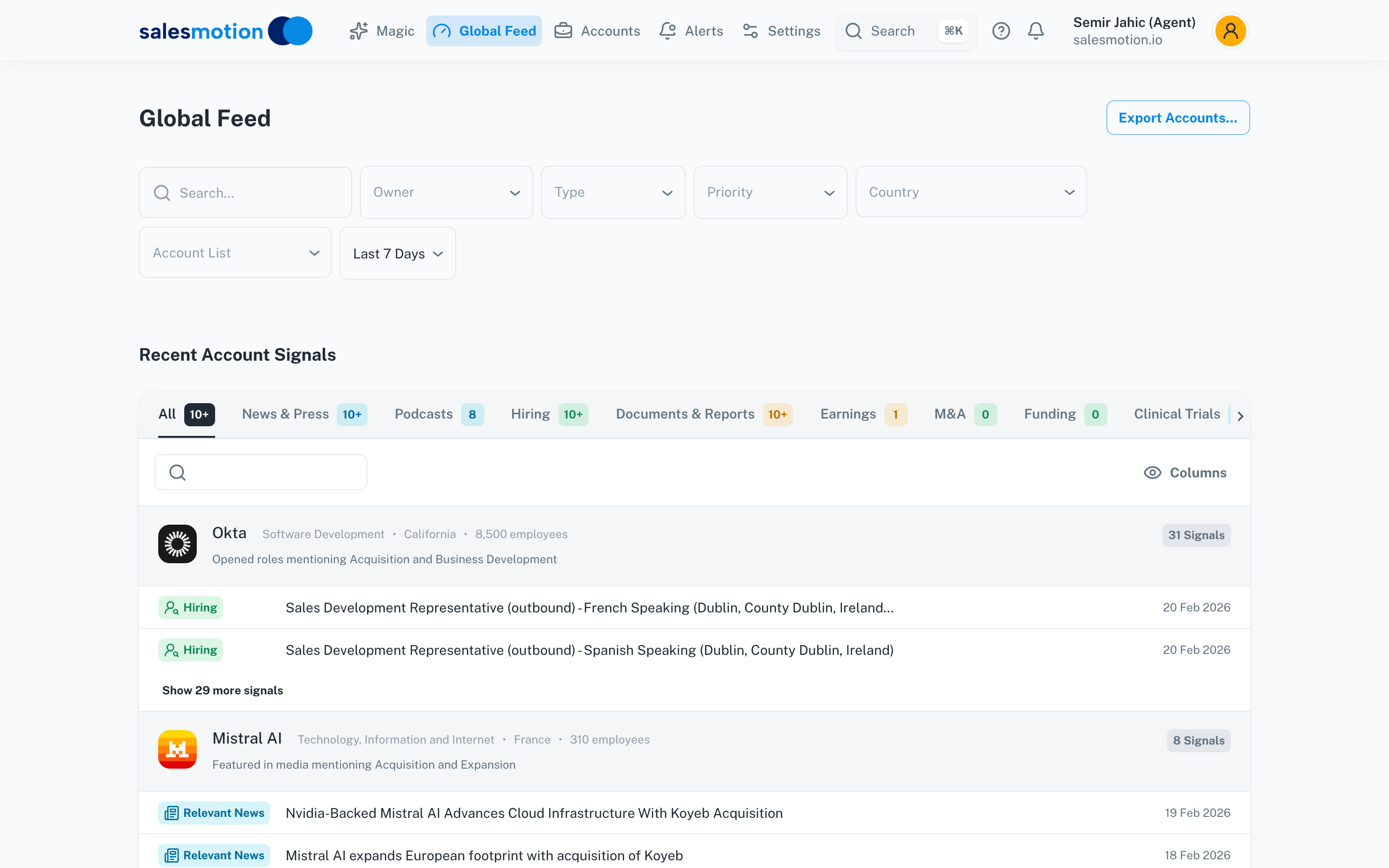 Salesmotion surfaces buying signals across your entire territory in a single feed — so pipeline opportunities come to you instead of requiring manual research.
What sets it apart: Most tools tell you who to call. This platform tells you why and when. When a target account posts a VP of Revenue Operations role, it flags the account and surfaces context: the new hire connects to an earnings call mention of a "sales transformation initiative," plus three recent competitive signals. The rep enters discovery already knowing the likely pain, the key stakeholders, and the timing.
Real results: Analytic Partners grew qualified pipeline 40% year-over-year and built $1M+ in Fortune 500 pipeline from a single signal-driven inbound deal. Frontify grew self-sourced revenue 4x in three quarters, with a 42% increase in sales velocity.
Best for: Mid-market and enterprise sales teams that need self-sourced pipeline from signals rather than purchased contact lists. Salesforce and HubSpot integration (Enterprise plan) means intelligence surfaces where reps already work.
Pricing: Flexible account-based pricing from $85/month. No six-month implementation. Teams like Incredible Health went from signature to go-live in 3 days.
Trade-off: Not a contact database. If your primary need is bulk contact export, pair it with a data provider.
2. Apollo.io
Apollo.io combines a 240M contact database with built-in email sequencing, making it one of the most accessible prospecting tools on the market. The free tier is genuinely usable, which is rare.
What sets it apart: The all-in-one approach. Instead of paying separately for a database, a sequencer, and an enrichment tool, Apollo bundles everything. The platform also includes AI-powered email writing and intent data signals.
Best for: Startups and SMBs building their first outbound motion. Teams that want database access, sequences, and a dialer without enterprise pricing.
Pricing: Free plan with 900 credits a year. Paid plans from $49 to $119 per user per month on annual billing.
Trade-off: Buying intent is capped by plan (1 intent topic on Free, 6 on Basic and Professional, 12 on Organization), and unused credits expire at the end of each billing cycle. See our Apollo alternatives comparison for a deeper look.
 Apollo.io combines a 240M contact database with built-in email sequencing and dialer.
3. ZoomInfo
ZoomInfo is one of the largest B2B contact and company databases, with 500M+ contacts and 100M+ companies. Its lineup spans ZoomInfo Sales, Marketing, Talent and Operations, plus Copilot and GTM Studio, covering intent data, engagement tools, and a conversation intelligence module.
What sets it apart: Data breadth and depth. ZoomInfo's firmographic, technographic, and contact data is the industry standard for large sales organizations. The platform's Scoops feature surfaces deals in market, and intent data helps prioritize accounts showing buying behavior.
Best for: Enterprise sales organizations that need comprehensive, regularly refreshed contact data at scale. Teams with dedicated sales ops to manage the platform.
Pricing: Not published. ZoomInfo's pricing page states that no dollar amounts are listed because pricing is consumption-based; Vendr reports a median contract of $33,500 a year based on 1,576 purchases. ZoomInfo Lite is a permanent free tier with 10 credits a month.
Trade-off: There is no published rate to check a quote against. The platform is a data powerhouse built around who is at a company, with Copilot adding buyer signals. Teams that want cited research on an account's strategic priorities pair it with an account intelligence layer. For a full comparison, see ZoomInfo alternatives.
 ZoomInfo is one of the largest B2B contact and company databases, with intent data and engagement tools bundled in.
4. Outreach
Outreach is a leading sales engagement platform, powering sequences, task management, and analytics for large sales teams. It automates the cadence of touchpoints (email, call, LinkedIn) and provides deal intelligence through its acquisition of Canopy.
What sets it apart: Sequence optimization. Outreach's AI recommendations for send timing, subject lines, and next steps are built on data from billions of interactions across its customer base. The platform also offers revenue intelligence features including deal health scoring and pipeline forecasting.
Best for: Enterprise sales teams with 20+ reps that need consistent, measurable outbound execution. RevOps teams wanting granular analytics on rep activity and sequence performance.
Pricing: Not published. Outreach sells four tiers — Amplify Essentials, Core, Plus and Pro — differentiated by AI credit allotments, and describes the model as per-user pricing with no platform fees, without listing dollar figures.
Trade-off: Outreach excels at executing outreach. Its Research and Revenue Agents add targeting signals from conversations, engagement and public sources. Teams often pair it with a signal or intent platform for targeting, then use Outreach for execution.
 Outreach a leading sales engagement platform powering sequences and deal intelligence.
5. Salesloft
Salesloft is a revenue workflow platform that combines cadence automation, conversation intelligence, deal management, and forecasting in one suite. It merged with Clari in December 2025, adding forecasting to the stack.
What sets it apart: One of the broadest feature sets among engagement platforms. Salesloft covers the full revenue cycle, from first touch to closed-won to renewal. Rhythm, its AI engine, prioritizes rep actions based on signals and priorities.
Best for: Revenue teams that want to consolidate engagement, conversation intelligence, and forecasting into a single vendor.
Pricing: Not published. Salesloft's pricing page lists products without dollar figures, contract terms, or seat minimums.
Trade-off: Feature breadth means there is a lot to deploy. Teams that only need outbound sequences should scope which products they need, since pricing comes from a quote.
 Salesloft a revenue workflow platform combining cadence automation with conversation intelligence.
6. 6sense
6sense uses AI and predictive analytics to identify accounts showing in-market buying intent before they fill out a form. The platform aggregates intent data from multiple sources and assigns accounts to buying stages, helping marketing and sales teams coordinate outreach.
What sets it apart: Predictive account scoring. 6sense's predictive AI goes beyond basic intent data to forecast which accounts are most likely to buy and when, and its RevvyAI and 6AI agents act on the output. The platform powers advertising, orchestration, and sales intelligence from a unified data model.
Best for: Enterprise marketing and sales teams running coordinated account-based selling motions. Organizations where marketing needs to prove pipeline contribution.
Pricing: Not published. Vendr's marketplace data reports a median annual contract of $62,220 across 386 purchases, ranging from $11,234 to $176,511.
Trade-off: 6sense is built for enterprise ABM programs, and Vendr's median contract of $62,220 a year reflects that. Smaller teams should check the fit before committing. Read more about 6sense pricing.
 6sense uses AI and predictive analytics to identify accounts showing in-market buying intent.
7. Demandbase
Demandbase is an ABM platform that combines account identification, intent data, advertising, and sales intelligence. It excels at helping marketing and sales teams run coordinated campaigns against named account lists.
What sets it apart: The advertising integration. Demandbase can serve targeted display ads to specific accounts and roles, then track engagement as a pipeline signal. This creates a closed loop between advertising spend and pipeline generation.
Best for: B2B marketing teams that need to prove ABM program ROI. Organizations where display advertising is a meaningful part of the demand generation mix.
Pricing: Not published. Demandbase describes a platform fee plus a flat fee per user without listing amounts; Vendr reports a median annual contract of $68,591 across 187 purchases, ranging from $24,000 to $164,037.
Trade-off: Demandbase is sold as one platform across marketing and sales. Its value for reps depends on how well marketing and sales operationalize the insights together.
 Demandbase combines account identification, intent data, and advertising for coordinated ABM campaigns.
8. Clay
Clay is a data enrichment and outreach platform that lets you build automated "tables" pulling data from 150+ sources, enrich contacts with a waterfall approach across multiple providers, and generate personalized outreach using AI.
What sets it apart: Flexibility. Clay's no-code interface lets you build custom prospecting workflows that would otherwise require a developer. The waterfall enrichment model queries multiple data providers sequentially, filling gaps that any single provider would miss.
Best for: Growth teams and technical SDR leaders who want to build custom prospecting workflows. Teams that value creative, highly personalized outreach over volume.
Pricing: Free plan, then Launch at $185/month and Growth at $495/month (roughly $167 and $446 on annual billing). Credits-based model means costs scale with volume.
Trade-off: Steep learning curve. Getting maximum value from Clay requires understanding data enrichment logic and building complex tables. It is a power tool, not plug-and-play. Less effective for teams that need structured, repeatable processes over creative experimentation.
 Clay lets you build custom enrichment and outreach workflows with 150+ data sources.
9. Instantly
Instantly focuses on cold email infrastructure: unlimited sending accounts, automated warmup, and inbox rotation. It solves the deliverability problem that kills most cold email campaigns before they start.
What sets it apart: Email deliverability at scale. Instantly manages mailbox rotation, warmup, and reputation monitoring automatically. The platform also includes a B2B lead database and a CRM for managing responses.
Best for: Agencies and early-stage startups running high-volume cold email campaigns where deliverability is the primary bottleneck.
Pricing: From $47/month for sending tools ($37.60 on annual billing). Lead database credits from $47/month.
Trade-off: Built for sending volume and deliverability rather than account intelligence or signal detection. Pairing it with a signal or enrichment tool covers targeting.
 Instantly solves cold email deliverability with unlimited sending accounts and automated warmup.
10. ListKit.io
ListKit.io is a B2B lead generation and sales intelligence platform built around a large database of triple-verified contacts and tools to help teams find prospects that match their ideal customer profile. It focuses on delivering clean, ready-to-use leads that can be exported directly into CRMs and outreach tools.
What sets it apart: Verified data and flexible workflows. ListKit's database contains hundreds of millions of business contacts with multi-step verification to reduce bounce rates. Its search interface allows users to filter by role, industry, location, and intent signals. Integrations let leads flow directly into platforms like HubSpot, Salesforce, and Smartlead without manual CSV exports.
Best for: Sales and marketing teams, especially startups, small-to-mid-sized businesses, and agencies, that want high-quality, verified lead data without extra cleanup. It works well for teams that already have a sequencing or engagement tool and need reliable contact lists to fuel campaigns.
Pricing: ListKit lists one plan, the Full Cold Email Stack, at $597 per month for 1,000 cold emails per day, cancel anytime. Higher sending volumes are selectable without a listed price.
Trade-off: ListKit now bundles lead data with domains, inboxes, warmup and multi-step email sequences, so it is built for high-volume cold email rather than signal-led account selection. Pair it with an account intelligence layer to decide which accounts are worth emailing.
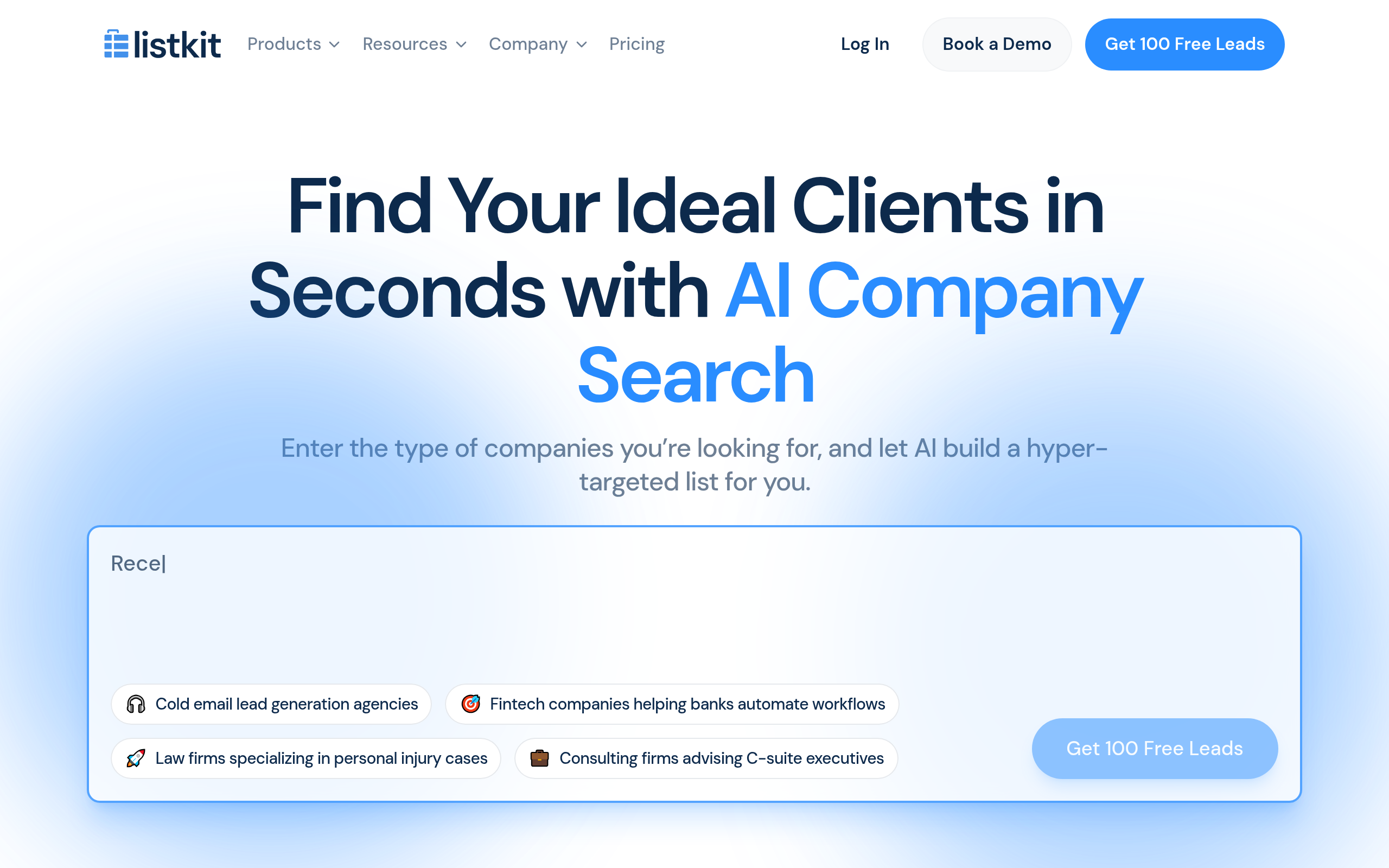 ListKit.io delivers triple-verified B2B contacts with intent signals and direct CRM integrations.
Signal-Based vs. Volume-Based Pipeline Generation
The 10 tools above represent two fundamentally different approaches to building pipeline.
Volume-based tools (Apollo, Instantly, Outreach) optimize for more: more emails, more calls, more contacts. They work by increasing the top of the funnel and relying on conversion math to produce enough meetings. This approach delivered strong results from 2015-2022, when inboxes were less crowded and buyers responded to well-crafted cold outreach.
Signal-based tools (6sense, Demandbase, and other signal-driven platforms) optimize for timing and relevance. They work by identifying which accounts are entering buying windows and surfacing the context reps need to engage with a relevant message at the right moment. Signal-qualified contacts convert at dramatically higher rates. Per Cognism's research, champion migration signals generate 114% higher win rates and 54% larger deal sizes.
Here is how the approaches compare in practice.
A volume-based SDR team sends 500 emails per rep per week. At a 2% reply rate and 25% meeting conversion, that produces roughly 2.5 meetings per rep per week. Quality varies widely.
A signal-based team monitors 500 accounts for buying signals. When 15 accounts show active signals in a given week, reps engage those accounts with context-rich outreach. At a 20%+ meeting rate on warm, signal-qualified accounts, that produces 3+ meetings per rep per week, with significantly higher deal quality and conversion rates.
The math favors signals at every stage of the funnel: higher response rates, larger deal sizes, shorter cycles, and better win rates. The question for most teams is not whether to adopt signal-based pipeline generation, but how quickly they can shift from volume to intelligence.
This does not mean volume tools become irrelevant. Early-stage companies still need to build initial pipeline before they have enough data for signal models to work. The most effective pipeline stacks going into 2027 combine both: a signal layer for pipeline coverage and prioritization, plus engagement tools (Outreach, Salesloft, or Clay) for multi-channel execution.

“Automatic account profile detail I can use to manage my territory. Using Salesmotion AI to generate value statements per persona, account, etc. Using Salesmotion to give me a starting point based on new hires, or news alerts is critical.”
Adam Wainwright
Head of Revenue, Cacheflow
Key Takeaways
- Pipeline generation now requires timing and relevance, not just volume. Only 16% of reps hit quota in 2024, and generic outreach continues to decline in effectiveness.
- Signal-based tools surface buying signals (leadership changes, earnings commentary, hiring patterns) that tell reps when accounts enter buying windows, not just who works there.
- For mid-market and enterprise teams, the highest-ROI pipeline generation investment is a signal layer. Analytic Partners grew qualified pipeline 40% YoY; Frontify grew self-sourced revenue 4x.
- Volume-based tools (Apollo, Instantly) still serve early-stage teams building their first outbound motion, but most organizations outgrow pure volume approaches as they scale.
- The best pipeline stacks for 2027 combine a signal or intelligence platform for targeting with an engagement platform for multi-channel execution.
- Evaluate tools on signal quality, CRM integration depth, and time-to-value, not just contact database size or email sending capacity.
Frequently Asked Questions
What is pipeline generation in B2B sales?
Pipeline generation is the process of creating qualified sales opportunities that have a realistic chance of closing. Unlike lead generation, which focuses on collecting contacts, pipeline generation encompasses the full motion from identifying potential buyers to booking qualified meetings. Effective pipeline generation combines prospecting, account research, signal monitoring, and outreach into a coordinated system that produces consistent, predictable revenue opportunities.
How do signal-based pipeline tools differ from traditional prospecting tools?
Traditional prospecting tools provide contact data and email addresses, helping reps find people to reach out to. Signal-based tools go further by monitoring real-time buying signals, such as leadership changes, funding rounds, earnings call language, and hiring patterns, to identify when accounts are entering active buying windows. This timing intelligence means reps engage accounts when there is genuine need, rather than sending cold outreach and hoping for interest. Teams using signal-based approaches typically see higher response rates, larger deal sizes, and shorter sales cycles.
What is the best pipeline generation tool for startups?
For startups with limited budgets, Apollo.io offers the best value with its free tier that includes database access, email sequencing, and a dialer. As the team grows past 10-15 reps and needs more sophisticated targeting, adding a signal platform provides the account intelligence layer that improves outreach quality and meeting conversion rates. Clay is another strong option for technically-minded growth teams that want maximum flexibility in building custom prospecting workflows.
How much pipeline coverage do B2B sales teams need?
Most sales organizations need 3-5x pipeline coverage to reliably hit quota. SMB teams with higher win rates and shorter cycles can operate closer to 3x. Enterprise teams with 6-12 month sales cycles and lower win rates typically need 4-5x coverage. The challenge is not just building enough coverage, but building it with quality. Signal-qualified pipeline converts at significantly higher rates, which means teams using signal-based tools can operate with less total coverage while still hitting their numbers.
Can you combine multiple pipeline generation tools effectively?
Yes, and most high-performing teams do. A typical enterprise pipeline stack includes a signal or intelligence layer (6sense, or a signal-first platform) for account prioritization, a contact database (ZoomInfo, Apollo) for finding the right people, and an engagement platform (Outreach, Salesloft) for executing multi-channel sequences. The key is ensuring these tools integrate cleanly, ideally syncing through your CRM, so reps get a unified view rather than toggling between disconnected platforms.