In the debate over cold calls vs. cold emails, sales teams often ask the wrong question. It isn't about which method is "better"—it's about knowing which tool to use for the right job.
Think of it this way: cold emails are your engine for scalable outreach, reaching a broad audience efficiently. Cold calls are your precision tool, perfect for creating immediate, meaningful conversations with high-value prospects. The most successful revenue teams don't choose a side; they master both.
The Verdict on Cold Calls vs. Cold Emails
The real question isn’t which outreach method wins, but when to use each one. For today's top sales leaders, the answer lies in a signal-driven approach. It’s about deploying the right tool for the right scenario, guided by context, timing, and the complexity of your target account.
This guide moves beyond a simple pros-and-cons list. We'll break down how to build a powerful outreach strategy that blends both methods to fill your pipeline and convert every opportunity.
At-a-Glance Comparison of Cold Calls vs. Cold Emails
Before diving into strategy, here’s a quick snapshot of how these two channels stack up based on hard data.
| Metric | Cold Email | Cold Call |
|---|---|---|
| Scalability | High. Automation lets you reach hundreds of prospects daily. | Low. A time-intensive, one-to-one activity with limited daily capacity. |
| Buyer Disruption | Low. Allows prospects to review and respond on their own time. | High. Interrupts a prospect's workflow and demands immediate attention. |
| Cost & ROI | Excellent. Highly efficient with a strong, proven return on investment. | Moderate. Higher cost-per-contact, best reserved for high-value targets. |
| Initial Touch | Preferred. Research shows most buyers prefer email for a first contact. | Less Preferred. Can feel intrusive for an initial, unsolicited interaction. |
The core difference is simple: email scales efficiently for broad outreach, while calls provide immediate, high-touch interaction for accelerating high-value deals.
On paper, the numbers heavily favor email. For instance, some studies show cold emails can generate a remarkable $36 to $42 for every $1 spent. This efficiency gap also appears in meeting booking, where emails produce about 1.5 meetings per 100 sends compared to just 0.08 meetings per 100 calls. You can explore more data on the ROI of email vs. calling through findings on cold outreach ROI at Saleshandy.
But these metrics don't tell the whole story. A well-timed call to a high-intent account can accomplish in five minutes what might take five emails to achieve.
See Salesmotion in action
Take a self-guided interactive tour — no signup required.
Analyzing Performance Metrics Head-to-Head

To build a winning outreach strategy, you have to move past gut feelings and dig into the numbers. When you stack cold calls against cold emails, it becomes clear that each channel has a distinct superpower. The right choice isn't about which is "better"—it's about whether you need volume and efficiency or depth and immediate qualification.
When it comes to pure scalability, cold email is the undisputed champion. Its strength is reaching a massive, targeted audience with minimal time investment per prospect. This makes it the perfect engine for top-of-funnel campaigns designed to generate a steady stream of leads.
Cold calling is a different game entirely. It’s a high-cost, high-reward activity. You can't make hundreds of calls in an hour, but one single, well-timed conversation can do what fifty emails can't: create a real-time, interactive dialogue that fast-tracks a high-intent account through your pipeline.
Conversion Rates and Time Investment
Looking at pure conversion efficiency, data reveals a clear trade-off. Some studies place the average cold call success rate around 2.35%, meaning you might need roughly 43 calls to land one sale. For high-value deals over $1 million, that rate can drop below 1.2%, requiring over 85 calls per sale.
Cold emails, on the other hand, play the numbers game differently. While average response rates hover between 1-5%, a highly targeted and personalized campaign can see that number soar to 25% or more. Even better, emails convert to actual meetings at a rate of 1.55% per 100 sends—a massive leap over the 0.08% meeting conversion rate for cold calling.
Key Takeaway: While a successful cold call can lead to a high-quality conversation, cold emails generate far more meetings for the effort invested. This makes email the more efficient tool for pure pipeline generation.
As you analyze your cold call performance, having the right tools makes a world of difference. A sophisticated system gives you the data you need to spot trends and coach reps effectively, especially when you master CRM with VoIP integration for sales.
Cost Per Acquisition and ROI
The financial metrics are where the differences really stand out. Because you can automate and send emails in bulk, the cost-per-acquisition (CPA) is dramatically lower than it is for calling. All the time a rep spends on research, dialing, and navigating gatekeepers makes cold calling a much pricier channel on a per-lead basis.
- Cold Email: Delivers a superior Return on Investment (ROI). It’s often cited as generating between $36 to $42 for every $1 spent, making it an incredibly cost-effective way to build and nurture a pipeline.
- Cold Call: Has a much higher upfront cost due to the significant rep time required. The overall ROI is lower, but it’s easily justified for high-value enterprise deals where a single win pays for months of effort.
Ultimately, the metrics tell a clear story: emails are your workhorse for creating initial opportunities at scale, while calls are your precision tool for high-value targets. If you're looking to make your emails more effective, especially with senior leaders, check out our deep dive on how to improve reply rates when cold emailing executives.

“The talking points are gold. If they're in Salesmotion, I know they're being discussed inside that business. That makes it easy to spark a real conversation, which is 90 percent of the battle.”
Andrew Giordano
VP of Global Commercial Operations, Analytic Partners
Matching Your Outreach Method to Your Buyer
The cold call vs. cold email debate isn't about which one is "better." It's about context. The right move depends entirely on who you’re targeting and the world they operate in. A strategy that crushes it in one industry will fall flat in another.
You have to get inside your buyer's head—their daily routine, how they prefer to communicate, and the way they make decisions. This is the key to picking the right tool for the job. A busy surgeon, for instance, isn't going to pick up an unscheduled call, but a relationship-driven financial advisor might.
Let's break down how this plays out in the real world.
B2B SaaS and Enterprise Software
In the fast-moving world of software, buyers are digitally savvy, drowning in information, and fiercely protective of their time. They’re used to doing their own research and prefer to communicate on their own schedule, without interruptions.
- Preferred Method: Cold Email. A sharp, signal-driven email is your best way in. Referencing a recent funding round, a new executive hire, or a market expansion shows you've done your homework. This low-friction approach lets them evaluate your value proposition on their own terms.
- Real-World Scenario: You spot a target company posting multiple jobs for a new data science team. A cold email with the subject line "Your new data science team" that links to a case study on accelerating model deployment is hyper-relevant and has a strong chance of getting a reply.
Healthcare and Life Sciences
The healthcare and life sciences industries move at a different pace, governed by long development cycles, strict regulations, and complex stakeholder webs. Decision-makers like hospital administrators or heads of clinical research are notoriously hard to reach and work on tight, unpredictable schedules.
A direct cold call might be seen as a major intrusion in a clinical setting. However, for a major equipment purchase or a strategic partnership, a call to an executive's assistant can be a necessary step to navigate the organization and get a formal introduction on the calendar.
A blended approach is your best bet here. A personalized email can introduce your solution, perhaps referencing a recent clinical trial milestone or a new FDA regulation. If they open that email or click a link, that’s your signal. It justifies a follow-up call to provide more detail.
Financial Services and Consulting
Professionals in finance, insurance, and consulting live and die by relationships and time-sensitive information. They’re used to getting calls, but they're also buried under them. Your outreach has to be sharp, credible, and get straight to the point—fast.
- Preferred Method: Hybrid Approach. While they're comfortable on the phone, their time is a fortress. A cold email that references a specific regulatory change or a recent M&A deal can warm up the conversation. The follow-up call then becomes much more effective: "I'm calling about the email I sent regarding the new compliance directive..."
- Real-World Scenario: A private equity firm announces a new fund focused on sustainable infrastructure. A call to an associate, followed by an email with a tailored one-pager on your firm’s due diligence services for renewable energy projects, speaks directly to their stated investment strategy.
At the end of the day, aligning your outreach with your buyer's context is non-negotiable. The smartest sales teams use insights from buyer intent data to understand these different worlds and personalize their approach for each one. To learn more, check out our detailed guide on how to use buyer intent data to drive sales.
Using Timing and Signals to Guide Your Outreach
Great outreach isn't just about choosing between a cold call and a cold email. It’s about answering the question, “Why now?” The most effective revenue teams connect their method to a specific moment in time. This is where account intelligence becomes your unfair advantage, turning real-world events into perfectly timed conversations.
Specific buying signals should dictate your outreach method. These triggers tell you not only who to contact but also how. By monitoring these events, you can move from being a generic nuisance to a welcome, timely advisor.
Decoding High-Intent and Low-Intent Signals
Not all signals are created equal. A subtle hint warrants a low-friction approach, while a major buying sign justifies a more direct, high-touch strategy. The key is to turn signal overload into a clear action plan for your sales team.
-
Low-Intent Signals (Best for Cold Email): These are early indicators that a company might be exploring a change. A cold email is perfect here. It’s non-intrusive and lets the prospect engage on their own terms.
- Example: A prospect likes a competitor's post on LinkedIn or engages with their content. This is a soft signal. A personalized email saying, "Saw you're interested in [topic], we just published a guide on a different approach..." is relevant without being pushy.
-
High-Intent Signals (Best for Cold Call): These are significant events that signal an urgent need or a major strategic shift. A cold call is justified because the context is strong, and the opportunity is time-sensitive.
- Example: A life sciences company receives regulatory approval for a new drug. This is a massive business event. A direct call to the Head of Commercialization becomes a high-value conversation about market launch strategies, not just a random interruption.
The signal dictates the strategy. A weak signal gets an email to build awareness. A strong signal gets a call to capitalize on a clear business need.
The following decision tree shows how your target buyer profile can influence the best outreach method, whether you're selling enterprise software or heavy equipment.
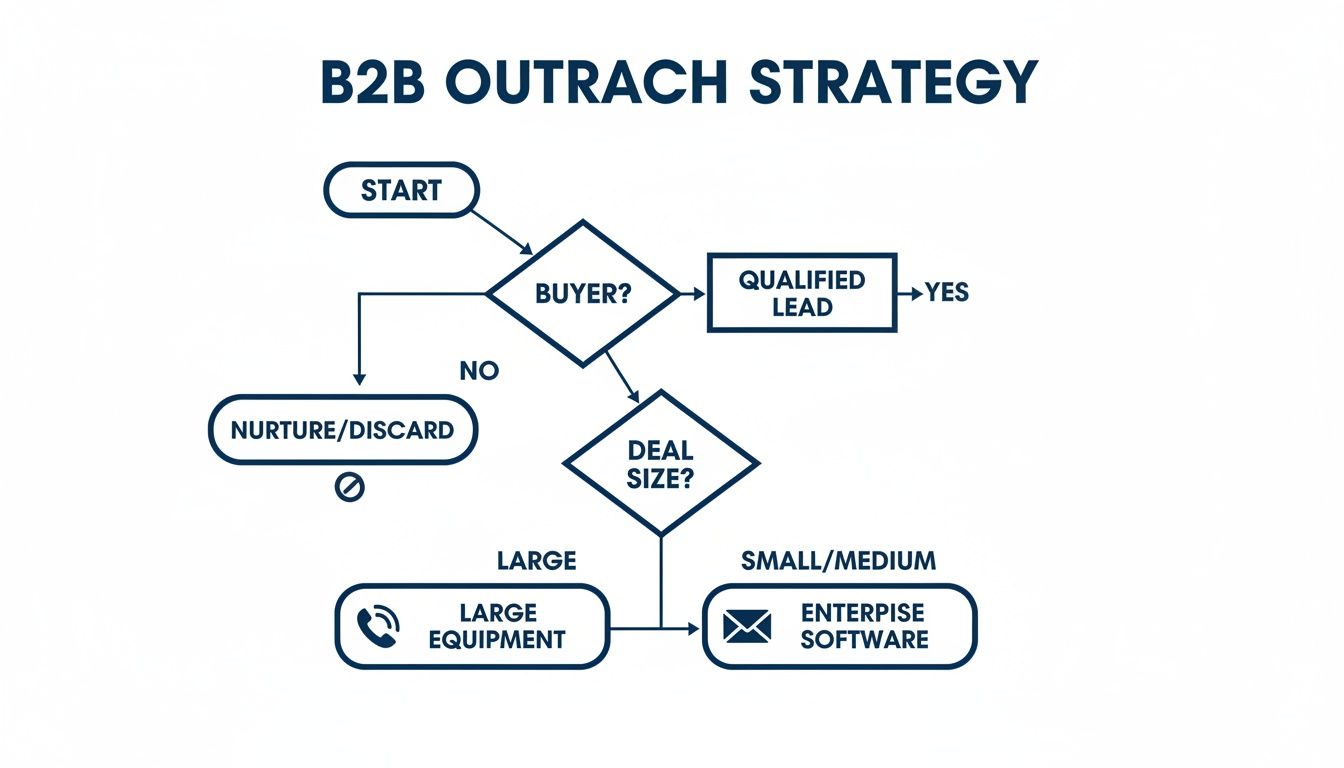
This flowchart illustrates how factors like deal size and lead qualification can guide your choice between an email-first or call-first approach.
Turning Signals into Actionable Outreach
To put this into practice, you need a system for translating signals into a prioritized workflow. Modern account intelligence platforms automate this by monitoring triggers across your target accounts and alerting your reps.
Consider these scenarios:
-
Executive Job Change: An executive you’ve previously engaged with moves to a new target account.
- Action: Send a congratulatory cold email. It’s a warm opening that re-establishes your relationship in their new role.
-
New Strategic Initiative: A company announces a major investment in supply chain optimization in their earnings call.
- Action: Place a cold call to the VP of Operations. Your reason for calling is directly tied to their company's publicly stated goals, making your pitch immediately relevant.
Timing is everything in sales. For a deeper look into optimizing your calling schedule, you can explore our guide on the best time to cold call. Mastering this turns your outreach from a shot in the dark into a precise, signal-driven strategy.

“All of the vendors that I've worked with, all of the onboarding that I have had to deal with, I will say, hands down, Salesmotion was the easiest that I have had.”
Lyndsay Thomson
Head of Sales Operations, Cytel
Building a Winning Hybrid Outreach Sequence

The top-performing revenue teams have moved past the cold calls vs. cold emails debate. They know the real advantage isn't in choosing one channel, but in blending them into a smart, multi-channel sequence. A hybrid strategy isn't about isolated actions; it's about creating a connected conversation that builds momentum with every touchpoint.
Instead of picking a lane, you orchestrate the entire journey. A signal-driven email warms up the prospect, and a well-timed call capitalizes on that initial awareness. This approach respects the buyer’s schedule while creating clear openings for real engagement, turning generic outreach into a valuable dialogue.
A Practical Blueprint for Hybrid Sequences
A winning sequence is more than just a random mix of calls and emails—it tells a story. Each step should build on the last, sparked by a specific business signal or trigger. This blueprint shows how you can graduate from a generic "just checking in" cadence to a timely, relevant conversation that cuts through the noise.
Here’s a sample 5-step sequence kicked off by a business signal:
- Day 1 (Signal-Driven Email): Lead with a personalized email triggered by a specific event, like a new company initiative or an executive quote. This gives you an immediate, compelling reason to reach out.
- Day 3 (Follow-Up Call): Make a call that directly references your email and the trigger event. This simple step bridges the gap between the two channels and reinforces your relevance.
- Day 5 (Value-Add Email): Send a follow-up email that offers something genuinely useful—a case study, an article, or a benchmark report—that speaks to a pain point related to the initial signal.
- Day 7 (LinkedIn Touchpoint): Engage on LinkedIn. This could be a thoughtful comment on their post or a brief connection request that mentions your previous touchpoints. Keep it professional and light.
- Day 10 (Final Call): Place a final call to try and start a live conversation. Briefly summarize the value you've shared and make a clear ask for a meeting.
For an even deeper dive into structuring your multi-step approach, you might be interested in our guide covering tips for creating a powerful email cadence.
Sample Talk Tracks and Email Snippets
Great hybrid outreach relies on messaging that ties directly to business pain. Your language needs to prove you’ve done your homework.
Cold Call Snippet (After Initial Email): "Hi [Prospect Name], this is [Your Name] from [Your Company]. The reason I'm calling is I sent you a quick email on Monday. I noticed your CEO mentioned supply chain optimization in their recent earnings call, and it reminded me of the work we did with [Similar Company] to reduce their logistics spend by 15%."
Email Template Snippet (Day 5):
- Subject: Following up on supply chain
- Body: "Hi [Prospect Name], hope your week is going well. Since optimizing your supply chain is a key priority, I thought you might find this case study on how [Client] navigated similar challenges valuable. Let me know if a brief chat next week makes sense."
Recent analysis shows that while 80% of sales require five or more touchpoints, multi-channel sequences dramatically improve efficiency. Cold emailing ROI sits between $36-42 per $1 spent—a figure that can jump significantly when integrated into a hybrid strategy. You can discover more insights about these findings on cold outreach ROI at Saleshandy.
To get the most out of your outreach, you have to make the next step effortless. Integrating AI-driven meeting scheduling with tools like Calendly automates the booking process the moment a prospect shows interest, making it a seamless final step in your hybrid sequence.
Frequently Asked Questions About Outreach Strategy
When it comes to cold calls versus cold emails, sales leaders and reps always have a few key questions. Let's dig into the most common ones with some practical, field-tested answers.
Which Is Better for Getting Past Gatekeepers?
Hands down, cold email is the most reliable way to land directly in a decision-maker's inbox. It completely sidesteps the human gatekeeper, giving your signal-driven message a chance to be read on their own time.
But don't discount the phone. A skilled caller can work magic with gatekeepers, especially on a follow-up call. Once you see a prospect has opened your email, you have a warm reason to connect: "Hi, I'm calling for [Prospect's Name]. I'm just following up on the email I sent them about their recent product launch." That context changes the entire dynamic.
How Do I Measure the Success of a Hybrid Strategy?
You need to track a mix of activity and outcome metrics. For emails, that means your open, click-through, and reply rates. For calls, you’re looking at connection rates and how many of those conversations turn into meetings.
But the one KPI that truly matters for a hybrid sequence is meetings booked per sequence started. When you tie that back to the signals that kicked off your outreach, you can start seeing which triggers—like funding news versus an executive hire—are actually producing pipeline. That's how you truly fine-tune your outbound strategy.
How Many Touchpoints Should a Sequence Have?
Data shows that most deals require at least five touchpoints, but far too many reps stop after one or two. A solid hybrid sequence should have 8-12 touches spread over a few weeks.
This isn't about spamming people. It's a strategic blend of:
- Automated emails
- Manually personalized emails
- Targeted cold calls
- Social media interactions (likes, comments, DMs)
The secret is to add value with every single touch. Instead of just "checking in," reference a new signal or share a fresh insight. That kind of thoughtful persistence, backed by real context, is what turns cold outreach into a warm conversation.
By automating research and transforming real-time signals into a usable point of view, Salesmotion helps revenue teams scale personalization, win timely conversations, and turn account activity into measurable pipeline growth. Learn how to turn signals into action.