Selling into hospitals and health systems means navigating one of the most complex buying environments in B2B. Healthcare contact data is notoriously difficult to source, verify, and maintain. The average hospital has dozens of decision makers spread across clinical, IT, procurement, and administrative departments, and a significant percentage of those contacts change roles or leave within any given year. B2B contact data for healthcare sales requires specialized approaches that general-purpose databases cannot deliver.
TL;DR: Healthcare buying committees are large and fragmented. The most effective approach layers industry-specific databases for clinical contacts, general B2B platforms for IT and C-suite contacts, and real-time signal monitoring to catch the leadership changes and strategic shifts that create buying windows.
Why Healthcare Contact Data Is Uniquely Challenging
Healthcare organizations operate differently from typical enterprises. Three structural realities make contact data harder to source and maintain.
Buying committees are unusually large. A 2025 Bain healthcare report found that enterprise health system technology purchases involve an average of 12-15 stakeholders across clinical, IT, procurement, finance, and compliance functions. In contrast, the average B2B technology purchase involves 6-10 people. More stakeholders means more contacts to source, verify, and keep current.
IT and clinical leadership speak different languages. The CIO cares about interoperability, security, and TCO. The Chief Medical Information Officer (CMIO) cares about clinical workflow, provider adoption, and patient outcomes. The VP of Supply Chain cares about cost reduction and vendor consolidation. Your outreach to each person must reflect their priorities, which means your contact data must include role context, not just names and email addresses.
Health system consolidation is accelerating. Hospital mergers and acquisitions continue at a rapid pace. When two health systems merge, the combined org chart reshuffles dramatically. The CIO of the acquired system may become a regional IT director, lose budget authority entirely, or leave the organization. Static contact databases reflect the pre-merger reality for months after the change.
See Salesmotion on a real account
Book a 15-minute demo and see how your team saves hours on account research.
Key Decision Maker Roles in Healthcare
Understanding who holds budget authority and who holds veto power is essential for building a useful healthcare contact list.
Chief Information Officer (CIO)
The CIO oversees technology strategy, infrastructure, and vendor management. In large health systems, the CIO typically reports to the COO or CEO and controls a significant IT budget. They are the most commonly targeted contact in healthcare sales, but often delegate evaluation to their direct reports.
Chief Medical Information Officer (CMIO)
The CMIO bridges clinical practice and technology. They influence decisions about EHR optimization, clinical decision support, telehealth platforms, and any tool that touches physician workflow. Many sales teams skip this role because it does not exist in other industries. That is a mistake. The CMIO can champion or kill a deal based on clinical relevance.
VP of Supply Chain
Healthcare supply chain leaders control procurement for everything from medical devices to software subscriptions. They manage vendor relationships, negotiate contracts, and enforce compliance with group purchasing organization (GPO) agreements. Missing this contact means you discover procurement requirements late in the deal cycle.
Chief Nursing Officer (CNO)
The CNO oversees nursing operations, staffing, and clinical quality. For products that affect nursing workflow, patient monitoring, or staffing optimization, the CNO is a critical stakeholder. They manage large teams and influence significant operational budgets.
Chief Financial Officer (CFO)
The CFO approves capital expenditures and evaluates ROI. In healthcare, where margins are tight and regulatory costs are high, the CFO often has final sign-off authority on technology purchases above a certain threshold. Your business case must survive their scrutiny.

“There's been a big focus on hyper personalization and relevance in our outbounding efforts. Salesmotion has been a key partner in hitting our significantly increased meeting targets. What stands out is how simple it is. Reps can log in and get valuable account insights within 30 seconds to a minute.”
Joe DeFrance
VP of Sales, Incredible Health
Data Quality Challenges in Healthcare Sales
Healthcare data quality problems are distinct from those in other industries.
Email domains are fragmented. Large health systems often operate multiple email domains across their facilities. A contact at a hospital that was acquired two years ago might still use their legacy email domain, while a colleague down the hall uses the parent system's domain. Batch email verification tools flag these inconsistencies as errors when they are actually valid addresses.
Direct contact information is scarce. Many clinical leaders work across multiple facilities, making direct phone numbers unreliable. Mobile numbers are particularly hard to source for healthcare executives who guard their personal contact information closely.
Title standardization is poor. Healthcare organizations use a wide variety of titles for equivalent roles. The person who manages health IT infrastructure might be called CIO at one system, VP of Information Services at another, and Director of Health Informatics at a third. Keyword-based contact searches miss these variations consistently.
Where to Find Healthcare Decision Maker Contacts
Building a comprehensive healthcare contact list requires layering multiple sources.
Industry-Specific Databases
Definitive Healthcare is the dominant player in healthcare-specific contact data, covering hospitals, physicians, health systems, and clinical leadership. Their data includes hospital-level metrics (bed count, case mix, technology stack) that help with targeting. Definitive Healthcare does not publish pricing; it quotes by solution, bundle and add-on.
Health System Websites and Press Releases
Health system leadership teams are often published on their websites. Press releases announce new hires, promotions, and organizational changes. Monitoring these sources manually is impractical at scale, but automated tools can track changes across hundreds of health systems simultaneously.
Signal-Based Monitoring
The most reliable way to keep healthcare contact data current is to monitor buying signals that indicate organizational changes. Salesmotion tracks leadership changes, strategic initiative announcements, technology implementations, and hiring patterns across health systems. When a large health system names a new CIO, that signal fires within days and includes context about the executive's background and likely priorities.
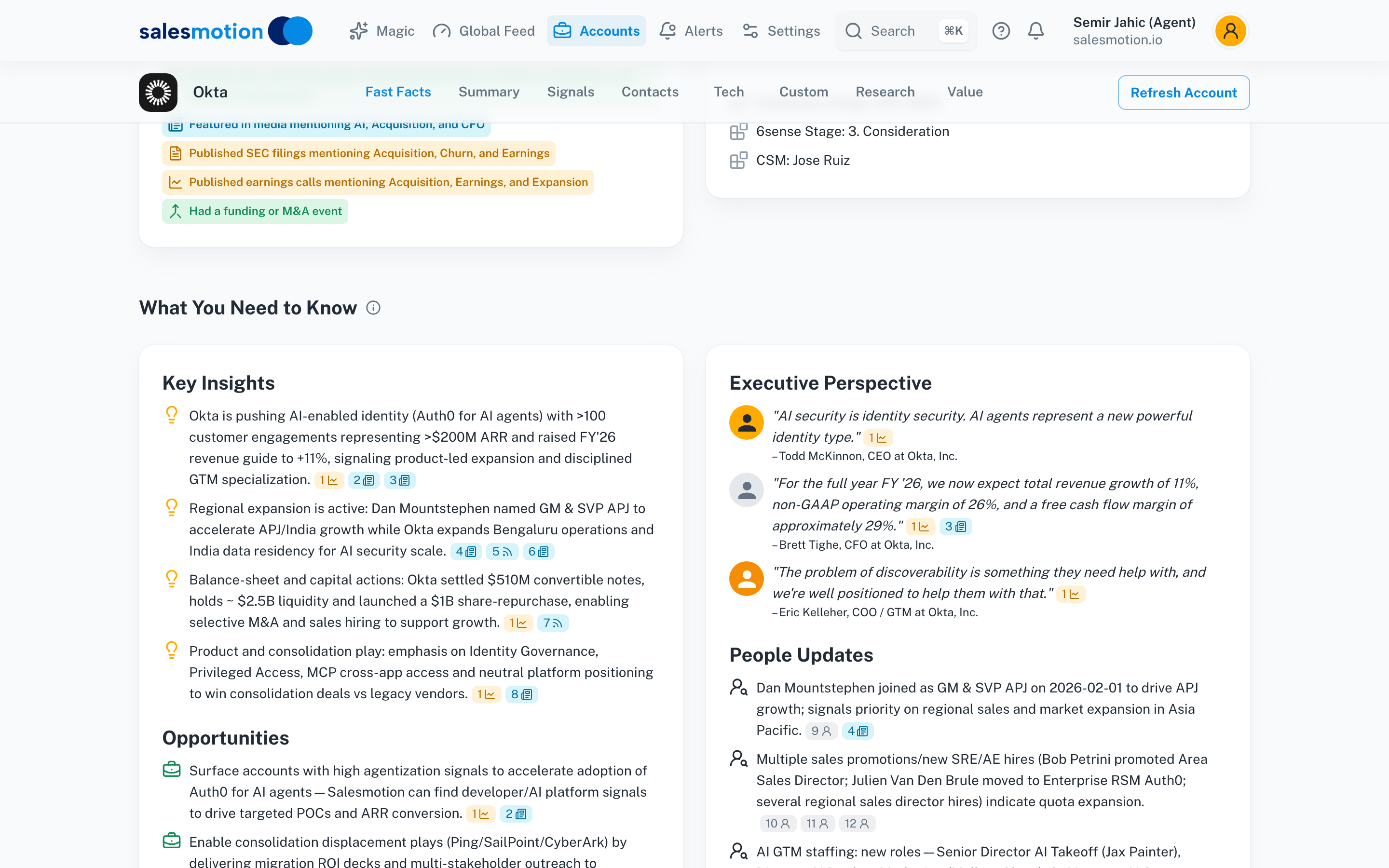 Salesmotion surfaces key insights, executive perspectives, people moves, and talking points — giving reps the context behind every contact.
Professional Associations
Organizations like HIMSS, CHIME, and ACHE maintain member directories and publish leadership lists. Conference speaker lists and award recipients are particularly valuable contacts because they signal engagement and influence in their field.

“All of the vendors that I've worked with, all of the onboarding that I have had to deal with, I will say, hands down, Salesmotion was the easiest that I have had.”
Lyndsay Thomson
Head of Sales Operations, Cytel
Healthcare Contact Data: Source Comparison
| Source Type | Coverage | Accuracy | Cost | Best For |
|---|---|---|---|---|
| Definitive Healthcare | Deep clinical + admin | High (80-85%) | Does not publish pricing | Hospital system targeting |
| General B2B databases | Broad, thin on clinical roles | Moderate (60-70%) | Free plans to quote-only annual contracts | IT and C-suite contacts |
| Signal-based platforms | Real-time, intent-enriched | High (verified + current) | Mid-market pricing | Leadership changes, buying windows |
| HIMSS/CHIME directories | Narrow, IT-focused | High (member-verified) | Membership-based | Health IT decision makers |
| LinkedIn Sales Navigator | Broad, self-reported | Moderate | $1,079.88-$1,799.88/yr per seat | Verification, relationship mapping |
Building a Healthcare Sales Prospecting Workflow
The best healthcare sales teams combine static contact data with dynamic signals to time their outreach. Here is how that works in practice.
A signal fires: a regional health system announces a new CIO hire from a competitor system. Salesmotion flags the account and surfaces context, including the new CIO's background at their previous organization, the health system's recent earnings commentary about digital transformation priorities, and current job postings for IT roles that suggest a technology initiative is underway.
The rep uses this intelligence to build a targeted outreach sequence. Instead of a generic introduction, they reference the leadership change and connect their solution to the health system's stated digital priorities. They map the buying committee using Salesmotion's account intelligence to identify the CMIO, VP of Supply Chain, and CFO, then build a multi-threaded approach.
This signal-driven workflow produces measurably better results. Teams report 85% less time spent on account research, freeing reps to focus on actual selling instead of manual data gathering.
For a full comparison of B2B contact data providers, see our guide. If you are specifically targeting health systems, our post on finding decision makers covers the broader framework.
Key Takeaways
- Healthcare buying committees average 12-15 stakeholders, requiring more contacts per account than typical B2B sales
- Five critical roles to map: CIO, CMIO, VP Supply Chain, CNO, and CFO, each with distinct priorities and evaluation criteria
- Health system consolidation means contact data from six months ago may already reflect a pre-merger reality
- Industry-specific databases provide clinical depth but miss IT and administrative contacts; layer with general B2B data
- Signal-based monitoring catches leadership changes and strategic shifts that create the best buying windows
- Time your outreach to organizational changes rather than relying on static lists and scheduled cadences
Frequently Asked Questions
How large is the typical buying committee at a hospital or health system?
Enterprise health system technology purchases typically involve 12-15 stakeholders spanning clinical leadership, IT, procurement, finance, and compliance. Smaller community hospitals may have 5-8 decision makers. The key is mapping not just the economic buyer (usually CIO or CFO) but also the clinical champion (CMIO or CNO) and the procurement gatekeeper (VP Supply Chain).
What is the best database for healthcare sales contacts?
Definitive Healthcare is the most comprehensive healthcare-specific database, covering clinical leadership, hospital metrics, and health system org charts. For broader coverage that includes IT and administrative contacts, teams typically layer in a general B2B database like ZoomInfo alongside a signal-monitoring platform for real-time updates on leadership changes.
How do I reach the CMIO at a health system?
The Chief Medical Information Officer is typically a physician who splits time between clinical practice and administrative duties. Direct email is more effective than cold calling. Reference specific clinical workflow challenges or recent EHR-related initiatives at their organization. CMIO contacts are best sourced through CHIME/HIMSS directories or industry-specific databases, since general B2B platforms often miss this role entirely.
How fast does healthcare contact data decay?
Healthcare contact data degrades 25-35% annually due to executive turnover, health system mergers, and organizational restructuring. Leadership transitions are particularly common in the CIO and VP of IT roles. Real-time signal monitoring is the most effective way to maintain accuracy, because it catches changes as they happen rather than relying on periodic database refreshes.