Sales teams spend thousands of dollars each month on data, but most cannot clearly articulate the difference between contact data and intent data, or when to use each. Contact data tells you who to reach. Intent data tells you when they might be ready to buy. The distinction matters because using one without the other leads to either blind outreach (contacts without timing) or invisible opportunities (timing without contacts). Understanding the difference between contact data vs intent data is essential for building a sales motion that actually converts.
TL;DR: Contact data provides the who (names, emails, phone numbers). Intent data provides the when (behavioral signals indicating purchase interest). The most effective B2B sales teams use both together: intent data to prioritize accounts, contact data to reach the right people at those accounts. Neither alone is sufficient.
What Is Contact Data?
Contact data is the foundational layer of B2B sales. It includes the information you need to reach a specific person at a target account.
Core fields include: name, job title, email address, phone number, company name, and LinkedIn profile URL. Premium contact data providers also include organizational hierarchy, department, reporting structure, and technology stack data.
Where it comes from: Contact data is sourced from public records, professional networks, email verification services, web scraping, user-contributed databases, and manual research. Major providers like ZoomInfo, Apollo, and Lusha maintain databases of hundreds of millions of business contacts.
What it does well: Contact data solves the "who" problem. When you know which company to target and which role to reach, contact data gives you the specific person and their contact information. This is the minimum requirement for any outbound sales motion.
Where it falls short: Contact data alone tells you nothing about timing or readiness. You know who the VP of Engineering is at your target account, but you do not know if they are currently evaluating solutions, dealing with a relevant pain point, or even in a position to buy. This is where intent data fills the gap.
What Is Intent Data?
Intent data captures behavioral signals that suggest a company or individual is researching topics related to your product or actively evaluating solutions.
Types of intent data: First-party intent comes from your own website and content (page visits, content downloads, demo requests). Third-party intent comes from external sources like publisher networks, review sites, and content syndication platforms. Behavioral signals include search patterns, content consumption, and competitive research activity.
Where it comes from: Third-party intent data providers like Bombora, G2, and TrustRadius aggregate behavioral data across publisher networks and review sites. They identify when companies are researching specific topics at elevated rates compared to their baseline.
What it does well: Intent data solves the "when" problem. It identifies accounts that are actively researching your category, visiting competitor pages, or consuming content related to problems your product solves. This helps prioritize outreach to accounts showing genuine buying activity rather than spraying the same message to every account on your list.
Where it falls short: Intent data is account-level, not person-level. Knowing that "Acme Corp is researching cybersecurity solutions" does not tell you which specific person at Acme Corp is doing the research, what their role is, or how to reach them. You still need contact data to act on the signal.

“The talking points are gold. If they're in Salesmotion, I know they're being discussed inside that business. That makes it easy to spark a real conversation, which is 90 percent of the battle.”
Andrew Giordano
VP of Global Commercial Operations, Analytic Partners
Contact Data vs Intent Data: A Direct Comparison
| Dimension | Contact Data | Intent Data |
|---|---|---|
| What it answers | Who to reach | When to reach out |
| Data type | Static (names, emails, phones) | Dynamic (behavioral signals) |
| Granularity | Person-level | Account-level (mostly) |
| Refresh rate | Monthly/quarterly updates | Daily/weekly signals |
| Primary use | Outbound prospecting, email campaigns | Account prioritization, timing |
| Decay risk | High (25-35% annual turnover) | Low (signals are inherently current) |
| Cost | Free tiers to quote-only contracts; Vendr reports a ZoomInfo median of $33,500/yr | Mostly quote-only; Vendr reports a Bombora median of $25,000/yr |
| Biggest limitation | No timing or readiness signal | No specific person or contact info |
Why You Need Both (and What Happens When You Use Only One)
Most sales organizations start with contact data because it feels actionable. You have names and emails, so you can start sending messages. But without intent data, you are guessing at timing. The rep sends 500 emails to VP-level contacts at 200 accounts, and maybe 5 of those accounts happen to be in an active buying window. That is a 2.5% account-level hit rate.
Adding intent data changes the math. Instead of blasting 200 accounts, you filter for the 30-40 accounts showing elevated research activity in your category. Now the same outreach effort is concentrated on accounts with genuine buying interest, and response rates increase proportionally.
The reverse problem is equally damaging. Some organizations invest heavily in intent data providers but do not have accurate contact data. They know which accounts are in-market, but they cannot reach the right individuals at those accounts. The intent signal decays quickly because buying windows are finite. If it takes you two weeks to manually find and verify contacts at an in-market account, you may have already missed the window.

“It's not even just about saving time — it's about uncovering things we otherwise might not research. Salesmotion helps us connect Guild to what's already publicly important to the company.”
Derek Rosen
Director, Strategic Accounts, Guild Education
Beyond Contact Data and Intent Data: The Case for Account Intelligence
The contact data vs intent data distinction is useful but incomplete. Both are inputs to a more complete picture: account intelligence.
Account intelligence combines who (contact data), when (intent and timing signals), and why (strategic context) into a unified view. It includes not just behavioral intent but also structural signals like leadership changes, earnings call commentary, hiring patterns, funding rounds, and strategic initiative announcements.
Here is a concrete example. A third-party intent provider tells you that a Fortune 500 company is researching "account intelligence platforms." That is useful. But Salesmotion tells you that the same company just hired a new VP of Sales Operations from a company that already uses your product, that their latest earnings call mentioned "investing in data-driven sales processes," and that they posted three RevOps job listings in the past month. That is actionable intelligence.
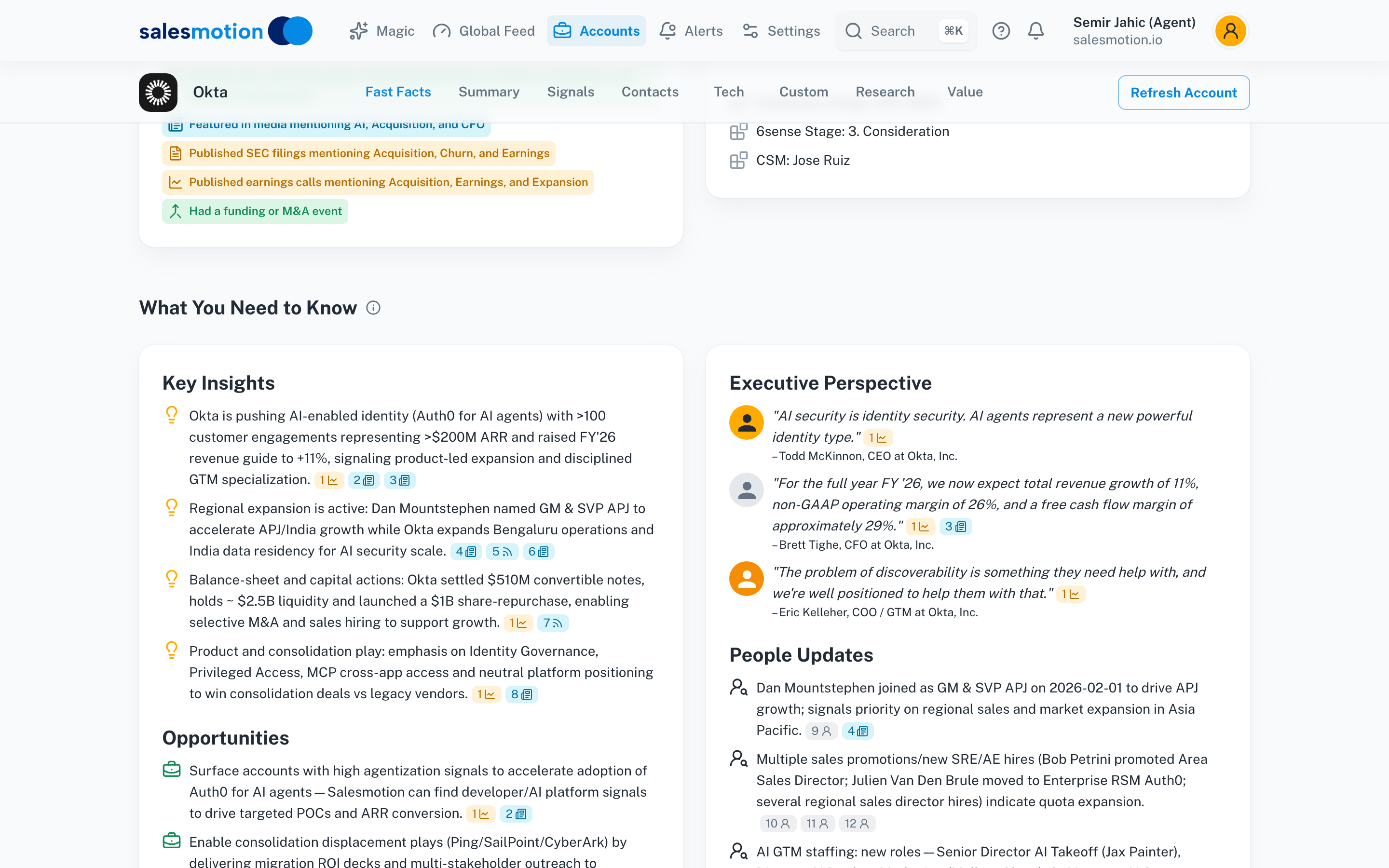 Salesmotion surfaces key insights, executive perspectives, people moves, and talking points — giving reps the context behind every contact.
The difference matters because intent data alone cannot distinguish between genuine evaluation and casual research. A junior analyst reading a blog post generates the same topic-level intent signal as a VP actively building a vendor shortlist. Account intelligence layers in context that helps you distinguish between the two.
Buyers who have used topic-level intent data ask the same question. A growth leader at an industrial technology firm told us: "did they truly have an intend to buy? My experience with that data is no."
How to Combine Contact Data and Intent Data in Practice
Here is a practical workflow that uses both data types effectively.
Step 1: Build your target account list. Use firmographic data (industry, company size, technology stack) to identify accounts that fit your ideal customer profile. This is the foundation.
Step 2: Prioritize with intent signals. Layer intent data to identify which accounts on your list are showing elevated research activity. Filter for accounts researching topics directly related to your product category.
Step 3: Source contacts at high-intent accounts. Use contact data providers to find the specific decision makers and influencers at your prioritized accounts. Focus on the buying committee roles that matter for your product.
Step 4: Enrich with account context. Add strategic context from signal monitoring: recent leadership changes, strategic initiatives, hiring patterns, and competitive dynamics. This is what transforms a generic outreach template into a personalized, relevant message.
Step 5: Time and personalize outreach. Use the intent signals to time your outreach and the account context to personalize it. Reference specific events (the new hire, the earnings commentary, the technology investment) rather than generic pain points.
Teams that follow this workflow report 2-4 hours saved per rep per week on research and significantly higher conversion rates compared to using either data type alone. Salesmotion automates steps 2-4 by continuously monitoring signals and enriching accounts across your territory.
Key Takeaways
- Contact data tells you who to reach; intent data tells you when to reach out. Using one without the other wastes budget and rep time.
- Intent data is mostly account-level, not person-level, so you always need contact data to act on intent signals
- The best approach layers both: intent data for prioritization, contact data for outreach, and account intelligence for full strategic context
- Static contact data decays 25-35% annually, while intent signals are inherently current but time-sensitive
- Account intelligence combines contact, intent, and strategic signals into a unified view that outperforms either data type alone
- Automating the signal monitoring and enrichment workflow saves 2-4 hours per rep per week and produces better conversion rates
Frequently Asked Questions
Can intent data replace contact data?
No. Intent data identifies which accounts are showing buying interest, but it operates at the account level, not the person level. You still need contact data to identify and reach the specific decision makers at those accounts. The two data types are complementary: intent data prioritizes where to focus, and contact data enables you to actually engage.
What is better for outbound prospecting: contact data or intent data?
Both are necessary for effective outbound. If forced to choose one, contact data is more fundamental because you cannot send outreach without it. But using contact data without intent data means you are guessing at timing, which dramatically reduces efficiency. The highest-performing teams use intent signals to prioritize accounts and contact data to reach the right decision makers.
How is account intelligence different from intent data?
Account intelligence is a broader category that includes intent data as one input among many. Intent data captures behavioral signals (content consumption, search patterns). Account intelligence adds structural signals like leadership changes, earnings commentary, hiring patterns, funding rounds, and strategic initiatives. These structural signals often indicate buying readiness more reliably than behavioral intent alone.
How much should a sales team budget for contact and intent data?
Budgets vary widely. Apollo and Lusha publish self-serve plans with free tiers, while ZoomInfo does not publish list pricing; Vendr reports a median ZoomInfo contract of $33,500 a year based on 1,576 purchases. For third-party intent, Bombora does not publish list pricing; Vendr reports a median annual contract value of $25,000 across 35 purchases. Signal-based account intelligence platforms that combine both functions can reduce total data spend while providing more actionable insights. The key metric is cost per qualified meeting, not cost per contact or cost per intent signal.