Every sales team has access to contact data. Names, emails, phone numbers, and job titles are commodities that dozens of providers sell at scale. Yet most sales teams still spend hours researching accounts before every call, still send generic outreach to contacts who are not in a buying window, and still lose deals because they did not understand the buying committee. The gap is not contact data. The gap is contact intelligence: the context, timing, and relevance layer that turns a name in a database into an actionable sales opportunity.
TL;DR: Contact data gives you emails and phone numbers. Contact intelligence adds context (why this person matters), timing (when they are likely to engage), and relevance (how your solution connects to their current priorities). The shift from data to intelligence is what separates high-performing sales teams from the rest.
What Is Contact Data?
Contact data is the baseline information needed to reach a specific person. It includes:
- Identifiers: Name, email address, phone number, LinkedIn URL
- Firmographics: Company name, industry, employee count, revenue
- Demographics: Job title, department, seniority level, location
- Technographics: Technology stack, tools in use, platform subscriptions
This data answers one question: how do I reach this person? Major providers like ZoomInfo, Apollo, and Lusha have built large businesses around providing this layer of information. The data is useful but incomplete.
Contact data tells you that Jane Smith is the VP of Revenue Operations at Acme Corp, and her email is jane@acme.com. It does not tell you that Jane joined Acme three months ago from a company that already used your product, that Acme's latest earnings call mentioned "investing in sales technology," or that the company posted four RevOps job listings in the past two weeks. That additional context is the difference between contact data and contact intelligence.
See Salesmotion on a real account
Book a 15-minute demo and see how your team saves hours on account research.
What Is Contact Intelligence?
Contact intelligence is the enriched, contextualized view of a contact that includes not just who they are, but what they are doing, what they care about, and why now might be the right time to reach them.
Contact intelligence includes:
- Role context: Not just "VP of Revenue Operations," but what that means at this specific company. Do they own the sales tech stack? Do they report to the CRO or the CFO? How large is their team?
- Activity signals: Recent job changes, published content, conference speaking engagements, LinkedIn activity, and professional community participation
- Company signals: Leadership transitions, hiring patterns, earnings call commentary, funding events, strategic initiatives, and competitive dynamics
- Relationship mapping: Who else at the company is connected to the contact? What is the reporting structure? Who influences the buying decision?
- Timing indicators: Signals that suggest this contact or their company is in an active buying window right now

“At first it sounded like a simple utility. But once we deployed it, it became clear there's nothing else like it. Any sales, business development, or client services team should try this. It changes the way you work.”
Andrew Giordano
VP of Global Commercial Operations, Analytic Partners
Contact Data vs Contact Intelligence: The Key Differences
| Dimension | Contact Data | Contact Intelligence |
|---|---|---|
| Answers | How to reach someone | Why, when, and how to engage them |
| Freshness | Point-in-time snapshot | Continuously updated signals |
| Depth | Name, title, email, phone | Role context, activity, signals, relationships |
| Actionability | Enables outreach | Enables relevant, timed outreach |
| Source | Database crawls, user-contributed data | Multi-source signal aggregation |
| Personalization support | Name and title merging | Strategic, context-driven messaging |
| Decay pattern | Degrades 25-35% per year | Self-refreshing (signals are inherently current) |
| Cost per contact | Low (pennies per record) | Higher but ROI-positive per engagement |
Why Contact Intelligence Matters More Than Contact Data
Three trends have made contact intelligence essential for B2B sales.
Buyer Expectations Have Changed
B2B buyers expect vendors to know their business before the first conversation. A Salesforce State of Sales report found that 87% of business buyers expect sales reps to act as trusted advisors. Generic outreach that demonstrates no understanding of the buyer's situation gets ignored. Contact intelligence provides the context reps need to meet this expectation.
Data Commoditization Has Eliminated the Contact Data Advantage
When every competitor has access to the same contact databases, having Jane Smith's email is no longer a competitive advantage. The advantage comes from knowing why Jane is worth reaching right now and what message will resonate with her specific situation. Contact intelligence is the differentiation layer.
Buying Committees Are Larger and More Complex
The average B2B technology purchase involves 6-10 stakeholders. Understanding not just who these people are, but how they relate to each other, what their individual priorities are, and who holds actual decision-making authority, requires intelligence that goes far beyond contact data.

“This is my singular place that very simply summarizes a company's top initiatives, strategies and connects them to my solution. Something I would spend hours researching manually, now it's automated.”
Derek Rosen
Director, Strategic Accounts, Guild Education
How Contact Intelligence Works in Practice
Here is a concrete example of the difference between contact data and contact intelligence in a real sales workflow.
Contact data tells you: John Chen is the CTO at MidTech Corp. His email is jchen@midtech.com. He has been in the role for 2 years. MidTech is a 500-person SaaS company.
Contact intelligence tells you: John Chen became CTO at MidTech 3 months ago (he was VP Engineering at DataFlow, which already uses your product category). MidTech's latest earnings call mentioned "modernizing our data infrastructure." They posted 4 data engineering roles in the past month. John published a LinkedIn article last week about "building scalable data pipelines." His former colleague, Sarah Park, is now VP Engineering at MidTech and reports to him.
With contact data alone, the rep sends a generic email to jchen@midtech.com. With contact intelligence, the rep sends a personalized message that references John's infrastructure modernization initiative, connects it to his published thinking on data pipelines, and offers a specific capability relevant to the hiring patterns they are seeing.
Salesmotion provides this level of contact intelligence automatically. When a target account shows buying signals, the platform surfaces the relevant contacts alongside the context and signals that make outreach relevant. Teams using this approach report 85% less time on account research and significantly higher engagement rates.
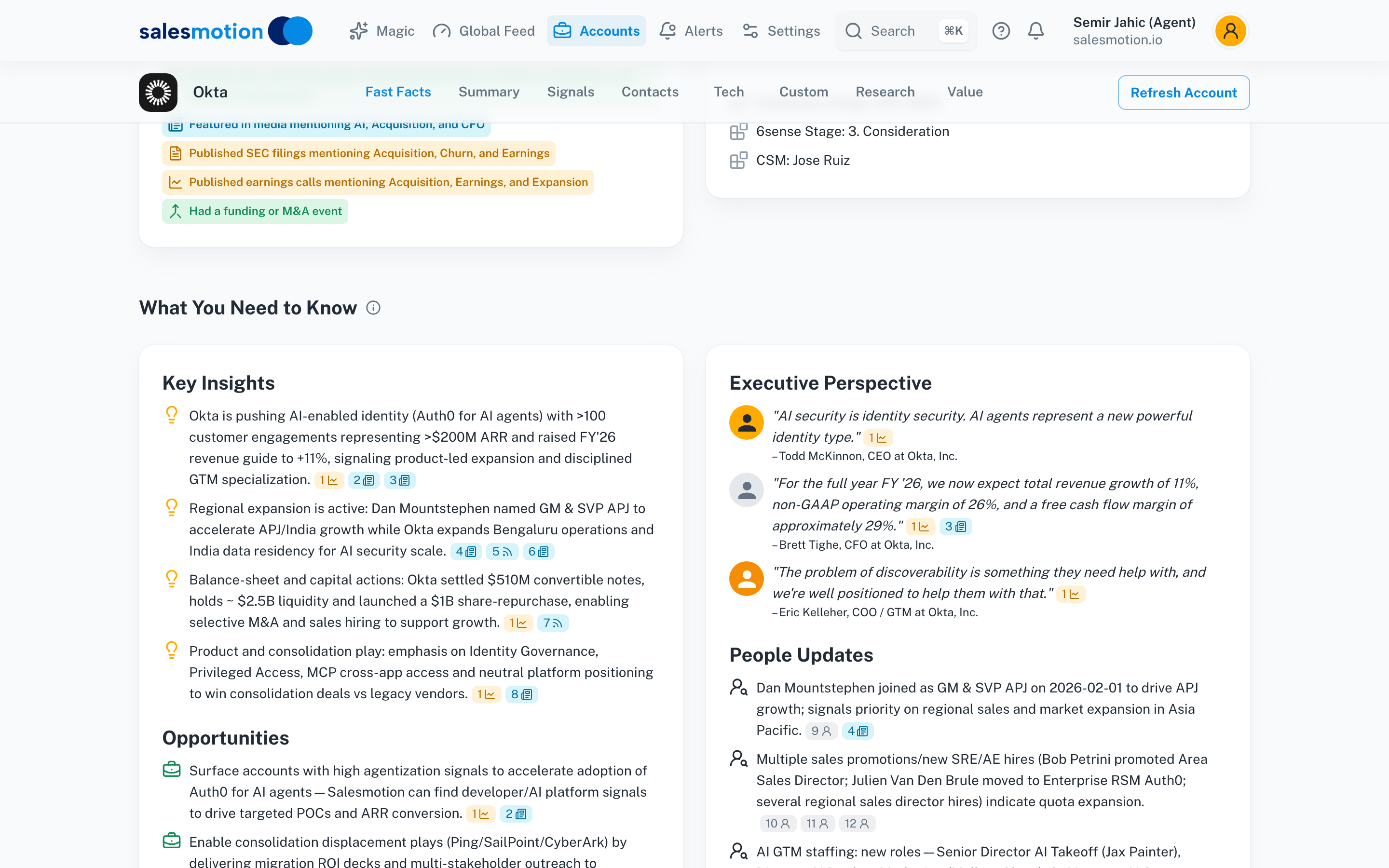 Salesmotion surfaces key insights, executive perspectives, people moves, and talking points — giving reps the context behind every contact.
Building a Contact Intelligence Practice
Shifting from contact data to contact intelligence requires changes to tools, processes, and team habits.
Layer Intelligence on Top of Existing Data
You do not need to replace your contact database. Contact intelligence layers on top of existing data. Keep your ZoomInfo or Apollo subscription for baseline contact data. Add signal monitoring and enrichment to provide the context layer.
Define the Signals That Matter for Your Business
Not all signals are equally valuable. For enterprise software sales, leadership changes and earnings call mentions are high-value signals. For startup sales, funding rounds and hiring surges are more predictive. Define the signal types that correlate with your buying patterns and configure your intelligence platform accordingly.
Train Reps to Use Intelligence, Not Just Data
The most common failure is providing intelligence that reps do not use. They default to templates because writing personalized outreach takes more effort. Solve this by building intelligence into the workflow: pre-populated account briefs, signal-triggered alerts, and suggested talking points that make personalization the path of least resistance.
Measure Intelligence-Driven Outcomes
Track the conversion rates of signal-triggered outreach versus generic outreach. Measure meeting quality, not just meeting quantity. Pipeline velocity from intelligence-driven deals versus data-driven deals tells you whether the investment is paying off.
For a broader comparison of contact data providers and how they compare to intelligence platforms, see our full guide. For a practical introduction to account intelligence, see our glossary entry.
Key Takeaways
- Contact data tells you how to reach someone; contact intelligence tells you why, when, and how to engage them effectively
- Contact data is commoditized. Every competitor has access to the same databases. Contact intelligence is the differentiator.
- The shift from data to intelligence reflects changed buyer expectations: 87% of buyers expect reps to act as trusted advisors
- Contact intelligence combines role context, activity signals, company signals, relationship mapping, and timing indicators into a complete view
- Layer intelligence on top of existing contact data rather than replacing your database subscription
- Measure the impact by comparing conversion rates, deal velocity, and meeting quality between intelligence-driven and data-driven outreach
Frequently Asked Questions
Do I still need a contact data provider if I have contact intelligence?
Yes. Contact intelligence does not replace contact data; it enriches it. You still need accurate email addresses, phone numbers, and basic firmographic data as the foundation. Contact intelligence adds the context layer: signals, timing, relationships, and strategic context. Think of contact data as the address book and contact intelligence as the briefing that tells you what to say when you call.
How is contact intelligence different from intent data?
Intent data captures behavioral signals indicating research interest (content consumption, search patterns). Contact intelligence is broader: it includes intent signals plus structural signals (leadership changes, earnings commentary, hiring patterns), role context, relationship mapping, and timing indicators. Intent data is one input to contact intelligence, not the whole picture.
What ROI should I expect from contact intelligence?
Teams using contact intelligence consistently report: 2-4 hours saved per rep per week on research, 20-40% higher response rates on outreach, and improved win rates on intelligence-qualified opportunities. The Analytic Partners sales team, for example, reduced research time by 85% and grew qualified pipeline 40% year-over-year after implementing signal-based intelligence.
Can small sales teams benefit from contact intelligence?
Absolutely. Small teams benefit even more because each rep manages a larger territory with less support. Contact intelligence automates the research that would otherwise consume a disproportionate share of selling time. A 5-person sales team saving 4 hours per rep per week recovers 1,000+ hours of selling time per year.