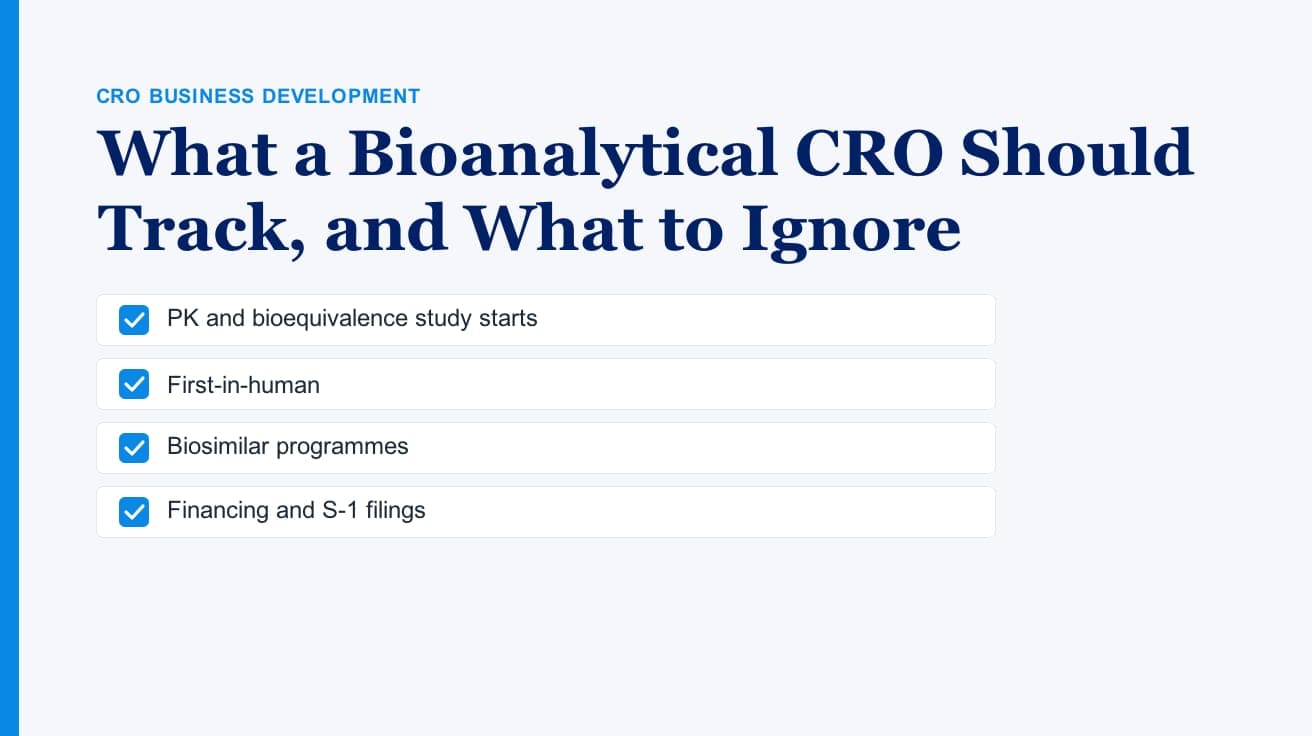
Roughly 74% of about 68,000 Form 8-K filings in an SEC review were filed within four business days of the reported event. For a contract research organization, that's a useful reminder: sponsors leave dated evidence of change. Strong business development teams turn that evidence into a credible view of the sponsor's delivery risks before sending a capabilities deck.
The opportunity is to contact more sponsors. It's to recognize when a program needs help, establish whether your operations team can deliver, and make the sponsor's choice easier to defend.
What CRO Business Development Involves in 2026
Here, CRO means contract research organization, the firm sponsors pay to run clinical trials, not chief revenue officer. CRO business development means identifying sponsors likely to need outsourced trial work before they go out to bid, then earning a place on their shortlist.
Say a biotech announces financing and adds an indication to its pipeline. A reactive team sends a capabilities presentation and waits for an RFP. A stronger team checks the development timeline, considers the enrollment challenge, and asks operations whether the relevant sites and staff are available.
The commercial conversation then starts with a trial problem, not a service menu.
Sell a feasible plan
Outsourcing makes execution the central question. A sponsor needs to know whether your team can recruit the right patients, manage the study's complexity, and resolve problems without constant intervention.
Two internal owners must agree before the opportunity advances:
- The business development lead owns the pipeline, sponsor relationship, and commercial next step.
- The operations head confirms feasibility, resource availability, and the assumptions behind the offer.
Competing on price before those assumptions are clear creates an avoidable trade-off: the team can win an attractive-looking contract that operations can't deliver profitably. Early qualification gives both sides room to adjust scope instead.
Pipeline test: Can you name the specific trial problem each open opportunity solves?
If the answer is only that the sponsor needs a CRO, the opportunity still needs work.
Org Structure, Enablement and Tooling
For a mid-sized CRO, a practical starting design is one BD lead, two segment owners, a clinical-operations feasibility lead, and a proposal manager. Treat that as a staffing model, not an industry benchmark. Oncology and cardiometabolic could be the initial segments.
BD should report to the commercial head, with a dotted line to operations. The feasibility lead signs off the risk register before a bid; the proposal manager controls submission work and records bid cost.
Build judgment before adding software
Use a quarterly pursuit-playbook session to rehearse qualification and risk-based bidding. Pair it with shadowing of live bid defenses and a comparable-study library containing inspection history, relevant outcomes, and usable references. Refresh that library quarterly, and let new hires master one segment before adding another.
The essential records are straightforward:
- Account record: Sponsor, program, stakeholders, stage, and owner.
- Signal log: Event, source link, date, and commercial hypothesis.
- Bid tracker: Effort, decision criteria, outcome, and reasons lost.
A well-kept spreadsheet can hold all of this. Add software when coordination becomes difficult, using the CRO business development tech stack guide to separate monitoring, contact research, outreach, and account history.
Can the feasibility lead say no to a bid, and does that decision get logged?
If not, the reporting structure still favors proposal volume over delivery discipline.

“There's been a big focus on hyper personalization and relevance in our outbounding efforts. Salesmotion has been a key partner in hitting our significantly increased meeting targets. What stands out is how simple it is. Reps can log in and get valuable account insights within 30 seconds to a minute.”
Joe DeFrance
VP of Sales, Incredible Health
Signals Worth Acting On and How to Verify Them
| Signal | Where to verify | First action |
|---|---|---|
| Trial start or phase move | Trial registries and sponsor press releases | Check enrollment needs and contact the trial team within a week |
| New protocol or indication | Sponsor pipeline page and investor materials | Draft a risk register for the new program |
| Financing or partnership | Press release and regulatory filings | Confirm the program timeline and likely capacity gap |
| Senior officer appointment | SEC Form 8-K, Item 5.02 | Reach the new leader with a point of view on the handoff |
| Clinical operations hiring surge | Job postings | Lead with delivery support for the internal capacity strain |
| Regulatory milestone | Company announcements | Time outreach ahead of the milestone date |
A signal deserves attention when it changes the sponsor's status quo and makes your capacity more relevant. As an operating rule, review events from the last 30 to 90 days, then adjust the window to the service you sell. That's a recommended filter, not evidence that every sponsor buys within that period.
A financing announcement alone doesn't establish an outsourcing need. Pair it with program timing, hiring, or a protocol change before assigning an account to active pursuit. Use clinical pipeline analysis by indication and phase to keep the event attached to the relevant program rather than the sponsor's name alone.
Separate disclosure from interpretation
The SEC's Form 8-K instructions generally require filing within four business days after a reportable event, unless another deadline applies; Item 5.02 covers specified senior-officer appointments, including principal executive and operating officers. Don't assume every commercial title automatically triggers that item.
Prioritize senior appointments and material agreements over routine website changes. Read the filing itself, then check the executive's remit, the sponsor's pipeline, and current hiring.
Keep two fields in the account record:
- Disclosed fact: What changed, when it happened, and the official source.
- Hypothesis: Why the change might affect outsourcing, capacity, or decision-making.
For example, a new operating leader may reassess vendor governance. That's a reasonable conversation starter, not proof that an incumbent CRO is being replaced.
Give each trigger an owner
Score events by seniority, recency, and relevance to the sponsor's programs. An executive appointment unrelated to clinical execution shouldn't outrank a funded program that fits your available team.
For a cross-industry comparison of lead handling and intake design, see Lighthouse Legal's intake guidance. Keep the clinical qualification criteria specific to sponsor pursuits.
Act within a week on high-priority signals. Log lower-priority events with a review date so useful patterns don't disappear into individual inboxes.
Qualification Funnel Stages and the Benchmarks to Beat
| Stage | Qualifying test | Metric to log | Benchmark |
|---|---|---|---|
| Segment sponsors | Therapeutic area, phase, geography, outsourcing model, study complexity | Accounts per segment | Establish your own baseline |
| Qualify account | Two or more live buying signals | Signal-to-qualified conversion | Baseline over four quarters |
| Map buying committee | Hard and soft criteria named for each buyer | Stakeholders mapped per account | Named owner for every criterion |
| Point of view before RFP | Operating model, risks, and timeline controls delivered | Pre-RFP meeting rate | Baseline over four quarters |
| Shortlist | Sponsor invites firm to bid | Shortlist rate | Commonly three to five firms |
| Qualified RFP | Complete scope, protocol, timelines, and decision criteria received | RFP win rate | Large-CRO median about 20–22%; therapeutic specialists high twenties to low thirties |
| Contract | Decision criteria met and terms agreed | Cycle time to contract | Track your trend by segment |
The shortlist and win-rate figures in the table come from Pulse RevOps' CRO qualification benchmarks: sponsors commonly narrow to three to five qualified CROs, while the reported large-CRO median RFP win rate is approximately 20–22%, with therapeutic specialists reaching the high twenties to low thirties. Treat those figures as directional because definitions of qualified RFP and awarded value differ.
The remaining table entries are operating rules. They're designed to make advancement explicit, not to imply universal performance targets.
Make every stage earn its place
Start with therapeutic area, development phase, geography, outsourcing model, and study complexity. A sponsor can be scientifically relevant but commercially unsuitable because its preferred outsourcing model doesn't match your offer.
Require at least two live buying signals before active qualification. Financing paired with a new protocol is more useful than financing alone; a compressed timeline paired with an internal capacity gap gives BD a concrete feasibility question.
Committee mapping should identify both hard criteria, such as staffing and quality systems, and soft criteria, such as responsiveness and working style. Before the RFP, deliver an operating point of view that the sponsor can challenge.
Protect proposal capacity
Don't treat an incomplete RFP as a reason to invent certainty. Ask for the scope, draft protocol, technical needs, assumptions, timelines, and decision criteria. Where inputs remain open, state exclusions and pricing assumptions plainly.
Compare your own trend over four quarters rather than a rival's headline number. Track stage-to-stage conversion, cycle time, bid cost, and reasons lost by criterion, separating price losses from feasibility, staffing, and evidence gaps.
A healthy top of funnel with a weak qualified-RFP win rate points toward bid quality or fit, not a need for more leads.
Before expanding prospecting, inspect what sponsors rejected and whether the same objection appears across pursuits.

“This is my singular place that very simply summarizes a company's top initiatives, strategies and connects them to my solution. Something I would spend hours researching manually, now it's automated.”
Derek Rosen
Director, Strategic Accounts, Guild Education
Mapping the Buying Committee and Multi-Threading
Gartner's buyer-enablement guide describes a complex B2B purchase as involving six to 10 decision-makers, with each bringing four or five independently gathered pieces of information. That's a general B2B finding, not a clinical-sponsor staffing rule, but it explains why relying on a single champion is fragile.
Your champion may want your team and still lack the evidence needed to persuade quality, finance, or procurement. Give them material they can circulate without translating your sales presentation.
| Sponsor role | Main concern | Useful evidence |
|---|---|---|
| Clinical lead | Therapeutic and protocol expertise | Relevant study summaries and scientific rationale |
| Clinical operations | Site coverage and enrollment | Feasibility findings, recruitment assumptions, staffing |
| Quality | Inspection readiness and oversight | Inspection history, quality controls, corrective-action approach |
| Finance | Stability and financial exposure | Financial information and explicit cost assumptions |
| Procurement | Comparable scope and clear obligations | Complete scope, exclusions, responsibilities, contract terms |
Translate the trigger for each buyer
Suppose a sponsor adds a program. Operations needs to understand whether the internal team can absorb it. Quality needs to assess oversight demands, while finance needs to understand when spending starts and which assumptions could change the budget.
Build a role-specific brief for each buyer: the shared event, that person's likely concern, supporting evidence, and a useful next question. Keep one consistent account narrative underneath those briefs.
Don't send identical messages to every stakeholder. A finance contact doesn't need the same opening as a clinical lead, and simultaneous generic outreach can make a coordinated team look disconnected. A multi-threading sales strategy should specify who contacts whom and how the team shares responses.
Re-map during leadership handoffs
When a senior sponsor leader changes, set an internal target to re-map the committee within a week. Check account ownership, interim responsibilities, budget authority, and whether the incoming leader has changed the evaluation process.
Keep the champion informed rather than working around them. Ask who else needs confidence in the plan and offer evidence matched to that person's concern.
The decisive check is simple: Can you name the person who could block the deal and the evidence that would satisfy them?
How to Run a Risk-Based Pursuit in Five Steps
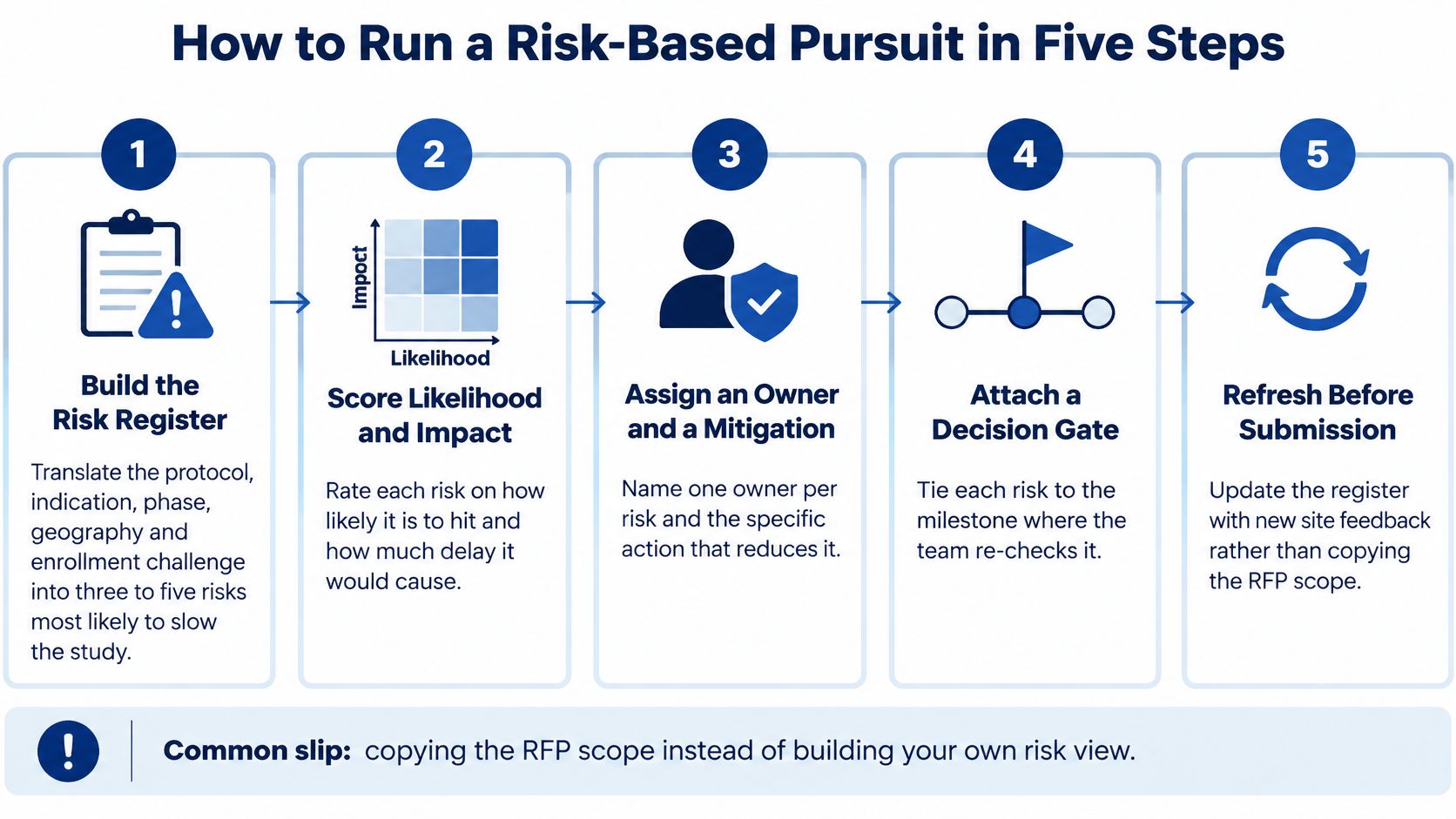
Start with the sponsor's risk register, then build the commercial response around it. The visual below shows the discipline needed to keep that register current throughout a pursuit.
Build the delivery case
-
Translate the study into risks. Use the protocol, indication, phase, geography, and enrollment challenge to identify the three to five issues most likely to delay delivery. Score likelihood and impact, then update the register as feasibility findings arrive. The common slip is copying the RFP scope instead of explaining what could go wrong.
-
Match risks to accountable resources. Name the people, sites, investigators, and systems that will address each issue. Distinguish committed staff from proposed staff and explain substitution arrangements. A global footprint isn't a substitute for a team the sponsor can evaluate.
-
Quantify the delivery plan. State enrollment assumptions, milestone dates, escalation thresholds, quality controls, and subcontractor governance. Include the patient-recruitment strategy, not just the site list. For a scenario involving restrictive eligibility criteria, show how screening assumptions affect recruitment and when the team would reconsider the site mix.
These steps require uncomfortable conversations internally. If a specialist is unavailable, BD should not imply that person will lead the study. Offer an alternative team or a revised start date before the sponsor builds its plan around an unsupported promise.
Make proof easy to inspect
-
Attach comparable evidence. Use studies with relevant operational similarities, inspection history, data-quality results, and references you have permission to share. Explain the limits of comparability. A study in the same therapeutic area may still be a weak comparison if its recruitment burden or geography was materially different.
-
Agree on governance before signature. Define communication cadence, decision rights, escalation ownership, and recovery actions. Tie unresolved risks to decision gates and refresh the register before submission. Treat responsiveness and cultural fit as delivery concerns because sponsors need confidence that difficult decisions won't stall.
The buying priorities support this approach. The Department of Pharmaceuticals' CRO market report reports roughly 61% of clinical-development work is outsourced and describes operational excellence as the top CRO attribute for about one-fifth of respondents, nearly twice the next attribute. In the same selection findings, therapeutic expertise ranked at 11%, prior positive experience at 8%, and data quality at 6%.
Leading with price skips those concerns. Price matters, but a lower number doesn't answer whether the proposed team can execute the study.
A strong bid defense opens with the top three delivery risks, names their owners, and shows a comparable study's enrollment curve against plan. Explain deviations and corrective actions rather than presenting only the successful endpoint.
KPIs That Prove Business Development Is Working
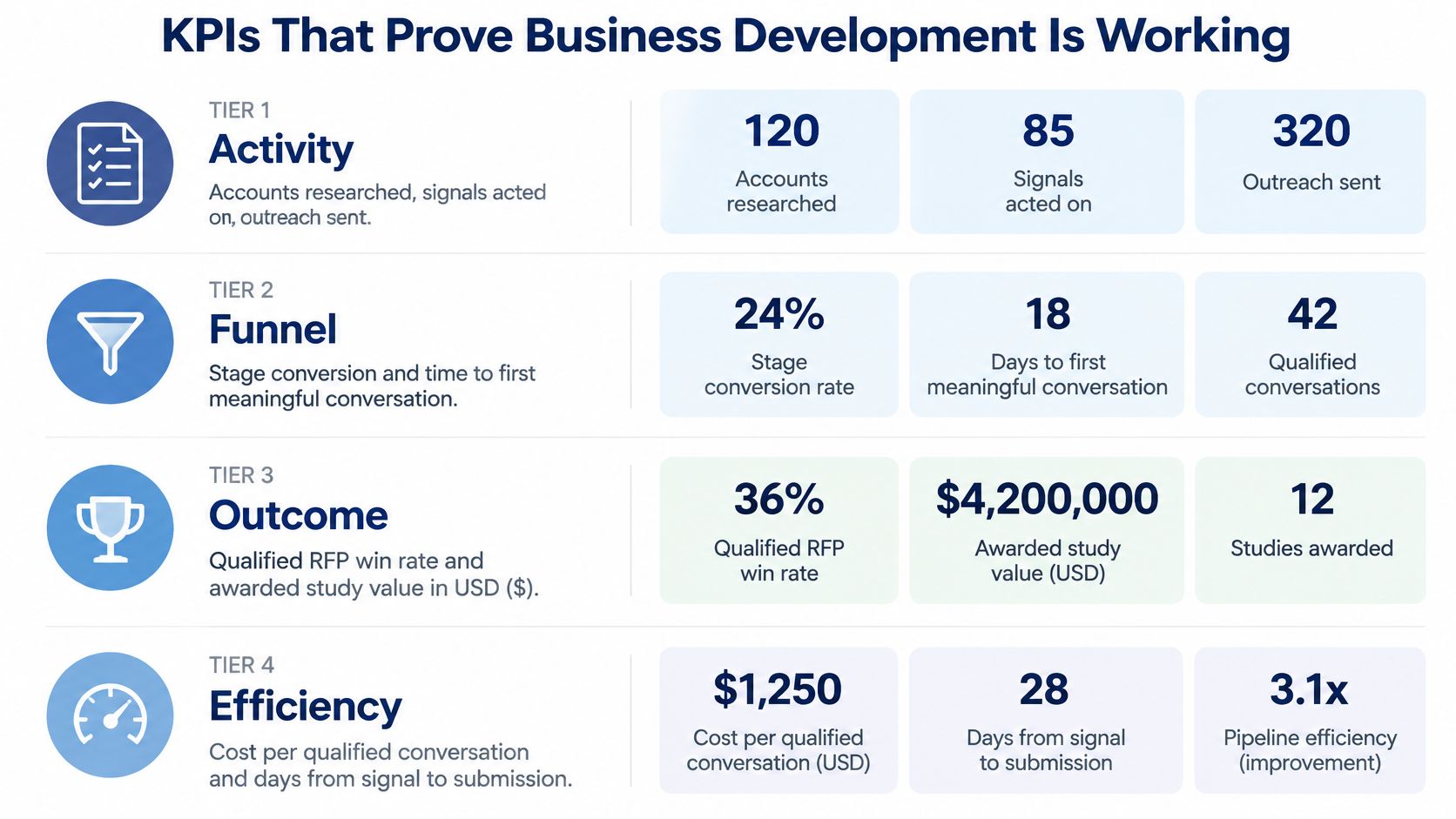
Organize the dashboard into four tiers so activity doesn't get mistaken for commercial progress.
| Tier | Measures | Management question |
|---|---|---|
| Activity | Accounts researched, signals acted on, outreach sent | Did the team work the intended accounts? |
| Funnel | Stage conversion, time to first meaningful conversation | Did relevant activity advance the pursuit? |
| Outcome | Qualified RFP win rate, awarded value | Did sponsors award suitable work? |
| Efficiency | Bid cost per win, research hours moved into account planning | Did the team use capacity better? |
Keep the distinctions visible in the reporting view.
Test incremental progress
The useful question for AI-assisted BD isn't whether the team produced more drafts. It's whether better research and timing created opportunities that wouldn't otherwise have advanced. The 2026 buyer-experience report provides context for evaluating AI-assisted commercial activity; your own pursuit records must establish whether it works for your segment.
Every automated signal or sequence needs:
- A hypothesis: Why this event should create a relevant conversation.
- A target cohort: Which sponsors qualify and which don't.
- Human review: Who checks source accuracy, interpretation, and proposed outreach.
- A downstream outcome: The progression you expect to improve.
Compare signal-triggered accounts with matched control accounts. Match therapeutic area, phase, sponsor size, prior relationship, and funding status where practical. Measure pipeline lift per signal, not alerts delivered.
Separate time savings from commercial results
Consider an illustrative experiment, not a customer case study: a four-person team researches 40 accounts a month. After signal filtering, research time falls by half, and 12 accounts reach a pre-RFP meeting compared with five in a matched control group.
That meeting gap is evidence worth investigating. It isn't proof of causality unless the cohorts and treatment are sufficiently comparable, and it isn't revenue until opportunities progress.
Cytel reduced research time by half and accelerated account planning by 30%. Those are useful efficiency outcomes, but a BD leader should still track where the recovered time goes and whether sponsor decisions improve.
Use consistent definitions across your sales pipeline metrics. Review stage progression monthly and win rates by decision criterion quarterly, keeping disqualified pursuits visible rather than deleting them from the denominator.
If activity rises while cycle time and win rate remain flat, inspect the signal filter before asking the team to send more. Faster research only helps when it changes account selection or pursuit quality.
Pick One Pipeline Motion and Start This Quarter
Choose a narrow pilot rather than rebuilding the entire commercial function. A defined segment makes it easier to see whether the team's judgment, evidence, or timing needs improvement.
Give the pilot a clear boundary
-
Select the segment. Choose one therapeutic area or signal type and assemble a working list of 20 to 30 sponsors. This is a manageable pilot size, not a market benchmark.
-
Write the qualification rule. Load the accounts into a tracking sheet or CRM and define which two live signals justify active pursuit. Name the source that confirms each signal.
-
Prepare delivery evidence. Build risk registers for the three most promising accounts, assigning a delivery owner to each risk. Resolve resource questions before requesting proposal effort.
-
Track from the start. Log stage conversion, qualified RFP rate, cycle time, and bid cost from the first week. Keep qualified RFP rate separate from qualified RFP win rate.
-
Make a decision at 90 days. Widen the segment only if the team can explain what worked. Otherwise, fix the weakest stage before adding accounts.
For help with signal monitoring, Salesmotion is one option. Teams book a call and work directly with a founder; during onboarding, we load target accounts, configure signals to the customer's ideal customer profile, and connect Salesforce or HubSpot. The playbook also works without a tool.
Write this commitment on day one, replacing the bracketed segment with your actual focus:
For the next 90 days we will pursue sponsors in [segment] that show two live signals, and we will judge ourselves on qualified RFP win rate.
Salesmotion monitors sponsor buying signals, builds cited account briefs, and drafts outreach tied to what changed. Visit Salesmotion to book a call and discuss a focused sponsor-monitoring pilot for your therapeutic area and delivery capacity.