In B2B, keeping a customer is just the start. The real goal is making them so successful they can't imagine working without you. But how do you shift from reactive support to proactive partnerships that drive revenue? It all comes down to smart customer success strategies that turn customer relationships into a growth engine.
This isn't just about preventing churn. It's about creating the conditions for expansion, advocacy, and loyalty. Done right, customer success becomes a reliable source of predictable revenue. The challenge is moving from theory to practical actions that deliver real results for both your customers and your bottom line.
This guide is a no-fluff roundup of 10 actionable strategies modern revenue teams are using right now. We'll break down the "what" and the "how," covering:
- Implementation Steps: A clear blueprint to get started.
- Key Metrics: How to measure what matters.
- Common Pitfalls: What to watch out for.
- The Account Intelligence Edge: How to use data for faster impact.
For a deeper dive into the foundations of CS, check out this complete guide to Customer Success for SaaS. Here, our focus is on the tactics that drive growth. Let’s get into it.
1. Deploy Dedicated Customer Success Management (CSM) Programs
Moving beyond generic, reactive support is a critical step. A dedicated Customer Success Management (CSM) program formalizes this by assigning a manager to be a strategic partner for your clients. A CSM's role isn't just solving problems; it's proactively ensuring customers achieve their goals with your solution. They become trusted advisors focused on value.

This high-touch approach is fundamental for long-term retention and expansion, especially with high-value B2B accounts. As pioneered by platforms like Gainsight, this strategy transforms the customer relationship from a transaction to a true partnership, making your solution indispensable.
How to Implement This Strategy
- Segment Your Customer Base: Not every customer needs a dedicated CSM. Tier your accounts by Annual Recurring Revenue (ARR), strategic value, or growth potential. High-value accounts might get a 1:1 CSM, while smaller accounts could be managed in a pooled model.
- Define the CSM Role and Cadence: Clearly outline the CSM's responsibilities, keeping them separate from sales and support. Set a predictable engagement schedule, like monthly check-ins and Quarterly Business Reviews (QBRs), to review progress and spot new opportunities.
- Empower CSMs with Tools and Training: Equip your team with a Customer Success Platform (CSP) or a solid CRM to track interactions, health scores, and milestones. Invest in training on your customers' industries, not just your product.
Accelerating with Account Intelligence
Account intelligence platforms supercharge CSM programs. Instead of relying on manual check-ins, CSMs can use real-time product usage data to spot accounts at risk or those ready to expand. This data-driven approach allows for precise, proactive outreach based on actual customer behavior.
See Salesmotion in action
Take a self-guided interactive tour — no signup required.
2. Onboarding and Implementation Excellence
The first 90 days of a customer relationship often set the tone for its entire future. A smooth, effective onboarding process is one of the most powerful customer success strategies because it gets customers to value, faster. This is where you guide new clients from setup to their first meaningful win, building good habits and proving your solution's worth from day one.
This phase is about more than just tech setup; it’s about aligning with the customer's business goals. As championed by customer success platforms like Totango, a great onboarding experience shows your commitment to the customer’s success. It turns a new purchase into an essential part of their operations.
How to Implement This Strategy
- Create Role-Specific Onboarding Paths: Avoid a one-size-fits-all approach. Develop separate onboarding tracks for different users, like admins, power users, and end-users. This ensures everyone gets relevant training.
- Establish Clear Go-Live Checklists: Define what success looks like at the end of onboarding. Work with the customer to create a shared checklist of technical setups, training goals, and key performance indicators (KPIs). This creates mutual accountability.
- Use a Multi-Channel Approach: Combine automated and human touches. Use in-app tutorials for basic features but schedule check-ins with a CSM at 30, 60, and 90 days. This blended strategy offers scalable support with a personal connection.
Accelerating with Account Intelligence
Account intelligence makes onboarding a dynamic, responsive process. Platforms can provide real-time data on feature adoption. If a key user hasn't logged in or a critical feature is untouched, a CSM gets an alert. This allows them to step in with targeted help, keeping customers on track to hit their value milestones.

“The moment we turned on Salesmotion, it became essential. No more hours on LinkedIn or Google to figure out who we're talking to. It's just there, served up to you, so it's always 'go time.'”
Adam Wainwright
Head of Revenue, Cacheflow
3. Data-Driven Customer Health Scoring
Moving beyond gut feelings is crucial for scaling your customer success strategies. A data-driven customer health score provides a clear, quantitative measure of an account's well-being. This score combines multiple data points—like product usage, support tickets, and engagement levels—into a single, actionable metric. It helps teams prioritize their efforts, predict churn, and spot expansion opportunities accurately.
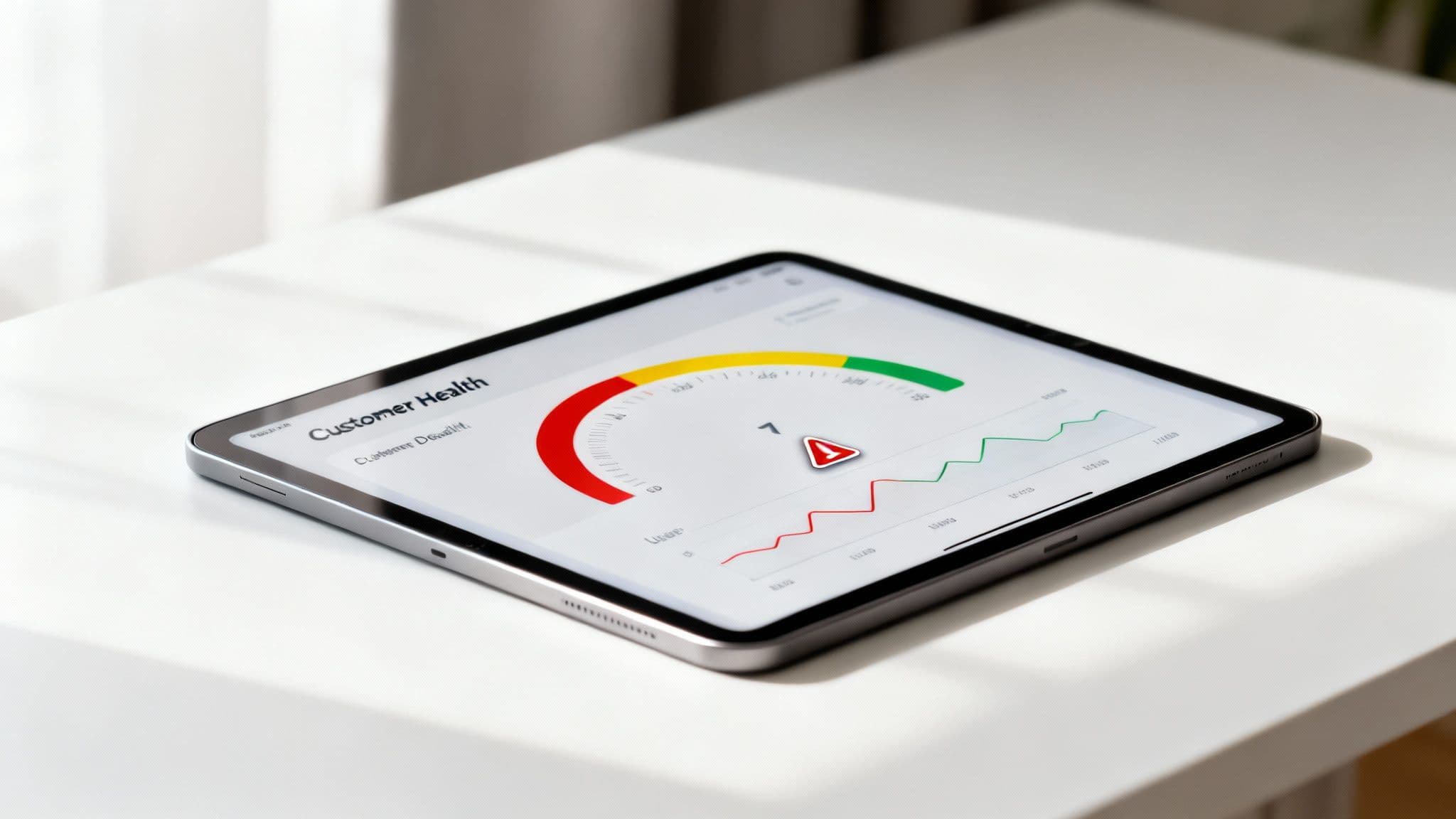
This methodical approach systematizes how you monitor your entire customer portfolio. Advocated by platforms like Gainsight, health scoring turns customer success from a reactive function into a proactive, predictive engine. It ensures your team focuses its resources where they're needed most.
How to Implement This Strategy
- Select and Weight Key Metrics: Don't try to measure everything. Start with 5-7 key indicators linked to retention, like product adoption rates, feature usage, and active users. Assign a weight to each metric based on its importance.
- Establish Clear Thresholds: Define what "good," "average," and "poor" health look like by setting clear red, yellow, and green thresholds. For example, an account could be "green" (90-100), "yellow" (70-89), or "red" (below 70). These scores should trigger specific actions for your CSMs.
- Review and Calibrate Regularly: Your product and customers evolve, so your health score should too. Review its accuracy and adjust the metrics and weights quarterly to ensure it remains a reliable predictor of outcomes.
Accelerating with Account Intelligence
Account intelligence enriches health scores by adding external behavioral data. By incorporating intent data, you can see if a "healthy" customer is suddenly researching competitors. This context helps CSMs understand the "why" behind a score, leading to more effective conversations that protect and expand revenue.
4. Product-Led Growth (PLG) Customer Success
Product-Led Growth (PLG) uses the product itself as the main driver for customer acquisition, adoption, and expansion. This strategy embeds customer success directly into the user experience, letting the product's value create organic growth. Instead of relying only on high-touch engagement, a PLG approach focuses on empowering users to succeed on their own.
This self-service model is a powerful engine for scalable growth. Companies like Slack and Figma have shown how an intuitive product can create viral adoption, with users becoming champions and driving expansion from the bottom up. As popularized by firms like OpenView Partners, this strategy shifts the CS focus from solving problems to optimizing the product experience.
How to Implement This Strategy
- Build In-App Onboarding and Guidance: Create seamless onboarding flows, interactive tours, and help guides directly within your app. The goal is to get users to their "aha!" moment as quickly as possible without needing human help.
- Focus CS on High-Value Segments: Rather than giving 1:1 support to everyone, concentrate your CSM team on high-potential accounts or users showing signs of enterprise-level expansion. This allocates your most valuable resources for the biggest impact.
- Leverage Product Analytics for Intervention: Use product usage data to understand user behavior and identify friction points. This allows you to proactively help struggling users or identify power users who could become internal champions.
Accelerating with Account Intelligence
Account intelligence is the backbone of a PLG customer success strategy. Platforms can provide the real-time product usage data needed to identify "Product Qualified Leads" (PQLs)—users whose in-app behavior shows they're ready for a sales or CS conversation. By tracking feature adoption, your team can engage the right users at the perfect moment to accelerate conversion and expansion.
“Automatic account profile detail I can use to manage my territory. Using Salesmotion AI to generate value statements per persona, account, etc. Using Salesmotion to give me a starting point based on new hires, or news alerts is critical.”
Adam Wainwright
Head of Revenue, Cacheflow
5. Community Building and User Advocacy
Building a vibrant community around your product is a powerful, often underused, customer success strategy. It moves beyond one-to-one interactions to create a network where customers help each other and share best practices. A strong community reduces the load on your support team and creates a powerful retention engine fueled by peer-to-peer engagement.

This strategy turns customers into passionate advocates. Think of Salesforce's Dreamforce community or HubSpot's Academy programs; they transform their user base into a strategic asset, driving both product adoption and organic growth.
How to Implement This Strategy
- Establish a Central Hub and Guidelines: Choose a platform for your community, whether it's a dedicated forum, a Slack channel, or a private group. Set clear community guidelines from day one to ensure a safe and productive environment.
- Recognize and Reward Advocates: Identify your most helpful community members and create a formal "champions" program. Offer them exclusive benefits like early access to features or public recognition. This encourages participation.
- Facilitate Engagement and Feedback: Don't just build the space and leave. Host regular webinars, Q&A sessions, and office hours. Critically, ensure your product and engineering teams participate, gathering feedback and making users feel heard. You can find great examples of how powerful customer stories are when amplified this way.
Accelerating with Account Intelligence
Account intelligence adds a data-driven layer to community management. By tracking product usage, you can identify power users who are prime candidates for your advocacy program. This allows CSMs to proactively invite the right customers into the community at the right time, maximizing engagement and turning your best users into your most vocal champions.
6. Customer Success Metrics and KPI Tracking
What you don't measure, you can't improve. A systematic framework for tracking key performance indicators (KPIs) is the foundation of any scalable customer success strategy. It turns your efforts from guesswork into a data-informed science, allowing you to prove your team's value, identify at-risk accounts, and pinpoint growth opportunities. Without clear metrics, you're flying blind.
This measurement-first approach provides an objective view of customer health and team performance. It aligns your Customer Success team with broader business goals like revenue retention and expansion. Modern platforms make it possible to build and share dynamic dashboards, ensuring everyone is looking at the same source of truth.
How to Implement This Strategy
- Select Core Metrics: Don't drown in data. Focus on 5-10 core KPIs that reflect your business goals. Balance leading indicators (like product adoption) with lagging indicators (like churn rate) for a complete view.
- Establish a Reporting Cadence: Create a rhythm for reviewing performance. This should include weekly team huddles to discuss at-risk accounts and monthly or quarterly reviews to analyze trends. Dashboards should be real-time, but human review is still critical.
- Connect KPIs to Action: Metrics are useless without action. For every KPI, define clear thresholds and the corresponding actions. For example, if a customer's health score drops below 70, it should automatically trigger a specific outreach from the CSM.
Accelerating with Account Intelligence
Account intelligence platforms are the engine behind meaningful KPI tracking. Instead of manual data pulls, tools can automate the collection of product usage signals and customer behavior, feeding them directly into your CS platform. This creates a dynamic, real-time health score that allows your team to act on insights instantly.
7. Strategic Account Planning and Executive Alignment
To truly embed your solution within a customer's business, customer success must become a strategic partnership. Strategic Account Planning formalizes this by creating a long-term roadmap for high-value clients, ensuring your solution is tied to their most critical business goals. This involves deep collaboration and building executive relationships to become an indispensable partner.
This strategy goes beyond standard check-ins by creating a shared vision for success. It emphasizes understanding a customer's entire business, not just their use of your product. Companies like Salesforce excel at this, integrating deeply into their enterprise clients' operations.
How to Implement This Strategy
- Develop Account-Specific Success Plans: For each strategic account, create a documented plan outlining their key business goals and the specific KPIs your solution will impact. This should be a living document, reviewed and updated with the customer.
- Map Key Stakeholders and Build Executive Relationships: Identify and map the organizational chart, from end-users to executive sponsors. Proactively build client relationships with decision-makers to ensure you have champions at the highest levels.
- Conduct Formal Business Reviews: Schedule structured Quarterly Business Reviews (QBRs) and annual strategic reviews. Use these meetings to report on progress, share industry insights, and align your product roadmap with the customer’s future priorities.
Accelerating with Account Intelligence
Account intelligence is the engine for effective strategic planning. Platforms provide the data needed to move beyond assumptions. By analyzing product usage patterns, a CSM can see which executives are actively involved and which departments are driving the most value. This intelligence enables CSMs to tailor their QBR presentations with concrete data, making every executive conversation more impactful. For a deeper look at this method, explore this guide on strategic account planning.
8. Proactive Outreach and Engagement Programs
Waiting for customers to have a problem before you engage is a surefire way to increase churn. Proactive outreach flips this model by initiating regular, value-driven touchpoints to guide customers and reinforce your solution's value. This strategy moves your team from a reactive, firefighting role to a strategic advisory position.
By anticipating needs and delivering guidance at the right time, you can prevent roadblocks and highlight new opportunities. This approach, popularized by engagement platforms like Intercom, is fundamental to modern customer success. It ensures customers feel supported throughout their journey, not just when they submit a support ticket.
How to Implement This Strategy
- Map the Customer Journey: Identify key milestones and potential friction points in the customer lifecycle. Use this map to plan targeted outreach, like sending a best-practice guide after they use a new feature for the first time.
- Segment Your Communications: Don't send the same message to everyone. Tailor your outreach based on user roles, product usage, or lifecycle stage. For example, send personalized feature announcements only to users who will benefit most.
- Leverage Multiple Channels: Create an engagement plan that includes email newsletters, in-app messages, webinars, and personalized calls. This ensures your insights reach customers where they are most active.
Accelerating with Account Intelligence
Account intelligence makes proactive outreach a precise science. Instead of relying on a calendar, platforms can trigger automated outreach based on real-time behavioral data. For example, a sudden drop in a feature's usage can automatically enroll a user in a targeted email campaign with helpful tips. This data-driven automation ensures your engagement is always relevant and perfectly timed.
9. Customer Education and Training Programs
A well-informed customer is an empowered and successful one. Investing in customer education and training is a proactive strategy that scales knowledge, reduces reliance on support, and helps users unlock your product's full value. Instead of answering the same questions repeatedly, you build a library of resources that serves customers 24/7.
This approach turns your company into a thought leader. Platforms like HubSpot Academy and Salesforce Trailhead have pioneered this model, proving that education can be a powerful engine for both customer success and lead generation. By providing immense value for free, they build deep trust and make their products the standard.
How to Implement This Strategy
- Develop Role-Based Learning Paths: Customers have different needs. Create tailored learning paths for administrators, end-users, and managers, with content structured from beginner to advanced.
- Create Bite-Sized, Accessible Content: Modern learners prefer short, digestible content. Break down complex topics into bite-sized modules, like 5-15 minute videos or short articles, and house them in a centralized, easy-to-navigate knowledge base.
- Incorporate Hands-On Learning: Theory is important, but practice cements knowledge. Include hands-on labs, quizzes, and even certification programs to test and validate user skills.
- Establish a Content Feedback Loop: Your educational content should be a living resource. Allow users to rate content, ask questions, and suggest improvements. Use this feedback to identify knowledge gaps and refine your training.
Accelerating with Account Intelligence
Account intelligence tools add precision to your customer education strategies. By tracking which features users are struggling with, you can proactively recommend relevant training modules. If an account shows low adoption of a key workflow, a CSM can be alerted to share the exact learning path they need, turning a risk into a moment of empowerment.
10. Churn Prediction and Retention Programs
Waiting for a customer to cancel is a reactive strategy that almost always fails. A proactive approach uses data to predict which customers are at risk of leaving before they decide. This data-driven strategy uses behavioral analytics to identify churn indicators, allowing for targeted intervention and retention campaigns. By focusing on leading indicators (like usage drops), you can save accounts that would otherwise be lost.
This predictive approach, championed by platforms like Gainsight, transforms churn management from a guessing game into a science. Instead of generic win-back offers, you can run precise, personalized retention plays based on why a customer is flagged as high-risk, dramatically improving retention.
How to Implement This Strategy
- Identify Top Churn Indicators: Analyze historical data to find common signals that come before churn. These could be decreased product usage, fewer logins, unresolved support tickets, or organizational changes.
- Segment At-Risk Customers: Don't treat all at-risk customers the same. Group them by why they are likely to churn (e.g., low adoption, key contact departure). This allows you to create tailored intervention plans. For a technical deep dive, consider guides on customer churn prediction.
- Create Tiered Intervention Plans: Develop actions based on the customer's value and risk level. A high-value, high-risk account might trigger a strategic business review, while a lower-value account could get automated re-engagement emails.
Accelerating with Account Intelligence
Account intelligence is the engine for effective churn prediction. Platforms provide the real-time behavioral data needed to build accurate predictive models. Instead of waiting for quarterly reports, CSMs can see which accounts are showing warning signs today. This allows them to prioritize their efforts and intervene with the right message at the right time. Learn more about the signals that can inform these retention strategies.
Customer Success Strategies — 10-Point Comparison
| Approach | Implementation complexity | Resource requirements | Expected outcomes | Ideal use cases | Key advantages |
|---|---|---|---|---|---|
| Customer Success Management (CSM) Programs | High — processes, hiring, ongoing management | High — dedicated CSMs, CRM and CS tools | Increased retention, upsell, stronger account relationships | Enterprise and high-value accounts needing white‑glove service | Personalized advocacy, early churn detection, expansion opportunities |
| Onboarding and Implementation Excellence | Medium–High — structured workflows and coordination | Moderate–High — implementation teams, training materials | Faster time‑to‑value, fewer rollout failures, better early adoption | Complex implementations, migrations, enterprise deployments | Reduces time‑to‑value, improves first impressions and adoption |
| Data‑Driven Customer Health Scoring | High — model design, integration, maintenance | High — data engineers, analytics platforms, instrumentation | Prioritized interventions, predictive churn insights | Data-rich environments with many accounts to triage | Objective risk identification, scalable prioritization of accounts |
| Product‑Led Growth (PLG) Customer Success | Medium–High — product changes and analytics | Moderate — product development, in‑app tooling, analytics | Scalable acquisition/adoption, lower CAC, rapid growth | Self‑service SMBs, viral collaboration tools, freemium models | Scales efficiently, drives organic growth, reduces human touch |
| Community Building and User Advocacy | Medium — governance, content, events | Moderate — community platform, managers, events budget | Peer support, higher engagement, generated advocacy and content | Products with active user bases, developer or niche communities | Lowers support load, builds authentic testimonials and referrals |
| Customer Success Metrics and KPI Tracking | Medium — metric definition, dashboards, governance | Moderate — BI tools, data pipeline, reporting resources | Better accountability, data‑driven decisions, performance visibility | Organizations aligning CS to business goals and scaling teams | Visibility into performance, supports prioritization and planning |
| Strategic Account Planning & Executive Alignment | High — bespoke plans and executive outreach | High — senior CS, cross‑functional involvement, executive time | Strong sponsorship, increased expansion, reduced executive‑level churn | Strategic/enterprise accounts with multi‑year value | Deep executive relationships, aligned long‑term roadmaps |
| Proactive Outreach and Engagement Programs | Medium — cadence design and personalization | Moderate — automation tools, content creation, channels | Improved engagement, sustained value delivery, feedback loops | Mid‑market and segmented customer bases needing regular touches | Keeps customers engaged at scale, consistent value communication |
| Customer Education and Training Programs | Medium — curriculum design, content maintenance | Moderate–High — LMS, content creators, instructors | Higher proficiency, lower support volume, certified advocates | Complex products or broad user bases requiring training | Scales user competency, reduces support and increases adoption |
| Churn Prediction and Retention Programs | High — predictive modeling and continuous tuning | High — ML expertise, data infrastructure, automation | Early identification of at‑risk customers, improved retention | Subscription businesses prioritizing retention and LTV | Enables targeted interventions, optimizes retention spend |
From Strategy to Action: The Path Forward
We've covered ten key customer success strategies, from foundational programs like onboarding and health scoring to advanced initiatives like community building and predictive churn analysis. Each strategy is a lever you can pull to turn customer relationships into long-term, value-driven partnerships. The shift from a reactive support model to a proactive, revenue-driving engine requires more than just a few new tactics; it's a change in mindset.
This shift hinges on one central theme: a deep, proactive understanding of your customer. It’s about knowing their goals, anticipating their challenges, and aligning your product’s value with their business outcomes. This is what elevates customer success from a cost center to a powerful growth engine.
Key Takeaways for Your Revenue Team
Looking back at these strategies, a few core principles stand out for any B2B organization:
- Proactivity is the New Standard: The days of waiting for a customer to raise a red flag are over. The most effective customer success strategies are built on proactive engagement, using data to anticipate needs and guide customers to success.
- Data is Your Compass: Gut feelings aren't enough. Robust customer success relies on a solid data foundation. From product usage metrics to health scores, data provides the objective truth about customer health and lights the path to value.
- Cross-Functional Alignment is Mandatory: Customer success isn't just one department's job; it's a company-wide philosophy. Success requires seamless collaboration between CSMs, Sales, Marketing, and Product to ensure a consistent, high-value customer experience.
- Technology as an Accelerator: People and processes are the heart of customer success, but technology is the nervous system. The right tools automate work, surface insights, and help your team operate at scale. Account intelligence platforms are game-changers, freeing your CSMs to focus on strategic conversations.
Your Actionable Next Steps
Reading about these strategies is the first step. Implementing them is where the real work begins. To avoid feeling overwhelmed, start small and build momentum.
- Conduct an Audit: Evaluate your current customer success maturity. Where are your biggest gaps? Is onboarding a struggle? Is churn a mystery until it's too late? Identify one or two key areas from this list to focus on first.
- Define Your "Success" Metrics: Before you start, define what success looks like. Will you measure it by lower churn, higher Net Revenue Retention (NRR), or better Customer Health Scores? Set your baseline and establish clear goals.
- Empower Your Team: Give your CSMs the tools and training they need. This means investing in customer success platforms, providing access to account intelligence, and fostering a culture of continuous learning.
Mastering these customer success strategies is the playbook for sustainable growth in today's B2B landscape. By moving from a reactive to a proactive stance, you not only protect your revenue but also unlock new avenues for expansion and advocacy. You build a loyal customer base that becomes your most powerful marketing and sales asset.
Ready to turn these strategies into reality with powerful, real-time account intelligence? Salesmotion automates the data gathering and analysis, so your team can focus on what matters most: building relationships and driving customer outcomes. See how you can accelerate your customer success initiatives by visiting Salesmotion today.
Key Takeaways
- Dedicated Customer Success Management programs transform customer relationships from transactions into strategic partnerships, driving both retention and expansion revenue.
- The first 90 days of onboarding set the tone for the entire customer lifecycle, making structured implementation excellence one of the highest-impact strategies you can invest in.
- Data-driven customer health scoring replaces gut feelings with quantitative metrics, enabling teams to prioritize at-risk accounts and spot expansion opportunities before they surface organically.
- Product-Led Growth embeds success directly into the user experience, allowing scalable self-service adoption while freeing CSMs to focus on high-value enterprise accounts.
- Proactive outreach and churn prediction powered by account intelligence let teams intervene with the right message at the right time, turning potential losses into retention wins.
- Cross-functional alignment between CS, Sales, Marketing, and Product is essential because customer success is a company-wide philosophy, not a single department's responsibility.
Frequently Asked Questions
What is the difference between customer success and customer support?
Customer support is reactive -- it responds to problems after they arise, such as tickets or bug reports. Customer success is proactive. It focuses on helping customers achieve their desired outcomes with your product before issues surface. A strong customer success function uses data and strategic engagement to prevent churn, drive adoption, and uncover expansion opportunities rather than waiting for something to go wrong.
How do I know which customer success strategies to prioritize first?
Start by auditing your biggest pain points. If customers are churning early, focus on onboarding excellence and health scoring. If retention is strong but expansion is flat, invest in strategic account planning and proactive outreach. The right starting point depends on where you are losing the most revenue or leaving the most growth on the table. Pick one or two strategies, measure their impact, then layer on additional initiatives.
How does account intelligence improve customer success outcomes?
Account intelligence provides real-time behavioral and product usage data that removes guesswork from customer success. Instead of relying on periodic check-ins to gauge satisfaction, your CSMs can see which accounts are thriving and which are showing early warning signs. This enables precise, timely interventions -- whether that means re-engaging a disengaged user, surfacing an expansion opportunity, or flagging a competitor evaluation before the customer makes a decision.
What KPIs should a customer success team track?
The most important KPIs include Net Revenue Retention (NRR), customer health score, churn rate, time-to-value during onboarding, product adoption rate, and Customer Satisfaction (CSAT) or Net Promoter Score (NPS). Balance leading indicators like usage frequency and feature adoption with lagging indicators like renewal rate. The key is connecting every metric to a specific action so that declining numbers trigger an intervention rather than just a report.
Can small B2B teams implement these strategies effectively?
Yes, but prioritization matters. Small teams should start with strategies that scale well, such as customer health scoring, proactive outreach automation, and a lightweight education program. You do not need a large CSM team to be effective. Use technology to automate repetitive tasks and focus your human resources on high-value accounts. Even a single CSM supported by an account intelligence platform can manage a meaningful book of business and drive measurable retention and expansion results.