Companies are spending $2 in sales and marketing for every $1 of new ARR. That ratio has climbed 14% since 2024. The SaaS go-to-market playbook that worked during cheap-capital growth, hire more reps, buy more tools, add more channels, breaks when every dollar must justify itself against CAC payback targets.
TL;DR: A SaaS go-to-market strategy must answer five questions: who buys, why they buy, what you charge, how they find you, and how you measure success. Product-led growth (PLG) works for simple products with ACV under $10K. Sales-led growth works for complex products with ACV above $25K and multi-stakeholder buying committees. Most B2B SaaS companies in 2026 use a hybrid model. The most important metric is LTV:CAC ratio, which captures both acquisition efficiency and customer value. Target 3:1 or higher with CAC payback under 12 months.
The Five Questions Every GTM Strategy Must Answer
Before choosing channels, hiring reps, or building a tech stack, answer these five questions. If any answer is vague, your GTM motion will waste money.
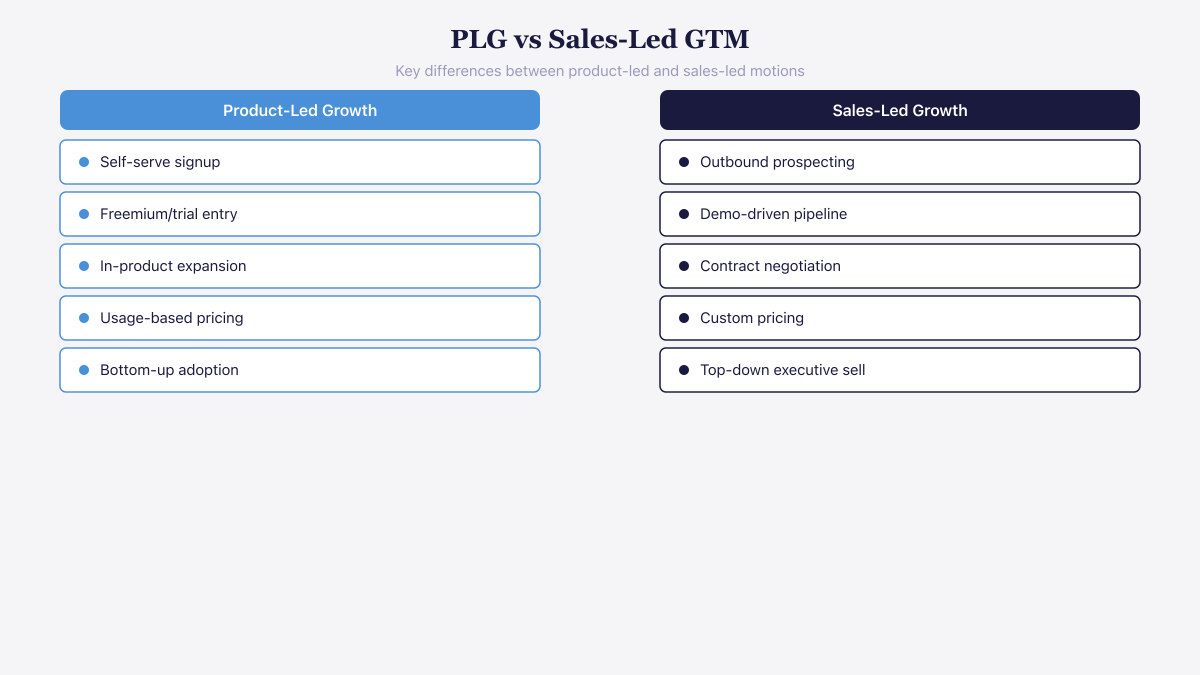 PLG and sales-led GTM serve different market segments and can complement each other.
Who are you selling to? Not "mid-market companies" but specific firmographic and behavioral profiles. Industry, headcount, revenue, tech stack, funding stage, and the specific job titles that champion and buy your solution. If you cannot describe your buyer in concrete terms, you are not ready for outbound.
Why will they buy? Name the exact problem you solve and explain what competitors cannot or will not do. Strong positioning requires three elements: problem clarity, competitive differentiation, and proof through outcomes or data. "We help companies grow revenue" positions you against nobody and means nothing.
What do you charge? Pricing must align with value delivered and scale with how customers use your product. Subscription models work for predictable usage. Usage-based pricing aligns cost with value but complicates forecasting. Tiered seat-based models encourage expansion. Most B2B SaaS companies use a hybrid approach.
How do they find you? Direct sales, self-service, partners, or a combination. The answer depends on your ACV and buyer complexity, which determines your GTM motion.
How do you measure success? Define the metrics that prove your GTM is working or broken. Without clear measurement, you will scale problems instead of solutions.
See Salesmotion on a real account
Book a 15-minute demo and see how your team saves hours on account research.
PLG vs. Sales-Led: Choosing the Right GTM Motion
The choice between product-led growth and sales-led growth is not philosophical. It is determined by your average contract value, product complexity, and buyer profile.
Product-led growth works when your product is simple enough for users to adopt without training, your ACV is under $10K, and individual users can experience value through a free trial or freemium tier. PLG reduces CAC because the product does the selling. ProductLed's 2025 benchmark survey found that 91% of SaaS companies plan to invest more in product-led growth.
Sales-led growth works when buying decisions involve multiple stakeholders, require customization or implementation support, and the ACV exceeds $25K. Sales-led motions are necessary when the product is complex enough that prospects cannot evaluate it independently and when enterprise procurement processes require human-to-human negotiation.
Hybrid models combine both and are now the dominant approach for B2B SaaS. PLG drives initial acquisition: users discover, try, and adopt your product through self-service. Sales handles expansion: when a user's organization shows buying signals like increased usage, multiple department adoption, or enterprise feature requests, a sales team engages to convert the self-serve account into an enterprise contract. This is signal-based selling in practice — letting account behavior, not a fixed cadence, decide when sales steps in.
Decision framework:
- ACV under $5K: Product-led or self-service
- ACV $5K-$25K: Hybrid with PLG acquisition and sales-assisted expansion
- ACV above $25K: Sales-led, potentially with trials for initial evaluation
- Complex buying committees: Sales-led regardless of ACV

“Automatic account profile detail I can use to manage my territory. Using Salesmotion AI to generate value statements per persona, account, etc. Using Salesmotion to give me a starting point based on new hires, or news alerts is critical.”
Adam Wainwright
Head of Revenue, Cacheflow
Building Your GTM in Six Steps
Step 1: Validate Product-Market Fit Before Scaling
GTM spend cannot fix a product problem. Signs of product-market fit: organic renewals without discounting, customers referring peers without incentives, inbound interest without heavy marketing spend, and adoption across multiple features (not just one).
If customers churn after a single contract or only use one feature, you have a retention problem that GTM investment will amplify rather than solve.
Step 2: Build a Tiered Account List
Segment target accounts by value, fit, and accessibility. Tier 1 accounts are perfect ICP fit with high deal potential. Tier 2 accounts match most criteria with moderate deal size. Tier 3 accounts are worth pursuing opportunistically but do not justify heavy investment.
Your ideal customer profile should combine firmographics (industry, size, revenue) with behavioral signals like hiring patterns, funding events, and technology adoption. Building that tiered list well depends on real account research, not a static spreadsheet of company names.
Step 3: Develop Messaging That Converts
Structure messaging as: lead with the prospect's pain, quantify the business impact, present your solution, and provide proof. Tailor by persona. A VP of Sales cares about pipeline and revenue. A Head of RevOps cares about efficiency and data quality. A CFO cares about cost reduction and predictability. Same product, different message.
Test messaging with real prospects before scaling to outbound sequences. Five discovery calls using your draft messaging will reveal more than any internal review session.
Step 4: Align Sales, Marketing, and Product
Misalignment between these teams is the most common cause of GTM failure. Establish shared definitions: what qualifies as a marketing qualified lead versus a sales qualified lead versus a product qualified lead. Define handoff protocols and feedback loops. Use unified dashboards so everyone sees the same pipeline data.
Step 5: Build a Focused Tech Stack
Resist the impulse to buy every category. Start with three foundations: CRM for pipeline management, account intelligence for targeting and research, and a sales engagement platform for outreach execution. Add conversation intelligence and analytics after the foundation is adopted and producing data. Consolidation beats accumulation — if you are weighing options for that account intelligence layer, this comparison of account intelligence tools breaks down where each one fits.
Step 6: Choose Channels That Compound
Focus on channels that scale with time, not just money. SEO and organic content, founder-led social (especially LinkedIn), outbound email, and referral programs build compounding assets. Paid advertising rents attention temporarily.
Set a monthly attribution review: which channels drive assisted pipeline, what are CAC payback trends by source, and which channels cannot prove influence after 90 days? Kill underperforming channels and shift budget toward what works.
The Metrics That Prove Your GTM Works
Track these metrics to evaluate whether your go-to-market strategy is building sustainable growth or creating an expensive lead generation machine.
LTV:CAC ratio. Customer lifetime value divided by customer acquisition cost. A ratio of 3:1 or higher indicates you can acquire customers profitably. Below 3:1, your unit economics will not sustain growth. This is the single most important GTM metric because it captures both acquisition efficiency and customer value.
CAC payback period. Months required to recover acquisition cost through recurring revenue. Under 12 months is healthy. Over 24 months is a red flag. This metric reveals whether growth is sustainable or debt-financed.
Net revenue retention (NRR). Revenue retained plus expansion minus churn. Above 120% means existing customers are growing fast enough to drive revenue growth even without new logos. This is the clearest signal of product-market fit and customer satisfaction.
Pipeline coverage. Pipeline value divided by quota. Target 3-4x coverage for typical B2B cycles. Insufficient coverage reveals a top-of-funnel problem. Excessive coverage with low win rates reveals a qualification problem.

“My ultimate goal is to know more about the company than they know themselves. Before, that took hours across multiple tools. With Salesmotion, I can get there in 30 minutes or less and walk into a Fortune 500 conversation fully prepared.”
Jeff Dalo
Senior Director Business Development, Analytic Partners
Key Takeaways
- A SaaS go-to-market strategy must answer five questions: who buys, why they buy, what you charge, how they find you, and how you measure.
- PLG for ACV under $10K. Sales-led for ACV above $25K. Hybrid for everything in between and most B2B SaaS companies in 2026.
- Validate product-market fit before scaling GTM investment. Spending on a broken motion accelerates failure.
- LTV:CAC ratio is the most important GTM metric. Target 3:1 or higher with CAC payback under 12 months.
- Align sales, marketing, and product around shared definitions and handoff protocols. Misalignment is the top cause of GTM failure.
- Choose channels that compound over time. Run monthly attribution reviews and kill channels that cannot prove pipeline influence after 90 days.
Frequently Asked Questions
When should a SaaS company revisit its GTM strategy?
Quarterly at minimum, and immediately when you see signals of breakdown: declining win rates, rising CAC, increasing churn, or significant competitive shifts. A GTM strategy is not a document you write once and follow forever. Market conditions change, buyer behavior evolves, and what worked at $1M ARR will not work at $10M ARR. The companies that grow efficiently treat GTM as a living system that gets updated with new data every quarter.
Can a company run both PLG and sales-led motions simultaneously?
Yes, and most B2B SaaS companies in 2026 do exactly this. The key is clear segmentation: PLG serves self-service users and lower-ACV accounts, while sales-led serves enterprise accounts with complex buying committees. The danger is internal conflict where sales teams compete with the self-service channel for the same accounts. Define clear rules about when an account transitions from PLG to sales engagement, typically based on usage thresholds, team size, or feature requests that indicate enterprise readiness.
What is the most common SaaS GTM mistake?
Scaling before proving the motion works. Teams hire SDRs, buy outbound tools, and launch multi-channel campaigns before validating that their ICP is accurate, their messaging converts, and their unit economics are sustainable. The most expensive mistake in GTM is scaling a broken motion because every dollar spent amplifies the problem rather than solving it. Prove the model with a small team first, then scale what works.