Let's get straight to the point. The core difference between demand generation and lead generation is this: demand generation creates desire for your solution, while lead generation captures contact information from people who are already looking.
Think of it this way. Demand generation is like being a renowned chef who consistently shares phenomenal recipes, hosts a popular cooking show, and builds a massive, loyal following. People trust your expertise and start to crave your food without you ever asking for a sale. You're building your reputation as the go-to authority.
Lead generation, on the other hand, is when that same chef announces, "I'm hosting an exclusive, hands-on cooking class next month—sign up here to reserve your spot." It's a direct, tactical move to capture the interest you've already cultivated.
A Quick Comparison of Demand Generation and Lead Generation

To truly master growth, you must see these as two distinct but tightly connected parts of your revenue engine. They have different goals, they speak to different audiences, and you measure their success with completely different yardsticks.
Demand generation is your big-picture, long-term strategy. It's focused on making your brand the definitive authority in its space. You're educating your entire potential market—even those who don't yet realize they have a problem. The goal is that when a need finally arises, your company is the first one they think of. This isn't about getting a form fill today; it's about earning trust for tomorrow.
Lead generation is far more tactical and immediate. It zeroes in on prospects already showing buying signals and works to turn that interest into a tangible lead for your sales team. This is where you offer something specific and valuable—like a demo, a custom assessment, or a gated whitepaper—in a direct exchange for their contact information.
“Demand generation is about creating the market. Lead generation is about capturing the market.”
Key Distinctions at a Glance
The easiest way to see the practical difference between lead generation and demand generation is to put their core functions side-by-side. One builds the foundational brand awareness and trust, while the other provides the on-ramp for sales conversations. Each has a specific, vital role in guiding a potential customer from being unaware of your existence to becoming a champion for your brand.
This table breaks down how these two critical functions operate, highlighting their unique objectives, metrics, and timelines. Understanding this distinction is the first step toward building a revenue strategy that delivers predictable growth.
| Criteria | Demand Generation | Lead Generation |
|---|---|---|
| Primary Objective | Create market awareness and educate potential buyers on their problems. | Capture contact details from prospects who are interested in a solution. |
| Main Focus | Building brand trust and establishing industry authority. | Converting existing interest into qualified sales leads. |
| Target Audience | A broad audience within your Ideal Customer Profile that may not yet recognize a need. | A narrow segment of individuals actively researching or showing buying signals. |
| Timeframe | Long-term, continuous effort focused on building relationships and brand equity. | Short-term, action-oriented campaigns aimed at immediate results. |
| Typical Metrics | Website Traffic, Branded Search Volume, Social Engagement, Share of Voice. | Marketing Qualified Leads (MQLs), Sales Qualified Leads (SQLs), Cost Per Lead (CPL), Conversion Rate. |
See Salesmotion in action
Take a self-guided interactive tour — no signup required.
Exploring the Core Philosophy Behind Each Strategy
To truly grasp the difference between lead generation and demand generation, you have to look beyond tactics. These aren't just two marketing playbooks; they represent two fundamentally different philosophies on how you earn future customers.
Demand generation operates on a long-game, audience-first philosophy. It's about earning trust and becoming the indispensable thought leader in your space. The core principle is to solve your market’s problems with high-value, un-gated content, making your brand a valuable resource long before anyone considers making a purchase.
Lead generation, in contrast, runs on a more direct, action-oriented philosophy. Its goal is transactional: identify and capture contact information from people showing immediate buying intent. This typically involves offering a specific, valuable asset—like a demo or a gated research report—in a direct trade for their details.
The Mindset of Abundance vs. Scarcity
Think of the demand generation philosophy as operating from a place of abundance. It’s built on the belief that by generously sharing your best insights for free, you build strong brand affinity and create a groundswell of interest. You’re playing the long game, focused on educating the 95% of your market that isn't actively buying right now, according to research.
In contrast, a pure lead generation approach can sometimes operate from a mindset of scarcity. It hones in on capturing the tiny 5% slice of the market that’s in an active buying cycle. The focus is on the immediate transaction—the form fill—not the long-term relationship. This is precisely where many teams encounter friction.
A singular focus on lead generation often floods the pipeline with low-quality leads, creating friction between marketing and sales. It prioritizes the transaction over the relationship, leading to poor conversion rates and wasted budget.
A powerful, real-world example of this philosophical split comes from Cognism's strategic pivot. The company was heavily invested in traditional lead gen, using gated content to feed its sales pipeline. The result? Their close rate from these leads was a dismal 0.2%.
Meanwhile, inbound inquiries from prospects who already knew their brand—who had been "warmed up" through demand gen—were closing at nearly 20%. That's a 100x difference. This stark contrast revealed the massive inefficiency of capturing "leads" without first building genuine demand. Cognism successfully flipped its strategy by prioritizing demand gen activities like SEO and social media, which allowed qualified leads to come to them.
Educate and Attract vs. Capture and Convert
Another effective way to frame the philosophical difference is to look at the primary verb for each strategy.
- Demand Generation: The core actions are to educate, inform, and attract. You're creating a gravitational pull toward your brand by being the most helpful and insightful voice in your industry.
- Lead Generation: The core actions are to capture, qualify, and convert. You're setting up a gate and asking for payment—in the form of contact information—to access a high-value asset.
This distinction is critical. It shapes every decision you make, from the content you create to the channels you prioritize. A demand generation mindset asks, "How can we solve a pressing problem for our entire target audience?" A lead generation mindset asks, "How can we persuade this specific person to fill out our form?"
Strong sales and marketing collaboration is essential to bridge this gap, ensuring the trust built through demand generation is seamlessly transferred when a prospect is finally ready for a lead-focused conversation. The most successful companies don't see this as a battle between two ideas. They see it as a necessary sequence: use demand gen to make your brand known and trusted, then use lead gen to efficiently capture the intent you worked so hard to create.

“Salesmotion is instrumental in helping me prioritize net-new accounts, understand their strategic initiatives, and cover more ground. With a lot of green-field accounts, I'm heavily leaning on the AI insights to tier my accounts and focus my time. The platform is incredibly intuitive and easy to use.”
Rob Webster
Enterprise Account Executive, Synthesia
Breaking Down Objectives Metrics and Channels
To really get the difference between demand generation and lead generation, you have to look past definitions and see how they work on the ground. The contrast becomes crystal clear when you compare their objectives, how you measure success, and the channels you use for each.
One strategy is about building an audience of future customers. The other is about converting today's active shoppers. Understanding this difference is what separates marketing teams that just create activity from those that drive predictable revenue growth.
Contrasting Core Objectives
The core purpose of each strategy shapes every tactic that follows. They aren’t trying to do the same thing, which is why judging them with the same KPIs is a classic recipe for friction between sales and marketing.
-
Demand Generation's Objective: The primary goal is to create awareness and educate the market. It’s about making your brand the definitive answer for a specific problem, often before prospects even know they have it. This is a long-term play focused on building authority and trust. For example, a cybersecurity firm might create un-gated content about emerging AI-driven threats to educate CISOs, building brand trust long before a sales cycle begins.
-
Lead Generation's Objective: This is all about capturing and qualifying buying intent. It’s a direct, action-oriented goal focused on identifying people who are actively looking for solutions and turning them into tangible leads. Following the example above, this would be offering a gated "AI Threat Readiness Assessment" to capture contact details from CISOs who are now actively seeking solutions. You can dive deeper into the fundamentals of effective Lead Generation to nail this part of the process.
This contrast explains a major point of friction in many B2B companies. Focusing only on lead gen often floods the pipeline with contacts who aren't ready to buy, simply because the foundational demand and trust were never built. In fact, research indicates that up to 79% of marketing-generated leads never convert into sales, often because they are not properly nurtured or qualified.
Divergent Metrics and Channels
Since their goals are different, it's no surprise their metrics and channels are, too. Trying to measure demand gen with lead gen KPIs is like judging a marathon runner by their 100-meter dash time—it completely misses the point.
Demand generation success is measured by influence and awareness over time. Lead generation success is measured by the immediate capture of qualified contacts.
This side-by-side comparison makes the practical differences impossible to miss.
Demand Generation vs. Lead Generation At a Glance
The table below breaks down the fundamental differences between demand generation and lead generation across key business criteria, from objectives and metrics to channels and timing.
| Criteria | Demand Generation | Lead Generation |
|---|---|---|
| Key Metrics | Branded Search Volume, Website Traffic, Social Engagement, Share of Voice, Pipeline Velocity | Marketing Qualified Leads (MQLs), Sales Qualified Leads (SQLs), Cost Per Lead (CPL), Form Conversion Rate |
| Primary Channels | Un-gated Blogs & Articles, Organic Social Media, Podcasts, Community Building, Video Content | Gated Content (eBooks, Whitepapers), Demo Request Forms, Webinar Registrations, Contact Us Pages |
| Content Focus | Educational, problem-focused, and valuable with no strings attached. Answers audience questions broadly. | Solution-focused, benefit-driven, and designed to persuade a user to exchange their contact information. |
This breakdown clarifies the distinction. Demand generation channels are open and built for mass education—think of it as a free public library of expert knowledge.
On the other hand, lead generation channels are gated and transactional, acting more like a private workshop where you must sign in to attend. You can explore some of these in our guide on proven lead generation techniques. Both are valuable, but they serve completely different functions in the buyer's journey.
When to Prioritize Each Approach for Maximum Impact
Knowing the difference between demand and lead generation is one thing. Knowing when to pull which lever is what actually grows a business.
This isn't about picking a side. It's a strategic balancing act that depends on your market position, product complexity, and revenue targets. For any revenue team, getting this balance right is a game-changer.
The chart below offers a simple decision-making framework. Your primary marketing goal will tell you whether to focus on building broad awareness or capturing active leads.
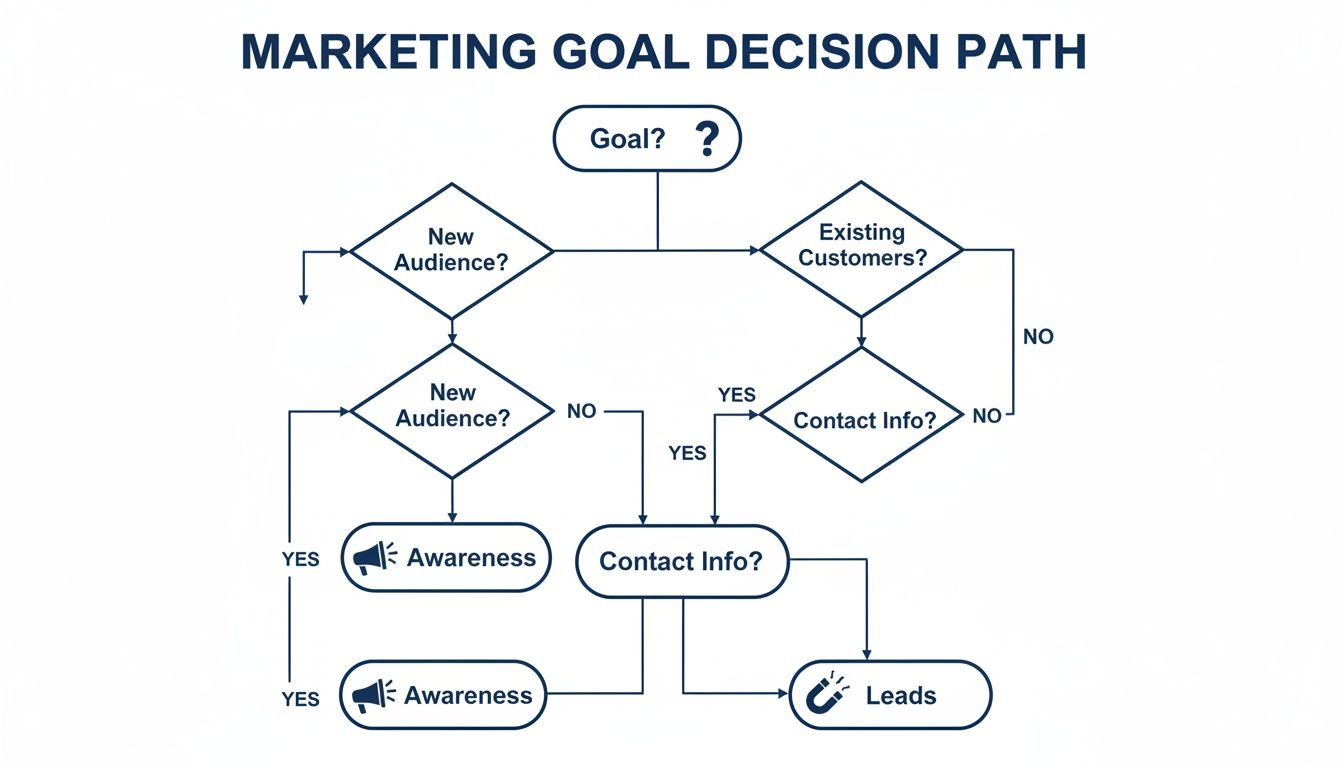
As the flowchart shows, if your main goal is to educate a new market and build brand awareness from scratch, demand generation is your starting point. If you’re looking to harvest existing interest and drive sales conversations now, lead generation should take priority.
Scenarios to Prioritize Demand Generation
Certain business situations demand a heavy investment in demand generation. Without it, your lead gen efforts will feel like trying to draw water from an empty well.
You should prioritize demand generation when you are:
- Launching a New Product or Category: If your solution is disruptive or creates a new category, you first have to teach the market about the problem it solves. A life sciences company with a novel diagnostic platform, for instance, can’t just run ads for their tool. They must first create content explaining the science and why current methods are insufficient.
- Entering a New Market: When you expand into a new geography or industry, your brand is an unknown entity. You must build credibility from the ground up by sharing valuable, ungated content that establishes you as a trustworthy expert.
- Facing a Long or Complex Sales Cycle: For big-ticket enterprise deals in sectors like professional services or industrial manufacturing, buyers spend months in research and internal discussions. Consistent demand generation through thought leadership is what keeps your brand top-of-mind throughout that long journey.
The most critical reason to invest in demand generation is simple math. Research shows that roughly 95% of your total addressable market isn't actively buying today. Demand generation is the only sustainable way to build a future pipeline and earn their business when they are ready.
Scenarios to Prioritize Lead Generation
While demand generation builds your future, lead generation cashes in on the present. It’s the right move when conditions are ripe and buyer intent is already established.
Double down on lead generation when you have:
- Strong Brand Recognition: If your company is already a well-known leader, a significant portion of the market knows who you are. An established SaaS provider with high brand equity can lean heavily on tactics like demo requests and gated reports to efficiently capture this existing intent.
- High-Intent Channels Available: When you can spot clear buying signals—like prospects visiting your pricing page or searching for competitor comparisons—it’s time for a direct lead generation play. The goal is to act on that signal immediately.
- Short-Term Revenue Targets: If your sales team is under pressure to hit a quarterly number, a targeted lead generation campaign aimed at bottom-of-funnel prospects is the most direct path to creating qualified opportunities quickly.
The strategic importance of demand gen became crystal clear as B2B buyers shifted to conducting extensive anonymous research online—the "dark funnel"—before ever identifying themselves. This shift rendered pure lead generation ineffective for capturing the majority of the market.
As Liam Bartholomew from Cognism famously noted, their lead generation efforts before a strategic shift yielded a tiny 0.2% close rate. After they prioritized building demand, that rate skyrocketed to 20%, ultimately growing their pipeline to $13 million. You can explore more on how this insight reshaped modern B2B strategy and why it matters to your business.

“The Business Development team gets 80 to 90 percent of what they need in 15 minutes. That is a complete shift in how our reps work.”
Andrew Giordano
VP of Global Commercial Operations, Analytic Partners
Integrating Demand and Leads with Account Intelligence

The most successful revenue teams have moved past the "demand gen vs. lead gen" debate. They know it's not a choice between one or the other. It’s about building a single, seamless engine where both work in concert.
The real challenge has always been bridging the gap. Marketing creates broad awareness, but when a prospect finally raises their hand, sales often lacks the context to turn that interest into a meaningful conversation. This is the classic disconnect that kills deals before they start.
This is where account intelligence comes in. It’s the connective tissue ensuring the trust you built during demand generation isn't lost the moment a lead generation play begins.
From Broad Demand to Specific Opportunity
Account intelligence platforms serve as your eyes and ears, continuously scanning the digital world for important buying signals across your target accounts. These aren't just generic news alerts; they are specific, real-world triggers that give your team the perfect "why now" for their outreach.
This intelligence enables marketing to run demand gen campaigns that are not only timely but also deeply relevant. Instead of pushing out generic content, they can create assets that speak directly to what's happening right now within their ideal customer profile.
For example, a marketing team can produce content analyzing a new regulatory change impacting the life sciences industry or a sudden wave of M&A activity in the SaaS world. This builds authority and captures the attention of accounts grappling with those exact challenges.
Account intelligence transforms marketing from a creator of broad awareness into a precise engine for identifying emerging intent. It answers the question, "Which of our target accounts are starting to think about a problem we can solve?"
This is a fundamental shift. It moves demand generation away from being a purely top-of-funnel branding exercise and gives it a direct role in spotting opportunities that could close this quarter.
Activating Intelligence for Sales
Here's where the magic happens. An individual from one of these now-warm accounts finally engages—perhaps by downloading a gated case study or visiting your pricing page. This creates a traditional Marketing Qualified Lead (MQL), but with a crucial difference.
Instead of just tossing a name and email over the wall to sales, an intelligent system delivers a rich, automated brief to the sales rep. This brief doesn't just tell them who engaged; it explains why it matters right now.
- The Competitor Switch: An alert shows a key executive at a target account just left a competitor and joined their team. This creates a small window of opportunity to introduce a better solution.
- The New Funding Round: An alert on a new funding announcement gives the sales rep a powerful reason to reach out, framed around helping the company scale and maximize its new capital.
- The Key Executive Hire: When a company hires a new CRO or CIO, it’s a massive signal that its strategy is about to change. An automated alert allows the sales team to be the first in the door with a relevant point of view.
This process turns what would have been a cold, contextless MQL into a warm, highly relevant conversation. The sales rep isn’t guessing; they are armed with the precise reason their outreach is timely and valuable.
A Practical Playbook for Integration
Let's walk through how this integrated approach works for a B2B SaaS company targeting enterprise clients.
- Demand Gen with Intelligence: The marketing team uses account intelligence to track signals like executive moves and negative online sentiment around a major competitor. They create blog posts and LinkedIn content about the "hidden costs" and "integration headaches" of that competitor's platform.
- Signal Identification: An account intelligence platform like Salesmotion flags that a target account’s CTO has been actively liking LinkedIn posts that are critical of that same competitor. This is a clear, early-stage buying signal.
- Lead Gen Capture: A week later, a product manager from that same company visits your website and downloads a gated whitepaper comparing your solution to the competitor.
- Context-Rich Handoff: The sales rep receives an instant alert. It doesn't just have the product manager's contact info—it includes the context of the CTO’s recent LinkedIn activity, complete with links to the relevant posts.
- Personalized Outreach: The rep's outreach is no longer generic. They can directly reference the challenges being discussed publicly, transforming the conversation from "I saw you downloaded our ebook" to "I noticed your team is exploring alternatives to [Competitor]; we help companies like yours solve [Specific Problem]."
This seamless flow ensures no demand goes to waste. It connects marketing’s broad efforts directly to sales’ targeted execution, making the entire revenue process more efficient and effective. You can learn more about putting this into practice by checking out our guide on using buyer intent data to fuel your outreach. This integrated system, powered by real-time account intelligence, finally solves the age-old disconnect between creating desire and capturing opportunity.
Actionable Playbooks for Enterprise B2B Teams
Theory is fine, but seeing how the demand gen and lead gen partnership works in the real world is what really matters. Let's move past abstract definitions and dig into concrete, industry-specific playbooks that show how this integrated strategy drives revenue for enterprise B2B teams.
The core idea is simple: use broad, educational demand generation to establish your brand's authority and warm up your target market. Then, the moment a buying signal appears, deploy a precise lead generation play to capture the opportunity. This way, you're not just creating awareness; you're ready to act on it.
The Life Sciences Playbook
Imagine you're the Chief Revenue Officer at a Contract Research Organization (CRO). Your market's success hinges on scientific breakthroughs and regulatory changes. An integrated playbook is your only way to stay relevant and capitalize on those make-or-break moments.
-
The Demand Generation Play: Your marketing team produces a steady stream of content analyzing recent FDA announcements and their impact on clinical trial design. This isn't gated; it’s un-gated blog posts, LinkedIn articles from your Chief Scientific Officer, and a podcast with industry experts. The goal is to become the trusted resource for navigating the regulatory landscape, building credibility with biotech and pharma leaders long before an RFP is issued.
-
The Lead Generation Play: Your account intelligence platform fires an alert: a target biotech firm just announced a successful Phase II trial for a new oncology drug. This is a massive buying signal. The alert immediately triggers a pre-built outreach sequence for the account executive, who can now engage with a hyper-relevant message about scaling up for Phase III trials, referencing the specific news.
The Enterprise SaaS Playbook
In the cutthroat SaaS world, timing and relevance are everything. Your buyers are constantly evaluating their tech stack, and a perfectly-timed conversation can be the difference between winning a deal and never even getting a meeting.
-
The Demand Generation Play: You start by tracking competitor mentions and negative sentiment online. You notice a pattern of complaints about a rival’s painful implementation process. This is your cue. Your team creates a series of articles and a downloadable guide on "The Five Signs It's Time to Switch Your CRM." This content educates the market on a known pain point and neatly positions your solution as the answer, creating demand among frustrated users.
-
The Lead Generation Play: An alert fires that a top-tier target account just hired a new Chief Information Officer (CIO). Any experienced rep knows a new executive will likely review major software contracts within their first 90 days. This signal triggers a multi-threaded outreach campaign involving both the sales rep and your own C-suite, welcoming the new CIO and offering insights tailored to their known priorities.
These playbooks demonstrate a crucial point: demand generation warms up the entire market, while lead generation provides the specific, timely reason for a salesperson to call.
Intelligent workflows are what make these playbooks scalable. By automating the monitoring of these signals and triggering the right outreach, you eliminate hours of manual research and empower your team to act with precision. This is how the conceptual difference between lead generation and demand generation becomes a concrete, repeatable process that connects broad market education directly to daily sales actions.
For more ideas on building out your strategy, you can explore our detailed guide on B2B demand generation strategies.
Frequently Asked Questions
You understand the theory behind lead gen vs. demand gen. But what happens when you need to put it into practice? Here are clear, no-fluff answers to the most common questions from teams implementing this strategy.
How Do I Measure the ROI of Demand Generation?
Measuring the ROI of demand gen requires shifting your focus from immediate, direct-response metrics like Cost Per Lead (CPL). Instead, track the leading indicators that prove your market presence and influence are growing. These are the metrics that predict future revenue.
Think of it as building brand gravity that pulls future buyers toward you. Key metrics to watch are:
- Branded Search Growth: Are more people searching for your company by name over time?
- Share of Voice: Is your brand mentioned more often than competitors in key industry conversations?
- Pipeline Velocity: Are deals moving through the sales funnel faster once they enter?
- Inbound Demo/Trial Rate: Are you seeing an increase in prospects coming to you directly asking for a demo, without clicking on a paid ad?
This is a long-term investment. A strong demand gen engine makes every future lead generation effort cheaper and more effective because you're no longer starting from zero with every prospect.
Can a Small Business Afford to Do Both?
Absolutely. You don't need a massive budget to run both demand and lead gen effectively. The key is to be incredibly focused and strategic with your resources.
For example, a small B2B service firm can focus its demand generation on a hyper-specific niche. They might create authoritative blog posts and build a strong LinkedIn presence to become the undisputed expert in that specific corner of the market. Their lead generation then becomes highly targeted, focusing only on high-potential accounts within that niche that show active buying signals.
How Can We Align Sales and Marketing?
True alignment between sales and marketing isn't built in a conference room with trust falls. It's forged on a foundation of shared data and common goals. The most effective way to achieve this is with a unified platform that serves as the single source of truth for all activity at your target accounts.
When marketing campaigns are informed by the same real-time buying signals that sales uses for outreach, alignment becomes a natural outcome of the workflow, not a forced initiative.
This integrated approach ensures the interest marketing creates is handed off to sales with the rich context needed for a meaningful conversation. It bridges the gap naturally and helps you turn interest into revenue.
By tracking real-world buying signals and turning them into actionable intelligence, Salesmotion helps revenue teams automate these playbooks and scale personalized outreach. Discover how you can bridge the gap between demand and leads at https://salesmotion.io.