At Salesforce, I watched reps spend entire mornings preparing for a single enterprise meeting. They had LinkedIn open in one tab, SEC filings in another, Google News in a third, and a spreadsheet trying to connect the dots. By the time they got on the call, they were exhausted from research and had maybe 20 minutes of useful intel to show for it. That workflow was already broken in 2020. In 2026, enterprise sales teams using AI for account research are operating in a completely different reality.
This post breaks down what actually changes when enterprise sales teams adopt AI-powered research automation. Not hypothetical ROI projections. Real before-and-after results from named companies, organized by role: what SDRs gain, what AEs gain, what managers gain, and what the numbers look like at the team level.
TL;DR: Enterprise sales teams using AI for account research are cutting preparation time by 60-90%, recovering 6+ hours per rep per week, and converting that time into pipeline. Specific results: Frontify saw 42% higher sales velocity, Guild Education saved 6 hours per rep weekly, Analytic Partners grew qualified pipeline 40%, and Cacheflow cut meeting prep by 60%. The pattern is consistent across industries and team sizes. The teams winning right now aren't the ones with more reps. They're the ones whose reps spend more time selling.
The Research Problem Enterprise Sales Teams Actually Have
The average B2B sales rep spends just 28% of their week actually selling. The rest goes to administrative work, internal meetings, and research. For enterprise sellers working complex deals with 6-12 month cycles and multiple stakeholders, that research burden is even heavier.
Here is what enterprise account research looks like without automation:
- 30-60 minutes per account toggling between LinkedIn, company websites, SEC filings, news sites, Crunchbase, and Google
- Stale information because nobody has time to re-research accounts they prepared for last quarter
- Inconsistent depth because the third account on the list always gets less effort than the first
- No signal awareness because reps only see what they manually search for, missing buying signals like earnings commentary, leadership changes, hiring patterns, and competitive moves happening between meetings
A 2025 Salesforce study found that 81% of enterprise sales teams are either experimenting with or have fully implemented AI tools. But adoption alone does not tell you what changes. The results below do.
Go from 6 hours to 6 minutes on your own accounts
Salesmotion's Research Agent builds the full account brief — signals, buying roles, financials — for every account in your territory. See it on real accounts.
What Changes for SDRs: From Cold Outreach to Signal-Driven Prospecting
SDRs live and die by volume. The traditional model is simple: more calls, more emails, more meetings. But enterprise SDRs know that volume without context produces low-quality meetings that AEs reject.
The before state: An SDR at Incredible Health was booking meetings through standard outbound motions. Research meant scanning a prospect's LinkedIn profile, maybe checking recent company news, and writing a semi-personalized email. Each account got 5-10 minutes of prep. The outreach was competent but generic.
The after state: After adopting Salesmotion's account intelligence platform, the SDR team started with signal-driven prioritization. Instead of working a static list alphabetically, they saw which accounts had active buying signals: new leadership hires, budget announcements, strategic initiatives mentioned in earnings calls, technology adoption changes. Research that took 5-10 minutes per account was pre-built. The result: Incredible Health increased quarterly meetings booked by 50%.
That is not a marginal improvement. It is a step change in how SDR capacity converts to pipeline. The same rep hours produced twice the output because every touchpoint was anchored to real-time context, not stale data.
For context, a recent industry benchmark from Outreach found that sales teams using AI-powered research tools cut research and personalization time by up to 90%. The SDR role is where that efficiency gain hits hardest because the role is entirely built around the research-to-outreach loop.

“Salesmotion has been a game-changer for me. I used to spend 12 hours a week on prospect research, now it's down to 4. Plus I'm finding stuff I was totally missing - podcasts, news mentions, the good bits.”
George Treschi
Account Executive, FY25 President's Club, Sigma
What Changes for AEs: Preparation That Compounds Across Deal Stages
For account executives managing enterprise deals, the account research problem compounds. A single deal might span 6-18 months with dozens of meetings across multiple stakeholders. Every meeting requires fresh preparation: what changed since the last conversation, who are the new players, what did the last earnings call reveal, what competitive threats are emerging.
George Treschi, an Account Executive at Sigma who earned FY25 President's Club, described the shift in concrete terms: he went from spending 12 hours per week on prospect research to 4 hours per week. That is 8 hours recovered every week, or roughly 400 hours per year.
But the time savings tell only half the story. Treschi specifically noted that AI-powered research surfaced information he was previously missing entirely: podcasts featuring prospects, news mentions, executive commentary, and competitive signals. The quality of preparation improved at the same time the quantity of effort decreased.
At Frontify, the impact showed up directly in deal metrics. After the sales team adopted AI-driven account research:
- Sales velocity increased 42% year over year
- Win rates improved 35% compared to the prior baseline
- Sales cycles shortened by 31%
These are not survey responses about how reps "feel" about AI. They are measured business outcomes tracked in the CRM. Head of Sales Thomas Meichtry and the RevOps team at Frontify tracked these numbers specifically to understand the impact of better pre-call preparation on downstream deal metrics.
The mechanism is straightforward: when an AE walks into every meeting already knowing the account's strategic priorities, recent leadership changes, competitive landscape, and financial context, the conversation starts at a higher level. Discovery is partially complete before the call begins. Stakeholders feel heard because the rep references their actual situation, not a generic pitch. Deals progress faster because trust builds earlier.
What Changes for Managers: Visibility Without Micromanagement
Sales managers face a different version of the research problem. They need to understand whether their team is working the right accounts with the right preparation, but they cannot sit in on every call or review every account plan. The traditional approach is pipeline reviews where reps self-report deal status, often with optimistic assessments and incomplete information.
At Guild Education, Director of Strategic Accounts Derek Rosen measured the manager-level impact: his team saved 6+ hours per rep per week on account research alone. For a team managing $20M+ enterprise deals with sales cycles up to 24 months, that is not just efficiency. It is the difference between reps having time to work their full territory versus cherry-picking the three accounts they know best and neglecting the rest.
At Analytic Partners, VP of Global Commercial Ops Andrew Giordano saw the impact in pipeline numbers: qualified pipeline grew 40% year over year. The mechanism was better research coverage. With AI handling the baseline research, reps could cover more accounts with deeper preparation. Giordano's team reported getting 80-90% of what they needed for prospecting and meetings in 15 minutes, compared to 3 hours previously.
For managers, the operational benefit goes beyond time savings. When every rep has access to the same depth of account intelligence, preparation quality becomes consistent across the team. The gap between your best researcher and your worst researcher narrows. New hires ramp faster because they are not starting from zero on every account. The team's collective intelligence scales with the tool, not just with individual effort.

“The moment we turned on Salesmotion, it became essential. No more hours on LinkedIn or Google to figure out who we're talking to. It's just there, served up to you, so it's always 'go time.'”
Adam Wainwright
Head of Revenue, Cacheflow
The Team-Wide ROI: What the Numbers Add Up To
Individual role improvements are compelling. But the real case for AI-powered account research emerges when you look at team-wide economics.
Time recovery math: If a 10-person enterprise sales team saves 6 hours per rep per week (the number Guild Education measured), that is 60 rep-hours recovered weekly. Over a year, that is 3,120 hours. At a fully loaded cost of $125/hour for an enterprise AE, that is $390,000 in recovered selling capacity annually, from a single team.
Pipeline math: Analytic Partners' 40% qualified pipeline increase did not come from hiring more reps. It came from existing reps covering more accounts with better preparation. When every account gets thorough research instead of just the top 10 on each rep's list, the addressable pipeline expands without adding headcount.
Velocity math: Frontify's 42% sales velocity improvement means deals that took 100 days now take roughly 70 days. For a team with $5M in pipeline at any given time, that acceleration means faster cash collection, more deal cycles per year, and compounding revenue growth.
Prep time math: Cacheflow cut meeting preparation from 90 minutes to 30 minutes, a 60% reduction. Head of Revenue Adam Wainwright described the shift as going from "hours on LinkedIn and Google" to having intelligence "served up to you, so it's always go time." For a rep running 4-5 meetings per day, that frees up 4+ hours daily.
According to Deloitte's 2026 State of AI in the Enterprise report, 72% of organizations now formally measure AI ROI, with productivity gains of 26-55% being the most commonly reported benefit. The sales use case is notable because the ROI is measurable in existing systems: CRM data already tracks velocity, win rates, pipeline creation, and activity volume. You do not need new dashboards to see the impact.
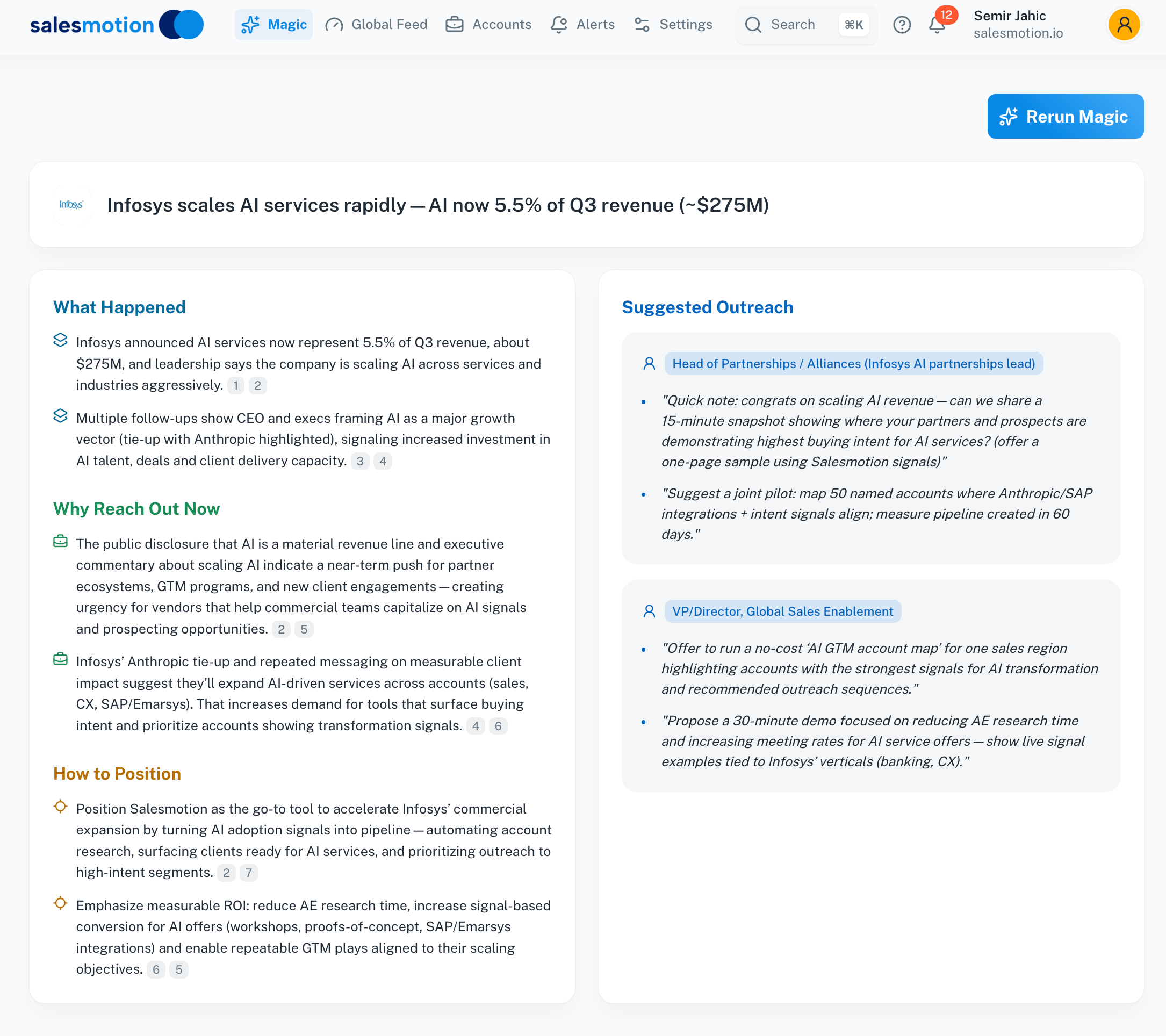 AI-generated account intelligence in minutes, not hours. The talking points, strategic context, and signals that used to take 6 hours of research.
Why Do Most "AI for Sales" Tools Fail to Deliver These Results?
Not every AI tool produces the results described above. The enterprise sales AI market is flooded with tools that automate the wrong things or solve problems that do not exist.
Contact databases with AI labels (like "AI-powered lead scoring") help reps find who to call but say nothing about why or when. For a deeper breakdown of how to separate real AI capabilities from marketing labels, see our guide to evaluating AI sales tools. Conversation intelligence tools analyze what happened after a call but cannot improve what happens before. Email automation tools optimize how many messages get sent but not whether those messages contain relevant context.
The teams in these case studies share a common pattern: they adopted tools that automate the research workflow itself. Not research summaries from stale training data. Not generic company profiles pulled from a database. Live, continuously updated account intelligence synthesized from hundreds of public and private sources, delivered before every meeting without manual effort.
That is the difference between AI that saves time and AI that changes outcomes. Salesmotion monitors 1,000+ sources per account, from earnings calls and SEC filings to job postings, news mentions, podcast appearances, and technology adoption signals. The result is that reps start every interaction with context that would have taken hours to assemble manually.
The industry data supports this distinction. A 2025 Bain analysis of enterprise sales productivity found that early AI deployments boosted win rates by over 30%, but only when the AI changed pre-call preparation, not just post-call analysis.
How Do You Evaluate Whether AI Research Will Work for Your Team?
Before committing to any AI research tool, run this quick diagnostic:
-
Measure your current state. How many hours per week do your reps spend on account research? Survey 5 reps. If the answer is under 2 hours, you have a different problem (your reps are not researching at all). If it is over 4 hours, AI research automation will produce measurable ROI within 90 days.
-
Audit research quality. Pull 10 recent discovery call recordings. In how many did the rep demonstrate knowledge of the account's strategic priorities, recent news, or competitive landscape? If it is fewer than 3 out of 10, your team has a preparation gap that more training will not fix.
-
Calculate the opportunity cost. Take your average AE's annual quota, divide by 2,080 work hours, and multiply by the hours they spend on research weekly. That is the revenue capacity locked up in manual research. For a rep carrying a $1.2M quota spending 6 hours per week on research, that is roughly $180,000 in annual selling capacity consumed by work a machine should be doing.
-
Run a controlled pilot. Give 3-5 reps access to an AI research tool for 30 days. Measure before and after on: prep time per meeting, meetings booked, pipeline created, and deal velocity. The teams in these case studies saw results within the first month.
If you want to see what this looks like on your own accounts, book a 15-minute demo and we will pull live intelligence on an account from your pipeline.
Key Takeaways
- Enterprise sales teams using AI for account research consistently recover 4-8 hours per rep per week, with Guild Education measuring 6+ hours and Sigma's George Treschi going from 12 hours to 4 hours of weekly research.
- SDR results are immediate: Incredible Health increased quarterly meetings by 50% by switching from static lists to signal-driven prospecting.
- AE results compound over deal cycles: Frontify saw 42% higher sales velocity, 35% better win rates, and 31% shorter sales cycles.
- Manager-level impact shows in pipeline growth: Analytic Partners grew qualified pipeline 40% without adding headcount.
- The common thread across all results is not AI as a category, but specifically automating the research-to-preparation workflow with live signals and continuously updated account intelligence.
- Start with a 30-day pilot measuring prep time, meetings booked, and pipeline created. The ROI shows up in data your CRM already tracks.
Frequently Asked Questions
How long does it take to see ROI from AI-powered account research?
Most teams in our case studies saw measurable results within 30 days. Cacheflow reported full platform utilization within 24 hours of signing. Incredible Health increased quarterly meetings by 50%. The timeline depends on your team's current research burden: teams spending 4+ hours per rep per week on manual research see the fastest returns because the time recovery is immediate.
Does AI account research work for complex enterprise deals with long sales cycles?
Yes, and the impact actually compounds with deal complexity. Guild Education manages deals worth $20M+ with cycles up to 24 months. The more stakeholders, competitive dynamics, and strategic context involved in a deal, the more value AI research provides. An AE managing 20-30 enterprise accounts cannot manually track earnings calls, leadership changes, and strategic initiatives across all of them. AI does that continuously.
What is the difference between AI account research and a contact database like ZoomInfo?
Contact databases tell you who to call by providing names, titles, emails, and phone numbers. AI account research tells you why to call and when to call by monitoring live signals: earnings commentary, leadership changes, hiring patterns, competitive moves, strategic initiatives, and technology adoption. The teams in these case studies did not improve results by getting better contact data. They improved by showing up to every conversation with context that made the interaction valuable for the buyer.
Can AI account research replace human judgment in enterprise sales?
No, and that is not the goal. The highest-performing teams use AI to handle the information gathering and synthesis that previously consumed hours of manual effort, then apply human judgment to the strategy, relationship building, and deal execution. AI surfaces that a target account's CEO mentioned "digital transformation" on their last earnings call and just hired a VP of Revenue Operations. The rep decides what to do with that intelligence. The research is automated. The selling is human.