A go-to-market (GTM) strategy framework is your blueprint for launching a product, entering a new market, or relaunching your brand. It’s a detailed plan that gets every department—from product and marketing to sales and customer success—working together toward a single goal: winning over your target audience.
Think of it as the playbook that answers the big questions: who are we selling to, what are we selling, why should they care, and how will we reach them?
Why You Need a Blueprint for Your Product Launch

Let's skip the jargon. Imagine building a house without a blueprint. The foundation might be crooked, the plumbing could lead nowhere, and the electrical wiring? A disaster waiting to happen. That house would be unstable and, ultimately, a failure.
Launching a product without a go-to-market strategy framework is the same kind of gamble.
When your teams operate in silos, you get mixed messages, wasted marketing spend, and a confused sales team. A solid framework cuts through that chaos by making sure everyone is on the same page.
Aligning Teams for Maximum Impact
A GTM framework is more than a pre-launch checklist; it's a repeatable model for growth. It forces you to answer the tough questions upfront, creating a clear path for every team to follow. This alignment isn't just nice to have—it's essential for success.
The research backs this up. Companies with a structured plan consistently get better results. In fact, organizations with a documented GTM framework see a 10% higher success rate in product launches and experience three times the revenue growth compared to those without one. Yet, fewer than 33% of companies have a formal GTM playbook.
This strategic alignment ensures your efforts build on each other, rather than conflict. To get there, your framework needs to answer a few core questions.
The Core Questions Your GTM Framework Must Answer
| The Question | What It Defines |
|---|---|
| Who is our customer? | Your Ideal Customer Profile (ICP), buyer personas, and key market segments. |
| What is our unique value? | Your core value proposition and the messaging that makes you stand out. |
| Where do we find them? | The most effective marketing and sales channels to reach your audience. |
| How do we win? | Your pricing strategy, sales motion, and the competitive advantages you’ll lean on. |
These questions form the foundation of your entire strategy, ensuring every decision is deliberate and moves you closer to your goals.
A GTM strategy isn't about having all the answers on day one. It’s about creating a structured way to find those answers, test your assumptions, and adapt quickly based on what the market tells you.
Ultimately, a strong framework maps out the entire process, from creating initial awareness to building a loyal customer base. It connects your product’s potential to real market success, ensuring you not only launch but thrive. To do this, you first need a deep understanding of the customer journey funnel and how each stage requires a different approach.
Validate your GTM targets with live account intelligence
Salesmotion helps GTM teams identify, score, and prioritize accounts using real-time signals — not stale firmographic lists.
The Core Components of a Winning GTM Framework

A go-to-market strategy framework isn’t a single document you create once. It's a set of interconnected parts, with each one building on the last to create a solid structure.
Getting these pieces right is what separates a confident launch from a costly mistake. Think of them as the support beams of your strategy—if one is weak, the whole structure becomes unstable. Let's break down these essential pillars.
Defining Your Target Audience and ICP
Before you write a single piece of copy, you have to know exactly who you're selling to. This goes beyond broad demographics. The goal is to define your Ideal Customer Profile (ICP)—a precise description of the perfect company that would get massive value from your product.
An ICP isn't just about company size or industry. It digs into firmographics (like revenue and employee count), technographics (the tech they use), and behavioral traits (like their growth trajectory).
Once your ICP is clear, you can drill down to the buyer personas—profiles of the actual people inside those companies who will influence or make the final decision. These personas should feel like real people with goals, frustrations, and motivations.
According to Gartner, a typical B2B purchase involves six to ten decision-makers. You need to understand these roles:
- The Initiator: The person who first identifies the problem.
- The User: The people who will use your product every day.
- The Influencer: A team member whose opinion carries weight.
- The Decision-Maker: The individual with the authority to say "yes" or "no."
- The Buyer: The person who controls the budget and handles the purchase.
- The Gatekeeper: Anyone who can block access to key players, like an executive assistant.
Crafting a Compelling Value Proposition
With a clear picture of your audience, you need to articulate why they should care. That's your value proposition—a clear, powerful statement explaining the unique benefit your product delivers, how it solves their problem, and why it’s better than the alternatives.
A common mistake is simply listing product features. A strong value proposition translates those features into tangible outcomes. Instead of saying, "Our software has an AI-powered analytics dashboard," you’d say, "Our software gives you real-time insights to cut operational costs by 20%."
Your value proposition is the heart of your messaging. It should be the first thing a prospect understands about you and the central theme in all your marketing and sales materials.
A strong GTM strategy relies on getting your target market, product positioning, and key messaging right. Digging into effective product marketing strategies is the best way to ensure your message lands. This foundational work informs every other part of your framework.
Selecting Your Channels and Sales Motion
Now you know who you’re talking to and what you’re telling them. The next question is: where and how will you reach them? This is about choosing your distribution channels and defining your sales motion.
The right channels depend on your ICP. Are they on LinkedIn? Do they attend industry conferences? Do they trust peer reviews? Your marketing and sales efforts must meet your audience where they already are.
Your sales motion defines the primary way you sell. It generally falls into one of these models:
- Self-Service: Customers find, try, and buy your product on their own. This is the classic PLG model, great for lower-priced products.
- Inside Sales: Sales reps connect with prospects remotely via phone, email, and video calls. It’s an efficient model for products with medium price points.
- Field Sales: Account executives meet prospects in person to navigate complex, high-value enterprise deals. This often means a longer sales cycle.
- Channel Sales: You partner with third parties—like resellers or agencies—to sell your product for you.
Setting Your Pricing Strategy and Metrics
Finally, you need a smart pricing strategy and a way to measure if any of this is working. Pricing isn't an afterthought; it’s a direct signal of your value and a huge part of your positioning. Consider models like subscription, usage-based, or tiered pricing to find what best aligns with how your customers get value.
Alongside pricing, you must define the Key Performance Indicators (KPIs) that tell you if your strategy is on track. We're not talking about vanity metrics like website traffic. These are the metrics tied directly to business health, like Customer Acquisition Cost (CAC), Lifetime Value (LTV), and sales cycle length.
These numbers give you the data you need to continuously improve your approach. To get your teams aligned around these crucial numbers, take a look at our guide on RevOps best practices.

“Salesmotion is instrumental in helping me prioritize net-new accounts, understand their strategic initiatives, and cover more ground. With a lot of green-field accounts, I'm heavily leaning on the AI insights to tier my accounts and focus my time. The platform is incredibly intuitive and easy to use.”
Rob Webster
Enterprise Account Executive, Synthesia
How to Build Your GTM Framework Step by Step
Knowing the components of a GTM framework is one thing. Assembling them into a workable plan is another. This is where theory meets reality. Let's walk through a practical, step-by-step process, using a new B2B SaaS product launch as our example.
Following these steps ensures your strategy is built on a solid foundation, moving logically from the big picture to daily execution.
Step 1: Define Your Ideal Customer Profile and Personas
Everything starts with the customer. Before you write any copy or choose a sales channel, you need absolute clarity on who your product is for. This begins with defining your Ideal Customer Profile (ICP).
An ICP isn’t a vague description. It’s a laser-focused profile of the perfect company that will get the most value from your solution. For our B2B SaaS example, a sharp ICP might look like this:
- Industry: Mid-market technology companies.
- Company Size: 100-500 employees.
- Annual Revenue: $20 million to $100 million.
- Geography: North America.
- Pain Point: They use inefficient, manual spreadsheets for sales forecasting, leading to inaccurate revenue predictions.
Once the ICP is locked in, develop your buyer personas. These are detailed profiles of the key people inside those ideal companies. Remember, you don't sell to a company; you sell to people with jobs, goals, and frustrations.
The goal is to move from an abstract market segment to a tangible picture of the people you need to win over. An ICP tells you which companies to target; personas tell you how to talk to the humans inside them.
Step 2: Craft Your Value Proposition and Messaging
You know who you're talking to. Now, what are you going to say? Your value proposition is the heart of your messaging. It needs to be a clear, powerful statement that explains the unique benefit you offer, how you solve your ICP’s problem, and why you're the best choice.
For our SaaS company, a weak value proposition would be something generic like: "We sell AI-powered sales forecasting software."
A strong value proposition focuses on the outcome: "Our platform helps revenue leaders at mid-market tech companies improve forecast accuracy by 30% in the first quarter, eliminating guesswork and securing predictable growth."
From this core statement, you can build a full messaging hierarchy that speaks directly to each buyer persona. The CFO cares about ROI. The VP of Sales is obsessed with hitting quota. Your messaging has to resonate in each of their worlds.
Step 3: Map the Full Customer Journey
Next, map out the entire path a prospect takes—from realizing they have a problem to signing a contract. This journey is often broken into a classic funnel framework.
- Top of Funnel (TOFU) - Awareness: The prospect is experiencing a problem but might not know a solution exists. Your job is to educate, not sell. Think helpful blog posts, webinars, and reports that address their pain points.
- Middle of Funnel (MOFU) - Consideration: The prospect is now actively looking for solutions. This is where you provide detailed content like case studies, comparison guides, and product demos to establish your product as a serious contender.
- Bottom of Funnel (BOFU) - Decision: The prospect is ready to buy. The focus shifts to sales conversations, free trials, and pricing discussions to close the deal.
Understanding this journey is critical. Over 30,000 new products are launched every year, and 95% of them fail. Why? Often, it's a disconnect between the company's sales process and the customer’s buying journey. A well-mapped funnel ensures your sales and marketing efforts are in sync with the customer's mindset at every stage.
Step 4: Build Your Sales Playbook and Enablement Plan
Finally, it's time to equip your sales team. A sales playbook is the tactical guide that turns your GTM framework into concrete, daily actions for your reps.
This is a living resource that should include:
- Key Messaging: How to talk about the value proposition for each persona.
- Objection Handling: Smart responses to common questions and pushback.
- Competitive Positioning: Talking points on how you compare to the competition.
- Discovery Questions: A list of questions to uncover pain points and qualify leads.
- Success Stories: Customer testimonials and case studies to use as proof.
This playbook is the cornerstone of your sales enablement strategy. A solid sales enablement framework ensures your team has the content, tools, and training they need to have valuable conversations. To get started, a practical GTM strategy template can provide a great structured jumping-off point.
Putting It All Together: A Sample Timeline
To make this more tangible, here’s what a 90-day GTM launch plan might look like for our B2B SaaS company. This timeline shows how different teams collaborate to bring the strategy to life.
Sample GTM Framework Timeline for a B2B SaaS Launch
| Phase | Key Activities | Responsible Team |
|---|---|---|
| Days -90 to -30 (Pre-Launch) | Finalize ICP and personas. Develop core value proposition and messaging. Conduct competitive analysis. Set initial pricing. | Marketing, Product, Sales |
| Days -30 to -1 (Pre-Launch) | Build sales playbook. Create TOFU/MOFU content (blog posts, webinar). Develop landing pages. Train sales team on messaging and product. | Marketing, Sales |
| Day 0 (Launch Day) | Announce product launch via press release, email, and social media. Activate paid ad campaigns. Begin targeted sales outreach. | Marketing, Sales |
| Days 1 to 30 (Post-Launch) | Monitor initial user feedback. Host "first look" webinar. Publish first customer case study. Qualify inbound leads and book demos. | Product, Marketing, Sales |
| Days 31 to 60 (Post-Launch) | Analyze early sales data and funnel metrics. Refine messaging based on prospect conversations. Optimize ad campaigns. Gather testimonials. | Marketing, Sales |
| Days 61 to 90 (Post-Launch) | Review GTM performance against KPIs. Update sales playbook with new objection handling. Plan next quarter's marketing campaigns. | All Teams |
This timeline is a guide, not a rigid rulebook. The key is that every activity is coordinated and builds on the last, ensuring a powerful launch that drives momentum from day one.
Measuring Success with the Right GTM Metrics
A strategy without metrics is just a guess. You can build the most beautiful go-to-market strategy framework, but if you can't measure its impact, you're just hoping for the best.
This isn’t about chasing vanity metrics. It's about focusing on the key performance indicators (KPIs) that tell you the real story of what’s working and what’s not.
This data-driven feedback loop is the only way to spot bottlenecks, validate your assumptions, and continuously improve your GTM engine. Without it, you're flying blind.
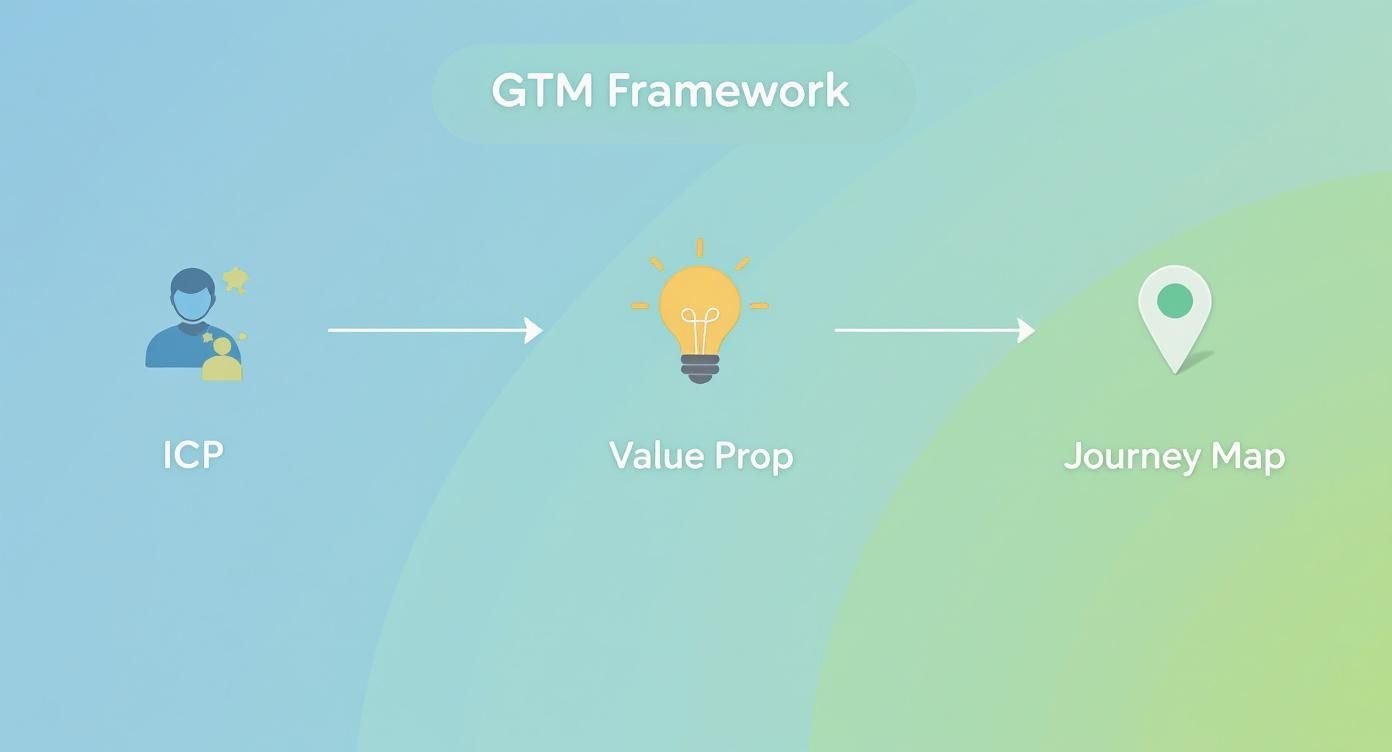
As the graphic shows, a solid strategy is a domino effect—get the first piece right, and the rest falls into place.
Core Metrics That Truly Matter
To cut through the noise, let's focus on four critical metrics that give you a clear view of your GTM framework’s health.
- Customer Acquisition Cost (CAC): This is what it costs to win a new customer. To calculate it, divide your total sales and marketing spend over a period by the number of new customers you acquired.
- Lifetime Value (LTV): This metric forecasts the total revenue you can expect from a single customer over their entire relationship with you. It’s the long-term view of a customer's worth.
- Sales Cycle Length: This is the average time it takes to close a deal, from the first contact to a signed contract. A long sales cycle can drain resources and delay revenue.
- Product Adoption Rate: This KPI tells you how many new customers are becoming active users. High adoption is a great sign that your product is delivering on its promise.
The LTV to CAC Ratio: The North Star of GTM Health
While each metric is useful on its own, the real insight comes when you put them together. The LTV to CAC ratio is arguably the most important indicator of a sustainable business model. It compares how much a customer is worth versus how much it cost to acquire them.
A healthy LTV to CAC ratio for a B2B SaaS company is generally considered to be 3:1 or higher. This means for every dollar you spend acquiring a customer, you get at least three dollars back over their lifetime.
If your ratio is too low, like 1:1, you're breaking even on every customer, leaving no room for profit. If it's extremely high, like 8:1, you might be underinvesting in growth. For a deeper look, check out our guide on essential lead generation key performance indicators.
Using Data to Refine Your Framework
Tracking these KPIs is step one. The real goal is using them to make smarter decisions. If your CAC is climbing, it might be time to re-evaluate your marketing channels. If the sales cycle is dragging, perhaps your value proposition isn't landing.
A surprising number of companies are still winging it. A recent report found that 15.4% of companies worldwide still don't have a defined GTM strategy. The same study revealed that 59% of businesses feel they underinvest in product launches—a huge problem when 79.5% believe launches have a major impact on revenue.
By keeping a close eye on your core metrics, you can make informed adjustments, ensuring your go-to-market strategy evolves from a plan into a predictable engine for growth.

“Automatic account profile detail I can use to manage my territory. Using Salesmotion AI to generate value statements per persona, account, etc. Using Salesmotion to give me a starting point based on new hires, or news alerts is critical.”
Adam Wainwright
Head of Revenue, Cacheflow
Bringing Your GTM Framework to Life
A great GTM strategy shouldn't just live in a slide deck; it needs to power your daily operations. The best plans are useless if they don't influence how your teams act every day. This is about closing the gap between your strategy and what actually happens on the ground.
Modern tools can transform a static plan into a dynamic engine for growth. Instead of a document that gathers dust, your framework can become a living part of your revenue workflow.
From Static Plan to Dynamic Action
The real challenge is making your strategy operational. How do you ensure your sales team is targeting your ICP? How do you equip them to deliver the right message at the right time? This is where technology that provides real-time account intelligence becomes a game-changer.
Instead of relying on outdated data, your teams can act on fresh buying signals. These are real-time indicators that an account in your ICP is actively looking for a solution or experiencing a change that makes them a perfect fit for you right now.
A GTM framework tells you who to target. Real-time intelligence tells you who to target today. This shift from a theoretical list to a prioritized action plan is key to making your strategy work.
For example, a key account in your ICP suddenly posts five new job descriptions for a role your product supports. That's a powerful buying signal. Your framework identified the account; intelligence tools empower your team to act on that opportunity instantly.
Activating Your Framework with Account Intelligence
Turning theory into pipeline requires a systematic, data-powered approach. It's about empowering your reps with the insights they need to have smarter conversations from the first touchpoint.
Here’s how modern platforms make your go to market strategy framework an actionable part of daily work:
- Prioritize the Right Accounts: Instead of reps guessing where to spend their time, account intelligence surfaces companies showing the strongest buying signals. This ensures your team’s effort is focused on the highest-potential accounts first.
- Personalize Outreach at Scale: Reps can move beyond generic templates. With insights from earnings calls, press releases, or executive interviews, they can craft messages that reference a company's specific goals, increasing reply rates.
- Measure Pipeline Impact: You can directly attribute meetings booked and pipeline created to specific GTM activities. This creates a clear feedback loop, showing you which signals and messaging are driving the best results.
This dashboard from Salesmotion shows how these signals are surfaced for reps, providing immediate context for outreach.
The screenshot shows how raw data is transformed into strategic insights, alerting reps to specific opportunities like new initiatives or leadership changes within their target accounts.
By automating this deep research, you give back hours to your sales team. Companies using this approach save reps more than 8 hours per week and see pipeline creation increase by as much as 40%. Technology bridges the gap between your high-level strategy and the on-the-ground execution needed to hit your revenue goals.
Key Takeaways
- A structured go-to-market strategy framework aligns product, marketing, sales, and customer success around a single plan, and companies with one see 10% higher launch success rates and 3x revenue growth compared to those without.
- The framework should progress through four phases: market analysis, positioning and messaging, channel strategy and enablement, and launch execution with clear decision gates between each phase.
- A sharp Ideal Customer Profile (ICP) is the foundation of every GTM decision -- it must go beyond basic firmographics to include technographics, buying signals, and behavioral data that reveal which accounts are ready to buy.
- Real-time account intelligence and buying signals like new executive hires, funding rounds, and earnings call priorities give your sales team the "why now" context that transforms generic outreach into relevant conversations.
- Measure GTM success through pipeline metrics like meetings booked, pipeline created, and win rates rather than vanity metrics -- and plan quarterly reviews with full strategy overhauls at least annually.
Answering Your Top GTM Framework Questions
Even with a detailed guide, you're bound to have questions when building a GTM strategy. This section tackles the most common ones, giving you clear, practical answers to help you move forward with confidence.
How Often Should I Update My GTM Strategy?
Your GTM strategy isn't a "set it and forget it" document. Markets change, competitors make moves, and customer needs evolve. As a rule of thumb, do a major review of the entire framework at least once a year.
But waiting a full year can be too slow. It's better to check in on your core metrics and tactics quarterly. This cadence lets you make smart, data-driven tweaks without a complete overhaul.
Consider these triggers for an immediate review:
- A major competitor makes a move: They launch a new product, slash prices, or target your best segment.
- Your key metrics are off track: If your Customer Acquisition Cost (CAC) is skyrocketing or your sales cycle is dragging, something is broken.
- You're launching a new product or entering a new market: Every new launch needs its own dedicated GTM plan.
- You're hearing the same feedback repeatedly: If prospects keep raising the same objection or customers keep asking for the same feature, your messaging might be off.
A GTM framework should be a living document, not a historical artifact. Regular check-ins ensure it remains a relevant and powerful tool for growth.
What Are the Biggest GTM Mistakes to Avoid?
Many companies stumble over the same hurdles when bringing a product to market. Knowing these common pitfalls is the first step to avoiding them. The single biggest mistake is not having a formal, written strategy in the first place. Winging it isn't a strategy.
Beyond that, here are three critical errors to dodge:
- Ignoring the Ideal Customer Profile (ICP): Many teams create a vague ICP, file it away, and then forget about it. If your sales and marketing efforts aren't laser-focused on acquiring companies that fit your ICP, you're signing up for high churn and unhappy customers.
- Focusing on Features Over Benefits: Customers don't buy features; they buy solutions. It’s a classic mistake to create messaging that lists what your product does instead of explaining the valuable outcome it delivers. No one cares about your product's bells and whistles unless they solve a real pain point.
- Misalignment Between Sales and Marketing: It's an old story. When marketing is measured on lead volume and sales is measured on closed revenue, they inevitably work against each other. True alignment happens when both teams share the same goal: generating pipeline and revenue.
Can a Small Startup Build a Powerful GTM Plan?
Absolutely. In fact, for a startup with limited resources, a tight go-to-market strategy framework is even more critical. You can't afford to waste money or time on channels that don't deliver or on an audience that will never buy.
A startup’s GTM plan doesn’t need to be a 100-page document. It should be a lean, focused plan that forces you to prioritize ruthlessly. Start by getting hyper-specific with your ICP—don’t try to be everything to everyone. Pick a small, niche market segment where you can win.
Next, lean into low-cost, high-impact channels like content marketing, targeted social media, and community building. Your goal is to create a repeatable and scalable sales motion, even if it starts with just the founder making the calls. For tactical guidance, see our Series A startup sales strategies. The key for any startup is focus: focus on the right customer, with the right message, in the right channel.
Ready to stop guessing and start acting on real-time intelligence? Salesmotion automatically captures buying signals from your target accounts and transforms them into actionable insights for your sales team. See how you can save reps 8+ hours a week and increase pipeline creation by 40%. Learn more about Salesmotion.
Frequently Asked Questions
What is a go-to-market strategy framework?
A go-to-market strategy framework is a structured blueprint that aligns product, marketing, sales, and customer success teams around a single plan for launching a product, entering a new market, or relaunching a brand. It answers the core questions of who you are selling to, what unique value you offer, where you will reach your audience, and how you will win against competitors. Companies with a documented GTM framework see 10% higher launch success rates and three times the revenue growth compared to those without one.
How long does it take to build and execute a GTM strategy?
A practical GTM launch plan typically spans about 90 days, broken into pre-launch preparation (ICP definition, messaging, competitive analysis, sales enablement), launch day activation, and 60 days of post-launch iteration based on early results. The pre-launch phase alone usually requires 30 to 60 days of focused work across product, marketing, and sales teams. However, the framework should be treated as a living document with quarterly reviews and at least one full annual overhaul.
What is the most important component of a GTM framework?
The Ideal Customer Profile (ICP) is the foundation of every GTM decision. A sharp, data-driven ICP that goes beyond basic firmographics to include technographics, buying signals, and behavioral data ensures your marketing and sales efforts are focused on accounts with the highest propensity to buy. Without a precise ICP, you risk wasted ad spend, generic content, and misalignment between sales and marketing.
What metrics should I use to measure GTM success?
The four most critical metrics are Customer Acquisition Cost (CAC), Customer Lifetime Value (LTV), sales cycle length, and product adoption rate. The LTV-to-CAC ratio is often considered the North Star of GTM health, with a healthy B2B SaaS benchmark being 3:1 or higher. Focus on these pipeline-focused metrics rather than vanity metrics like website traffic or raw lead volume.
What are the biggest GTM mistakes to avoid?
The three most common mistakes are ignoring your Ideal Customer Profile after creating it, focusing messaging on product features rather than business outcomes, and allowing misalignment between sales and marketing teams. Another critical error is not having a formal strategy at all, which affects over 15% of companies worldwide. Each of these mistakes leads to wasted resources, confused messaging, and missed revenue targets.
Can a startup build an effective GTM strategy with limited resources?
Absolutely, and a tight GTM framework is arguably even more critical for startups with limited resources. The key is ruthless prioritization: get hyper-specific with your ICP by targeting a small niche where you can win, lean into low-cost high-impact channels like content marketing and targeted social media, and build a repeatable sales motion even if it starts with just the founder making calls.