
If you want to build a sales pipeline that works today, you need to ditch the static lists and embrace a dynamic, signal-driven approach. It’s less about just filling a funnel and more about precision engineering—pinpointing companies showing real intent to buy right now.
Your Blueprint for a Modern B2B Sales Pipeline

Let's be direct: the old playbook of casting a wide net and hoping for the best is broken. The traditional sales pipeline model doesn't hold up in today's complex B2B world, where you're dealing with multiple stakeholders and long sales cycles. A modern approach demands a shift in thinking.
Instead of burning through outdated contact lists, the goal is to build an intelligent system that runs on real-world triggers. These buying signals are events that tell you a company might be ready for a change, giving you the perfect opening.
What Are Buying Signals?
Buying signals are timely, specific events that create new opportunities or challenges for a company, making them more open to hearing about new solutions. Think of them as your "in."
Here are a few classic examples:
- Funding Announcements: Fresh capital almost always means a new budget is being allocated for growth projects.
- Key Executive Hires: A new VP of Sales or CIO isn't going to sit on the sidelines. They want to make an impact fast, which often involves bringing in new tools and shaking up strategies.
- New Product Launches: A major release can create a domino effect of needs for new marketing, sales, or operational support.
- Mergers and Acquisitions: M&A activity is a massive organizational shake-up, opening doors for vendors who can solve the integration and consolidation pains that follow.
This signal-driven strategy moves your team from a reactive, volume-based game to a proactive, value-driven one. Suddenly, your outreach is backed by timely, relevant context that answers the most important question in sales: "Why now?"
The core idea is simple: Stop chasing cold leads and start engaging with accounts that are actively showing a need. This shift improves relevance, accelerates outreach, and focuses your team's limited resources on opportunities with the highest probability of closing.
This guide is your step-by-step blueprint for building a pipeline that works. We're moving beyond theory to give you an actionable playbook for designing a system that drives predictable revenue. Of course, a strong pipeline starts with effective lead generation; make sure you understand how to generate B2B leads to build a solid foundation.
Before we dive into the steps, let's summarize the foundational elements of this approach. These are the four pillars everything else is built on.
The Four Pillars of a High-Performing Sales Pipeline
| Pillar | Description | Key Outcome |
|---|---|---|
| Clear Definitions | Precisely define each stage of your pipeline and the criteria for moving an account from one stage to the next. | A consistent, predictable, and measurable sales process that everyone on the team understands and follows. |
| Signal-Driven Sourcing | Identify and prioritize accounts based on real-time buying signals, not just static firmographics. | A pipeline filled with high-intent accounts that are more likely to be in an active buying cycle. |
| Contextual Outreach | Craft personalized prospecting sequences based on the specific buying signal that triggered the outreach. | Higher engagement and response rates because your messaging is immediately relevant to the prospect's situation. |
| Systematic Operations | Build a repeatable system for routing, tracking, and managing opportunities within your CRM and sales tools. | An efficient, scalable engine that minimizes manual work and provides clear visibility into performance. |
With these pillars in mind, you're ready to start building.
Throughout this guide, we'll cover the core components you need, from defining stages that reflect your buyer's journey to sourcing accounts with AI-powered intelligence. For a deeper dive, you can also explore our detailed guide on sales process optimization. It’s all about creating a system that not only finds opportunities but gives your team the context they need to win them.
Defining Pipeline Stages That Reflect Reality

Let’s be honest. If your sales pipeline stages are “Lead,” “Opportunity,” and “Closed,” you’re flying blind. Those generic labels tell you about your internal process, but they say nothing about what’s happening on the buyer's side.
Building a pipeline that converts means making a fundamental shift: define stages that mirror your customer's journey.
When your pipeline is well-defined, it becomes a shared language for your entire revenue team. Marketing, sales, and customer success are all on the same page about what it means for a deal to advance. Getting this clarity right is the first, most critical step to plugging pipeline leaks and ensuring your marketing spend turns into revenue.
Moving Beyond Vague Labels
The problem with generic stages is they’re open to interpretation. One rep’s “Qualified Lead” is another rep’s “Just kicking the tires.” This leads to messy handoffs, inaccurate forecasts, and deals that stall for no apparent reason.
The fix? Map your stages to verifiable actions your buyer takes. Instead of focusing on what your sales team does, anchor every stage to what the customer has agreed to do.
The goal is to create an objective, evidence-based system. A deal should only move forward when a specific, buyer-centric milestone has been hit. This removes all the guesswork and "happy ears" from the equation.
This approach forces you to think from the outside in. What are the non-negotiable steps a prospect has to take to get from vaguely interested to signing a contract? Each of those steps is a potential pipeline stage.
Building Buyer-Centric Stages
Let's walk through a practical example for a B2B SaaS company with a complex sale. Their old, inward-facing pipeline probably looked like this:
- Lead
- Contacted
- Meeting Booked
- Proposal Sent
- Closed
Sound familiar? Now, let's rebuild it around the buyer’s journey. The new stages will focus on the customer’s commitments and actions, giving us a much clearer picture of deal health.
A Modern, Buyer-Centric Pipeline:
- Awareness & Engagement: The prospect has engaged with content (downloaded a whitepaper, joined a webinar) and fits our basic ICP.
- Discovery Call Confirmed: They've agreed to a specific time to discuss their challenges. This is the first real commitment.
- Pain Acknowledged: In the discovery call, the prospect has stated they have a problem we can solve and agrees it's a priority.
- Solution Demo Completed: Key stakeholders have attended a tailored demo and confirmed our solution aligns with their needs.
- Champion Validated: We’ve found our internal champion—someone actively helping us navigate their organization.
- Business Case Approved: The prospect has internally reviewed and signed off on the business case, including ROI and the implementation plan.
- Procurement & Legal Review: The deal has officially moved to the final gatekeepers for contract negotiations.
See the difference? Every stage is tied to a clear, verifiable action from the buyer. For more examples of how to structure these buyer-focused steps, check out our deep dive on sales pipeline stages.
Defining Your Entry and Exit Criteria
Once your stages are set, you need to define the entry and exit criteria for each one. This is the rulebook that governs your pipeline, ensuring every rep runs the same playbook.
For each stage, document two things:
- Entry Criteria: What must be true for a deal to enter this stage?
- Exit Criteria: What commitment or action must be secured to move the deal to the next stage?
Let’s use our "Solution Demo Completed" stage as an example.
- Entry Criteria: An economic buyer and at least one other key stakeholder have accepted the calendar invite for a scheduled demo.
- Exit Criteria: The demo is completed. The key stakeholders have verbally confirmed the solution meets their needs. A follow-up meeting is booked with our champion to map out next steps.
This level of detail kills ambiguity. It makes pipeline reviews ten times more productive. Instead of asking a rep for their “gut feeling,” you can ask, “Have you met the exit criteria for the champion validation stage?” The answer is either yes or no.
This structured approach is vital at the top of the funnel, where the MQL-to-SQL handoff often breaks down. Many teams are stuck with a dismal MQL-to-SQL conversion rate of just 15%. Broader data shows that of all website visitors, only about 2.3% become leads. Of those, 31% become MQLs, and a mere 13% of MQLs ever convert to SQLs. By tightening these definitions, top-performing teams can blow these numbers away. You can see how your own metrics stack up against B2B conversion rate benchmarks.

“There's been a big focus on hyper personalization and relevance in our outbounding efforts. Salesmotion has been a key partner in hitting our significantly increased meeting targets. What stands out is how simple it is. Reps can log in and get valuable account insights within 30 seconds to a minute.”
Joe DeFrance
VP of Sales, Incredible Health
Sourcing and Scoring Accounts with Signal Intelligence
The quality of your sales pipeline comes down to the quality of the accounts you put into it. If you're still working off static lists built from firmographics like industry and company size, you're playing a losing game.
It’s time to move to a dynamic, signal-driven approach.
This means shifting your focus from "who" fits your ideal customer profile to "who" is showing active buying signals right now. This is the core of account intelligence—tracking the real-world triggers that create immediate sales opportunities.
Beyond Static Lists to Real-Time Triggers
Think about it. A company doesn't just wake up one day and decide to buy a complex B2B solution. Something has to change. A new executive gets hired, they close a funding round, or a new strategic initiative is announced. These are the moments that create budget and urgency.
Your job is to catch these moments as they happen.
An account intelligence platform like Salesmotion automates this process. It acts as a 24/7 watchtower over your target accounts, scanning everything from press releases and earnings calls to leadership changes and social media activity.
Here are the kinds of high-value signals you should be tracking:
- Financial Triggers: Funding rounds, M&A activity, or a strong earnings report can signal fresh investment and expansion plans.
- Leadership Changes: A new C-level executive is almost always looking to make their mark with new tools and strategies within their first 90 days.
- Strategic Moves: A company announcing a new product line or expanding into a new market creates a ripple effect of new operational needs.
- Pain Signals: Negative news, like a poor earnings report for a competitor, gives you the perfect, timely reason to reach out with a better solution.
The key isn't just seeing the signal; it's turning raw information into an actionable insight. A good platform doesn't just tell you what happened; it gives your reps the context to understand why it matters.
Tracking these events eliminates the "manual research tax" where reps spend hours piecing together context before sending an email. Instead, high-intent accounts are automatically surfaced and delivered to your team with the "so what" already spelled out. To get a better handle on this, you can learn more about what intent data is and how it works.
Creating a Dynamic Account Scoring Model
So, you're tracking signals. The next step is to prioritize them. Not all triggers are created equal. A $100 million Series C funding round is a much stronger signal than a mid-level manager changing jobs. This is where a dynamic scoring model comes in.
Instead of just scoring leads based on website visits, you'll score accounts based on the significance of the real-world events happening within them. This simple shift ensures your sales team always focuses its energy on the deals with the highest probability of closing—and closing soon.
Your scoring model should be a living system, not a one-time setup. It should weigh different signals based on how strongly they correlate with closed-won deals in your business.
Start by assigning point values to different types of signals. Here’s a basic framework to get you started:
| Signal Type | Example | Score | Why It Matters |
|---|---|---|---|
| High Impact | New funding round >$50M | +50 | Indicates significant new budget and growth initiatives. |
| High Impact | New C-level executive hire | +40 | New leaders want to make an impact quickly with new tools. |
| Medium Impact | New product launch | +25 | Creates downstream needs for marketing, sales, or support. |
| Medium Impact | Competitor mentioned in news | +20 | Offers a timely, relevant angle for competitive positioning. |
| Low Impact | Company speaking at an event | +10 | Shows thought leadership and potential areas of focus. |
You can build this logic directly within an account intelligence platform or your CRM. The system should automatically increase an account's score whenever a new, relevant signal is detected. This creates a dynamic "hot list" of accounts that should be at the top of every rep's priority list each morning.
This signal-based system transforms your pipeline from a static list into a living ecosystem. You're no longer guessing who might be ready to buy. You're using real-world data to pinpoint the exact moment an account enters a buying window, giving your team the ultimate competitive advantage: timing.
Bringing Your Pipeline to Life with Smart Automation
A great sales pipeline strategy is just a theory until you bake it into your team's daily workflow. If your well-defined stages and signal-based accounts are just sitting in a spreadsheet, they aren’t driving revenue. The magic happens when you operationalize your pipeline within your tech stack—your CRM, Slack, and email.
This is where you connect insight to action. The goal is to create a system that practically runs itself, cutting down on administrative drag and freeing up your sellers to do what they do best: sell. It’s all about getting the right information to the right person at the right time, automatically.
This is where the signal intelligence process, from detection to outreach, comes alive.
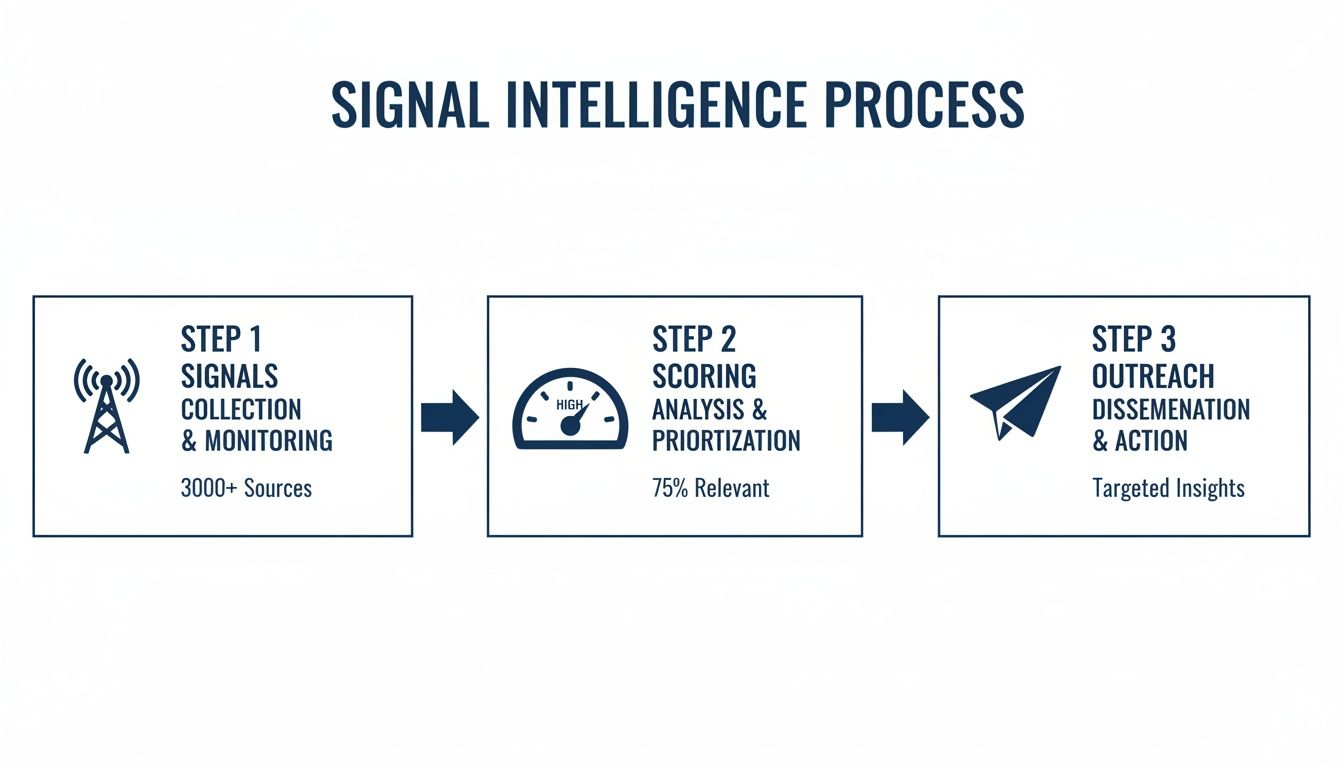
The diagram shows a clean, three-step process: raw signals are captured, scored for relevance, and then used to power targeted outreach.
Automating the 'Why Now'
The most powerful part of a signal-driven approach is giving reps the perfect "why now" for their outreach. Automation delivers this context on a silver platter. Instead of reps hunting for a reason to call, the reason finds them.
Imagine your account intelligence platform detects that a target account just hired a new Chief Information Security Officer (CISO). A smart workflow should instantly kick off a series of actions:
- A Slack Alert: The assigned account executive gets a real-time notification in a dedicated channel, complete with the news and a direct link to the source.
- A CRM Task: A new task is automatically created in the CRM, prompting the rep to launch a "New CISO" sequence within 24 hours.
- Data Enrichment: The new CISO’s contact information is automatically enriched and added to the account record.
This simple workflow eliminates the guesswork and ensures no opportunity slips through the cracks. It turns a piece of news into an immediate, actionable sales play.
Crafting Trigger-Based Outreach Sequences
Once you're routing signals automatically, the next step is to arm your team with pre-built, trigger-based messaging. The key is to match the message directly to the signal. A generic "just checking in" email won't cut it.
Let's say the signal is a competitor's poor earnings report, which calls out customer service issues.
Your outreach shouldn't just mention the news; it must connect that pain point directly to your value proposition. The goal is to show you've done your homework and are reaching out with a relevant solution, not another generic pitch.
Here’s how you could structure a two-touch sequence for that trigger:
Email 1: The Timely & Empathetic Nudge
- Subject: Saw the news about [Competitor Name]
- Body: Briefly acknowledge their competitor’s recent struggles with customer support. Connect this industry-wide challenge to the value your solution provides. End with a soft call-to-action, like offering a relevant case study.
Email 2: The Value-Driven Follow-Up (3 days later)
- Subject: A different approach to [Pain Point]
- Body: Follow up with a specific, data-backed insight about how companies like theirs overcome this challenge. This isn't a sales pitch; it's valuable advice that positions you as an expert. Offer a brief 15-minute chat to share more.
After you've defined your stages and sourced accounts, keeping the conversation going is crucial. Smart automation can streamline these tasks. Consider using specialized sales follow-up email templates to ensure your messaging stays consistent and effective.
Configuring Your CRM for Pipeline Clarity
Your CRM is the central nervous system of your sales pipeline. If it isn’t set up correctly, your strategy and automation will be built on a shaky foundation. These best practices aren't complicated, but they are critical.
- Custom Fields for Signals: Create custom fields on your account and opportunity records to tag the specific signal that kicked off the engagement (e.g., "Funding Round," "Executive Hire"). This lets you track which triggers generate the most pipeline.
- Clear Stage Definitions: Make sure your buyer-centric stages and their entry/exit criteria are documented right inside the CRM, often as help text on the opportunity stage field. No ambiguity.
- Dashboards for Visibility: Build dashboards that track key pipeline metrics like conversion rates between stages, average deal size by signal type, and sales cycle length. This gives leaders an at-a-glance view of pipeline health.
Systematizing your pipeline this way produces dramatically different results. For AEs at enterprise software firms, this often means needing 500–1,000 target accounts to build a pipeline of 20–30 opportunities each month. Data shows that companies with a system see 99.83% of qualified opportunities become appointments, and 36.41% of discovery calls qualify as ICP-fits. Revenue leaders who use account intelligence to monitor these triggers can cut research time by 40–60%, boosting pipeline quality without a massive increase in effort.

“This is my singular place that very simply summarizes a company's top initiatives, strategies and connects them to my solution. Something I would spend hours researching manually, now it's automated.”
Derek Rosen
Director, Strategic Accounts, Guild Education
Measuring and Optimizing Pipeline Performance
A well-designed sales pipeline is a powerful engine, but it needs regular check-ups to perform at its peak. You can't fix what you don’t measure. This is where you start managing pipeline health with data, not gut feelings.
The trick is to focus on the handful of Key Performance Indicators (KPIs) that actually predict and drive revenue. When you track the right things, your pipeline data tells a story—revealing bottlenecks, coaching opportunities, and the specific levers you can pull to accelerate growth.
The Core Four Pipeline Health Metrics
Forget overwhelming dashboards. To get a true, real-time read on your pipeline's health, you only need to focus on four critical areas. These metrics work together to give you a complete picture of your pipeline's quantity, quality, and efficiency.
Let’s break them down:
- Conversion Rate by Stage: This is the most direct measure of pipeline leakage. Tracking the percentage of deals that move from one stage to the next shows you exactly where deals are stalling. A low conversion rate from "Discovery Call" to "Solution Demo," for instance, might point to a problem with your initial qualification.
- Average Sales Cycle Length: How long does it take for a deal to get from creation to close? A lengthening sales cycle can be an early warning sign of friction in your process, new competitor pressure, or reps struggling to create urgency.
- Average Deal Size: Are you winning the right kinds of deals? This metric helps you understand if your team is selling high-value solutions or getting bogged down in smaller opportunities. You can segment this by lead source or signal type to see which channels produce the most lucrative deals.
- Pipeline Velocity: This is the ultimate health metric. It calculates how quickly deals are moving through your pipeline and turning into revenue. The formula is: (Number of Opportunities x Average Deal Size x Win Rate) / Sales Cycle Length. A higher velocity means your sales engine is humming.
Monitoring these four KPIs is non-negotiable. For a deeper dive, you can explore our complete guide to sales pipeline metrics.
Benchmarking Performance Against Reality
Once you start tracking these metrics, the next question is, "So, what does 'good' look like?" The answer depends on your industry. Setting realistic targets means understanding the benchmarks for your specific market.
It's essential to recognize that conversion rates vary dramatically. For instance, professional services firms might see overall conversion rates around 15%, while B2B SaaS companies typically see lower rates between 1–3%. Within SaaS, Trial-to-Paid conversions can range from 8–20%, and SQL-to-Opportunity often sits at 30–50%. In contrast, industrial manufacturing shows stronger late-stage conversion, with SQL-to-Opportunity rates between 35–55% and Opportunity-to-Won between 25–45%.
The goal isn't to perfectly match an industry benchmark. The real value is using these numbers as a starting point to set internal goals and spot where you're significantly over- or underperforming.
Running Pipeline Reviews That Drive Action
Data is useless if it doesn't lead to action. The weekly pipeline review is where your metrics come to life, transforming from numbers on a dashboard into a strategic coaching session. An effective review isn't a forecast roll-up; it's a forward-looking conversation focused on problem-solving.
To make these meetings count, shift the focus from interrogating reps to collaborating on strategy.
Here's what a high-impact pipeline review looks like:
- Focus on "At-Risk" Deals: Don't waste time on deals that are progressing smoothly. Use your data to flag opportunities that have stalled in a stage for too long.
- Ask "What's Next?" Questions: Instead of asking for a subjective "confidence level," ask for evidence. "What are the confirmed next steps?" and "Who are we still missing in the decision-making circle?" are far more effective.
- Identify Systemic Bottlenecks: Is the whole team struggling to convert deals at a specific stage? This points to a systemic issue—maybe a need for better training on discovery calls or more compelling demo materials.
- Celebrate What’s Working: When a rep successfully moves a tough deal forward, dig into how they did it. Sharing these small wins and tactics across the team is a powerful form of peer-to-peer coaching.
By consistently measuring these core KPIs and using that insight to drive actionable pipeline reviews, you create a powerful feedback loop. This continuous process is how you build a sales pipeline that doesn’t just hold deals—it actively accelerates them toward a close.
Got Questions About Building Your Sales Pipeline?
Even with the best playbook, questions pop up when you're building a sales pipeline. Let's tackle some of the most common ones.
How Often Should I Review My Sales Pipeline?
This requires two distinct rhythms. As a sales leader, you need a weekly team-wide pipeline review. This is your command center meeting—the place to check the pulse of every key deal, find coachable moments, and make sure you have enough in the tank to hit the team’s number.
For individual reps, reviewing their pipeline needs to be a daily habit. A quick 15-minute scan each morning is all it takes to set priorities, move deals to the right stage, and spot opportunities that might be going cold. This simple check-in prevents that end-of-quarter fire drill.
What’s a Good Pipeline Coverage Ratio?
The classic rule of thumb is to keep your pipeline coverage between 3x to 5x your quota. So, if your quarterly target is $500,000, you should aim for a pipeline with $1.5 million to $2.5 million in qualified deals.
But that's just a starting point. The real answer depends on your sales motion.
- Complex enterprise sales, with long deal cycles, often demand a higher ratio—closer to 4x or 5x. You need extra padding for deals that slip into the next quarter.
- High-velocity, transactional models can often get by with a leaner 2x or 3x coverage. The cycles are shorter and more predictable.
The best way to find your magic number is to look at your historical data. Your own win rates will tell you exactly what coverage you need to hit your targets.
How Is a Sales Pipeline Different From a Sales Funnel?
This trips people up all the time. A sales funnel is a marketing-centric view of the world. It visualizes the entire journey from an anonymous website visitor to a qualified lead, focusing on volume and conversion rates. It's the buyer's journey from their perspective.
A sales pipeline, however, is a seller-centric tool. It maps out the specific stages and actions your sales team takes to move a deal from creation to close. It’s your active playbook for managing opportunities and forecasting revenue.
The funnel tracks the entire buyer's journey. The pipeline focuses on the active sales process your team controls. One is a big-picture marketing metric; the other is a hands-on sales management tool.
Ready to stop guessing and start building a pipeline driven by what your accounts are actually doing? Salesmotion is the AI-powered account intelligence platform that tells you who is ready to buy and why now. We arm your reps with timely, actionable insights so they can turn real market activity into measurable pipeline.