The SPIN Selling sales methodology is a conversation, not a pitch. It’s a structured way of asking questions to guide a buyer through four stages: Situation, Problem, Implication, and Need-payoff. The goal isn't to push a product; it's to act as a consultant, helping your prospect see their own challenges and co-create the value of your solution.
Why SPIN Selling Is a Modern B2B Game-Changer

Buyers are buried under an avalanche of information and generic sales pitches. SPIN Selling helps you cut through the noise. This isn't just another sales acronym; it's a powerful framework born from one of the most comprehensive sales studies ever conducted.
Its real strength is its buyer-first philosophy. Instead of leading with features, SPIN forces you to understand the customer's world first. This makes it incredibly effective in complex B2B sales—like SaaS, finance, or professional services—where building trust and solving deep-seated problems are non-negotiable.
Before we dive into each question type, here's a quick cheat sheet. This table breaks down what each question does and what you're trying to accomplish. Think of it as your roadmap.
| Question Type | What It Does | Your Primary Goal |
|---|---|---|
| Situation | Gathers facts and background information about the buyer's current process. | Understand the context and earn the right to ask deeper questions. |
| Problem | Explores difficulties or challenges the buyer is facing. | Uncover implied needs and surface pain points the buyer is aware of. |
| Implication | Digs into the consequences of the identified problems. | Make the pain urgent by connecting small problems to larger business consequences. |
| Need-payoff | Asks about the value or usefulness of solving a problem. | Guide the buyer to articulate the value of a solution in their own words. |
This structure provides the foundation for every strategic conversation. Keep these goals in mind as we explore how to ask these questions in the real world.
Built on Data, Not Guesses
SPIN Selling's credibility comes from its rock-solid origins. In the 1980s, Neil Rackham and his team at Huthwaite International analyzed over 35,000 sales calls from 10,000 salespeople across 23 countries.
This wasn't about gut feelings. It was a scientific study to pinpoint the behaviors that separated top performers from everyone else. The framework that emerged showed an average 17% boost in sales productivity for teams that adopted it. This data-driven foundation shifts selling from an art to a reliable science, giving you a proven structure for every conversation. It's a move away from aggressive closing tactics and toward collaborative problem-solving.
By guiding buyers to articulate a solution's value themselves, you transform the sales process. The buyer sells themselves on the solution because they've connected the dots between their pain and the potential payoff.
Why It Thrives Today
Let's face it: modern B2B buyers are sophisticated. They’ve done their homework long before speaking to a sales rep, and a generic pitch is an instant deal-killer. SPIN Selling is the antidote, equipping you for smarter, more relevant conversations.
It helps you:
- Establish Credibility: Asking insightful questions shows you're an expert interested in their business, not just your commission.
- Uncover Latent Needs: Many buyers don't realize the true cost of their problems. Implication questions make those consequences real.
- Build a Strong Business Case: Need-payoff questions get the buyer to state the ROI in their own words, which is far more convincing than you saying it.
This is why SPIN remains a cornerstone among B2B sales methodologies. But even the best methodology needs qualified leads. Combining a timeless framework like SPIN with modern lead generation is how you build a predictable growth engine. For a deeper dive, check out a comprehensive guide on B2B lead generation through social listening.
See Salesmotion in action
Take a self-guided interactive tour — no signup required.
Nailing Your Situation and Problem Questions

The opening phase of a SPIN conversation is all about discovery, and it lives or dies by your Situation and Problem questions. Get this right, and you’ve built a solid foundation for a valuable discussion. Get it wrong, and the call feels like an interrogation—and it's usually over before it starts.
The secret is to ditch lazy, generic questions. Never walk into a meeting and ask, “So, tell me about your business.” You should already know. This is where modern account intelligence becomes a seller's superpower, letting you craft smarter questions that prove you've done your homework.
Before you plan your questions, be clear on who you're talking to and why they're a good fit. If you need a refresher, it helps to define and identify Sales Qualified Leads, as these initial questions are designed to surface them.
Master the Art of Situation Questions
Situation questions are your starting point. Their purpose is to gather context about the buyer's current world—their processes, tools, and goals. But there’s a catch: the goal is not to uncover facts you could have found with a five-minute Google search. It’s to validate your research and earn the right to go deeper.
Top performers use these questions to confirm what they already suspect, not to learn from a blank slate.
Imagine opening a call by referencing a specific initiative from their last earnings report. Instantly, you’re not just another salesperson; you’re a prepared partner who respects their time.
For example, a generic question sounds like this:
- “What are your current priorities?”
A much stronger, research-backed question sounds like this:
- “I saw in your Q2 earnings call that a key priority is expanding into the EMEA market. Could you walk me through how your team is currently structured to support that international growth?”
See the difference? The second question shows preparation and builds immediate credibility. Using one of the best account research software options can put this kind of intel at your fingertips, giving you the signals you need to craft these killer openers.
Uncovering Pain with Problem Questions
Once you have a solid understanding of their situation, you can pivot smoothly to Problem questions. This is where you gently probe for challenges, frustrations, and bottlenecks. Your objective is to guide the prospect to admit, in their own words, that they have a problem that needs fixing.
The most effective Problem questions don't just ask about challenges; they explore the friction in a prospect's current state. They guide the buyer to voice frustrations they might not have fully articulated before.
Again, avoid the generic stuff like, “What are your biggest challenges?” That question just invites a canned, surface-level response. Instead, use what you learned from your Situation questions to investigate specific areas where you know your solution shines.
Real-World Scenario: Selling a Sales Automation Tool
Let’s say you learned through your Situation questions that a prospect’s reps are manually updating their CRM after every call. Now you can start digging for the pain that comes with that.
- Weak Question: “Is manually updating the CRM a problem for you?” (This closed-ended question makes it too easy for them to just say "no.")
- Strong Question: “How much time do your reps typically spend on CRM data entry each week, and what impact does that have on their actual selling time?”
This question works because it's open-ended and prompts the prospect to quantify the issue. It helps them connect the dots between the manual process (the situation) and a negative business outcome (the problem), setting the stage perfectly for Implication questions.

“The talking points are gold. If they're in Salesmotion, I know they're being discussed inside that business. That makes it easy to spark a real conversation, which is 90 percent of the battle.”
Andrew Giordano
VP of Global Commercial Operations, Analytic Partners
Building Urgency With Implication and Need-Payoff Questions
So you've uncovered a clear problem. It’s tempting to jump in and pitch your solution. Don’t. Resisting that urge is what separates pros from amateurs.
Identifying a challenge is just the start. The real magic in the SPIN Selling methodology happens when you make that problem feel both expensive and urgent. This is where Implication and Need-payoff questions come in, turning a minor inconvenience into a major business priority.
Connecting Problems to Business Consequences
Implication questions explore the consequences of the problem you just found. They connect the pain point to its broader, more serious ripple effects across the business. Your goal isn't to be a fearmonger, but a strategic partner helping the prospect see the full picture.
Think of it this way: if a problem is a small leak in a boat, your Implication questions help the captain realize it's not just about getting their feet wet—it's about the engine flooding and the cargo getting ruined.
To ask powerful Implication questions, think like an executive. Ditch user-level frustrations and elevate the conversation to the impacts that leadership cares about: costs, time, and risk.
Let's go back to our sales team that's stuck manually updating their CRM. The problem is that it’s a time sink. But the implications are far more severe.
- Weak Implication Question: "Is that frustrating for your team?" (This focuses on feelings, not business impact.)
- Strong Implication Question: "If your reps are spending five hours a week on data entry, how does that impact your forecast accuracy when deals are moving fast at the end of the quarter?"
See the difference? The second question directly links a mundane task to a critical business function—forecasting. It forces the prospect to confront the real financial and operational consequences of their current process.
The most powerful Implication questions make the buyer pause and think, "Huh, I hadn't considered that." They shift the conversation from a small operational snag to a significant strategic risk.
This is critical in complex B2B sales. Neil Rackham’s original research found that aggressive closing tactics consistently fail in major sales. Meanwhile, top performers who follow the SPIN sequence see their close rates improve by 17% on average. For teams in cutthroat markets like B2B SaaS, this structured way of exploring pain builds the business case for you. You can learn more about how SPIN equips modern sales teams to succeed.
Guiding Buyers to the Solution with Need-Payoff Questions
Once you’ve successfully laid out the serious consequences of the problem, it’s time to pivot. Need-payoff questions flip the script from pain to gain. Instead of dwelling on what's going wrong, you guide the buyer to articulate the value of a solution—in their own words.
These questions are positive, solution-focused, and empowering for the buyer. You're asking them to envision a better future where their problems are gone.
Here’s how you can frame them:
- Ask about the value: "If you could automate that CRM data entry and give your reps back five hours of selling time each week, what would that mean for hitting your quarterly number?"
- Focus on the benefits: "How would having more accurate forecasting data help your leadership team make better strategic decisions?"
- Connect to personal wins: "What would it mean for your team's morale if they could focus on closing deals instead of admin work?"
When you ask these questions, you’re not pitching; you're co-creating the value proposition. The buyer is the one spelling out the benefits, which is far more convincing than you ever could be. They are essentially building the business case for you, making the final decision feel like their own idea.
Putting SPIN Selling Into Your Daily Workflow
Theory is great, but execution is what closes deals. Understanding the SPIN framework is one thing; weaving it into your team's daily habits is another. That’s what separates high-performers from everyone else. This is your playbook for making SPIN a consistent, scalable part of your sales motion.
Moving from concept to practice means creating specific workflows for each role. For Sales Development Representatives (SDRs), it's about crafting smarter outbound messages. For Account Executives (AEs), it’s structuring discovery calls to pull out maximum insight.
The goal is to stop treating SPIN like a special tactic and start making it your core methodology. Let's break down how.
A Playbook for SDRs Crafting Outbound Messages
The full four-step SPIN sequence is too long for a cold email or a LinkedIn message. Instead, your SDRs should use a punchy "mini-SPIN" approach to spark curiosity and land that first meeting. It's a value-driven tactic that proves you've done your homework.
Here’s how a mini-SPIN message comes together:
- Situation (The Hook): Kick off with a signal or trigger event you observed.
- Problem (The Hypothesis): Connect that signal to a common, high-impact problem your solution addresses.
- Implication (The Teaser): Briefly hint at the negative business consequence of that problem.
- Need-Payoff (The CTA): Propose a meeting to discuss how they can achieve a positive outcome.
Real-World Example: An SDR's Email
Subject: New VP of Sales & Forecast Accuracy
Hi [Prospect Name],
Saw your team just brought on a new VP of Sales to scale the go-to-market function (Situation).
Often when a new sales leader steps in, one of the first priorities is getting a grip on forecast accuracy, especially if reps are still logging call data by hand (Problem). That can lead to a shaky pipeline right when leadership needs a clear view the most (Implication).
Worth a quick chat next week about how we help teams automate this and give their new leader a much clearer picture of the pipeline (Need-Payoff)?
This simple shift turns a generic cold email into a relevant, consultative conversation starter.
Structuring the AE Discovery Call
For AEs, the discovery call is where the full SPIN methodology truly shines. A well-structured call flow ensures you hit all your key points while letting the conversation feel natural. A pre-call checklist is essential.
- Pre-Call Checklist:
- Review recent company news, earnings reports, and major initiatives.
- Map out key stakeholders on LinkedIn and understand their roles.
- Prep 2-3 initial Situation questions based on your research.
- Hypothesize potential Problems based on their industry and the intel you’ve gathered.
This process is about uncovering a problem and then building the urgency to solve it.
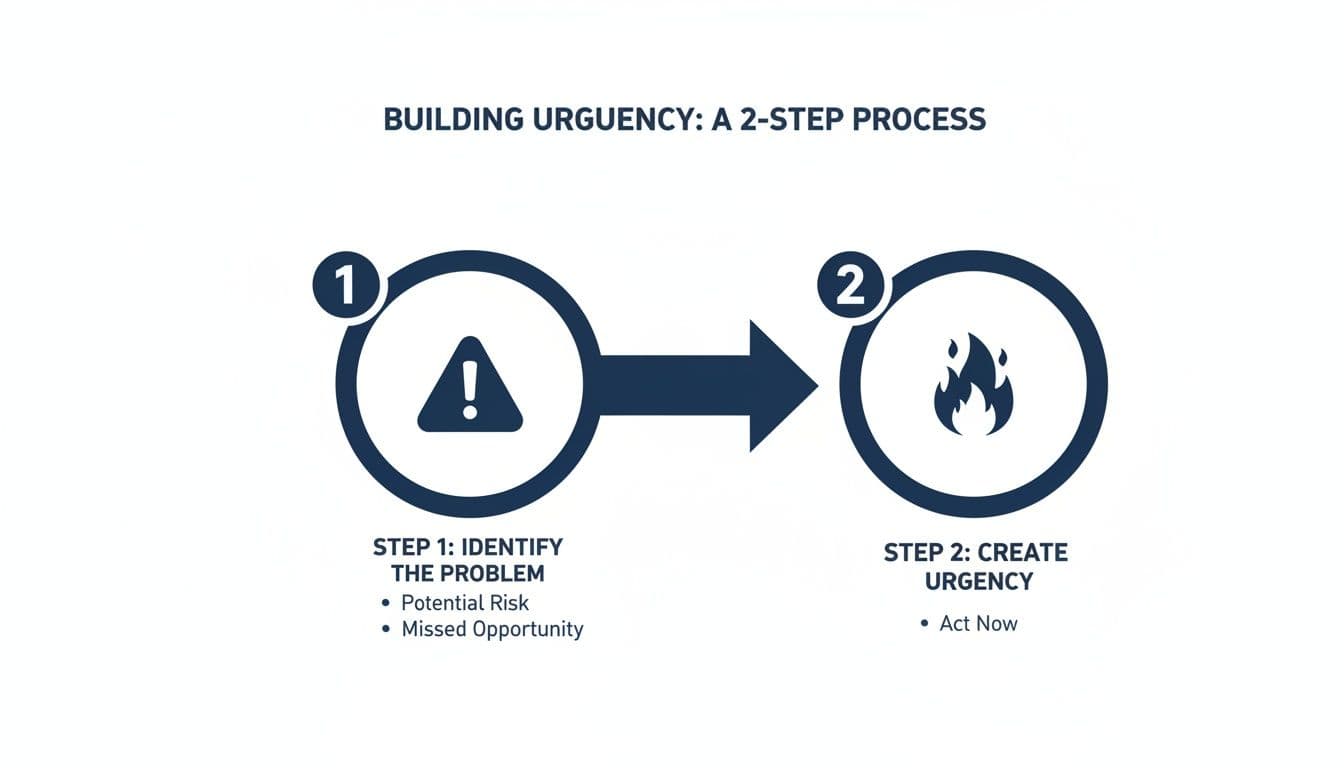
The visual above nails it: a problem only becomes a priority when its consequences are impossible to ignore. That’s the entire point of your Implication questions.
After the call, logging your insights properly in the CRM is critical. Don't just summarize the conversation. Tag specific pains, desired outcomes, and powerful quotes from the prospect. This data becomes gold for your follow-up and for getting internal alignment.
Automating parts of this process can be a huge time-saver. To dig deeper, check out our guide on sales process automation.

“All of the vendors that I've worked with, all of the onboarding that I have had to deal with, I will say, hands down, Salesmotion was the easiest that I have had.”
Lyndsay Thomson
Head of Sales Operations, Cytel
How to Measure the Impact of Your SPIN Strategy
Rolling out SPIN Selling is a great strategic move, but without the right numbers, it's just a good intention. You can't improve what you don't measure. A proper implementation should show up in your pipeline and on your bottom line.
To prove your efforts are paying off, look beyond simple activity metrics like call volume. The real magic of SPIN shows up in numbers that reflect the quality and efficiency of your sales conversations.
Key Metrics to Track
Before launching the SPIN framework, benchmark your current performance. This "before" picture is your baseline, allowing you to clearly show leadership the ROI of this new approach.
Focus on a few core performance indicators:
- Meeting-to-Opportunity Conversion Rate: Are your discovery calls turning into qualified pipeline more often? A jump here is a strong early sign that your team's conversations are hitting the mark.
- Average Sales Cycle Length: Because SPIN is good at uncovering urgency and building a solid business case, you should see deals moving through the pipeline faster.
- Average Deal Size: This is where Implication and Need-payoff questions shine. When reps use them well, they uncover larger, more strategic opportunities. An increase in your average contract value (ACV) is proof you're tying your solution to significant business problems.
- Overall Win Rate: This is the ultimate test. A higher win rate proves that your team isn't just having better conversations—they're closing more of the opportunities they create.
By tracking these metrics, you shift the conversation from "how busy are we?" to "how effective are we?" This data doesn't just validate your strategy; it also uncovers coaching opportunities to help your team sharpen their skills.
Modern B2B teams are already seeing impressive results. One team achieved 15% higher win rates within one month of adopting SPIN, along with 11% month-on-month revenue growth. This lines up with broader research showing that a structured methodology can lift win rates by 11% compared to more informal approaches.
Key Metrics for Tracking SPIN Selling Success
To make this practical, here’s a quick-glance table of the most important KPIs. Think of this as your scorecard for a successful SPIN rollout. It breaks down not just what to track, but why it matters and how SPIN directly influences it.
| Metric to Track | What It Reveals | How SPIN Improves It |
|---|---|---|
| Meeting-to-Op Conversion | The quality of your discovery calls and whether reps are uncovering real pain. | Problem and Implication questions ensure reps qualify effectively, turning more initial meetings into real pipeline opportunities. |
| Average Sales Cycle Length | How efficiently deals move through the pipeline. | Need-payoff questions help buyers articulate the value themselves, building urgency and accelerating the decision-making process. |
| Average Deal Size (ACV) | Whether reps are selling strategically and tying the solution to significant business impact. | By exploring the full consequences with Implication questions, reps uncover larger needs, justifying a bigger investment and a larger deal. |
| Overall Win Rate | The ultimate measure of effectiveness—are you closing more of the deals you work? | SPIN creates a stronger, buyer-centric business case. When buyers see the clear value (Need-payoff), they're more likely to choose your solution. |
| Stakeholder Engagement | Whether you're successfully reaching key decision-makers. | A structured SPIN approach helps reps engage different stakeholders by tailoring questions to their specific problems and desired outcomes. |
Ultimately, this data-driven approach moves SPIN from a theoretical framework to a measurable business driver. You’re not just guessing that it’s working; you have the numbers to prove it.
These metrics are fundamental to understanding your team's performance. For a more detailed breakdown, explore our complete guide on how to measure sales productivity.
Key Takeaways
- SPIN Selling is a data-backed methodology built from analyzing over 35,000 sales calls, providing a proven structure for consultative conversations that boost win rates by an average of 17 percent.
- Situation questions should validate your existing research and earn the right to go deeper, not uncover basic facts you could have found with a quick search.
- Implication questions are the most powerful lever in the framework because they connect a prospect's surface-level problem to serious business consequences like lost revenue, wasted time, and strategic risk.
- Need-payoff questions get the buyer to articulate the value of a solution in their own words, which is far more persuasive than any pitch you could deliver yourself.
- SDRs can use a "mini-SPIN" structure in outbound emails to create consultative, signal-driven messages that consistently outperform generic cold outreach.
- Track meeting-to-opportunity conversion rate, average deal size, sales cycle length, and overall win rate to measure the concrete business impact of your SPIN implementation.
A Few Lingering Questions About SPIN Selling
Even with a proven framework like SPIN, it's smart to ask how it fits into the reality of modern sales. Let's tackle a few of the most common questions.
Is SPIN Selling Still Relevant With AI and Digital Sales?
Absolutely. In fact, it’s more relevant than ever.
AI-powered tools are fantastic for surfacing the what—the signals, the data, the context. But SPIN provides the human framework for understanding the so what. Technology supercharges your approach by feeding you the real-time intel you need to ask sharp Situation and Problem questions right out of the gate.
Think of it this way: AI gives you the ammunition, but SPIN teaches you how to aim. It provides the essential human touch needed to use that intelligence to build trust and uncover deep-seated needs.
Can You Use SPIN Selling for Outbound Prospecting?
SPIN is a game-changer for outbound. While you probably won't run through the full S-P-I-N sequence in a cold email, the core philosophy is perfect for cutting through the noise.
A killer outbound message often follows a mini-SPIN structure. You can reference an observed signal (Situation) to hypothesize a likely Problem, briefly touch on the Implication, and then ask for a meeting to explore the potential Need-payoff.
This shift makes your outreach feel consultative and relevant, a world away from the generic feature dumps that prospects immediately delete.
The heart of SPIN—understanding before you prescribe—is the perfect antidote to generic, low-performing outbound. It forces you to pivot your message from "here's what we do" to "here's what I've noticed you might be facing."
How Long Does It Take to See Results From SPIN Selling?
While true mastery is a journey, most teams start seeing positive changes quickly. The key is consistent application and coaching. You can't just run a two-hour training and expect miracles.
Early signs of success usually show up in your leading indicators within the first month. You'll notice higher-quality discovery calls and more confident qualification.
Hard metrics like shorter sales cycles and higher win rates typically follow within one to two quarters of consistent, team-wide use. It's an investment, but the payoff is a more predictable, value-driven sales motion.
Frequently Asked Questions
What is the biggest mistake reps make when first learning SPIN Selling?
The most common mistake is treating the four question types as a rigid checklist rather than a natural conversation flow. Reps who mechanically march through Situation, Problem, Implication, and Need-payoff questions in order often sound like they are reading from a script. The best practitioners internalize the purpose of each question type and let the conversation flow naturally while ensuring all four areas are covered.
How does SPIN Selling work with other methodologies like MEDDICC or Challenger?
SPIN Selling complements other methodologies rather than competing with them. SPIN provides the conversational framework for discovery calls, while MEDDICC offers a deal qualification structure and Challenger focuses on teaching, tailoring, and taking control. Many high-performing teams use SPIN for their questioning technique during discovery and then map what they learn into their MEDDICC framework for deal management.
Is SPIN Selling effective for shorter, transactional sales cycles?
SPIN was originally designed for complex, large-deal selling, and the full framework works best in sales cycles with multiple stakeholders and longer decision timelines. For shorter cycles, the Problem and Need-payoff questions are still highly effective at uncovering pain and building urgency. SDRs can use the "mini-SPIN" approach in outbound messaging to add consultative value even in faster-moving deals.
Ready to supercharge your SPIN conversations with real-time account intelligence? Salesmotion delivers the actionable signals your reps need to ask smarter questions and build urgency from the first touchpoint. Stop the manual research and start having more relevant, value-driven discussions today. Learn how Salesmotion can transform your sales process.