Every sales leader is asking the same question right now: if Claude can search the web, why pay for account intelligence? Ask Claude to research an account and you get a crisp, sourced brief in under a minute. It feels like account research is solved.
So we tested Salesmotion vs. Claude on real accounts. We expected to write a post about hallucinations. That is not what we found, and the real answer is more useful.
Key Takeaways
- Claude was accurate. Across 277 signals it attributed one to the wrong company, and none of its news links were dead.
- Accurate is not the same as complete. Claude Sonnet 5.5 found 59% of the useful signals Salesmotion had for the same accounts. Claude Opus 5.5 found 78%.
- The gaps cluster where search is weak: executive podcasts and video, clinical-trial registries and hiring history.
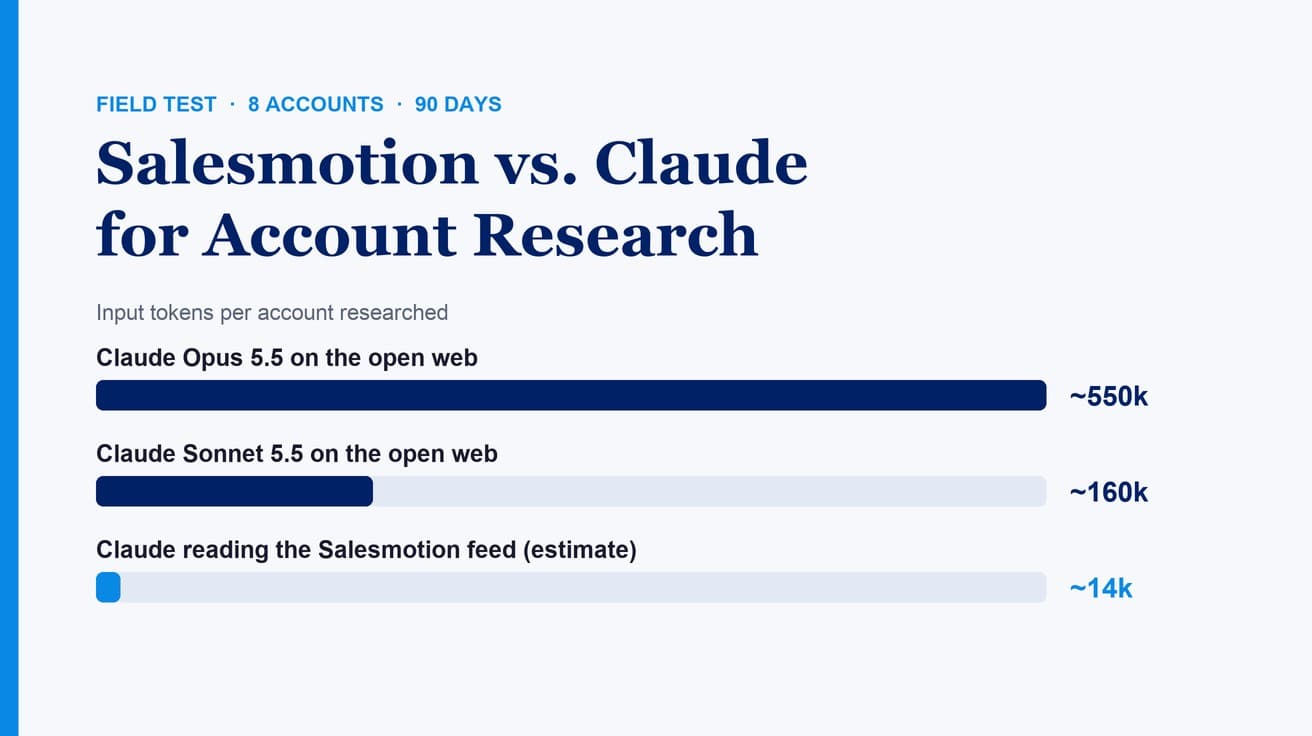
- The cost lands at territory scale. Opus averaged about 550,000 tokens and four and a half minutes per account.
- The best setup is Claude reading Salesmotion, not Claude re-reading the internet for every question.
How We Ran the Test
We picked eight accounts a typical B2B team might be working: Amplitude, Rackspace Technology, Zscaler, Samsara, Navan, Kestra Medical Technologies, IQVIA and Cytokinetics. A mix of SaaS, IT services, life sciences and one small-cap.
For each account, Claude got the brief an AE would give: find every signal from the last 90 days that is a reason to reach out (news, earnings, filings, leadership changes, partnerships, launches, clinical updates, hiring), list open go-to-market roles, and give the current employee count with a source. Claude had web search and page fetching and nothing else. We ran it on two models: Claude Sonnet 5.5, the fast default, and Claude Opus 5.5, the deep-research option.
Then we compared both against what Salesmotion already had for the same accounts and window. An independent model matched events, flagged anything about the wrong company and rated whether each item was actually useful to a seller. We also checked every link Claude cited.
Finding 1: Claude Was Accurate
This is the part we did not expect. Across 277 signals, Claude attributed exactly one to the wrong company. Not one of its news links was dead. On employee counts it went straight to the latest annual filing, which is the number a CFO would quote.
If your objection to AI account research is "it makes things up", that objection is getting weaker every quarter. The Claude web search tool cites its sources, and in our test those sources held up.
Our own feed was not perfect either. Some podcast and news items for Amplitude were about Amplitude Energy, an Australian gas producer. We are fixing that. Accuracy is a fair fight, and anyone who tells you otherwise has not run the test recently.
Finding 2: Accurate Is Not the Same as Complete
The fast model found 59% of the useful signals Salesmotion had for these accounts. Opus found 78%. Where the gaps showed up says a lot about how the open web works:
- Earnings, filings and press releases: Opus found all of them. This is the most indexed, most linked content on the internet, and Claude is very good at it.
- Executives on podcasts and video: Claude found 3 of 13. A CEO explaining their AI roadmap on a niche industry podcast is one of the best openers a rep can have, and it is nearly invisible to search.
- Clinical trial updates: Claude found none of the four we had. They live in registries, not in news.
- Hiring history: When Claude could find a company's public job board, it pulled every open role, sometimes more than we track. For IQVIA, which does not publish one, it found 21 roles to our 59. Neither model could tell when roles had opened or closed, and a posting that closed last month is often the signal that a team just got its budget.
To be fair, Claude also surfaced useful items we did not have, such as Rackspace's new Chief AI Officer, a division president's departure disclosed in an 8-K and its NVIDIA partnership. Breadth on demand is a real strength.
See Salesmotion on a real account
Book a 15-minute demo and see how your team saves hours on account research.
Finding 3: The Bill Comes Due at Territory Scale
Here is what one account cost, priced at Anthropic's published API rates:
| Approach | Tokens per Account | Time per Account | Cost per Account |
|---|---|---|---|
| Claude Sonnet 5.5 researching the web | ~160,000 | ~40 seconds | ~$0.22 |
| Claude Opus 5.5 researching the web | ~550,000 | ~4.5 minutes | ~$2.10 |
| Claude reading Salesmotion's 90-day feed | ~14,000 (estimate) | already collected | a fraction |
The deep model made an average of 46 web calls per account, reading pages only to throw most of them away. That is fine for one account before a big meeting. Now multiply it by a real territory.
A rep with 200 accounts who wants a weekly refresh is looking at roughly $2,300 a year with the fast model while missing about 40% of the signals, or $22,000 a year with the deep model and about 15 hours of agent time every week. Per rep, before anyone reads the output. And the results depend on which model you ask: the same prompt returned 2 signals for Amplitude on Sonnet and 24 on Opus.
On a Claude subscription, that cost shows up as usage limits instead of an invoice. Research that starts from zero every time is the most expensive way to use an AI. We covered the human version of this problem in the cost of manual account research. The AI version is cheaper per account, but it scales the same way.
Finding 4: Nobody Asks About the Account They Forgot
The test above is the best case: a rep who knows which account to ask about and asks at the right moment. Real pipeline comes from the accounts nobody is looking at this week. A new CFO, a leadership departure in an 8-K or a sudden burst of sales hiring only helps if something tells you it happened.
You can schedule an AI agent to re-research every account every week. You are then paying the per-account bill above on every run, for every account, to rediscover mostly the same pages. Account intelligence has to watch every account continuously and tell you when something changes.
Our Point of View: Claude Is the Analyst, Salesmotion Is the Research Desk
The question is not Salesmotion or Claude. It is where the data comes from.
Claude is the best analyst most sales teams have ever had access to. It can turn a pile of signals into an account plan, a stakeholder map or a first email that sounds like you. What it should not be doing is re-reading the internet every time you ask a question, paying for it in tokens, minutes and the 20 to 40% of signals it never reaches.
Salesmotion does the collection once, continuously, across sources a web search does not reach. It resolves which company each signal belongs to, filters out the noise and keeps the history. Then Claude does what it is best at.
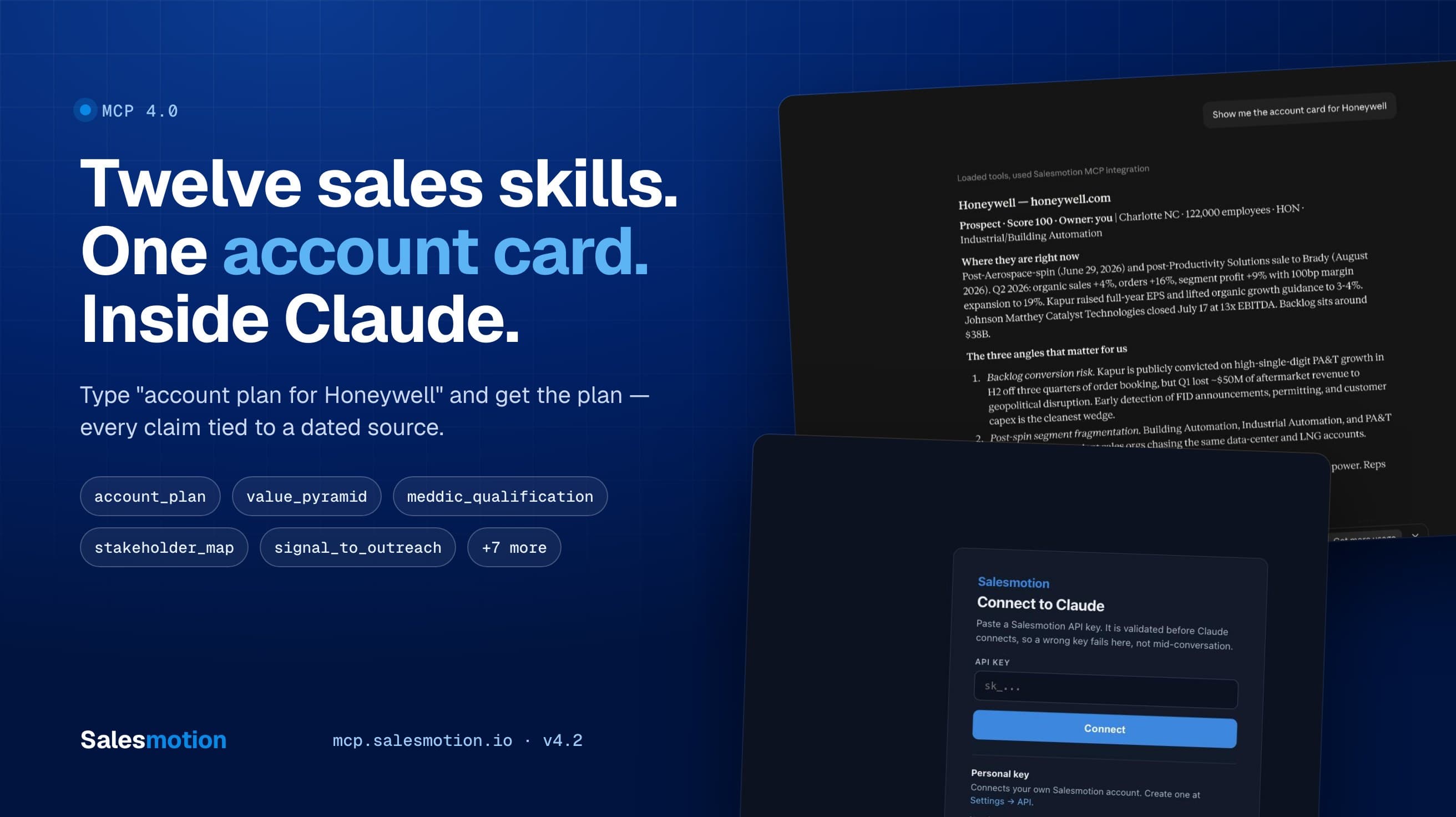
That is why we built the Salesmotion MCP for Claude. Connect it once and Claude reads your accounts' signals, people and history directly: around a tenth of the tokens of the fast model researching from scratch, and a fortieth of the deep one. MCP 4.0 adds twelve guided sales workflows on top. Same analyst, better inputs.
What This Means for Your Team
- Use Claude for thinking, not for collecting. Prep, synthesis, messaging and planning are where it shines.
- Do not judge AI research by one account. Run it across your territory, every week, and look at the bill and the gaps.
- Watch for the signals search does not surface. Executive interviews, registries, job history and anything behind a login are where the best openers hide.
- Give your AI a source of truth. The model is only as good as what it reads.
For a broader look at where general-purpose assistants fit next to dedicated tools, see ChatGPT vs. sales intelligence tools. We will keep running this test as models improve and publish the results either way.
Frequently Asked Questions
Can Claude replace a sales intelligence tool for account research?
For a single account before a meeting, Claude with web search does good, accurate work. In our test of eight accounts, it found 59% (Sonnet 5.5) to 78% (Opus 5.5) of the useful signals Salesmotion had, and it missed most executive podcast appearances, clinical-trial updates and hiring history. Across a full territory, the time and token cost of researching from scratch every week adds up quickly.
Does Claude hallucinate when researching companies?
Not much, in our test. With web search enabled, Claude attributed one of 277 signals to the wrong company, and none of its cited news links were dead. The bigger risk is not fabrication. It is the signals it never finds.
How many tokens does AI account research use?
Claude Sonnet 5.5 used about 160,000 input tokens per account and Claude Opus 5.5 about 550,000, mostly from search results and fetched pages. Reading the same account's 90-day Salesmotion feed is roughly 14,000 tokens by our estimate.
How does Salesmotion work with Claude?
Through the Salesmotion MCP. Connect it to Claude once, and Claude can pull an account's signals, filings, earnings commentary, hiring and people directly, then reason over them. Claude does the analysis, Salesmotion supplies the data.
How was the test run?
Eight accounts, a 90-day window ending October 9, 2026, one run per model with only web search and page fetching enabled. An independent model compared Claude's results with Salesmotion's feed, flagged wrong-company items and rated usefulness, and every cited link was checked. It is a focused field test, not a statistical benchmark.