Most go-to-market strategy documents read like aspirational fiction: define your ICP, craft your messaging, select your channels, and revenue will follow. The reality is that 72% of B2B companies fail to meet their GTM plan targets within the first year, according to CB Insights data. The gap between strategy and pipeline isn't a planning problem. It's an execution problem. A GTM framework that can't be operationalized in 90 days isn't a strategy. It's a slide deck.
TL;DR: An effective go-to-market strategy framework has four phases: Market Analysis (weeks 1-3), Strategy Design (weeks 4-6), Execution Build (weeks 7-9), and Launch and Iterate (weeks 10-12). Each phase has specific deliverables and decision gates. The framework works for new product launches, market expansions, and sales motion redesigns. The key differentiator between strategies that generate pipeline and those that don't is how quickly the plan connects to real buying activity.
Phase 1: Market Analysis (Weeks 1-3)
Strategy built on assumptions generates pipeline built on hope. The first three weeks are about replacing assumptions with data.
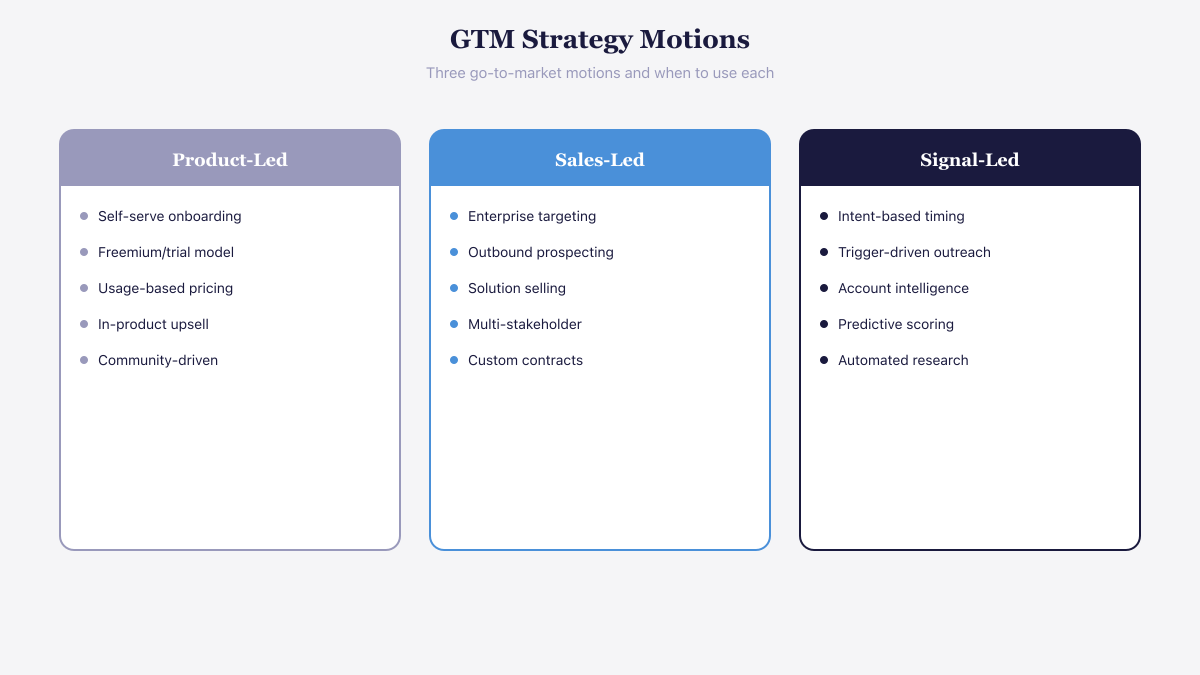 Most 2026 GTM strategies combine elements of product-led, sales-led, and signal-led motions.
Define Your Total Addressable Market With Specificity
Generic TAM calculations (industry size x average deal size) are useless for execution. Instead, build a bottoms-up TAM:
- Identify your ideal customer profile by analyzing your best 10-20 customers. What do they have in common? Industry, employee count, revenue range, technology stack, growth stage, and organizational structure.
- Count the accounts that match. Use firmographic databases to quantify how many companies share those characteristics.
- Apply qualification filters. Not every ICP-fit account will buy this year. Filter by growth signals, hiring activity, funding stage, and competitive landscape.
The output should be a named account list, not a market size number. You should be able to say "there are 1,200 accounts in our primary TAM, 350 in our serviceable addressable market, and 80 that show active buying signals this quarter."
Map the Competitive Landscape
For each competitor in your category:
- Positioning: What do they claim to do, and for whom?
- Strengths: Where do they genuinely outperform alternatives?
- Weaknesses: Where do customers complain, and what gaps does your solution address?
- Customer base: Which accounts are they winning, and which segments do they dominate?
This mapping drives positioning decisions in Phase 2. If every competitor leads with "AI-powered" messaging, leading with that claim won't differentiate you.
Identify Buying Patterns
Research how your target buyers actually purchase:
- Committee composition: How many stakeholders are involved? Which functions (sales, IT, finance, operations)?
- Evaluation triggers: What events prompt a vendor evaluation? Buying triggers like leadership changes, funding events, and technology contract renewals.
- Decision timeline: How long does the typical evaluation take from first contact to signed contract?
- Information sources: Where do buyers research solutions? Analyst reports, peer communities, Google, LinkedIn, review sites?
See Salesmotion on a real account
Book a 15-minute demo and see how your team saves hours on account research.
Phase 2: Strategy Design (Weeks 4-6)
With market analysis complete, design the strategy around three decisions: who to target, what to say, and how to reach them.
Segment and Prioritize
Not all ICP-fit accounts deserve equal effort. Create three tiers:
| Tier | Criteria | Approach | Rep Allocation |
|---|---|---|---|
| Tier 1 | ICP fit + active buying signals | Fully personalized, multi-threaded | Named accounts |
| Tier 2 | ICP fit, no current signals | Warm nurture, signal-triggered activation | Territory-based |
| Tier 3 | Adjacent fit | Automated sequences, content-led | Pooled/automated |
This tiering prevents the most common GTM failure: treating all accounts equally and spreading resources too thin.
Develop Positioning That Connects to Buyer Pain
Your positioning must answer three questions in 10 seconds:
- What problem do you solve? Not what you do. What pain goes away.
- For whom? Be specific enough that non-ICP readers self-select out.
- Why you, why now? What makes your approach uniquely effective for this problem at this moment?
Test positioning against the "so what?" filter: if a VP of Sales reads your one-liner and their reaction is "so what?", the positioning isn't specific enough. "AI-powered sales intelligence" is generic. "Account intelligence that replaces 5 tools and 3 hours of research per account" addresses a specific pain with a specific outcome.
Select Channels Based on Buyer Behavior
Channel selection should follow buyer behavior, not marketing preference:
- If buyers research on Google: Invest in content and SEO targeting the keywords they search during evaluation.
- If buyers trust peer recommendations: Build case studies, customer communities, and review site presence.
- If buyers respond to direct outreach: Build a signal-driven prospecting motion with personalized, research-backed messaging.
- If buyers attend events: Prioritize industry conferences and webinars for pipeline generation.
Most B2B GTM strategies benefit from a primary channel (where 60-70% of pipeline originates) supplemented by 2-3 supporting channels.

“Automatic account profile detail I can use to manage my territory. Using Salesmotion AI to generate value statements per persona, account, etc. Using Salesmotion to give me a starting point based on new hires, or news alerts is critical.”
Adam Wainwright
Head of Revenue, Cacheflow
Phase 3: Execution Build (Weeks 7-9)
Strategy without operational infrastructure generates zero pipeline.
Build the Sales Motion
Define exactly how reps will engage each account tier:
For Tier 1 (signal-driven):
- Monitor for buying signals using account intelligence
- When signals fire, generate personalized outreach referencing the specific event
- Multi-thread into 3+ stakeholders within 30 days of first contact
- Run consultative discovery anchored to the account's stated priorities
For Tier 2 (nurture-to-activate):
- Add to content nurture sequences with relevant educational material
- Monitor for activation signals (leadership change, funding, hiring spike)
- When signals activate, escalate to Tier 1 treatment with personalized outreach
For Tier 3 (automated):
- Automated email sequences with light personalization
- Content-led engagement (blog, webinars, reports)
- Score based on engagement and promote to Tier 2 when interest intensifies
Configure the Technology Stack
The GTM tech stack should support the sales motion, not dictate it:
- CRM: Foundation for all pipeline tracking and reporting
- Account intelligence: Signal monitoring and research automation for Tier 1 accounts
- Sales engagement: Sequence management and outreach execution
- Content and enablement: Case studies, competitive battle cards, and sales collateral
Salesmotion fits the account intelligence layer, providing the buying signals and automated research that make Tier 1 engagement possible at scale. Teams like Frontify achieved 42% sales velocity improvement by adding intelligence-driven account prioritization to their GTM motion.
Establish Pipeline Metrics and Dashboards
Define success metrics before launch, not after:
| Metric | Target | Measurement Cadence |
|---|---|---|
| Pipeline created (dollars) | Set based on revenue target / win rate | Weekly |
| Qualified meetings booked | Set based on meeting-to-opportunity conversion | Weekly |
| Account engagement rate (Tier 1) | 50%+ contacted within 30 days | Monthly |
| Signal-to-meeting conversion | 10-15% for signal-triggered outreach | Monthly |
| Channel attribution | Track pipeline source by channel | Quarterly |
Phase 4: Launch and Iterate (Weeks 10-12)
Execute the First 30 Days With Intensity
The first 30 days after launch set the operational cadence. Focus on:
- Weekly pipeline reviews comparing actual pipeline creation to targets
- Signal response time: How quickly are reps acting on buying triggers? Same-day response to Tier 1 signals should be the standard.
- Message testing: Run A/B tests on positioning, subject lines, and outreach templates across segments.
- Quick wins: Identify and celebrate the first closed deals, booked meetings, and positive responses. Momentum matters for team buy-in.
Iterate Based on Data, Not Opinions
After 30 days, you'll have enough data to make the first adjustments:
- If response rates are low: The messaging may not connect to buyer pain. Test different pain point angles.
- If meetings don't convert to pipeline: Discovery may be weak, or the ICP definition needs refinement.
- If one channel dramatically outperforms: Shift resources toward what's working rather than trying to make underperforming channels work.
- If certain signal types produce better outcomes: Double down on those signals and deprioritize low-conversion triggers.
The GTM framework is designed to produce a working pipeline engine in 90 days, not a perfect one. Perfection comes from iteration, not planning.

“There's been a big focus on hyper personalization and relevance in our outbounding efforts. Salesmotion has been a key partner in hitting our significantly increased meeting targets. What stands out is how simple it is. Reps can log in and get valuable account insights within 30 seconds to a minute.”
Joe DeFrance
VP of Sales, Incredible Health
Key Takeaways
- Effective GTM strategies follow four phases: Market Analysis (weeks 1-3), Strategy Design (weeks 4-6), Execution Build (weeks 7-9), and Launch and Iterate (weeks 10-12).
- Replace generic TAM calculations with named account lists filtered by ICP fit and active buying signals. Strategy built on specific accounts generates specific pipeline.
- Tier accounts by signal strength, not just ICP fit. Allocate resources to Tier 1 (active signals) accounts first, nurture Tier 2, and automate Tier 3.
- Position around the specific pain you solve and the specific outcome you deliver. Generic "AI-powered" messaging doesn't differentiate in 2026.
- Configure your tech stack to support account intelligence, sales engagement, and pipeline analytics. The intelligence layer determines which accounts get the right attention at the right time.
- Establish metrics before launch. Pipeline created, meetings booked, signal-to-meeting conversion, and channel attribution are the leading indicators that determine whether to iterate or accelerate.
Frequently Asked Questions
What is a go-to-market strategy framework?
A go-to-market strategy framework is a structured approach to bringing a product or service to market. It defines your target audience, positioning, channels, sales motion, and success metrics. The framework converts market opportunity into operational execution by specifying not just what you'll do, but how, when, and what resources are required. Strong frameworks include clear phase gates and iteration cycles.
How long does it take to build a GTM strategy?
A comprehensive GTM strategy can be built and launched within 90 days using a phased approach: 3 weeks for market analysis, 3 weeks for strategy design, 3 weeks for execution build, and 3 weeks for launch and initial iteration. The key is parallel workstreams. Market analysis and initial strategy work can overlap, and technology configuration can begin while positioning is being finalized.
What is the most common GTM strategy mistake?
The most common mistake is treating all target accounts equally instead of tiering by buying signal strength. Teams that spread resources evenly across 500 accounts generate weaker results than teams that focus 60-70% of effort on the 50-80 accounts showing active buying triggers. The second most common mistake is spending too long in planning without establishing operational infrastructure. A good-enough plan executed in 90 days beats a perfect plan launched in 6 months.
How do you measure GTM strategy success?
Track pipeline creation (dollars and opportunities) as the primary metric, supported by qualified meetings booked, account engagement rate, signal-to-meeting conversion, and channel attribution. Revenue is the ultimate measure, but pipeline metrics are leading indicators that tell you whether the strategy is working within the first 30-60 days, before deals have time to close.