At its core, intent to buy is the set of digital clues a company leaves when they're actively looking for a solution like yours. It’s the digital body language that signals who is in-market and when you should reach out. This turns a cold call into a perfectly timed, helpful conversation.
What Is B2B Buyer Intent?
Think of yourself as a detective. A single clue—someone from a target account visits your pricing page—is interesting, but it’s not enough to build a case.
But what happens when you piece more clues together? That same company downloads a competitor's whitepaper. An executive searches for "best CRM for enterprise." Then you spot a news article about their recent funding round. Suddenly, the picture is clear. This company isn't just browsing; they're on a mission to buy.
First-Party vs. Third-Party Intent Signals
To understand intent, you need to know where these signals come from. The data falls into two main buckets, each giving you a different piece of the puzzle.
Here's a quick breakdown of where these signals originate and how they fit into your sales strategy.
| Signal Type | Definition | Examples | Primary Use Case |
|---|---|---|---|
| First-Party | Data you collect directly from your own digital properties. It's exclusive to you. | Website visits (pricing, case studies), email engagement, content downloads, webinar attendance. | Identifying accounts already aware of and engaging with your brand. |
| Third-Party | Data gathered from across the web, outside your ecosystem, showing anonymous research activity. | Topic-based research on publisher sites, competitor product reviews, keyword searches, forum discussions. | Discovering net-new accounts in-market for your solution before they know you exist. |
The real power is in combining them. First-party data tells you who's interested in you, while third-party data reveals who's interested in a solution like yours. Together, they give you a complete map of your market's buying journey. For a deeper look, check out our guide on what is intent data.
Why Intent to Buy Matters Now More Than Ever
Not long ago, sales reps were the gatekeepers of information. Today, the buyer holds the power. B2B buyers now do most of their research independently, long before they ever want to talk to a salesperson.
By the time a prospect reaches out, they could be 60-90% of the way through their decision. If you’re waiting for them to raise their hand, you’re already late.
This makes spotting early signals critical. The global intent data market is expected to hit $1.5 billion by 2025 for a reason. In fact, 99% of businesses see a jump in sales or ROI after using intent data. This makes sense when you consider that B2B buyers run an average of 12 online searches before even landing on a specific brand's website.
Understanding intent to buy lets your team stop guessing and start engaging with precision. It provides the "why now"—the context that cuts through the noise and ensures your message lands with the right person at the right moment.
See Salesmotion in action
Take a self-guided interactive tour — no signup required.
The Anatomy of High-Value Intent Signals
Not all signals are created equal. Some are whispers, while others are blaring alarms that a company has a real intent to buy. The key is to separate the signal from the noise, and that starts with understanding the anatomy of a high-value clue.
These signals fall into two main camps: the digital footprints prospects leave as they research, and the real-world business events that force them to look for something new.
Behavioral Signals: The Digital Footprints
Behavioral signals are the online actions a company and its employees take during their research. Think of it as their digital body language. They're actively digging for information and building a shortlist—often before your sales team knows they exist.
This shift to digital-first research is massive. An incredible 92% of all B2B purchases now start with an online search. What's more, 62% of buyers feel they can narrow down their top vendors based on digital content alone.
This lines up with the fact that 33% of all B2B buyers (and 44% of millennials) would rather have a buying experience completely free of sales reps. For a closer look, see our deep dive into what is a buying signal in sales.
So, what are the most powerful behavioral signals to watch for?
- High-Frequency Topic Searches: When a company suddenly consumes a lot of content around a specific topic—like "cybersecurity compliance for finance"—they're deep in a research cycle. This shows the problem is top of mind.
- Competitor Comparisons: Once prospects start looking at "Your Company vs. Competitor" articles or spending time on review sites like G2, they’ve moved past casual browsing. They are in active evaluation mode.
- Pricing Page Visits and Content Downloads: Actions like visiting a pricing page or signing up for a product-focused webinar are strong indicators of serious intent. These are not passive activities; they signal a user is moving down the funnel.
Event-Driven Signals: The Real-World Triggers
While behavioral signals show what a company is interested in, event-driven signals often reveal why they are interested now. These real-world business triggers create urgency and open a window of opportunity for a perfectly timed, relevant conversation.
These triggers are your secret weapon against generic outreach. Instead of a canned pitch, you can lead with a message that proves you’ve done your homework and understand their current business reality.
A news event isn't just news; it's a sales opportunity. It provides the perfect "why now" for your outreach, transforming a cold interaction into a warm, relevant discussion.
To make the most of these signals, you need to understand concepts like lead scoring. A solid lead scoring system helps you prioritize which accounts to act on when these events happen. You can learn more about What Is Lead Scoring and How Does It Fuel Sales Growth to build a more structured approach.
Here are some of the most powerful event-driven triggers:
- New Executive Hires: A new CIO or CRO isn't hired to maintain the status quo. They are brought in to drive change, which often involves reviewing the tech stack and bringing in new solutions within their first 90 days.
- Funding Announcements and M&A Activity: A fresh round of capital or a merger signals a major strategic shift. The company is scaling up or integrating new systems, creating a perfect opening for vendors who can help them manage that change.
- Regulatory Shifts: A new compliance requirement can force a company’s hand, creating an immediate, non-negotiable need for solutions that help them adapt.
- Major Company Milestones: This could be a product launch, an expansion into a new market, or a significant partnership. Each of these events often requires new tools and services to support the initiative.

“Salesmotion empowers me to cultivate a great buyer experience. I'm able to challenge prospects' thinking and be a trusted consultative seller. A major part of this is Salesmotion insights.”
Austin Friesen
Account Executive, FY25 #1 President's Club, Clari
Turning Buyer Intent Signals into Pipeline
Spotting a buying signal is just the first step. The real work is turning that insight into measurable pipeline. Without a clear workflow, sales teams get buried in "signal overload," where every alert feels urgent but nothing moves forward. You need a system.
To transform intent data from noise into a predictable revenue engine, a simple three-part framework works best: Detect, Score, and Act. This gives you a clear path from identifying an opportunity to engaging a buyer with a message that lands.
The process is about turning raw actions and real-world events into focused, actionable intelligence.
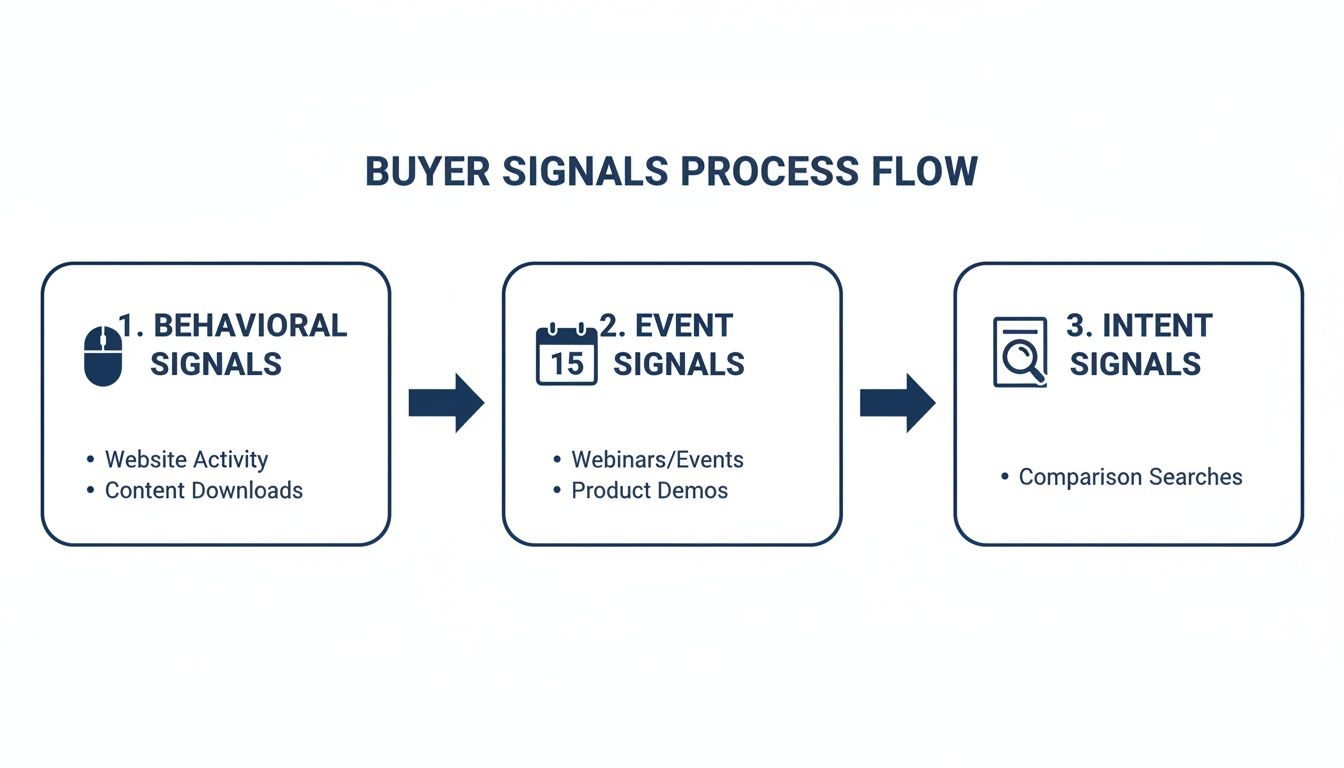
This shows how scattered online actions and triggers are captured and refined into genuine buyer intent.
Detect Always-On Account Signals
The first step is automated, continuous monitoring. Manual research doesn't scale. Your reps can't spend their days scrolling through news feeds, hoping to stumble on something useful. Modern revenue teams use account intelligence platforms as their eyes and ears on the market.
This detection phase involves:
- Defining Your Triggers: First, tell your system what to look for. Build a list of the key behavioral and event-driven signals that matter for your ideal customer profile (ICP).
- Automated Monitoring: The platform then watches your target accounts 24/7, scanning press releases, regulatory filings, hiring changes, and social media activity.
- Contextual Alerts: A good system delivers a concise, actionable alert—often inside your CRM or Slack—that explains why this signal is important.
Score and Prioritize High-Value Accounts
Once signals start coming in, you need a way to figure out which ones deserve immediate attention. Not every funding announcement or topic search has the same weight. This is where signal-based scoring comes in, helping you separate the mildly interested from accounts that are ready to talk now.
A scoring model built on real-time intent signals is far more dynamic than traditional static scoring. It prioritizes accounts based on what they are doing right now, not just who they are.
This goes beyond basic firmographics like company size. It incorporates timely, behavioral data. For example, a company that fits your ICP but shows no recent activity might get a low score. But a smaller company that just hired a new CIO and is actively researching your product category? That one shoots to the top of the list.
Act with Timely and Relevant Outreach
The final and most critical step is to act. With a prioritized list of high-intent accounts, your sales team can stop guessing and start engaging with purpose. This is where you connect the dots between the signal and the sale.
Here are a few powerful sales plays you can run:
- Trigger-Based Email Sequences: When a key event happens, like a funding round, automatically enroll key stakeholders at that account into a relevant email sequence. The message can directly reference the event.
- Value-Driven Outbound Messaging: Arm your reps with context. Instead of a generic "checking in" email, they can lead with, "I saw your company just announced an expansion into Europe, and that often creates challenges with X..." It’s a completely different conversation.
- Automated Meeting Briefs: Before a call, reps can get an automated brief summarizing the latest signals and key talking points, ensuring every conversation is strategic.
By following this Detect, Score, and Act framework, you create a system for converting buyer intent into pipeline. It ensures your team focuses on the accounts most likely to close. You can learn more about turning data into qualified leads in our guide on intent data for SQLs.
How Buyer Intent Drives Sales in Key Industries
The real power of tracking intent to buy isn't just a theory; it’s seeing it in action. Generic signals are a good start, but the magic happens when you layer them with industry-specific intelligence. That context is what turns a news alert into a closed deal.
Every industry has its own rhythm and triggers. What signals a huge opportunity in Life Sciences might be noise in B2B SaaS. Understanding these nuances is what separates top-performing sales teams from the rest.
Let's walk through a few real-world scenarios to make this concrete.
Life Sciences: A Clinical Milestone Unlocks Opportunity
Imagine a biotech firm, "Innovate Therapeutics," that's developing a new drug. A contract research organization (CRO) has them on its radar, but there hasn't been a compelling reason to reach out.
Then, two signals hit at once. First, Innovate Therapeutics announces it has successfully completed Phase II clinical trials. Days later, they secure a major funding round, earmarked for scaling up to Phase III.
This isn't just news; it’s a massive buying trigger. The CRO’s sales team knows that moving to the next trial phase creates immediate needs—from patient recruitment to data management. And with fresh funding, budget objections have vanished. The team’s outreach is no longer a cold pitch; it’s a perfectly timed offer to solve an urgent problem.
B2B SaaS: A New CTO and a Search Spike
Now let's look at a B2B SaaS company selling cybersecurity compliance software. They've had a major enterprise on their target list for months with no engagement.
Suddenly, their account intelligence platform flags two key events. The target company hires a new CTO known for prioritizing security modernization. At the same time, third-party data shows a spike in searches from that company’s IP addresses for terms like "SOC 2 compliance automation."
The sales team now has a powerful story. The new CTO is under pressure to make an impact in their first 90 days, and the research surge confirms compliance is a top priority. Their outreach can be tailored to this context, positioning their software as the perfect tool to help the new CTO score an early win.
Financial Services: A Regulatory Shift Creates Immediate Demand
Consider a fintech company that specializes in anti-money laundering (AML) compliance tech. Business is steady, but they're always looking for an edge.
One morning, a government body announces stricter reporting standards for financial institutions, with a tight six-month implementation deadline. For the fintech vendor, this is a gold rush.
Regulatory changes aren't an inconvenience for financial firms; they are non-negotiable mandates. This external pressure instantly creates budget and urgency, opening a massive window of opportunity.
The sales team can immediately segment their outreach to every institution affected by the new rule. Their messaging isn't about a nice-to-have feature; it's about helping companies avoid massive fines. The regulatory announcement itself becomes the core of their value proposition.
Vertical-Specific Buying Triggers and Sales Plays
These stories show how different events in each industry create unique opportunities. The table below breaks down a few more examples, translating real-world triggers into actionable sales plays.
| Industry Vertical | Key Buying Signal (Example) | Associated Pain Point | Effective Sales Play |
|---|---|---|---|
| SaaS | New executive hire (e.g., VP of Sales) | Pressure for early wins, need to re-evaluate tech stack. | Offer a "First 90 Days" assessment or benchmark report. |
| Life Sciences | FDA approval or successful clinical trial | Rapid scaling needs, new operational complexities. | Position solution around commercial launch readiness. |
| Financial Services | New regulatory mandate (e.g., AML, data privacy) | Compliance risk, tight implementation deadlines. | Lead with a "Compliance Gap Analysis" offer. |
| Industrial / Mfg. | Announcement of a new factory or plant expansion | Supply chain disruption, need for new operational tech. | Focus on solutions for operational efficiency and scaling. |
| Professional Services | Large client win or major project announcement | Resource constraints, need for tools to manage growth. | Highlight how your tool improves project profitability. |
As you can see, the most powerful approach is highly specific. By layering general signals with deep industry knowledge, you can pinpoint the moment your solution becomes indispensable and craft a message that resonates. It’s about moving from "what" happened to "why" it matters to them.

“We have very limited bandwidth, but Salesmotion was up and running in days. The template made it easy to load our accounts and embedding it in Salesforce was simple. It was one of the easiest rollouts we've done.”
Andrew Giordano
VP of Global Commercial Operations, Analytic Partners
Building Your Intent-Driven Sales Strategy
Turning raw intent to buy data into a scalable sales machine requires more than just access to signals. It demands a clear strategy built by RevOps and sales leaders together. The goal is to create a repeatable motion that everyone on the team understands and can execute.
This blueprint isn't just about a new tool. It's a mindset shift, moving your team from reactive selling to proactive, signal-based engagement. Let's walk through the essential steps.
Define Your Ideal Customer and Key Signals
Before you can act on signals, you have to know which ones matter. This foundational step requires deep collaboration between sales, marketing, and leadership to define your ideal customer profile (ICP) with clarity.
Go beyond basic firmographics. What are the specific traits of a company that gets the most value from your solution? Once your ICP is locked in, you can identify the corresponding buying signals.
- Event-Driven Triggers: What real-world events create an immediate need for your product? Think funding rounds, new executive hires, or regulatory changes.
- Behavioral Clues: What online research patterns show a company is actively in-market? This could be spikes in searches for competitor names or specific keywords.
This defined list of signals becomes the blueprint for your entire strategy.
Choose Your Tools and Integrate Your Tech Stack
Trying to do this manually is a recipe for missed opportunities. To operate at scale, you need technology that automates the detection and delivery of intent signals. This is where an account intelligence platform becomes essential.
The right tool will continuously monitor your target accounts for your specific signals and feed them directly into your team's existing workflow.
The goal is to make acting on intent as seamless as possible. Signals should show up where your reps already work—whether that's your CRM, a Slack channel, or their email inbox. This removes friction and drives adoption.
A well-integrated system ensures that insights become actionable triggers, not just another unread notification.
Train and Enable Your Team to Act
Dropping a new tool in your team's lap is not a strategy. Effective enablement is what separates a failed software investment from a competitive advantage. Your reps need to understand the "what," "how," and "why."
Studying real-world Account Based Marketing (ABM) playbooks can provide actionable insights as you build your strategy. Training should be practical and playbook-driven, showing reps exactly how to turn a signal into a compelling conversation. For a closer look at this process, explore our guide to signal-based selling.
Measure What Truly Matters
You can't measure the success of an intent-driven strategy by meetings booked alone. You have to look deeper to understand the real business impact. The right KPIs will show you how your strategy is influencing the entire sales cycle.
This focus is backed by market trends. By 2025, 46% of marketers plan to increase their use of intent data for personalized outreach, and 65% report that these signals improve forecasting accuracy.
Start tracking the metrics that reveal true efficiency and effectiveness:
- Decreased Sales Cycle Length: Are deals closing faster?
- Increased Deal Velocity: Is the time between stages shrinking?
- Higher Conversion Rates: Are more conversations turning into qualified opportunities?
- Improved Win Rates: Is your team winning more competitive deals?
Tracking these outcomes proves the ROI of your strategy and builds a case for investing more in signal-based selling.
Common Pitfalls of Using Buyer Intent Data
Adopting an intent to buy strategy can feel like a superpower, but knowing the common traps is crucial. A successful approach means understanding what to avoid so your efforts create pipeline instead of just noise.
One of the biggest mistakes is jumping on weak or isolated signals without context. A single whitepaper download doesn't mean an account is ready for a sales call. Chasing low-quality signals wastes time and can damage your brand's reputation with premature outreach.
Navigating Signal Overload and Data Decay
Another major challenge is "signal overload." When every minor event triggers an alert, reps get overwhelmed and start ignoring notifications. It's critical to filter and score signals so that only the most urgent and relevant opportunities rise to the top.
Just as dangerous is relying on stale information. Intent data has a short shelf life. A company that was actively researching last month may have already made a purchase. Acting on old data makes your outreach feel tone-deaf and out of touch.
The most effective intent strategies focus on a continuous stream of fresh, relevant signals. This ensures every conversation is based on what’s happening right now, not weeks ago.
Maintaining Privacy and Ethical Standards
Finally, privacy and ethics are non-negotiable. Modern sales intelligence must be both powerful and respectful. The best practice is to focus on company-level signals rather than invasive individual tracking. This means you're monitoring a company’s public activities and research trends—not an individual’s personal browsing history.
This approach builds trust by showing a responsible use of data. It ensures your outreach is powered by legitimate business intelligence, helping you connect with prospects in a way that feels both insightful and respectful.
Common Questions About Buyer Intent
As teams start building a smarter sales motion, a few common questions always come up. Let's tackle the most frequent ones to give you more clarity.
How Is AI-Powered Intent Data Different from a News Feed?
Think of a standard news feed or Google Alert as a firehose of raw information. It’s unfiltered, creates a lot of noise, and leads to "signal overload." It tells you what happened, but not why it matters to you, leaving your team to connect the dots.
An AI-powered account intelligence platform, in contrast, acts like an expert analyst. It sifts through the noise, filtering signals based on your target accounts and identifying meaningful patterns. It delivers the crucial “so what” context. So, instead of just seeing that a company hired a new CFO, your team gets a concise alert explaining why that event creates a timely opportunity.
Can Intent Data Work for Both New Business and Existing Customers?
Absolutely. It’s not just a prospecting tool; its power lies in its application across the entire customer lifecycle.
-
For Prospecting: Intent data helps you prioritize accounts. It gives you the "why now" to make your initial outreach relevant and well-timed, dramatically improving your chances of starting a conversation.
-
For Account Management: For existing customers, it acts as an early warning system and an opportunity finder. A signal that a customer is researching a competitor or acquiring a new company is a critical trigger. It allows you to be proactive, get ahead of risk, and uncover expansion revenue.
How Long Does It Take to See ROI from an Intent Data Strategy?
While big-picture results take time, many teams see leading indicators of success surprisingly quickly. It’s common to see a measurable lift in efficiency metrics within the first quarter.
Almost immediately, you can expect to see higher email reply rates and more productive conversations. These early wins build momentum for the lagging indicators that follow, like increased pipeline, faster deal cycles, and better win rates over the next few quarters. The key is to measure both initial efficiency gains and long-term revenue impact.
Ready to stop guessing and start engaging buyers with perfect timing? See how Salesmotion turns real-time signals into actionable revenue opportunities. Get your personalized demo today.