Most teams that "do ABM" are really just doing outbound with a shorter list. They take their ICP criteria, build an account list, and send the same pitch to fewer people. Then they wonder why the results look identical to their old spray-and-pray approach.
TL;DR: Real outbound ABM treats each target account as its own market, with research-driven, personalized outreach coordinated across multiple stakeholders. Companies running true ABM see 208% higher marketing-generated revenue and close deals 67% faster. The key difference is depth: 20-50 deeply researched accounts outperform 1,000 names on a list every time. Start with your best existing customers, reverse-engineer the pattern, and build plays around real buying signals.
What Makes Outbound ABM Different From Regular Outbound
The line between ABM and outbound is blurry because most ABM programs are just outbound with better targeting. True outbound ABM has three distinguishing characteristics:
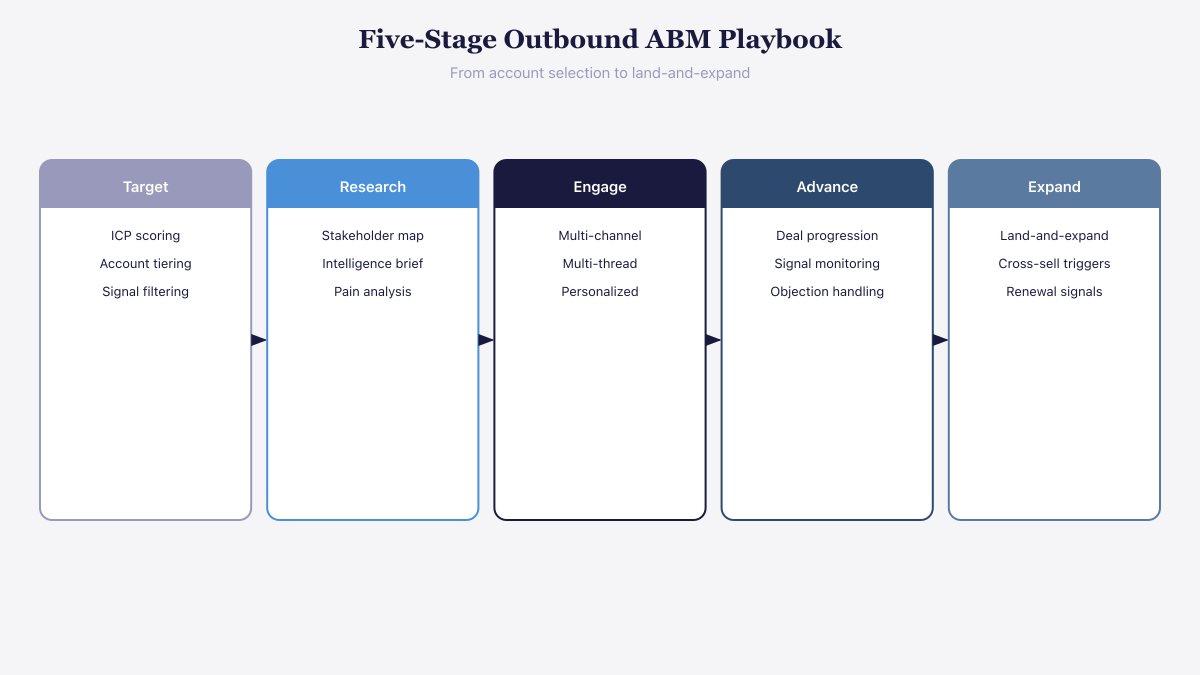 The outbound ABM playbook progresses through five stages from targeting to expansion.
Account-level research, not contact-level. Traditional outbound personalizes at the contact level: "Hi Sarah, I see you're VP of Sales at Acme." Outbound ABM personalizes at the account level: "Acme just raised a Series C, hired three new AEs, and your CEO mentioned tripling the sales team in the earnings call." That depth of context changes the entire conversation.
Multi-stakeholder engagement, not single-threaded. Enterprise deals now involve an average of 22 stakeholders. Reaching one person and hoping they champion your solution internally is not a strategy. Outbound ABM coordinates outreach across the buying committee: the end user gets a feature-benefit message, the budget holder gets an ROI message, and the executive sponsor gets a strategic perspective.
Signal-triggered timing, not calendar-driven cadence. Instead of sending sequences on a fixed schedule, outbound ABM fires plays when something changes at the target account. A new CRO hire, a funding round, or a competitor displacement creates a natural conversation starter that makes outreach relevant.
See Salesmotion on a real account
Book a 15-minute demo and see how your team saves hours on account research.
When Outbound ABM Is Worth the Investment
ABM requires more time and resources per account than traditional outbound. It pays off in specific scenarios:
High deal values ($50K+ annually). The extra research and personalization time makes financial sense when individual deals are worth six figures. You cannot afford generic outreach on accounts this valuable.
Multiple decision-makers. When IT, finance, and line-of-business leaders all need to sign off, coordinated multi-stakeholder outreach outperforms single-threaded approaches. Organizations that align sales and marketing around ABM report 60% higher win rates.
Long sales cycles (3+ months). ABM is a relationship strategy, not a transactional one. If your typical deal closes in two weeks, traditional outbound is more efficient. If it takes six months, ABM's compounding relationship-building pays dividends.
Well-defined target market. You need a clear ideal customer profile to make ABM work. If you cannot describe your best customer in specific terms (industry, size, tech stack, pain points), you are not ready for ABM.
For deals under $25K annual contract value, traditional outbound is more cost-effective. The per-account investment in ABM research and coordination does not justify the return on smaller deals.

“The talking points are gold. If they're in Salesmotion, I know they're being discussed inside that business. That makes it easy to spark a real conversation, which is 90 percent of the battle.”
Andrew Giordano
VP of Global Commercial Operations, Analytic Partners
The Five-Stage Outbound ABM Playbook
Stage 1: Build Your Target Account List
Start with your best existing customers. Analyze them for patterns: industry, company size, tech stack, growth stage, common pain points. These patterns become your targeting criteria.
Keep the initial list focused. Twenty to 50 accounts is the right range for a first ABM program. Larger lists dilute the quality of research and personalization that makes ABM effective. You can always expand after proving the model works.
For each account, identify two to three key contacts: a champion (the person who would use your solution daily), an economic buyer (the person who controls budget), and an executive sponsor (the person who approves strategic initiatives).
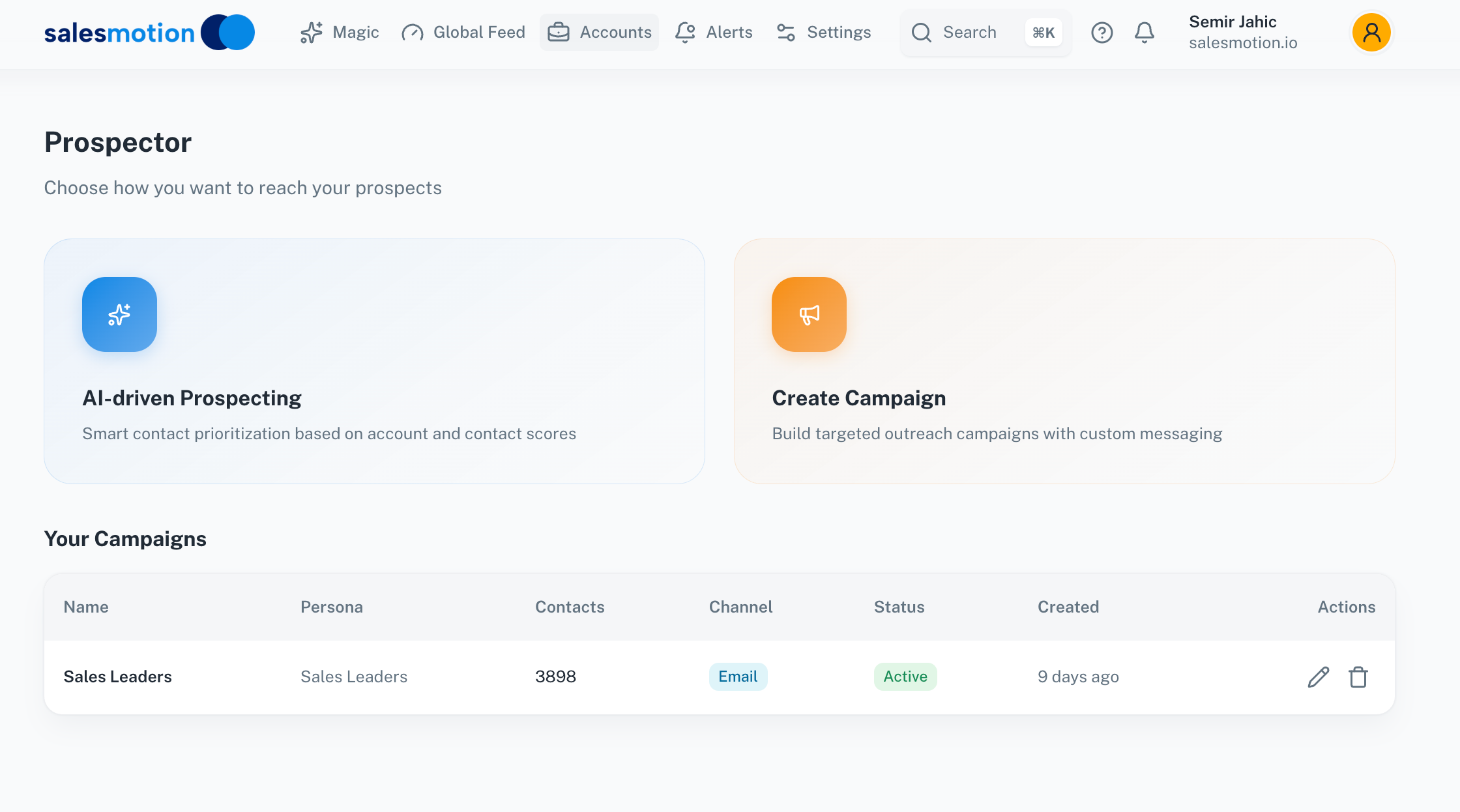 Salesmotion's prospect module identifies key contacts at each account and provides AI-generated outreach tied to account-specific signals.
Stage 2: Score and Prioritize Dynamically
Not every target account deserves equal attention at the same time. Dynamic scoring helps concentrate effort where it matters most.
Weight scoring toward timing signals over static fit. A mid-market company showing active buying signals is a better target this week than a Fortune 500 company with no current intent, even if the Fortune 500 deal would be larger.
Factors to score:
- Intent signals: Are they researching your category or visiting your website?
- Trigger events: Have they received funding, hired key roles, or announced expansion?
- Engagement history: Have they responded to previous outreach or attended your events?
- Competitive vulnerability: Are they using a competitor approaching contract renewal?
Stage 3: Research and Craft Account-Specific Messaging
This is where ABM separates from regular outbound. For each active account, invest 30 to 60 minutes in research:
- Recent news, earnings calls, press releases
- LinkedIn activity from key contacts
- Job postings that reveal priorities and pain points
- Tech stack analysis to identify integration opportunities
- Competitor relationships and potential displacement angles
Translate research into messaging that references specific account context. A CFO cares about cost reduction and ROI. A VP of Sales cares about pipeline and win rates. A Head of RevOps cares about workflow efficiency and data quality. Same solution, different message for each persona.
Stage 4: Execute Coordinated Multi-Channel Plays
Structure outreach as a coordinated sequence, not isolated touches:
- Day 1: Personalized LinkedIn connection request to champion (no note, blank requests get higher acceptance)
- Day 3: Email to economic buyer referencing recent company news or trigger event
- Day 7: LinkedIn message to champion with a relevant case study
- Day 10: Email to executive sponsor with a strategic perspective on their industry challenge
- Day 14: Follow-up call to champion with specific meeting ask
Each touchpoint builds on the previous one. References across messages demonstrate that your outreach is coordinated and intentional, not random.
Stage 5: Measure and Optimize
Track these metrics to evaluate your ABM program:
- Account engagement score: Total interactions across all contacts at each account
- Multi-contact penetration: How many stakeholders have you engaged per account?
- Pipeline velocity: How quickly do ABM accounts move through your funnel versus traditional leads?
- Deal size: ABM should generate larger average deals (ITSMA research shows up to 200% larger)
- Win rate: Organizations running aligned ABM report 60% higher win rates
Do not measure success by activity volume. An ABM program sending 50 deeply personalized messages that generate 10 qualified meetings dramatically outperforms 5,000 generic emails that generate the same 10 meetings, because the ABM meetings convert at a much higher rate. For a deeper dive into which metrics matter most, see our guide to ABM metrics that predict revenue.
ABM Compliance: The Non-Negotiables
Outbound ABM requires careful attention to email compliance. These rules are not optional:
Use dedicated outbound infrastructure. Do not send ABM sequences from your marketing automation platform. Use specialized outbound tools that manage deliverability, throttling, and compliance features.
Keep outbound separate from marketing emails. Adding prospects to your newsletter without permission is both a compliance violation and a brand-damaging experience. Sales emails are one-to-one communications. Newsletters are opt-in marketing.
Maintain domain health. Configure SPF, DKIM, and DMARC properly before launching any outbound program. Poor domain reputation tanks deliverability for your entire organization, not just your ABM sequences.

“My ultimate goal is to know more about the company than they know themselves. Before, that took hours across multiple tools. With Salesmotion, I can get there in 30 minutes or less and walk into a Fortune 500 conversation fully prepared.”
Jeff Dalo
Senior Director Business Development, Analytic Partners
Key Takeaways
- True outbound ABM is account-level research, multi-stakeholder coordination, and signal-triggered timing. Not just regular outbound with a shorter list.
- ABM delivers 208% higher marketing-generated revenue and up to 200% larger deal sizes, but only for high-value deals ($50K+) with long sales cycles.
- Start with 20-50 accounts based on your best customer patterns. Expand after proving the model works.
- Score accounts dynamically based on intent signals and trigger events, not just static firmographic fit.
- Coordinate outreach across the buying committee. Single-threaded deals are the number one reason enterprise deals stall.
- Measure account engagement, multi-contact penetration, and pipeline velocity. Activity metrics like emails sent are irrelevant.
Frequently Asked Questions
How long does it take to see results from outbound ABM?
Engagement and meeting bookings should appear within 30 to 60 days if targeting and messaging are strong. Real pipeline generation takes 3 to 6 months. Closed revenue typically shows up after 6 to 12 months, depending on your sales cycle. Do not pull the plug early. ABM is a compounding strategy that rewards patience.
Can a small team run outbound ABM effectively?
Yes. Small teams often execute ABM better because they are forced to be selective about which accounts to target. Start with 20 to 30 high-value accounts instead of trying to scale to hundreds. Use account intelligence tools to automate research so your team can focus on strategic outreach rather than manual data gathering.
What is the most common ABM mistake?
Treating ABM as a marketing campaign instead of a coordinated revenue strategy. ABM fails when marketing builds the target list but sales ignores it, or when outreach is generic despite the "ABM" label. The single biggest predictor of ABM success is whether sales and marketing teams share the same target account list, signal definitions, and engagement data.