The most repeated advice in sales is that outbound is dead. It isn’t. Bad outbound is dead.
Teams didn’t lose the channel. They wore it out with manual research, weak timing, and generic messaging sent at scale. A rep opens six tabs, skims a press release, copies a LinkedIn detail into a sequence, and hopes that counts as personalization. Then leadership wonders why the team owns a stack of tools but still struggles to create consistent pipeline.
The data doesn’t support the “outbound is over” story. 70% of salespeople still successfully connect with prospects and generate meetings over the phone, and 75% of executives will schedule a meeting based on a cold call or email alone according to Novocall’s outbound call statistics roundup. The issue is execution. The same dataset notes that the average sales rep makes 52 calls a day, while over 30% of leads receive no follow-up after an initial rejection. That’s not a channel problem. That’s an operating model problem.
What’s changing now isn’t just better tooling. It’s a category shift. Outbound technologies are moving from systems reps use to systems that do meaningful parts of the work on their behalf. That changes the rep’s role. Less time stitching together context. More time deciding where to lean in, how to frame the problem, and when to push a live conversation forward.
That distinction matters. A sequencing platform helps a rep send messages faster. An agent-based platform helps the team know who to contact, why now, and what to say before a human even touches the account. If you run RevOps or own pipeline, that’s the difference between adding activity and building a repeatable outbound machine.
The Future of Outbound Technologies Is Here
The old way of buying outbound tech was simple. Add a data vendor. Add a sequencing tool. Add a dialer. Add LinkedIn. Then ask reps to connect the dots.
That stack still leaves a huge amount of work on the rep’s desk. Someone still has to decide which account matters today, what signal is relevant, which stakeholder to approach, and how to turn that signal into a point of view. Few manage to solve that consistently.
The real problem is manual outbound
Manual outbound breaks in predictable ways:
- Research gets skipped: Reps don’t have time to prepare every account in depth.
- Timing gets missed: A useful trigger appears, but no one acts while it’s fresh.
- Messaging gets bland: Sequences sound personalized on the surface but generic underneath.
- Follow-up falls apart: Activity is high, but persistence is uneven.
Practical rule: If your outbound process depends on every rep doing deep account research before every touch, it won’t scale.
That’s why “more tools” usually disappoints. Most tools speed up one task. They don’t own the workflow. They still depend on a human to notice the right event, interpret it, and act.
A new category is taking over
The strongest outbound technologies now work like operating systems for account intelligence. They monitor target accounts continuously, assemble context from multiple sources, and push recommended actions to the rep.
That’s a different category from classic sales tech.
A classic tool says, “Here’s a database” or “Here’s a sequence builder.”
An agent-based system says, “This account hired a new executive, here’s why that matters, here’s the likely initiative behind it, here’s who to contact, and here’s a draft based on the actual trigger.”
That’s why the future of outbound doesn’t look like more dashboards. It looks like fewer manual steps between signal and action.
See Salesmotion in action
Take a self-guided interactive tour — no signup required.
Understanding the Shift to Autonomous Sales Agents
A sales engagement tool is like a power drill. Useful, fast, and completely dependent on the person holding it.
An autonomous sales agent is closer to a skilled assistant. It doesn’t just wait for instructions. It keeps watch, gathers information, prepares work, and hands a rep something usable.

Tools help reps do tasks
Traditional outbound technologies are still task-centric:
| Category | What it does | What it still expects from the rep |
|---|---|---|
| Data provider | Supplies contacts and account records | Validate fit, add context, decide timing |
| Sequencer | Sends multi-step outreach | Write message logic and personalization |
| Dialer | Increases call throughput | Pick targets and handle prioritization |
| Alert feed | Surfaces account updates | Figure out whether any update matters |
That’s why even good teams feel buried. The stack is productive, but only if reps do a lot of invisible labor around it.
Agents take ownership of workflows
Autonomous outbound technologies shift from task support to workflow ownership. They work in the background, all day, across the account list.
A practical definition is simple. An agent observes, reasons, and produces an output tied to a goal.
In outbound, that usually means three things:
- Watching for change across target accounts
- Interpreting relevance against your ICP and motion
- Producing next actions that a rep can review and use
That’s a meaningful shift in job design. Reps stop acting like part-time researchers and part-time list builders. They spend more time on judgment, live conversations, and account strategy.
If you want a useful breakdown of what this looks like in sales, Salesmotion’s post on the AI sales agent category is a solid reference point.
The question isn’t whether AI can write an email. The question is whether your system can understand why this account matters right now.
Why this changes team performance
The biggest gain isn’t convenience. It’s consistency.
Manual outbound depends on individual rep discipline. Some reps are excellent at spotting timing and writing from context. Others default to volume. Agents close that gap by making research depth and trigger awareness part of the system, not part of rep luck.
That creates a healthier operating model:
- Managers get clearer prioritization
- Reps get stronger starting points
- RevOps gets a more structured signal layer
- Leadership gets a cleaner path from account activity to pipeline creation
This is why agent-based outbound technologies aren’t just another feature wave. They change who does the work first.

“Salesmotion helps you spot signals from prospect accounts, news items / job hiring alerts etc that indicate that now is a good time to reach out with a well-crafted message.”
Rob Douglas
Director of Sales, icit business intelligence
The Core Components of an Agent-Based Platform
Teams generally don’t need another tool that dumps more records into the CRM. They need a system that turns raw account activity into usable outbound execution.
That’s why the architecture matters.
A practical agent-based platform usually has three jobs running in parallel: discover context, detect timing, and turn both into outreach. When those jobs live in separate tools with no coordination, reps end up doing the stitching themselves.
This visual captures the model well.
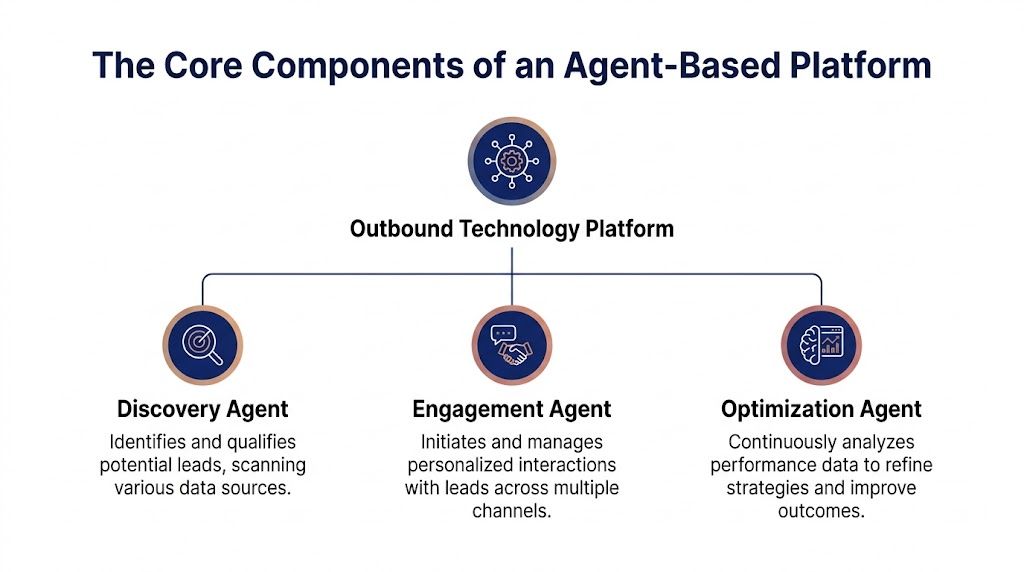
Research Agent
The first job is building a structured understanding of the account.
A good Research Agent doesn’t just collect facts. It synthesizes them into something a seller can use. That includes business initiatives, likely priorities, stakeholder context, risks, and competitive angles. It should answer basic questions fast: what’s changing here, what are they likely trying to achieve, and where could our message fit?
Generic personalization doesn’t move deals. Consequently, useful personalization starts with relevant context.
According to Tendril’s guide to building outbound that scales, data enrichment can achieve up to 40-60% higher personalization rates in outreach and cause a 25-35% uplift in response rates when real-time technographic, firmographic, and intent signals are appended to prospect records. That’s the practical value of a strong research layer. It turns “Hi, I saw your company is growing” into a message anchored to something real.
Signal Agent
Research alone is static. Pipeline needs timing.
A Signal Agent watches for events that create urgency or relevance. That can include leadership changes, funding announcements, hiring patterns, investor updates, earnings commentary, product launches, competitive friction, or social activity that signals a shift in priorities.
The hard part isn’t finding events. Basic alert tools can already do that.
The hard part is filtering noise.
A weak system sends every mention, every post, every headline. A strong one scores relevance against your market, your ICP, and your sales motion. It should tell the rep not just that something happened, but whether that event is worth acting on.
When signal volume rises, rep focus usually drops unless the system explains the “so what.”
Outreach Agent
The third job is translation.
Once the platform knows what the account is doing and why the timing matters, it has to convert that into actual outbound. That means drafting outreach, suggesting talk tracks, recommending the next contact, and fitting the message to the buying context.
Many older outbound technologies often fail in this regard. They can identify contacts and they can send sequences, but they don’t create a convincing bridge between account intelligence and outreach.
A Outreach Agent should do that bridge work for the rep.
For example, it can take a hiring signal, connect it to a broader initiative, and draft a sequence around the likely operational pressure behind the role. That’s much stronger than dropping a company mention into a standard template.
Teams evaluating this category can compare approaches through tools like AI outreach, where the focus is less on template automation and more on context-driven messaging.
Why the three parts need each other
These agents only create value when they operate as a system.
- Research without signals gives you smart notes but weak timing.
- Signals without research create alerts but not insight.
- Prospecting without either produces activity that sounds polished but lands flat.
The best outbound technologies connect all three. The account gets understood. A change gets detected. Outreach gets produced while the trigger is still relevant.
That’s how you reduce the research tax without sacrificing message quality.
How Outbound Agents Turn Signals Into Pipeline
The easiest way to judge outbound technologies is to watch what happens between a trigger and a rep action.
If the platform still leaves the rep with a pile of tabs, a rough note, and a blank email, it’s not doing enough. If it compresses that workflow into a usable next step, it changes pipeline creation.

Example one with a new executive hire
A target account hires a new CRO.
A basic alert system says, “New CRO joined.” That’s mildly interesting, but not actionable on its own.
An agent-based workflow does more. It connects the executive move to the company’s likely commercial priorities, surfaces relevant context on the business, identifies which teams may be under pressure, and drafts outreach tied to the mandate a new revenue leader usually inherits. The rep reviews it, adjusts tone, and sends it while the change is still fresh.
That’s how a trigger becomes a conversation.
Example two with competitive pressure
A company mentions a competitor problem in a public setting, such as an earnings discussion or executive interview.
Again, the raw event is not enough. Most reps won’t know whether that signal reflects a real opening, a passing remark, or a thread worth pursuing.
A stronger system explains the risk signal. It frames the likely operational issue, highlights why your solution may be relevant, and suggests a talk track focused on de-risking the buyer’s next move instead of pitching features.
That’s a major shift in message quality. The rep doesn’t open with “We help companies like yours.” The rep opens with a point of view.
Example three with intent from hiring patterns
Hiring is one of the most practical outbound inputs because it often reflects active priorities. A cluster of role openings can signal expansion, tooling gaps, process change, or internal pressure in a function.
When outbound agents monitor that pattern over time, they can spot a direction, not just an event. The outreach becomes more credible because it connects the hiring pattern to the business motion behind it.
For teams building around buyer signals, Salesmotion’s explainer on buyer intent data gives a useful frame for separating curiosity from usable intent.
Good outbound doesn’t just answer “who should we contact?” It answers “why would this person care today?”
The operational payoff is speed with context. According to Outbound Kitchen’s summary of AI-assisted outbound, outbound platforms that blend human oversight with AI-driven signal detection and orchestration can deliver 3-5x faster pipeline velocity, and CIENCE Technologies reported a 27% average increase in SQLs using this blended approach to act on “why now” triggers.
That result makes sense. Teams move faster when the system handles the discovery and prep work, and humans step in where judgment matters.

“Automatic account profile detail I can use to manage my territory. Using Salesmotion AI to generate value statements per persona, account, etc. Using Salesmotion to give me a starting point based on new hires, or news alerts is critical.”
Adam Wainwright
Head of Revenue, Cacheflow
Choosing the Right Outbound Intelligence Platform
Most platforms claim they help with outbound. Fewer help your team decide what matters.
That’s the main evaluation lens I’d use. Not “How many data sources do you have?” Not “Can you write emails?” The key question is whether the platform reduces noise enough for reps and managers to act with confidence.

What weak platforms do
Weak outbound technologies usually fall into one of two buckets.
The first bucket is raw data delivery. You get contact records, job changes, funding news, and a flood of updates with very little prioritization.
The second bucket is content automation without intelligence. The platform can generate an email, but the message is only as good as the prompt or record behind it.
Both create work. They don’t remove it.
What strong platforms do
A strong outbound intelligence platform filters, interprets, and recommends.
Here’s the practical difference:
| Capability | Basic platform | Strong platform |
|---|---|---|
| Account updates | Sends alerts | Prioritizes relevant signals |
| Personalization | Uses fields | Uses business context |
| Research | Shows source fragments | Synthesizes into a point of view |
| Next step | Leaves it to rep judgment | Suggests action and talk track |
Salesmotion fits the newer category. It runs research, signal monitoring, and prospecting agents across target accounts, then routes actionable context into Slack, email, or CRM. The key difference is that it turns account activity into a suggested next move instead of just surfacing another alert.
Questions worth asking in a demo
Don’t evaluate this category on surface polish. Ask questions that expose how the system thinks.
- How do you determine signal relevance? Ask what makes one trigger important and another ignorable.
- Can the platform explain the “so what”? If an alert appears, the rep should understand why it matters without doing another round of research.
- Where does the output go? Good intelligence has to show up inside existing rep workflows.
- Can reps edit and apply judgment? Full autonomy isn’t the goal. Useful human oversight is.
If you want a broader market view before narrowing vendors, this roundup of AI sales prospecting tools is a helpful place to compare how different products approach prospecting, enrichment, and automation.
Buying an outbound platform without testing signal quality is like buying a lead list without checking whether anyone fits your market.
How to Implement and Measure Your Outbound Strategy
Most outbound rollouts fail for a simple reason. Teams install the software but keep measuring the old way.
If you only track opens, replies, and call counts, you’ll miss the actual value of agent-based outbound. The primary gain is better timing, better prioritization, and tighter conversion from signal to opportunity.
Start with workflow, not features
Implementation should begin with account coverage and routing.
Pick the accounts that matter most. Define which signals are meaningful for your motion. Decide where alerts should land. Then connect the platform to the systems reps already use, usually CRM, messaging, and engagement tools.
That avoids a common mistake. Teams launch a new intelligence layer but force reps to check another dashboard. Adoption drops fast when the value lives outside the daily workflow.
A cleaner rollout usually follows this sequence:
- Define your target account groups
- Map high-value signals to those groups
- Route alerts into active rep channels
- Set review rules for generated outreach
- Inspect outcomes by signal type
Use KPIs that match the motion
Agent-based outbound needs different operational metrics.
The most useful ones are usually closer to buying motion than activity volume:
- Signal-to-opportunity conversion: Which trigger types create pipeline
- Pipeline velocity by account segment: Which segments move faster once signals appear
- Rep response time to signal: How quickly the team acts on relevant change
- Sequence depth by signal class: Whether some triggers justify broader multi-touch effort
For pipeline leaders, these measures are more useful than vanity engagement rates because they connect outbound behavior to account progression. Salesmotion’s guide to sales pipeline metrics is a helpful reference if you’re refining that reporting layer.
Fix attribution before it becomes a finance problem
One of the biggest gaps in modern outbound is attribution. Multi-touch sequences blur the line between useful touches and wasted effort.
That challenge is well captured in TrustRadius’ discussion of evolved outbound, which notes that revenue teams struggle with the attribution and ROI measurement problem for multi-touch sequences and need clearer ROI analysis by signal type and account segment in order to know which efforts drive pipeline and which simply consume resources: takeaways from outbound email isn’t dead, it’s just evolved.
The fix is practical. Start attribution at the signal.
If a sequence begins because of an executive move, a hiring pattern, or a funding event, tag the motion accordingly. Then track outcomes against that originating trigger. You won’t get perfect attribution overnight, but you will get a much clearer view of which signals deserve budget, rep time, and sequence depth.
That’s how outbound technologies become measurable operating infrastructure instead of another top-of-funnel experiment.
If your team is still spending more time researching accounts than talking to buyers, it’s worth looking at how Salesmotion approaches outbound with research, signal, and prospecting agents. The practical test is simple. See whether it helps your reps act faster on real account changes and gives RevOps a cleaner way to measure which signals create pipeline.