The best revenue intelligence platforms are Gong for intelligence built on recorded customer conversations, Salesloft for forecasting with Clari Forecast alongside sales engagement, and Avoma for teams that want a published per-seat price and a free trial. Outreach, Salesforce, Revenue Grid, Backstory (formerly People.ai) and Terret (formerly BoostUp) complete the list of eight. A revenue intelligence platform sits on top of your CRM, captures calls, emails and deal activity, and tells managers and reps which deals and forecasts need attention.
TL;DR: Pick Gong if you want deal, forecast and coaching insight grounded in captured customer interactions; pricing is quoted, per user plus a platform fee. Pick Salesloft if forecasting is the priority and you want Clari Forecast in the same platform as cadences and conversation intelligence; pricing is quoted. Pick Avoma if you want published pricing: from $19 per recorder seat per month on annual billing, with a Revenue Intelligence add-on and a free 14-day trial. Salesforce customers can also add Revenue Intelligence inside Sales Cloud from $220 per user per month.
| Top pick | Best for | Starting price |
|---|---|---|
| Gong | Deal and forecast insight from customer conversations | Custom (per-user licence + platform fee) |
| Salesloft (with Clari Forecast) | Forecasting and sales engagement in one platform | Custom, quote-only |
| Avoma | Published per-seat pricing with a free trial | From $19/seat/month, annual billing |
Why Trust This Guide?
Every price and product fact in this guide was checked against the vendor's own website on 10 October 2026. Where a vendor publishes no price, the guide says so and does not estimate. Where a figure comes from a third party, the third party is named in the same sentence.
Salesmotion publishes this guide. Revenue intelligence is not Salesmotion's category, so it has no numbered slot in the list. It appears once, in "Where Salesmotion Fits" after the eight reviews, with a plain description of what it adds alongside these platforms.
The first-party angle comes from our own conversations. We sat in 55 sales and customer calls between August and October 2026. In 26 of them the first question was where the intelligence would live: in the CRM, the sequencer or the AI assistant the team already uses.
"without having to duplicate the task between your solution and our internal sales tool." Business development director, CRO
"I think with our tech stack, it's quite fragmented." Sales lead, data software
That is the test this guide applies: does the platform put deal and forecast insight where the team already works, and can you tell before a sales call what it will cost.
The order of the list is based on fit for a B2B sales leader who wants forecasting and deal visibility on top of the CRM. The first three are the picks for the three most common buyers: a team led by conversation data, a team led by the forecast, and a team that needs a published price. The remaining five are ordered by how much of the revenue intelligence job each vendor's own site documents today.
Our agents work one step before your pipeline
Revenue intelligence reads the deals you already have. Salesmotion's agents tell reps which accounts to work and why now. Book a 30-minute demo and see it on your own accounts.
Book a demo →What Is a Revenue Intelligence Platform?
A revenue intelligence platform is software that captures sales activity automatically (calls, meetings, emails, calendar events and CRM changes), analyzes it with AI, and turns it into deal insight, forecast guidance and coaching for the revenue team. It reads from and writes to the CRM. It does not replace it.
Most platforms in this category cover three jobs:
- Conversation intelligence: recording, transcribing and analyzing customer calls and meetings.
- Deal and pipeline intelligence: showing which opportunities are progressing, stalled or missing stakeholders, based on real activity.
- Forecasting: a forecast built from captured activity and deal data instead of rep self-reporting.
Vendors start from different places. Some began with call recording, some with forecasting, some with sales engagement, and one is the CRM itself. That starting point is still the best predictor of where each one is strongest.

“The Business Development team gets 80 to 90 percent of what they need in 15 minutes. That is a complete shift in how our reps work.”
Andrew Giordano
VP of Global Commercial Operations, Analytic Partners
Revenue Intelligence vs. Analytics: The Critical Difference
Most sales teams confuse analytics with intelligence. Sales analytics answers "what happened?" Revenue intelligence answers "what should we do next?"
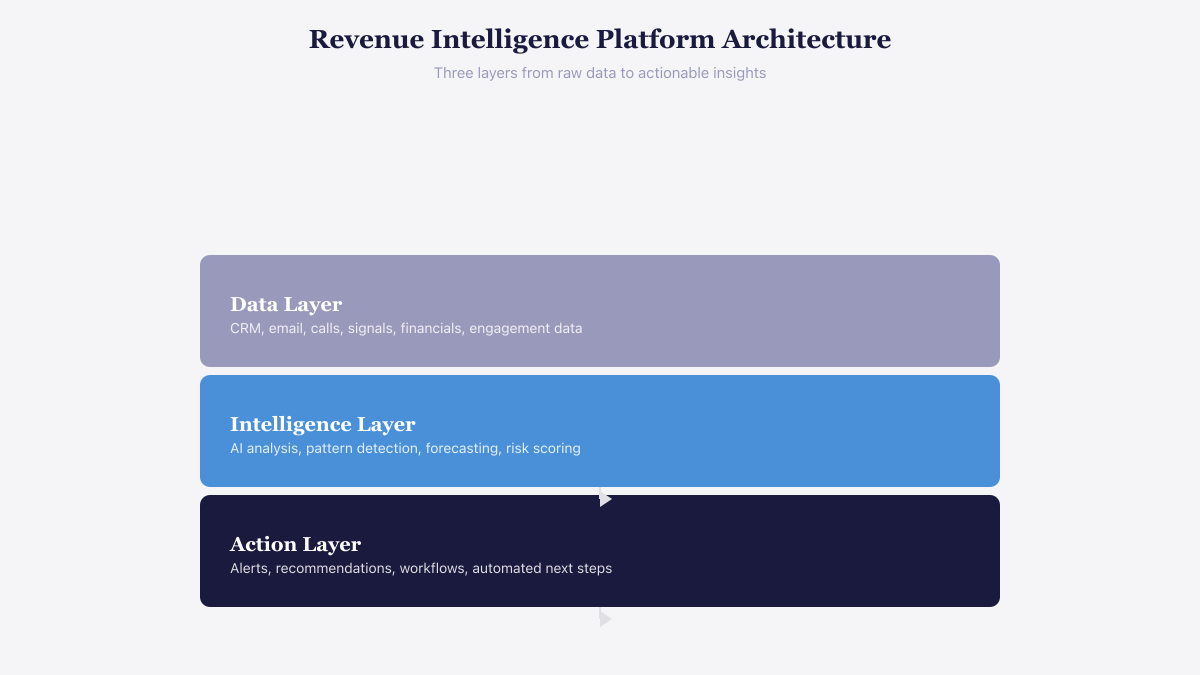 Revenue intelligence platforms transform raw data into actionable insights through three distinct layers.
Your CRM is a system of record. It logs activities, stores contact information, and tracks deal stages. But CRM data is backward-looking and only as good as what reps manually enter. BI dashboards layer charts on top of that same historical data. They are useful for board presentations. They are not useful for deciding which deals to inspect this morning.
Revenue intelligence platforms work differently. They ingest signals from multiple sources, including buying signals, engagement data, conversation analysis and market triggers, then interpret those signals to surface recommendations. The output is not a report. It is a prioritized action list.
The distinction matters because sales teams are not short on information. They are short on coordination. A hiring spike at a target account might appear in your enrichment tool. A pricing page visit shows up in your marketing automation. A competitor mention surfaces in call recordings. Without a platform connecting these signals, reps must manually stitch context together across five or six different tools.
Best Revenue Intelligence Platforms in 2027
Before the detailed reviews, here is a side-by-side view of all eight platforms.
| Platform | Best for | Standout capability | Pricing | Free plan or trial |
|---|---|---|---|---|
| Gong | Insight from customer conversations | Gong Revenue AI OS built on captured interactions | Custom (per-user licence + platform fee) | Not stated on pricing page |
| Salesloft (with Clari Forecast) | Forecasting plus sales engagement | Clari Forecast alongside Cadence and Conversation Intelligence | Custom, quote-only | None listed |
| Avoma | Published per-seat pricing | AI meeting assistant with a Revenue Intelligence add-on | From $19/seat/month, annual billing | Free 14-day trial |
| Outreach | Engagement-led teams that want forecasting | Sales engagement, Kaia conversation intelligence and forecasting | Custom (per-seat + AI credits) | None listed |
| Salesforce | Teams that want it inside the CRM | Revenue Intelligence add-on for Sales Cloud | Starter $25 → Max $550/user/mo | Free 30-day trial |
| Revenue Grid | Automatic activity capture for Salesforce | Email, calendar and Salesforce activity capture | From $30/user/month | Not stated |
| Backstory (formerly People.ai) | One product without feature tiers | Full product for every user | Does not publish pricing | Not stated |
| Terret (formerly BoostUp) | Forecasting with a short proof of concept | Terret Forecast and Terret Conversation Intelligence | Does not publish pricing | Free 48-hour proof of concept |
Two other names appear on revenue intelligence shortlists: 6sense, which sells revenue marketing and sales intelligence built on intent data, and Chorus. Clari is no longer a separate company. It merged with Salesloft, and its forecasting product is sold as Clari Forecast.
1. Gong
What it is: Gong describes its product as the Gong Revenue AI OS. It captures customer interactions and builds on them with Gong Engage, Gong Forecast, Gong Enable, Gong Agents and the Gong Revenue Graph. Its homepage reports more than 5,000 customers.
Best for: Sales organizations that want deal, forecast and coaching insight to start from what buyers said on calls and in emails.
What it is strong at: First-party evidence at scale. Gong's intelligence comes from your own customer conversations, which makes it a natural base for deal review, coaching and a forecast that reflects real engagement. The platform now spans engagement, forecasting and enablement on the same data. Gong Engage "recommends who to contact, when to engage, and what to say" and pulls in signals from partners including 6sense, G2, LinkedIn and Dealroom. On 30 September 2026 Gong announced a sales enrichment layer for revenue teams. In May 2026 it reported annual recurring revenue above $500 million.
Pricing: Gong does not publish list pricing; contracts are quoted per organization. Its pricing page confirms licences are priced per user with a platform fee based on the number of users supported, and that integrations are included.
Choose it if: recorded customer interactions are the asset you want everything else built on, and you are ready for a quote-based purchase. Gong's core strength is what happens in customer interactions; research on accounts before the first conversation is a separate job.
2. Salesloft (with Clari Forecast)
What it is: Salesloft calls itself "the predictive revenue system." Clari and Salesloft completed their merger on 3 December 2025, and the combined company trades as Salesloft. Clari continues as a product name: Clari Forecast is the forecasting product. Salesloft's site cites 4,000+ sales teams.
Best for: Revenue leaders who want the forecast and the day-to-day selling workflow from one vendor.
What it is strong at: Forecasting next to execution. The product line covers Cadence, Conversation Intelligence, Deals, Rhythm, Clari Forecast, Inspect, Revenue Cadences, Analytics and Signals, so the forecast sits beside the activity that produces it. Salesloft says it "captures every revenue signal across your stack." Its AI agents include Deal Summaries, Stalled Deals Insight, Sales Methodology Extraction, Account Research and a Rhythm Prioritizer that organizes daily to-dos based on signals and priorities. A Salesloft MCP server connects the platform to Claude, ChatGPT and Copilot.
Pricing: Salesloft does not publish list pricing; contracts are quoted per organization. Its pricing page lists products without dollar figures, contract terms or seat minimums.
Choose it if: forecast accuracy is the main reason you are buying and you also want cadences and conversation intelligence in the same contract. The product line carries both Salesloft and Clari-named products, so agree in the quote which ones are included.
3. Avoma
What it is: Avoma describes itself as "an all-in-one AI Meeting Assistant, Collaboration, and Intelligence platform." It records, transcribes and summarizes calls and integrates with the CRM. Conversation Intelligence and Revenue Intelligence are sold as add-ons to the base plans.
Best for: Small and mid-market teams that want to see the price before talking to sales and to test the product on their own calls.
What it is strong at: Transparency and a low starting cost. Avoma is the only platform in the top three with a full published price list, and it offers a free 14-day trial of the Organization plan with no credit card required. Pricing is per recorder seat, and viewers are free.
Pricing: Published on Avoma's pricing page, per recorder seat. Startup is $19 per seat per month billed annually, or $29 billed monthly. Enterprise is $39 per seat per month, billed annually only. Add-ons per seat per month: Conversation Intelligence at $29 on annual billing or $35 monthly, Revenue Intelligence at $29 or $35, and Lead Router at $19 or $25.
Choose it if: you want conversation and revenue intelligence at a per-seat price you can put in a budget today, and a two-week trial matters more than a platform that also runs your outbound engagement.
4. Outreach
What it is: Outreach describes itself as an "Agentic AI Platform for Revenue Teams." Its platform covers sales engagement, conversation intelligence, deal management, deal insights, forecasting, mutual action plans, pipeline management and rep coaching. Kaia is its AI conversation intelligence and meeting assistant.
Best for: Teams that run their selling motion in a sales engagement platform and want deal insight and forecasting on the same data.
What it is strong at: Sales execution at enterprise scale with intelligence attached. Outreach says its customers "close over 2 million opportunities every month." Its agent line-up includes a Deal Agent, a Meeting Prep Agent, a Revenue Agent that identifies high-intent accounts, and a Research Agent that combines "conversation data from Outreach with first-party engagement data and third-party public data." In September 2026 Outreach reported 12x growth in AI credit consumption in the first half of the year.
Pricing: Outreach does not publish list pricing; contracts are quoted per organization. It sells four tiers (Amplify Essentials, Core, Plus and Pro) differentiated by AI credit allotments, described on its pricing page as per-user pricing with no platform fees.
Choose it if: your reps already work in Outreach, or you are choosing an engagement platform and want forecasting and conversation intelligence included in that decision.
5. Salesforce
What it is: Salesforce sells revenue intelligence inside its CRM. Sales Cloud's pricing page lists Conversation Intelligence, Predictive Forecasting, Activity Capture, Deal Insights and Opportunity Scoring in its feature table, and a separate Revenue Intelligence add-on.
Best for: Teams standardized on Salesforce that want forecasting and deal insight without adding another vendor.
What it is strong at: Proximity to the system of record. According to Salesforce, the Sales Cloud Core plan "includes everything in Pro Suite, plus advanced pipeline management and forecasting, opportunity scoring, conversation intelligence, APIs and Agentforce with the free Salesforce Foundations add-on." The intelligence works on CRM data where it already lives. Core, Advanced and Max replaced Salesforce's previous upper editions in September 2026.
Pricing: Salesforce publishes Sales Cloud pricing: Starter Suite at $25, Pro Suite at $100, Core at $195, Advanced at $395 and Max at $550 per user per month, billed annually (Starter can also be billed monthly). Agentforce for Sales is listed from $125 per user per month. The same pricing page lists the Revenue Intelligence add-on from $220 per user per month and a free 30-day trial for all Sales Cloud editions.
Choose it if: Salesforce is already your CRM and you would rather extend it than integrate a separate platform. Ask your account team which features are included in your edition before you compare it with a dedicated tool.
6. Revenue Grid
What it is: Revenue Grid automatically captures email, calendar and Salesforce activity, then adds pipeline insight, forecasting and sales engagement. Its tagline is "Own the Full Revenue Journey."
Best for: Salesforce teams whose first problem is that activity never reaches the CRM.
What it is strong at: Activity capture as the foundation, at a published price. Revenue Grid sells three plans, so a team can start with capture alone and move up when it wants the fuller product.
Pricing: Published on Revenue Grid's pricing page: Activity Capture 360 at $30 per user per month, Knowledge Capture at $49 per user per month, and Revenue Grid Ultimate at $149 per user per month.
Choose it if: you run Salesforce, your forecast suffers because emails and meetings are not logged, and you want a per-user price you can see before a call.
7. Backstory (formerly People.ai)
What it is: People.ai is now called Backstory. It describes its product as an "end-to-end revenue intelligence solution" with the promise "Answer your toughest revenue questions and know what to do next."
Best for: Teams that want one revenue intelligence product without choosing between feature tiers.
What it is strong at: Simple packaging. Backstory says it does not charge by feature tier: "everyone gets the full product."
Pricing: Backstory does not publish pricing. Its pricing page offers a quote tailored to your team.
Choose it if: you used or evaluated People.ai before and want to see what it sells today, or you prefer a single full product to an edition ladder.
8. Terret (formerly BoostUp)
What it is: BoostUp is now called Terret. It sells Terret Nexus, Terret Forecast ("Machine-precision pipeline forecasting") and Terret Conversation Intelligence ("Conversations translated into revenue").
Best for: Teams that want to test a forecasting product on their own data before any commercial conversation.
What it is strong at: A fast way to evaluate. Terret offers a free 48-hour proof of concept, described as "No cost, no obligation."
Pricing: Terret does not publish pricing. Its site has no pricing page and directs buyers to book a demo.
Choose it if: forecasting and conversation intelligence are the two jobs you need, and a two-day proof of concept is the way you prefer to judge a vendor.

“Automatic account profile detail I can use to manage my territory. Using Salesmotion AI to generate value statements per persona, account, etc. Using Salesmotion to give me a starting point based on new hires, or news alerts is critical.”
Adam Wainwright
Head of Revenue, Cacheflow
Where Salesmotion Fits
Revenue intelligence platforms analyze the deals and conversations that are already in your pipeline. Salesmotion works one step earlier. It is an account intelligence platform that tells reps which accounts to work and why now, which is why it has no numbered slot above and why teams run it alongside a revenue intelligence platform instead of in place of one.
Salesmotion has three AI agents. The Signal Agent monitors 1,000+ public sources for 50+ signal types at the accounts you track: leadership changes, hiring, earnings commentary, funding and strategic initiatives. The Research Agent turns that into a cited account brief. The Outreach Agent drafts outreach from the research for a rep to review.
To see the agents on your own accounts, book a 30-minute demo.
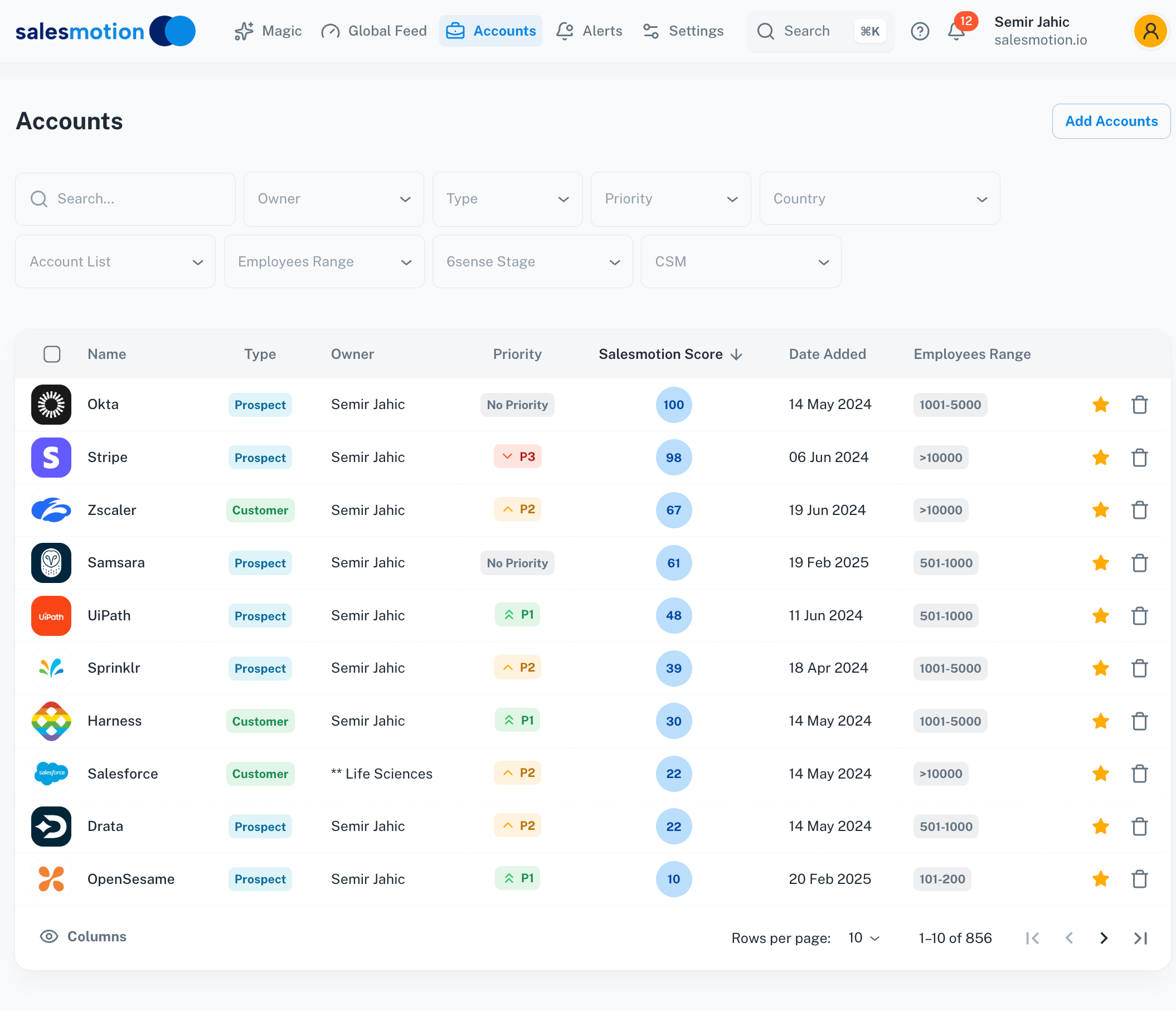 The account dashboard shows which accounts have new signals today.
Salesmotion's Take
A quick honesty note on this list. Revenue intelligence tools like Gong and Clari Forecast are built around the calls and deals in your pipeline, and they are excellent at it. Salesmotion sits one step earlier: we tell reps which accounts to call and why now, the top-of-funnel account intelligence that creates the pipeline those tools then analyze. We are complementary, not a replacement. If you want to see what that pre-call layer looks like, the interactive demo is the fastest way.

Semir Jahic
CEO & Co-Founder, Salesmotion
The connection is simple. Revenue intelligence platforms are built around the deals and conversations already in your pipeline. An account signal, such as a new executive, an earnings-call priority or a hiring surge, is often the reason a conversation starts. Every signal comes with its source, so a rep can check it before using it.
Salesmotion has a native Salesforce integration, a HubSpot integration, a REST API and an MCP server for Claude, ChatGPT and other assistants. Pricing is published: $85/mo for individuals on a monthly contract, with custom pricing for teams and enterprise.
How to Choose
Start from the situation you are in, not from the feature list.
You want coaching and deal review based on what buyers said. Shortlist Gong. Its intelligence starts from captured customer interactions, and forecasting and enablement sit on the same data.
The forecast is the problem. Shortlist Salesloft for Clari Forecast, and ask Terret for its 48-hour proof of concept so you can compare the two on your own pipeline.
You have 1 to 10 reps, or need a price today. Start with Avoma. The Startup plan is $19 per seat per month on annual billing, the Revenue Intelligence add-on is $29, and the 14-day trial needs no credit card. Add signal monitoring when deal complexity warrants it.
Your reps already work in a sales engagement platform. If that platform is Outreach or Salesloft, evaluate its own forecasting and conversation intelligence before adding a second vendor.
Salesforce is the centre of everything. Price the Revenue Intelligence add-on, and look at Revenue Grid if the underlying issue is that emails and meetings never reach the CRM.
You have 50 or more reps and long sales cycles. Gong, Salesloft and Outreach are the three broad platforms. Give each the same scope and ask for a total cost in writing, because none of the three publishes a price.
Your reps handle live deals well but pipeline is thin. That is an account selection and timing problem. An account intelligence layer such as Salesmotion sits alongside whichever platform you choose.
How Revenue Intelligence Platforms Work
The best platforms follow a three-stage model: capture, interpret, and guide.
Capture. The platform ingests signals from across your revenue stack: CRM activities, email engagement, call recordings, website visits, intent data, news triggers, hiring patterns, and funding events. This creates a unified signal layer that no single tool provides on its own.
Interpret. Raw signals become intelligence through AI-driven analysis. Account scoring identifies which prospects are most likely to convert. Deal risk alerts flag opportunities showing warning signs (slowing engagement, missing stakeholders, stalled momentum). Whitespace detection reveals expansion opportunities within existing accounts.
Guide. Intelligence becomes action through prioritized recommendations pushed into rep workflows. Which accounts should you call today? Which deals need attention before they slip? Which existing customers are showing signals that indicate expansion readiness? The platform answers these questions automatically, reducing the cognitive load that slows reps down.
The Business Case: What the Data Shows
The best-known published figure for revenue intelligence is vendor-commissioned, so read it with the source in mind.
The most cited figure is from Forrester Consulting. In a 2021 Total Economic Impact study commissioned by Gong, Forrester modelled 481% ROI over three years for a composite organization, with benefits of $12.1 million against costs of $2 million. A composite is a model built from customer interviews, not a single customer's result.
The category has also consolidated. Clari and Salesloft completed their merger in December 2025, which put Clari's forecasting product and Salesloft's sales engagement platform under one name. People.ai and BoostUp both now sell under new names, Backstory and Terret.
The practical business case is simpler than any study. Count the hours managers spend assembling a forecast by hand, the deals that slipped without warning last quarter, and the activity that never reached the CRM. Those three numbers tell you what a platform is worth to your team.
Who Benefits and How
Revenue intelligence delivers different value to different roles across the revenue team.
For CROs and VP Sales: Forecast predictability improves because intelligence is based on real engagement data, not rep self-reporting. Deal risk surfaces early enough to intervene. Pipeline quality becomes visible, not just pipeline volume.
For frontline managers: Coaching becomes data-driven. Managers can see which deals need attention, which reps are struggling with specific objection types, and how top performers differ from average reps in their engagement patterns.
For individual reps: The daily question "what should I work on?" gets answered automatically. Instead of spending 30 minutes each morning reviewing accounts across multiple tools, reps open their CRM to a prioritized list of recommended actions with supporting context.
For RevOps: Signal unification eliminates the cross-system stitching that consumes operations bandwidth. Data flows from capture to action through a single platform rather than a patchwork of integrations.
For marketing: Alignment with sales improves because both teams see the same account intelligence. Marketing can prioritize ad spend and content toward accounts showing real buying signals rather than spraying budget across a static target list.
Evaluating Revenue Intelligence Platforms
Not every platform calling itself "revenue intelligence" delivers on the promise. Here is what to look for.
Real-time signal ingestion. The platform should pull data from your CRM, engagement tools, website, intent data providers, and public sources continuously, not on a daily or weekly batch. Stale intelligence is worse than no intelligence because it creates false confidence.
AI-driven prioritization, not just dashboards. If the platform only shows charts and graphs, it is analytics with a new label. True revenue intelligence recommends specific actions: call this account, rescue this deal, expand this customer.
CRM-native integration. Intelligence that lives in a separate tab gets ignored. The recommendations should appear inside the tools reps already use every day: CRM, email client, and Slack. If reps must log into a separate platform to access intelligence, adoption will fail.
Cross-functional visibility. Revenue intelligence should serve sales, marketing, customer success, and RevOps from a unified data layer. Platforms that only serve one function recreate the silo problem they are supposed to solve.
Transparent scoring methodology. You should be able to understand why the platform scores one account higher than another. Black-box scoring creates trust problems with reps who do not understand why they are being told to prioritize specific accounts.
A price you can compare. Five of the eight platforms in this guide quote on request. Give each vendor the same user count and product scope, and ask what is included, what is an add-on, and what the contract term is.
When Revenue Intelligence Is Not the Right Investment
Revenue intelligence platforms deliver outsized value for teams with certain characteristics. They are not the right fit for everyone.
Too early: If your team has fewer than five reps and your sales tools stack is still basic (CRM plus email), revenue intelligence adds complexity without proportional value. Build your foundation first.
Too disconnected: If your CRM data is unreliable, your engagement tools are not integrated, and your team uses different processes across regions or segments, a revenue intelligence platform will amplify the mess rather than clarify it. Fix data hygiene and process consistency first.
Too small to justify: If your average deal value is under $15K and your sales cycle is under 30 days, the per-deal value of intelligence-driven optimization may not justify an enterprise platform. A published per-seat plan is the safer first step.
Ready to benefit: Teams with 10+ reps, deal values above $25K, sales cycles longer than 60 days, and a functioning CRM with reasonable data quality. These teams have enough signal volume and deal complexity to make intelligence-driven prioritization transformational.
Key Takeaways
- The top three picks are Gong (insight from customer conversations), Salesloft (forecasting with Clari Forecast plus sales engagement) and Avoma (published per-seat pricing with a 14-day trial).
- Three of the eight platforms publish prices: Avoma from $19 per seat per month on annual billing, Revenue Grid from $30 per user per month, and Salesforce, whose Revenue Intelligence add-on starts at $220 per user per month. Gong, Salesloft, Outreach, Backstory and Terret quote on request.
- Names have changed. Clari is part of Salesloft and sold as Clari Forecast, People.ai is Backstory, and BoostUp is Terret.
- Revenue intelligence answers "what to do next," not "what happened." This distinction separates it from CRM and BI dashboards.
- The best platforms follow capture, interpret, guide: ingest signals, analyze patterns, recommend actions.
- Revenue intelligence is not for every team. You need reliable CRM data, 10+ reps, and deal complexity that justifies the investment.
- Revenue intelligence covers the deals you have. Account intelligence covers the accounts you should be talking to. Teams use both.
Frequently Asked Questions
What are the best revenue intelligence platforms for 2027?
The best revenue intelligence platforms are Gong (deal, forecast and coaching insight from captured customer interactions), Salesloft (forecasting with Clari Forecast alongside sales engagement, after its merger with Clari in December 2025) and Avoma (published per-seat pricing with a free trial). Outreach, Salesforce, Revenue Grid, Backstory (formerly People.ai) and Terret (formerly BoostUp) complete the list. Each serves a distinct buyer; the comparison table above shows pricing and trials side by side.
What is a revenue intelligence platform?
A revenue intelligence platform is software that automatically captures sales activity such as calls, meetings, emails and CRM changes, analyzes it with AI, and turns it into deal insight, forecast guidance and coaching. It sits on top of the CRM. Most platforms combine conversation intelligence, deal and pipeline intelligence, and forecasting.
How is revenue intelligence different from conversation intelligence?
Conversation intelligence is a subset of revenue intelligence. It analyzes sales calls and meetings to surface coaching insights and deal risk. Revenue intelligence is broader: it combines conversation data with CRM activities, engagement signals and forecasting to give a complete picture of pipeline health. Gong, Salesloft, Outreach, Avoma, Terret and Salesforce all sell conversation intelligence as one part of a wider product.
Which revenue intelligence platform is best for mid-market teams?
Avoma is the most accessible mid-market option, with plans from $19 to $39 per seat per month on annual billing, Conversation Intelligence and Revenue Intelligence add-ons at $29 each, and a free 14-day trial. Revenue Grid is the other published-price choice for Salesforce teams, from $30 per user per month. For teams that need account research and signal monitoring instead of call recording, Salesmotion starts at $85/mo for individuals.
What does a revenue intelligence platform cost?
It depends on whether the vendor publishes a price. Avoma starts at $19 per seat per month on annual billing. Revenue Grid runs from $30 to $149 per user per month. Salesforce lists its Revenue Intelligence add-on from $220 per user per month on top of a Sales Cloud edition. Gong, Salesloft, Outreach, Backstory and Terret do not publish pricing: Gong's pricing page describes per-user licences plus a platform fee, and Outreach describes per-user pricing with no platform fees. For those five, the number comes from a quote.
Is there a free revenue intelligence platform or free trial?
Three of the eight offer a free way to test. Avoma offers a free 14-day trial of its Organization plan with no credit card required. Salesforce offers a free 30-day trial for all Sales Cloud editions. Terret offers a free 48-hour proof of concept. Gong, Salesloft and Outreach list no trial on their pricing pages; ask Revenue Grid and Backstory directly.
Can revenue intelligence replace our CRM?
No. Revenue intelligence platforms sit above the CRM, not instead of it. Your CRM remains the system of record for contacts, accounts, activities, and deal stages. The revenue intelligence platform reads CRM data, adds captured activity and analysis, and pushes recommendations back into the CRM. The two systems are complementary. Salesforce is the exception in form only: it sells revenue intelligence as part of the CRM itself.
How long does it take to see ROI from a revenue intelligence platform?
It depends on how quickly the platform captures enough activity to be useful and how consistently managers use it in deal reviews. The best-known benchmark is Forrester Consulting's 2021 Total Economic Impact study, commissioned by Gong, which modelled 481% ROI over three years for a composite organization. On the account research side, Guild Education saved 6 hours per rep per week with Salesmotion.
How the Signal Agent watches your accounts
50+ signal types across 1,000+ public sources, with alerts in your CRM, by email and in Slack.