A role in Revenue Operations (RevOps) is the strategic heart of a company. It syncs up sales, marketing, and customer success, getting them to work as one powerful engine. The goal is to tear down departmental walls, clean up the data, and build a clear, predictable path to growth.
Think of RevOps as the central nervous system for your go-to-market strategy.
What Is a Revenue Operations Role?

Let's cut through the jargon. A Revenue Operations role isn't just a new name for Sales Ops—it’s the blueprint for your entire revenue engine. For years, businesses ran with separate departments, each with its own goals, tools, and data. Marketing generated leads, sales closed deals, and customer success handled renewals.
This old way of doing things creates friction. Marketing hits its lead quota, but sales complains the leads are poor quality. Sales hits its number, but customer success deals with a leaky bucket because the wrong customers were brought on board. RevOps is designed to fix this.
The Shift From Silos to Synergy
The main job of RevOps is to smash these organizational silos. It gets sales, marketing, and customer success on the same page, using the same tech, and chasing the same metrics. Instead of three separate funnels, RevOps builds one seamless customer journey, from the first touchpoint all the way to renewal.
This integrated approach is no longer a nice-to-have; it's essential for scaling in today's B2B world. In fact, Gartner predicts that 75% of the highest-growth companies will have a RevOps model in place by 2025. Why? Because it creates alignment and predictability.
"A RevOps manager’s primary responsibility is to ensure that all revenue-generating functions operate in harmony. This includes optimising processes, unifying data systems, and enabling teams to work toward shared goals."
This harmony comes from focusing on three core pillars:
- Process: Designing and tuning the end-to-end customer lifecycle to eliminate bottlenecks and increase speed.
- Technology: Managing the go-to-market tech stack to create a single source of truth for all revenue data.
- Data: Turning raw data into smart insights that guide strategy and lead to better decisions across the board.
Distinguishing RevOps from Sales Ops
It's a common mistake to think RevOps is just a bigger version of sales operations. While they overlap, their scope is completely different. For a deeper look, check out our guide on sales operations roles and responsibilities.
In short, Sales Ops is tactical. It's laser-focused on making the sales team more efficient through CRM management, territory planning, and process tweaks. Our sales operations guide covers the full scope of the function.
RevOps, on the other hand, takes a bird's-eye view of the entire revenue process. It’s not just about helping sales; it's about orchestrating collaboration between all customer-facing teams. This strategic function makes RevOps a priority for the C-suite, transforming reactive departments into a unified, data-driven revenue machine.
See Salesmotion in action
Take a self-guided interactive tour — no signup required.
Deconstructing the Modern RevOps Job Description
So, what does a high-impact RevOps professional actually do? It’s more than just managing a CRM or pulling reports. A modern revenue operations job description focuses on the strategic outcomes that drive predictable growth.
The best way to understand the role is to break it down into four core pillars of responsibility. Think of these as the foundational columns holding up your revenue structure. Each is distinct yet connected, working together to create a smooth, efficient, and data-driven go-to-market machine. A great job description will outline responsibilities within each of these areas.
Process Architecture and Optimization
This is the blueprint of your revenue engine. Process architecture is about designing, building, and constantly refining the entire lead-to-cash journey. A RevOps professional in this seat is like a civil engineer for your GTM motion, ensuring there are no traffic jams slowing down progress.
Their work is grounded in efficiency and scalability. They map out every touchpoint, from the moment a lead enters the funnel to when a customer renews. This isn't just documentation; it's about actively hunting down and eliminating bottlenecks.
Examples of process-focused responsibilities include:
- Automating lead routing in Salesforce to cut response times and get prospects to the right rep instantly.
- Refining the handoff protocol between marketing and sales to prevent qualified leads from falling through the cracks.
- Standardizing the quote-to-cash workflow to speed up deal closing and improve forecasting accuracy.
Technology and Systems Management
If process is the blueprint, then technology is the infrastructure. RevOps owns the entire go-to-market (GTM) tech stack. This pillar is about much more than just administering tools; it’s about building an integrated ecosystem where data flows freely and creates a single source of truth.
A key part of the job is to evaluate, implement, and manage the software that powers sales, marketing, and customer success. This demands a deep understanding of how platforms—like CRMs, marketing automation, and account intelligence tools—work together. The goal is to make sure the tech serves the strategy, not the other way around.
The ultimate aim of tech stack management in RevOps is to create a frictionless experience for both internal teams and customers. When systems are aligned, reps can focus on selling, marketers can personalize outreach, and success managers can proactively support clients.
Data and Insights
Data is the lifeblood of RevOps. This pillar is about turning raw numbers into actionable business strategy. A RevOps professional doesn't just report on what happened; they diagnose why it happened and recommend what to do next. This is where the analytical muscle of the role truly shines.
They are responsible for building and maintaining the dashboards, reports, and forecasting models that give leadership a clear view of business health. This includes tracking key metrics like ARR, net revenue retention, and customer acquisition cost. By digging into funnel conversion rates and sales cycle velocity, they uncover insights that drive smart decisions. To do this well, it's essential to understand RevOps best practices for turning analytics into revenue.
Strategic Enablement
Finally, strategic enablement is about equipping the revenue teams to win. This goes beyond traditional sales training. It involves using insights from the other three pillars to give teams the right processes, tools, and information at the right time.
For instance, a RevOps leader might use data to see that deals are stalling at the negotiation stage. In response, they could work with sales leadership to create better battle cards, refine pricing models, or bring in a new proposal management tool. A core part of any revenue operations job description involves this proactive, strategic support. Professionals are tasked with responsibilities that directly drive revenue predictability, from analyzing sales funnels to monitoring churn. You can explore detailed role responsibilities to see how these tasks are framed in job postings. By empowering teams with data-backed resources, RevOps ensures the entire GTM engine operates at peak performance.

“Consolidation of prospect company information that I can use frequently to be way better informed when I'm doing my outbound, preparing for a meeting, or building relationships. Ease of use and Customer Support is excellent.”
Werner Schmidt
CEO & Co-Founder, Lative
Comparing RevOps Roles by Seniority Level
Not all Revenue Operations roles are the same. Hiring for the right stage of company growth is critical, and the term "RevOps" can mean different things depending on seniority. A startup’s first RevOps hire is a world away from a VP joining an established enterprise team.
Getting these distinctions right is the first step to writing a job description that attracts the talent you need. Think of it like building a house: you need laborers, a general contractor, and an architect. Each role is vital, but they operate at different levels of execution and strategy.
This hierarchy is especially important when you’re building your go-to-market teams. To see how RevOps fits into the bigger picture, it helps to understand the typical sales operations org structure and how these teams collaborate. Role clarity prevents overlap and maximizes impact.
RevOps Analyst: The Tactical Executor
The RevOps Analyst is your hands-on practitioner, deep in the weeds of your data and systems. They are the foundation of any RevOps function, focused on tactical execution and keeping the information flowing through your revenue engine clean and reliable.
Their day-to-day is about precision. They are the keepers of your CRM, the builders of your dashboards, and the first line of defense against messy data.
An Analyst’s world revolves around:
- Building and maintaining reports in Salesforce and BI tools like Tableau.
- Performing data cleanup and enforcing data hygiene across all systems.
- Supporting the sales team with ad-hoc reporting and troubleshooting CRM issues.
- Assisting with the daily administration of the GTM tech stack.
The Analyst's primary job is to answer the "what" questions: What are our conversion rates this quarter? What does our pipeline coverage look like? Their work delivers the accurate data that managers and directors depend on to build their strategies.
RevOps Manager: The Process Owner
Moving up the ladder, the Revenue Operations Manager shifts from pure tactical execution to owning processes and leading projects. While an analyst maintains the system, a manager improves it. They’re the general contractor, making sure all the pieces of the GTM motion come together correctly.
This role demands a mix of analytical skills and cross-functional diplomacy. A manager doesn’t just build reports; they interpret the data and then work with sales, marketing, and success leaders to fix the broken processes behind the numbers.
A RevOps Manager’s core mission is to bridge the gap between daily operations and broader business strategy. They translate leadership's revenue goals into actionable projects and efficient workflows.
RevOps Director: The GTM Strategist
At the top of the pyramid, the Director or VP of Revenue Operations acts as the architect for the entire go-to-market strategy. Their focus is less on individual tasks and more on the overall health and scalability of the company’s revenue engine. They are a key partner to the C-suite, providing data-driven insights for high-stakes business decisions.
Their work is about looking ahead—forecasting, capacity planning, and defining the strategic roadmap for the RevOps function. They lead the team, manage the tech stack budget, and ensure the company's operational framework can support its long-term growth. The four pillars of RevOps—Process, Technology, Data, and Enablement—all fall under their strategic command.
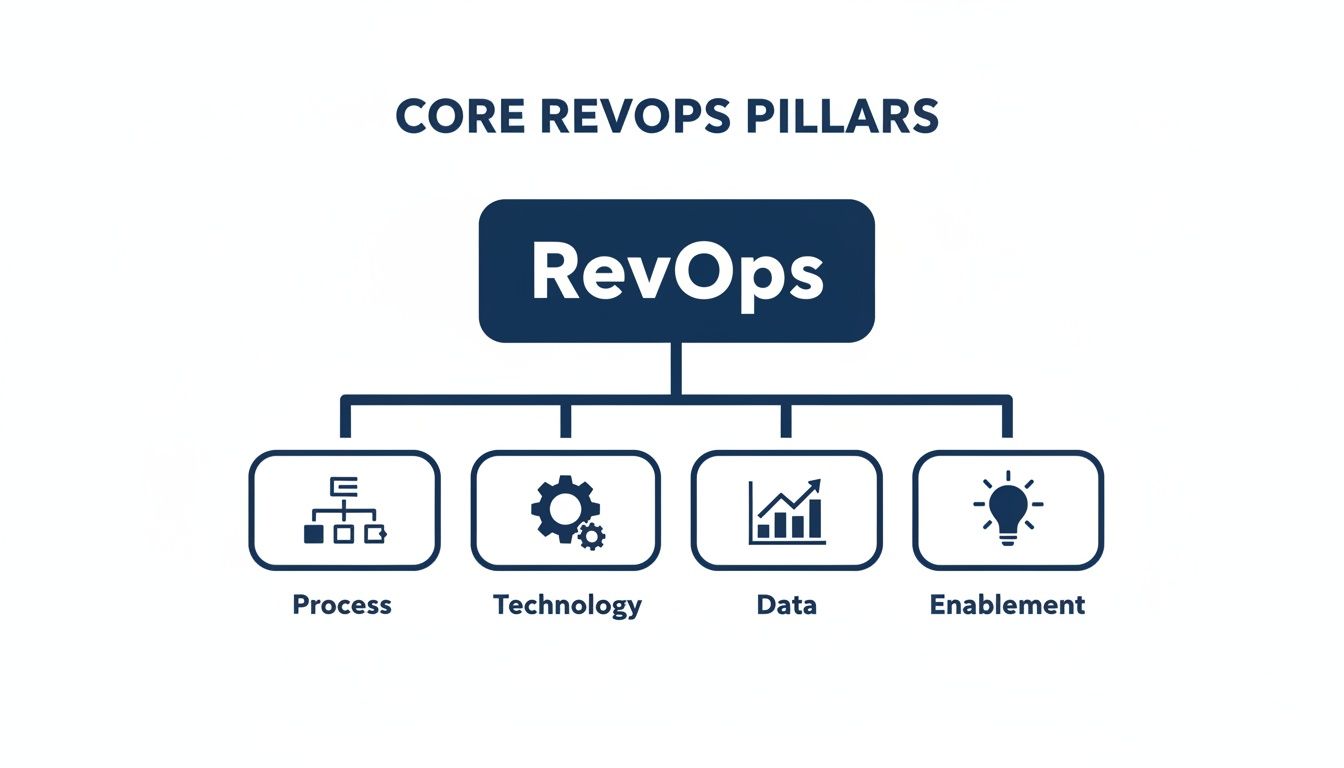
This shows how a senior RevOps leader must master each domain to build a cohesive and effective GTM strategy.
To make these differences clearer, here's a side-by-side comparison.
Revenue Operations Roles Compared: Analyst vs. Manager vs. Director
| Attribute | RevOps Analyst | RevOps Manager | RevOps Director/VP |
|---|---|---|---|
| Primary Focus | Tactical execution and data integrity. | Process optimization and project management. | Strategic planning and GTM architecture. |
| Key Questions | "What happened?" (reporting) | "Why did it happen?" (analysis) | "What should we do next?" (strategy) |
| Time Horizon | Weekly, monthly. | Quarterly, semi-annually. | Annually, multi-year. |
| Core Skills | Data analysis, CRM admin, reporting. | Project management, process design, stakeholder management. | Leadership, financial modeling, GTM strategy, executive communication. |
| Main Deliverables | Dashboards, data hygiene reports, ad-hoc analysis. | Process maps, project plans, performance analysis. | GTM strategy, annual plan, technology roadmap, board-level reporting. |
| Success Metric | Data accuracy and report timeliness. | Project completion and process efficiency gains. | Revenue growth, forecast accuracy, operational scalability. |
Understanding these distinct levels of responsibility is crucial. It ensures you hire the right person with the right scope to solve your business's current problems while building the foundation for future growth.
Essential Skills and Tools for Top RevOps Talent

Beyond the job title, what makes an elite RevOps professional? It's a blend of technical skill and big-picture thinking. Your ideal candidate isn’t just a system admin or a data analyst; they're a hybrid talent who can connect a messy tech stack to measurable revenue growth.
This unique combination separates a good RevOps hire from a game-changing one. They need to be comfortable diving deep into CRM workflows one minute, then presenting a high-level strategic roadmap to the C-suite the next. When writing a revenue operations job description, getting this mix right is key.
Core Hard Skills and Technical Proficiencies
Hard skills are the bedrock—the tangible abilities a RevOps professional needs to manage the systems and data that fuel your revenue engine. These are the non-negotiables.
- CRM Mastery: Deep expertise in a platform like Salesforce or HubSpot is table stakes. A top candidate doesn't just use the CRM; they know how to architect it for scale, build reliable workflows, and ensure data integrity.
- Data Visualization and BI: Turning raw data into a compelling story is critical. Proficiency with tools like Tableau or Power BI is how they build dashboards that give everyone from a frontline rep to a board member instant clarity.
- Marketing and Sales Automation: A solid grasp of marketing automation (e.g., Marketo, Pardot) and sales engagement tools is a must for streamlining the lead-to-cash journey. This means they understand the mechanics of lead scoring, routing, and attribution.
The technology behind these skills is always changing, which is why understanding how to build and manage a complete marketing technology stack has become a central part of the modern RevOps role.
The Rise of Account Intelligence
One of the most powerful additions to the modern RevOps toolkit is an account intelligence platform. In complex B2B sales, knowing when and why to engage a target account is half the battle. These platforms eliminate the manual research that slows reps down.
Instead of reps spending hours scouring the web for buying signals, RevOps can arm them with automated alerts on critical events like executive changes or funding rounds. This gives the GTM team the "why now" they need to craft relevant outreach.
Essential Soft Skills for Driving Change
While technical skills get the systems running, soft skills are what allow a RevOps leader to influence the organization and drive lasting change. These abilities are harder to screen for but just as important.
- Analytical Problem-Solving: Top RevOps talent doesn't just report numbers; they diagnose the problems behind them. They have a natural curiosity that drives them to dig into the data, find the root cause of a bottleneck, and propose a solution backed by evidence.
- Strategic Thinking: They connect day-to-day operational fixes to the company's biggest revenue goals. It’s about looking past the immediate fire drill to build systems and processes that are built to last.
- Cross-Functional Communication: A great RevOps professional is a translator. They can explain complex technical concepts to non-technical stakeholders and articulate the business needs of sales and marketing to the data team, ensuring everyone is speaking the same language.

“This is my singular place that very simply summarizes a company's top initiatives, strategies and connects them to my solution. Something I would spend hours researching manually, now it's automated.”
Derek Rosen
Director, Strategic Accounts, Guild Education
Ready-To-Use Revenue Operations Job Description Templates
Writing the perfect RevOps job description is tough. You're searching for someone who is part strategist, part technologist, and part data scientist—all rolled into one. You also need to communicate their impact in a way that gets the right people to apply.
To make it easier, we’ve put together two ready-to-use templates you can adapt for your hiring process.
These aren't just lists of tasks. They're designed to focus on outcomes and strategic contribution, helping you attract top-tier talent who want to build, optimize, and drive predictable revenue. Checking out various job roles available on different platforms can also provide inspiration.
Mid-Level Revenue Operations Manager Template
Think of the Revenue Operations Manager as the engine room of your go-to-market strategy. They own the processes and lead the projects that turn high-level goals into tangible workflows and system upgrades. This role is a perfect fit for someone with a few years of experience who is ready for more ownership.
Job Title: Revenue Operations Manager
Role Overview:
We're looking for a data-driven and process-oriented Revenue Operations Manager to join our growing team. You'll be the central hub for our sales, marketing, and customer success teams, responsible for optimizing the processes and systems that power our revenue engine. You will own key projects—from refining our lead-to-cash workflow to managing our GTM tech stack—and ensure we have the infrastructure to scale effectively.
Key Responsibilities:
- Process Optimization: Analyze our end-to-end customer lifecycle, identify bottlenecks in our sales and marketing funnels, and implement solutions to eliminate them.
- Technology Management: Administer and improve our core GTM tech stack, including our CRM (like Salesforce or HubSpot) and marketing automation tools.
- Data Analysis & Reporting: Build and maintain dashboards that provide actionable insights into GTM performance, sales forecasting, and key business metrics.
- Cross-Functional Alignment: Act as the primary liaison between sales, marketing, and customer success to ensure seamless handoffs and consistent processes.
- Sales Enablement: Equip the sales team with the tools and data they need to succeed, including territory planning, quota setting, and performance insights.
Skills & Qualifications:
- 3-5 years of experience in Revenue Operations, Sales Operations, or a similar role.
- Deep expertise in CRM administration and process building (Salesforce certification is a plus).
- Proficiency with data analysis and visualization tools (e.g., Tableau, Power BI).
- Strong project management skills with a proven ability to lead cross-functional initiatives.
- Excellent communication skills and the ability to translate complex data into a clear business narrative.
Senior Director of Revenue Operations Template
The Director of Revenue Operations is the architect of your go-to-market motion. This person is a key partner to the C-suite, shaping the systems, data, and processes that drive predictable, scalable growth. They don't just manage the engine—they design it.
Job Title: Director of Revenue Operations
Role Overview:
We're seeking a strategic Director of Revenue Operations to lead our RevOps function and build the operational foundation for our next phase of growth. As a key member of the revenue leadership team, you will own the architecture of our GTM strategy, from technology and process to data insights and enablement. You will lead a team of operations professionals and work with executive leadership to ensure our revenue engine is tuned for predictability and scale.
This role is critical for unifying our go-to-market efforts. RevOps has evolved from a mid-funnel efficiency play into a full-funnel orchestrator, and we need a leader to drive that strategic vision. Companies with strong RevOps achieve 19% faster revenue growth and 15% higher profitability, and this role will be instrumental in delivering those outcomes.
Key Responsibilities:
- GTM Strategy: Partner with the CRO and other C-level leaders to design and execute a cohesive go-to-market strategy.
- Team Leadership: Build, mentor, and lead a high-performing Revenue Operations team.
- Technology Roadmap: Own the strategy, budget, and implementation of our GTM tech stack to create a single source of truth.
- Forecasting & Planning: Develop sophisticated forecasting models and spearhead the annual planning process, including territory design and quota setting.
- Executive Reporting: Create and present board-level reports and analyses on pipeline health, GTM performance, and key revenue metrics.
Skills & Qualifications:
- 8+ years of experience in Revenue Operations or a related field, with at least 3 years in a leadership role.
- A proven track record of building and scaling a RevOps function in a high-growth B2B environment.
- Expert-level knowledge of Salesforce architecture and the broader GTM technology ecosystem.
- Strong financial acumen with experience in SaaS metrics, forecasting, and board-level reporting.
- Exceptional leadership and communication skills, with the ability to influence strategy at the executive level.
Key Takeaways
- Revenue Operations is a strategic function that aligns sales, marketing, and customer success under a unified framework to drive predictable, scalable revenue growth.
- A strong RevOps job description must clearly define success metrics, required technical skills (CRM architecture, data modeling, automation), and the cross-functional scope of the role.
- RevOps roles span a wide seniority range, from analysts focused on reporting and data hygiene to VPs who own the entire go-to-market tech stack and forecast accuracy.
- The most critical skills for RevOps hires are CRM expertise, data storytelling, process design, and the ability to drive change management across multiple departments.
- When interviewing candidates, use case studies and situational questions that test diagnostic thinking and the ability to connect operational changes to measurable revenue outcomes.
How to Interview and Hire Your Next RevOps Leader
A great job description will get the right candidates in the door, but the interview process is where you’ll find a true strategic leader. You have to get past the resume and dig into how a candidate thinks, diagnoses problems, and drives change. That means asking questions that test what they can do, not just what they’ve done.
To streamline your hiring process, you can even explore how to leverage automation in talent acquisition for a more efficient way to find top talent. This frees you up to spend time with the most promising candidates.
Crafting the Right Interview Questions
Your goal is to understand a candidate’s problem-solving skills, strategic mindset, and ability to get others on board. A smart mix of behavioral, situational, and technical questions is the best way to do this.
Here are a few targeted questions to get beneath the surface:
- Describe a time you diagnosed and fixed a significant bottleneck in a go-to-market process. What was your method, who did you involve, and what was the outcome? (Tests diagnostic and collaboration skills.)
- Walk me through how you would build a forecasting model that the board can trust. What data sources would you use, and how would you validate its accuracy? (Assesses technical and financial acumen.)
- Imagine our sales team is struggling with low lead conversion rates. What are the first three things you would investigate to understand the root cause? (Reveals analytical and process-oriented thinking.)
The best RevOps candidates don't just answer with theory; they tell stories. They should be able to clearly articulate the problem, the actions they took, and the measurable impact their work had on revenue. Look for answers that link operational changes to business results.
Moving Beyond Questions to a Case Study
While questions are great, a case study is the ultimate test. It’s your chance to see a candidate’s thought process in action, simulating a real challenge they’d face in the role.
A powerful case study doesn’t need to be overly complicated. Give the candidate a realistic business scenario, a sample data set (like a messy sales pipeline report), and a clear objective.
For example:
"Here is a snapshot of our sales pipeline for the last quarter. The sales team missed its forecast by 20%. Analyze this data and prepare a brief presentation on your top three initial findings and your recommended next steps."
This single exercise reveals more than any question could. You'll see how they structure their analysis, how they communicate complex data, and whether they can turn raw insights into an actionable plan.
A Simple Hiring Checklist for RevOps Leaders
Use this checklist to structure your hiring process and ensure you’re covering all essential bases.
1. Define Success Before You Start:
- What are the top 3-5 KPIs this role will own? (e.g., forecast accuracy, sales cycle length, pipeline velocity).
- What is the 90-day, 6-month, and 1-year plan for this person?
2. Structure the Interview Process:
- Screening Call (HR/Hiring Manager): Focus on cultural fit, high-level experience, and salary expectations.
- Technical Deep Dive: Ask specific questions about their experience with your tech stack and process design.
- Case Study Presentation: Assess their strategic thinking and communication skills.
- Stakeholder Interviews (Sales, Marketing, CS Leaders): Evaluate their ability to collaborate and build cross-functional relationships.
- Final Interview (Executive): Confirm strategic alignment and leadership potential.
3. Evaluate for Key Attributes:
- Problem-Solving: Do they diagnose root causes or just treat symptoms?
- Data Storytelling: Can they turn a spreadsheet into a compelling business narrative?
- Change Management: Have they successfully driven adoption of new processes or tools?
Ready to arm your revenue teams with the real-time account intelligence they need to win? Salesmotion transforms messy signals into actionable context, eliminating manual research and ensuring your team always has a credible "why now." Discover how Salesmotion can fuel your GTM strategy.
Frequently Asked Questions
What is the difference between Revenue Operations and Sales Operations?
Sales Ops is traditionally focused on making the sales team more productive through CRM management, territory planning, and process optimization. RevOps takes a broader, strategic view of the entire revenue process, aligning sales, marketing, and customer success into a single cohesive engine. RevOps oversees the full customer lifecycle, not just one part of the funnel.
What is the typical salary range for Revenue Operations roles?
Compensation varies by experience, location, and company size. RevOps Analysts typically earn $70,000 to $110,000, RevOps Managers fall between $100,000 and $160,000, and Directors or VPs can command $170,000 to $275,000 or more in major tech hubs. These figures often include performance-based bonuses that increase total compensation.
What are the four core pillars of a RevOps role?
The four pillars are process architecture (designing and optimizing the lead-to-cash journey), technology and systems management (owning the GTM tech stack), data and insights (turning raw numbers into actionable strategy), and strategic enablement (equipping revenue teams with the right processes, tools, and information at the right time).
What KPIs should a RevOps team track?
Core KPIs include Annual Recurring Revenue, Net Revenue Retention, Customer Lifetime Value, and Customer Acquisition Cost. Deeper operational metrics like sales cycle length, pipeline velocity, forecast accuracy, and funnel conversion rates between stages provide the diagnostic data needed to identify bottlenecks and drive improvements across the entire revenue engine.
What skills should I look for when hiring a RevOps professional?
Essential hard skills include CRM mastery in platforms like Salesforce or HubSpot, data visualization proficiency with tools like Tableau or Power BI, and knowledge of marketing and sales automation systems. Equally important are soft skills like analytical problem-solving, strategic thinking that connects operational fixes to revenue goals, and cross-functional communication ability to bridge technical and business teams.
How should I interview RevOps candidates effectively?
Go beyond standard behavioral questions by including a practical case study that simulates a real business challenge. Give candidates a sample data set, such as a pipeline report from a quarter where the team missed forecast, and ask them to present their top findings and recommended next steps. This reveals how they structure analysis, communicate complex data, and connect operational insights to actionable plans.