Sales operations has evolved from a back-office support function into one of the most strategic roles in B2B revenue organizations. According to Gartner, companies with dedicated sales operations teams achieve 15-20% higher revenue growth than those without. Yet many organizations still conflate sales ops with CRM administration, creating misaligned expectations that lead to burnout, high turnover, and unrealized potential. If you're building, restructuring, or evaluating your sales operations function for 2027, understanding the full scope of the role is the starting point.
TL;DR: Sales operations encompasses five core domains: strategy and planning, technology management, data and analytics, process optimization, and sales enablement support. The most effective sales ops teams spend 60-70% of their time on strategic work (forecasting, territory design, compensation modeling) and 30-40% on tactical execution (CRM maintenance, reporting, tool administration). When the ratio inverts, you have an admin function, not a strategic one.
What Sales Operations Actually Covers in 2027
Sales operations exists to remove friction from the selling process and provide the data infrastructure that enables revenue teams to make better decisions. The function spans five domains:
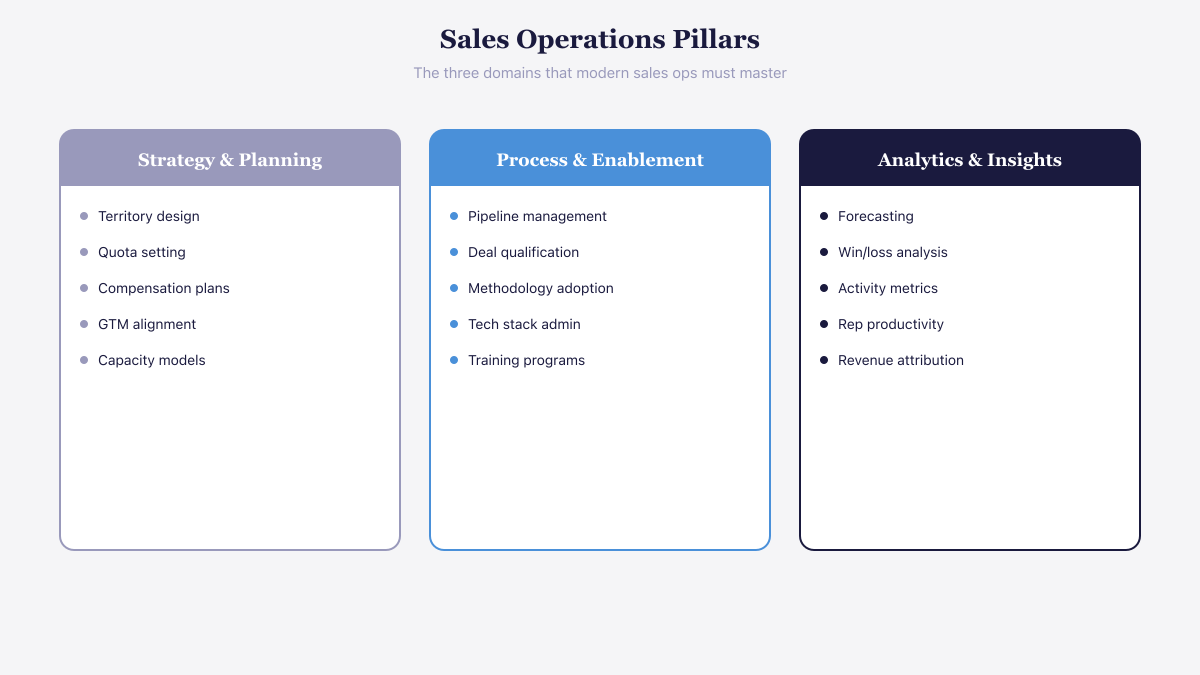 Modern sales ops must master strategy, process, and analytics to drive revenue growth.
1. Strategy and Planning
This is where sales ops has the highest strategic impact. Key responsibilities include:
- Territory design and optimization. Balancing account distribution across reps based on potential, industry, geography, and existing relationships. Poor territory design is one of the most common causes of missed quotas.
- Quota setting and compensation modeling. Designing commission structures that incentivize the right behaviors. Modeling how different scenarios (higher base, accelerators, SPIFs) affect both rep motivation and company economics.
- Go-to-market planning. Supporting leadership in annual and quarterly planning with pipeline analysis, market sizing, and capacity modeling.
- Sales forecasting. Building and maintaining forecast models that incorporate pipeline data, historical conversion rates, and market signals.
2. Technology Management
Sales ops owns the sales technology stack, which averaged 13 tools per team in 2026. Key responsibilities:
- CRM administration. Configuring Salesforce, HubSpot, or other CRM platforms. Managing fields, workflows, automation rules, and integrations.
- Tool evaluation and procurement. Assessing new tools against business requirements, managing vendor relationships, and negotiating contracts.
- Integration architecture. Ensuring data flows cleanly between CRM, engagement platforms, account intelligence tools, and analytics systems.
- Adoption monitoring. Tracking which tools reps actually use and identifying low-adoption tools that should be consolidated or replaced.
3. Data and Analytics
Sales ops is the custodian of revenue data quality. Responsibilities include:
- Pipeline reporting. Building dashboards that show pipeline health, stage conversion rates, velocity metrics, and forecast accuracy.
- Performance analytics. Identifying what separates top performers from average reps through activity analysis, win/loss patterns, and productivity metrics.
- Data hygiene. Maintaining CRM data quality through deduplication, enrichment, and validation processes.
- Revenue attribution. Connecting marketing activities to pipeline and revenue outcomes through multi-touch attribution models.
4. Process Design and Optimization
Sales ops designs and refines the processes that reps follow:
- Lead routing and scoring. Defining which leads go to which reps, based on criteria like geography, deal size, industry, and engagement level.
- Stage definitions and exit criteria. Establishing clear criteria for moving deals between pipeline stages, reducing forecast variance.
- Handoff processes. Managing transitions between SDR and AE, AE and CSM, and across team boundaries.
- Deal desk operations. Managing pricing approvals, discount thresholds, and non-standard deal structures.
5. Sales Enablement Support
While sales enablement is often a separate function, sales ops provides the operational infrastructure:
- Onboarding program administration. Setting up new reps with tools, access, territories, and initial training workflows.
- Content and resource management. Ensuring reps can find the collateral, case studies, and competitive intelligence they need.
- Training program coordination. Supporting sales methodology rollouts, new tool training, and process updates.
Sales Operations Roles and Responsibilities by Level
The sales operations function scales with team size. Here's how roles typically tier:
Sales Operations Analyst (Entry Level)
Primary focus: Data management, reporting, and CRM administration.
- Build and maintain pipeline dashboards and reports
- Process data cleanup and enrichment
- Manage CRM configuration changes
- Support tool implementation and troubleshooting
- Generate ad-hoc analysis for sales leadership
Typical background: Business analytics, finance, or early-career sales operations. Strong Excel and CRM skills.
Sales Operations Manager
Primary focus: Process optimization, forecasting support, and technology management.
- Design and implement lead routing and scoring models
- Manage sales technology stack evaluation and procurement
- Build forecast models and analyze pipeline health
- Own stage definitions, exit criteria, and deal desk processes
- Partner with sales leadership on territory and quota decisions
Typical background: 3-5 years in sales operations or revenue operations, with CRM certification and analytics experience.
Director/VP of Sales Operations
Primary focus: Strategy, cross-functional alignment, and organizational design.
- Define sales operations strategy aligned with revenue goals
- Partner with C-suite on annual planning, market expansion, and capacity modeling
- Own compensation design and quota methodology
- Drive sales technology roadmap and consolidation strategy
- Manage and develop the sales operations team
- Lead cross-functional initiatives with marketing ops, finance, and customer success
Typical background: 7-10+ years in revenue-facing operations roles. Deep expertise in forecasting, compensation design, and organizational strategy.
Sales Operations vs. Revenue Operations: The 2027 Reality
The "RevOps" movement of 2020-2023 aimed to unify sales, marketing, and customer success operations under a single function. In practice, the implementation varies widely:
Full RevOps model: A single operations leader owns the entire revenue stack from marketing automation through CRM through customer success tools. This works well in companies under 500 employees where a unified data model prevents silos.
Hybrid model: Sales operations maintains its own team but reports into a RevOps leader alongside marketing ops and CS ops. Each function has specialized expertise while sharing data infrastructure and strategic alignment.
Standalone sales ops: In larger enterprises with complex sales motions, dedicated sales operations teams often remain independent because the depth of sales-specific expertise required (territory design, compensation modeling, deal desk) warrants specialization.
The model matters less than the outcome: revenue data should flow without silos, and sales teams should have the operational support they need to sell effectively. Regardless of model, embedding signal-based selling into operational workflows is becoming a priority for leading teams.
Building a High-Impact Sales Operations Team
Hire for Strategic Impact, Not Just Technical Skills
The most common hiring mistake in sales ops is optimizing for CRM expertise over business acumen. (For role templates, see our revenue operations job description guide.) A strong Salesforce admin who can't connect data to revenue strategy will keep the lights on but won't drive growth. Look for:
- Analytical thinking: Can they translate data patterns into actionable recommendations?
- Business context: Do they understand how sales organizations generate revenue, not just how CRM workflows function?
- Communication: Can they present findings to sales leadership in terms that drive decisions?
- Process design: Can they identify inefficiencies and design scalable solutions?
Measure the Right Outcomes
Sales ops teams that measure success by CRM uptime and report delivery are trapped in the tactical zone. Strategic measures include:
| Metric | What It Shows |
|---|---|
| Forecast accuracy | How well the organization predicts revenue |
| Quota attainment distribution | Whether territories and quotas are balanced |
| Pipeline conversion by stage | Where the sales process is leaking |
| Tool adoption rate | Whether technology investments are delivering value |
| Time-to-productivity for new hires | How effective onboarding processes are |
| Revenue per operations FTE | Whether the team is scaling efficiently |
Protect Strategic Time
The biggest threat to sales ops impact is getting consumed by tactical requests. Establish clear service-level expectations for ad-hoc requests, automate recurring reports, and dedicate specific days or blocks to strategic projects. The 60/40 split (strategic/tactical) should be a management target, not an aspiration.

“We have very limited bandwidth, but Salesmotion was up and running in days. The template made it easy to load our accounts and embedding it in Salesforce was simple. It was one of the easiest rollouts we've done.”
Andrew Giordano
VP of Global Commercial Operations, Analytic Partners
Key Takeaways
- Sales operations spans five domains: strategy and planning, technology management, data and analytics, process optimization, and enablement support.
- The most impactful sales ops teams spend 60-70% of their time on strategic work (forecasting, territory design, compensation) rather than tactical CRM administration.
- Roles tier from Analyst (data and reporting) through Manager (process and technology) to Director/VP (strategy and organizational design).
- The RevOps vs. Sales Ops debate matters less than the outcome: unified revenue data, effective processes, and strategic operational support for sales teams.
- Hire for business acumen and analytical thinking, not just CRM expertise. The best sales ops leaders connect data to revenue strategy.
- Measure sales ops impact through forecast accuracy, quota attainment distribution, and pipeline conversion rates, not CRM uptime and report volume.
Frequently Asked Questions
What is the difference between sales operations and revenue operations?
Sales operations focuses specifically on supporting the sales function: territory design, CRM management, pipeline analytics, compensation modeling, and sales process optimization. Revenue operations is a broader function that unifies sales, marketing, and customer success operations under a single data and process infrastructure. In practice, many organizations use the terms interchangeably, and the distinction depends on organizational size and structure.
What skills do you need for a sales operations role?
Core skills include CRM administration (Salesforce or HubSpot), data analysis (Excel, SQL, BI tools), process design, and strong communication. More senior roles require strategic planning, compensation modeling, forecasting expertise, and cross-functional leadership. The trend is toward analytical and strategic capabilities rather than purely technical CRM skills.
How large should a sales operations team be?
A common benchmark is one sales operations FTE per 25-50 sales reps, though this varies with sales complexity. Enterprise sales motions with complex deal structures and multiple tools require more ops support per rep. High-velocity inbound motions with standardized processes can operate with leaner ops ratios. Start with the strategic projects that would drive the most impact and staff accordingly.
What tools do sales operations teams use?
The core stack includes a CRM (Salesforce, HubSpot), a BI/analytics platform (Tableau, Looker, or built-in CRM analytics), a sales engagement platform (Outreach, Salesloft), and increasingly an account intelligence platform like Salesmotion for research automation and signal monitoring. Additional tools depend on the sales motion: CPQ for complex pricing, conversation intelligence for call analysis, and territory planning software for large field teams.