Think of your sales operations org structure less like a rigid chart and more like the blueprint for your revenue engine. It's the framework that defines the roles, workflows, and responsibilities that make your sales team not just busy, but efficient and predictable. For a full overview of what the function covers, see our sales operations guide.
A well-designed structure is what separates reactive fire-fighting from proactive, scalable growth.
The Strategic Blueprint for Your Revenue Engine
Imagine a fast-growing B2B company hitting a wall. Sales are up, but the processes are a mess. Forecasting is a guessing game, and your top reps are drowning in admin work. Sound familiar? This is exactly why a formal sales operations org structure is critical. It organizes your team to move beyond just selling and start selling smarter.
This structure brings clarity and accountability, ensuring everyone knows their role in driving revenue. Instead of reps wasting precious hours building dashboards or wrestling with CRM data, a dedicated ops team handles the backend machinery. This shift lets your sellers get back to what they do best: talking to prospects and closing deals.
From Tactical Support to Strategic Partner
Sales ops has come a long way. A decade ago, the function was mostly tactical—managing Salesforce fields and pulling basic reports. But today’s B2B sales cycles are a different beast, often involving large buying committees and complex pricing models.
In response, sales ops has become a strategic pillar of the business, responsible for building the infrastructure for predictable growth. You can learn more about this evolution and the core pillars of a modern sales ops team at Subskribe.
A well-oiled sales operations function delivers clear wins:
- Increased Rep Productivity: By automating tasks and optimizing workflows, ops gives valuable selling time back to your reps.
- Improved Forecast Accuracy: With clean data and standard processes, leadership can finally trust pipeline projections.
- Enhanced Scalability: A solid structure means you can add new reps and enter new markets without everything breaking.
The Foundation of Predictable Revenue
Ultimately, the goal of any sales ops team is to build a sales motion that is both repeatable and scalable. A huge part of that is building a robust sales pipeline that converts deals efficiently and predictably. It’s about creating an environment where success isn’t an accident—it’s engineered.
A strong sales ops structure transforms your revenue engine from a collection of individual efforts into a synchronized, high-performance machine. It provides the systems, data, and processes needed to win consistently.
See Salesmotion in action
Take a self-guided interactive tour — no signup required.
Three Proven Sales Ops Structure Models
Picking the right sales operations org structure isn't about finding a perfect, one-size-fits-all template. It’s about matching the model to your company's DNA—its size, complexity, and growth stage. The structure that works for a 20-person startup will cripple a global enterprise, and vice versa.
Getting this right is fundamental. It determines whether your sales team gets the support it needs to hit its numbers or spends half its time fighting internal friction.
Let's break down the three most common models. We'll use simple analogies to make it clear how each one functions, so you can see which might be the best fit for your team.
This flowchart brings the choice to life. You're either intentionally building a structure for proactive, predictable growth, or you're stuck in a cycle of reactive, chaotic fire-fighting.
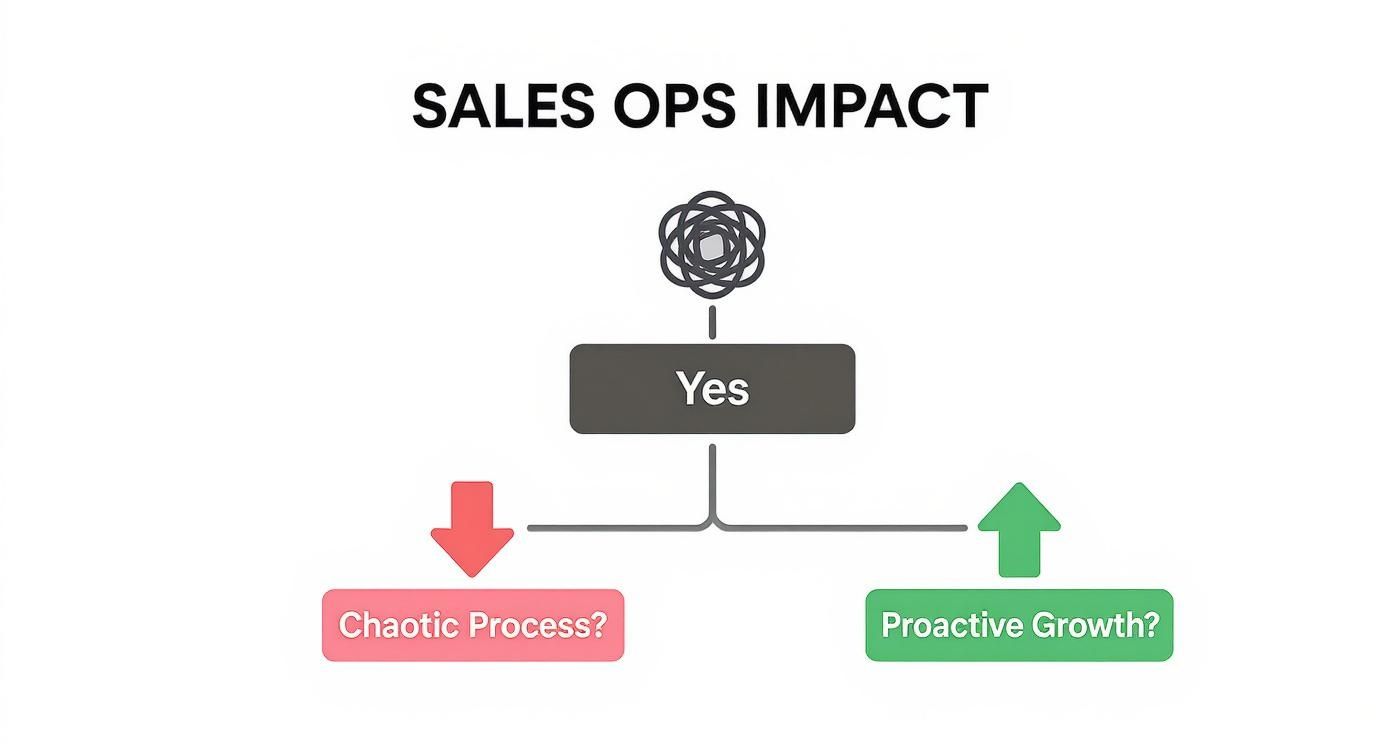
A formal structure isn't just bureaucracy; it's the bridge from operational chaos to strategic, repeatable revenue.
The Centralized Model: Your Air Traffic Control Tower
Think of the centralized model as an air traffic control tower for your entire sales organization. You have one, unified Sales Ops team at the heart of the business, managing processes, technology, and data for everyone.
This hub-and-spoke approach guarantees every sales rep, manager, and leader is operating under the same set of rules, using the same tools, and working from the same playbook. It’s all about consistency.
This model is incredibly effective for creating efficiency, especially in smaller to mid-sized companies where standardization is key. When all requests flow through one team, you can enforce best practices and maintain clean data. For example, a centralized team can roll out a new CRM workflow and ensure 100% adoption because they own the entire process.
But it’s not perfect. As a company scales and sales teams specialize—perhaps splitting into SMB, Mid-Market, and Enterprise segments—a single centralized team can become a bottleneck. Regional teams or specialized product lines might feel like their unique needs are stuck in a queue, leading to friction.
The Federated Model: Your Local Fire Departments
On the flip side, you have the federated (or decentralized) model, which works like a network of local fire departments. Instead of one central command, Sales Ops specialists are embedded directly within different sales teams, regions, or business units. Each "fire department" is dedicated to its specific group, providing tailored, on-the-ground support.
This structure is a powerhouse for delivering rapid, relevant support. An embedded ops person understands the day-to-day challenges of their team—whether that’s navigating a complex enterprise deal or optimizing a high-velocity SMB sales motion. This proximity builds trust and allows for quick pivots. For instance, an ops expert supporting the APAC region can immediately adjust reporting for local market nuances without waiting for approval from a global HQ.
The major risk here is chaos. With multiple ops teams working independently, you can easily end up with data silos, conflicting processes, and a messy tech stack. What one team calls a "best practice" might directly contradict another's, making it nearly impossible to get a single, unified view of sales performance.
The Hybrid Model: Your Special Forces Unit
The hybrid model aims for the best of both worlds, operating much like a special forces unit. It combines a lean, centralized team that focuses on global strategy with embedded ops specialists who act as forward-deployed experts.
The central "command" team sets the high-level strategy, manages core systems like the CRM, and defines the global KPIs everyone is measured against.
Meanwhile, the embedded specialists work shoulder-to-shoulder with sales teams, adapting those global strategies to local needs. They act as a critical two-way link, translating central directives into practical field applications and funneling frontline intelligence back to the core team. This gives you both the consistency of a centralized model and the agility of a federated one.
The hybrid approach is often considered the most scalable and resilient sales operations org structure for growing companies, as it balances strategic governance with tactical flexibility.
This model is the go-to for larger, more complex organizations. It allows you to maintain a consistent operational backbone while giving different business units the autonomy they need to win in their markets. The biggest challenge? You have to nail the communication and alignment between the central and embedded teams to avoid turf wars and confusion.
To make the choice clearer, here’s a simple breakdown of how these three models stack up.
Comparison of Sales Operations Org Structure Models
| Model | Best For | Primary Advantage | Potential Challenge |
|---|---|---|---|
| Centralized | Startups & Mid-Sized Businesses (Under 200 reps) | Consistency, efficiency, strong data governance | Can become a bottleneck as the company scales; may lack specialized business unit knowledge |
| Federated | Large, Geographically Dispersed, or Diversified Enterprises | Agility, deep business unit alignment, rapid support | Risk of inconsistent processes, data silos, and a fragmented tech stack |
| Hybrid | Scaling & Large Companies (Over 200 reps) | Balances global strategy with local execution; highly scalable | Requires strong communication and clear definitions of roles to avoid conflict between central and embedded teams |
Ultimately, the right model isn't static. What works for you today might need to evolve as your company grows. The key is to understand these structures so you can make an intentional choice that sets your revenue engine up for success.

“We're no longer fishing. We know who the right customers are, and we can qualify them quickly. Salesmotion has had a direct impact on pipeline quality.”
Andrew Giordano
VP of Global Commercial Operations, Analytic Partners
Defining Key Roles Within Your Sales Ops Team
A strong sales operations org structure is more than just a chart; it's about getting the right people in the right roles. Once you've chosen a model—centralized, federated, or hybrid—the next step is to fill it with talent who can execute the vision.
Think of building your sales ops team like assembling a pit crew. You need a data detective to find the source of a slowdown, a process guru to streamline pit stops, a tech expert to keep the engine diagnostics running, and a strategic leader to orchestrate the whole operation. Without these roles, your sales engine won't perform at its peak.
Each role brings a unique skill set to the table, and understanding their contributions is key to building a high-impact team.

The Foundational Roles
Every sales ops team, regardless of size, is built on a few core positions. These are the first hires and form the backbone of your operational support system.
-
Sales Operations Analyst: This is your data detective. Analysts live in spreadsheets, CRMs, and analytics tools, digging for insights that others miss. They build reports, create dashboards, and answer the critical "why" behind the numbers—like why win rates are down in a specific territory or which lead sources are performing. Their work is the raw material for every strategic decision.
-
Sales Operations Manager: If the analyst is the detective, the manager is the architect. They take insights from the analyst and use them to design and refine the sales process. This covers everything from managing the CRM and ensuring data hygiene to defining rules of engagement. Their goal is to make the entire sales motion more efficient, repeatable, and scalable.
Specialized Expertise for Scaling Teams
As your organization grows, generalist roles become less effective and the need for specialized expertise becomes obvious. These specialist roles handle complex, high-value functions that require deep knowledge in a specific area.
Adding these specialists is a clear sign of a maturing sales operations org structure. It allows your team to move from "keeping the lights on" to driving real strategic value.
A common question is how big these teams get. Research shows that about 31% of closely related sales enablement teams are just one-person departments, while 34% have two to four members. Larger groups with five to nine professionals make up 18%, and only 17% of companies have more than 10 people in these functions.
Key Specialist Positions
-
Sales Systems Administrator: This person is the guru of your tech stack. They own the administration, configuration, and integration of key tools like Salesforce and HubSpot. When a workflow breaks or a new integration is needed, the Systems Admin solves it, ensuring your reps have the tools they need to do their jobs without friction.
-
Deal Desk Analyst: The Deal Desk Analyst is your navigator for complex and non-standard deals. They partner with sales, finance, and legal to structure quotes, manage approvals, and ensure profitability and compliance. For a B2B SaaS company with tricky pricing, a Deal Desk is essential to accelerate deal velocity and mitigate risk.
-
Director of Sales Operations: This is the strategic leader of the function. The Director sets the vision, aligns the ops roadmap with the company's revenue goals, and acts as a key advisor to sales leadership. They are less involved in the day-to-day work and more focused on long-term planning, team development, and proving the ROI of the department.
You can learn more about the specific duties of each position by checking out our guide on sales operations roles and responsibilities.
How to Scale Your Sales Operations Team
Knowing when to grow your sales ops team can feel more like an art than a science, but getting it wrong can stall your growth. Hire too late, and your sales engine gets buried in operational debt—messy data, clunky processes, and inefficient reps. Hire too early, and you’re paying for a specialist you don't fully need.
The key is to spot the inflection points that signal it's time to grow.
Scaling isn't just about adding headcount. It’s a deliberate process of matching operational muscle to the needs of your growing sales machine. This means you need an honest assessment of your current pain points and a clear view of where the business is headed. A well-timed expansion of your sales operations org structure ensures your foundation can support the next stage of revenue.
Spotting the Triggers to Hire
Your business will send up smoke signals when your current ops function is stretched thin. These aren't just minor headaches; they're systemic problems that are actively capping your revenue potential. Learning to spot these triggers is the first step toward smart scaling.
Here are the most common signs it's time to make your next sales ops hire:
- You Hit a Rep Headcount Milestone: This is the classic trigger. Once your sales team crosses the 15-20 rep threshold, a single ops person (or a sales manager pulling double duty) can't keep up. The volume of requests for reports, CRM tweaks, and process support becomes overwhelming.
- Data Quality Starts to Degrade: When you can no longer trust your pipeline data or your forecast feels like a wild guess, it’s a massive red flag. This means CRM hygiene is slipping, and you need someone dedicated to data governance before bad data undermines your decision-making.
- Sales Leaders Are Drowning in Admin: If your Head of Sales is spending their weekends building dashboards or troubleshooting CRM workflows, you have a problem. Their time should be spent on high-level strategy and coaching, not tactical ops work.
The goal is to hire proactively, just before the pain becomes acute. If you wait until processes are completely broken, you’ve already lost significant momentum and revenue.
A Phased Approach to Hiring
Scaling your sales ops team should follow a logical progression, moving from generalist support to specialized expertise as your organization becomes more complex.
This phased approach ensures you're always solving your most pressing operational problem without over-investing in niche skills before you need them.
-
The First Hire (The Generalist): Your first sales ops hire is almost always a Sales Operations Analyst or Manager. This person is a jack-of-all-trades—handling CRM administration, reporting, basic process improvements, and putting out fires. They build the initial foundation.
-
The Second Hire (The Specialist): As you grow, you'll need deeper expertise. The next hire is often a Sales Systems Administrator to own the tech stack, especially if integrations are getting messy. Or, it could be a Deal Desk Analyst if complex, non-standard deals are becoming a major bottleneck.
-
Building Out the Team (Strategic Leadership): With a small team in place, you’ll eventually need a Director of Sales Operations. This person provides strategic leadership, aligns ops with broader revenue goals, and manages the growing team. You can find more RevOps insights in our guide to RevOps best practices.
Ratios, Reporting Lines, and Scaling Benchmarks
As you grow, it's helpful to use industry benchmarks to guide your headcount and team structure. While every company is different, these ratios provide a solid starting point for planning your sales operations org structure.
To make this clear, here’s a table outlining when and who to hire as your sales team scales.
Sales Ops Scaling Milestones and Headcount Ratios
| Sales Team Size | Typical Trigger Point | Recommended First/Next Hire | Target Ops-to-Rep Ratio |
|---|---|---|---|
| 1-15 Reps | Sales manager overwhelmed by admin; reps building own reports. | Sales Operations Analyst (Generalist) | 1:15 |
| 16-30 Reps | CRM becomes messy; tech stack needs dedicated ownership. | Sales Systems Administrator | 1:20 |
| 31-50 Reps | Complex deals slow down sales cycles; forecasting is inconsistent. | Deal Desk Analyst or Sales Ops Manager | 1:25 |
| 50+ Reps | Lack of strategic direction; need for process standardization across teams. | Director of Sales Operations | 1:30 |
A common benchmark is to maintain a ratio of roughly one sales ops professional for every 25 to 30 sales reps. For businesses with highly complex sales motions or those in a hyper-growth phase, that ratio might tighten to 1:20.
The reporting structure will also evolve. Initially, sales ops often reports directly to the Head of Sales. As the company matures and the focus shifts to the entire revenue lifecycle, it's common for sales ops to move under a Chief Revenue Officer (CRO). This shift is crucial for ensuring alignment across sales, marketing, and customer success. For particularly complex system overhauls, some companies bring in external expertise like Salesforce Consulting Services to manage large-scale projects during periods of intense growth.
“We have very limited bandwidth, but Salesmotion was up and running in days. The template made it easy to load our accounts and embedding it in Salesforce was simple. It was one of the easiest rollouts we've done.”
Andrew Giordano
VP of Global Commercial Operations, Analytic Partners
Measuring the Impact of Your Sales Ops Structure
Designing the perfect sales operations org structure is one thing, but proving it works is where the real value is. How do you move beyond anecdotes to show your team is making a tangible difference?
The answer is in the data. You need to track key performance indicators (KPIs) that directly link your operational efforts to revenue outcomes. This isn't about vanity metrics; it's about building a data-backed case that demonstrates your team’s impact.
When you focus on the right measurements, you can justify your team's existence, secure future investment, and constantly refine your structure for better performance.

Efficiency Metrics
Efficiency metrics are about how well your sales team is using its time and resources. A strong Sales Ops function should be obsessed with removing friction and streamlining workflows. These KPIs prove whether those efforts are paying off.
-
Sales Cycle Length: This is the average time it takes to close a deal, from first touch to final signature. When Sales Ops refines the sales process or implements better tools, this number should go down. For example, a well-managed Deal Desk can shave days off contract negotiations.
-
Lead Response Time: In sales, speed wins. This metric tracks how quickly reps follow up with inbound leads. Sales Ops directly impacts this by optimizing lead routing rules in the CRM and setting up instant notifications, making sure no lead goes cold.
Effectiveness Metrics
Effectiveness metrics tell you how well your sales team is performing its core function: closing deals. While individual rep skill is a factor, Sales Ops creates the environment where sellers can succeed consistently. These KPIs reveal the health of your entire sales motion.
-
Quota Attainment Rate: This is the percentage of sales reps hitting or exceeding their quota. A rising attainment rate is a powerful indicator that Sales Ops initiatives—like improved training, better sales collateral, or more accurate territory assignments—are working.
-
Win Rate: This metric calculates the percentage of opportunities that convert into closed-won deals. When Sales Ops provides better data or optimized sales plays, reps are better prepared, which should directly increase the win rate.
Investing in data-driven sales operations yields measurable improvements. Companies with advanced sales ops functions report a 15% higher quota attainment rate and sales cycles that are 20% faster than their peers, largely due to better data, governance, and analytics. You can explore more about these findings on Visdum.
Strategic Metrics
Finally, strategic metrics measure the high-level business impact of your Sales Ops team. These are the KPIs that get the most attention from the C-suite because they speak directly to the predictability and scalability of the revenue engine.
A core part of this is understanding and improving seller output. For a deeper dive, check out our guide on how to measure sales productivity.
-
Forecast Accuracy: This measures how close your team's sales forecast is to the actual revenue booked. Sales Ops owns the forecasting process, from ensuring data hygiene in the CRM to implementing forecasting models. High accuracy builds confidence across the entire business.
-
CRM Data Quality: While not a traditional KPI, the health of your CRM data is a foundational strategic metric. Clean, accurate, and complete data is the fuel for every other report and decision. Sales Ops is the guardian of this data, and its quality is a direct reflection of their effectiveness.
Sales Operations Org Structure by Company Stage
The right sales operations org structure changes dramatically as your company scales. What works at Series A will hold you back at Series C. Here is how the team, reporting lines, and focus areas should evolve at each stage.
Series A (10–30 Reps): The Foundation
At Series A, your entire sales ops function is likely one person — a generalist Analyst or Manager who reports directly to the Head of Sales.
| Role | Headcount | Focus |
|---|---|---|
| VP Sales | 1 | Owns quota, coaches reps, runs forecasts |
| Sales Ops Analyst/Manager | 1 | CRM admin, reporting, basic process design |
| SDR Team | 3–5 | Outbound prospecting |
| Account Executives | 5–15 | Closing |
Key priorities: Clean CRM data, basic lead routing, standardized pipeline stages, foundational dashboards. The ops generalist also typically owns sales enablement content at this stage.
Model: Centralized (one person = one team).
Series B (30–80 Reps): The Build-Out
After raising a Series B, you are scaling the sales team aggressively. One ops generalist cannot keep up with territory carving, tech stack integrations, and compensation modeling. This is when you hire your first specialists.
| Role | Headcount | Focus |
|---|---|---|
| VP Sales | 1 | Strategy, hiring, cross-functional alignment |
| Director of Sales Ops | 1 | Ops roadmap, reporting to VP Sales or CRO |
| Sales Ops Manager | 1 | Process optimization, territory management |
| Sales Systems Admin | 1 | CRM + tech stack ownership |
| SDR Manager(s) | 1–2 | SDR coaching and pipeline generation |
| SDR Team | 8–15 | Outbound + inbound qualification |
| AE Team | 15–40 | Closing (possibly split SMB / Mid-Market) |
Key priorities: Territory design, segment-specific playbooks, deal desk processes, forecast model refinement. Start tracking pipeline velocity and stage-by-stage conversion rates.
Model: Centralized, beginning to explore hybrid as segments diverge.
Series C (80–200+ Reps): The Specialization
At Series C and beyond, your sales org has distinct segments (SMB, Mid-Market, Enterprise), possibly multiple products, and likely international teams. Sales ops must specialize to serve these different motions.
| Role | Headcount | Focus |
|---|---|---|
| CRO | 1 | Full revenue lifecycle ownership |
| VP Sales Ops / RevOps | 1 | Strategy, reporting to CRO |
| Sales Ops Managers | 2–3 | One per segment (SMB, MM, Enterprise) |
| Sales Systems Team | 2–3 | CRM, integrations, data engineering |
| Deal Desk | 1–2 | Complex deal structuring, approvals |
| Sales Enablement | 2–3 | Onboarding, training, content |
| Segment Sales Leaders | 3–4 | VP-level leaders per segment |
| AE Teams | 50–150+ | Segment-specific closing |
| SDR Teams | 15–40 | Segment-specific prospecting |
Key priorities: Predictive forecasting, multi-touch attribution, advanced account-based selling motions, cross-segment analytics. The reporting line typically shifts from VP Sales to CRO at this stage.
Model: Hybrid — central strategy team with embedded ops specialists per segment.
Enterprise (200+ Reps, Multi-Product): The Revenue Operations Center
At enterprise scale, Sales Ops often merges with Marketing Ops and CS Ops into a unified Revenue Operations function reporting to the CRO.
| Role | Headcount | Focus |
|---|---|---|
| CRO | 1 | Owns all revenue-generating functions |
| SVP Revenue Operations | 1 | Unified ops across Sales, Marketing, CS |
| Sales Ops Team | 4–8 | Segment-specific ops + analytics |
| Marketing Ops Team | 3–5 | Campaign ops, attribution, lead management |
| CS Ops Team | 2–3 | Renewal forecasting, expansion pipeline |
| Systems & Data Team | 3–6 | Platform architecture, integrations, BI |
| Deal Desk Team | 2–4 | Global deal structuring |
| Enablement Team | 3–5 | Content, onboarding, methodology training |
Key priorities: RevOps-level alignment across all GTM functions, unified data warehouse, AI-powered forecasting, global process standardization. See our RevOps best practices guide for the operational framework.
Model: Hybrid with strong central governance and regional/segment embedded specialists.
Stage Comparison Summary
| Stage | Ops Headcount | Ops:Rep Ratio | Model | Reports To |
|---|---|---|---|---|
| Series A | 1 | 1:15–20 | Centralized | VP Sales |
| Series B | 3–4 | 1:20–25 | Centralized → Hybrid | VP Sales / CRO |
| Series C | 6–10 | 1:20–25 | Hybrid | CRO |
| Enterprise | 15–30+ | 1:15–20 | Hybrid (RevOps) | CRO |
Common Mistakes to Avoid in Your Org Design
Designing your sales operations org structure is a high-stakes game. Get it right, and you supercharge your revenue engine. But a few common missteps can create friction, waste resources, and hold your sales team back.
Frankly, learning from these pitfalls is the fastest way to build an effective foundation. I've seen leaders make the same mistakes over and over, often with the best intentions. They'll hire a specialist to solve a niche problem, only to realize a generalist was what they really needed. Or they'll underinvest, treating sales ops as a cost center instead of the strategic driver it is.
Let's break down the big ones so you can sidestep them.
Hiring Specialists Too Soon
One of the most frequent errors is hiring for specialization before the foundation is solid. Bringing on a Deal Desk Analyst when your CRM data is a mess is like hiring a Formula 1 mechanic to work on a car without an engine. It’s a waste of specialized talent and budget.
Your first hire should almost always be a generalist—a sharp Sales Operations Analyst or Manager who can tackle the basics: cleaning up data, standardizing reporting, and streamlining core processes. Once that operational bedrock is in place, then you can start adding specialists to solve more complex problems.
A classic symptom of this mistake? You have a highly skilled, expensive employee who is constantly pulled into basic reporting or data entry tasks. Their strategic value is neutralized because their expertise is wasted on problems that should have been solved months ago.
Underinvesting in the Function
Another critical error is treating sales operations as a purely administrative function. When leadership views sales ops as just a "cost of doing business," they starve it of the resources, headcount, and authority it needs to make an impact. This leads to burnout and a reactive, fire-fighting culture.
True sales ops is a strategic partner to the sales team, responsible for optimizing the entire revenue process. That requires real investment in both talented people and the right technology. Companies that invest see a clear ROI through shorter sales cycles, higher win rates, and more predictable forecasting. Underinvestment guarantees you’ll never see those benefits.
Creating Data Silos Between Departments
Even with the best team, a flawed structure can create crippling information silos. This happens all the time in federated models where embedded ops teams don't communicate with each other or a central team. The marketing ops team might track leads differently than sales ops, creating a "black hole" where MQLs seem to disappear.
This disconnect makes a unified view of the customer journey impossible. To avoid this, you must establish clear communication channels and a single source of truth for your data—which is almost always the CRM. Maintaining excellent data practices is foundational, and you can learn more by reading our guide to improving CRM hygiene.
Failing to Define Clear Roles
Ambiguity is the enemy of efficiency. It’s that simple. When roles and responsibilities aren't clearly defined, work gets duplicated and crucial tasks fall through the cracks. You'll have two different people building similar reports while nobody takes ownership of the lead routing rules that are breaking.
This leads to confusion, frustration, and wasted effort. A well-designed sales operations org structure includes detailed role definitions that outline exactly who owns what. This clarity ensures accountability and allows each team member to focus on their specific area of impact, creating a synchronized and high-performing operations unit.
Key Takeaways
- A well-designed sales operations org structure transforms your revenue engine from reactive fire-fighting into proactive, scalable growth.
- The three proven models -- Centralized, Federated, and Hybrid -- each fit different company sizes and complexities; the right choice depends on your growth stage.
- Core roles evolve from generalist (Analyst/Manager) to specialist (Systems Admin, Deal Desk) to strategic leader (Director) as your sales team scales.
- The first sales ops hire should typically come when your team crosses 10-15 reps and the sales manager is overwhelmed by admin work.
- Track efficiency metrics (sales cycle length, lead response time), effectiveness metrics (quota attainment, win rate), and strategic metrics (forecast accuracy, CRM data quality) to prove impact.
- Common mistakes include hiring specialists too early, underinvesting in the function, creating data silos between departments, and failing to define clear role boundaries.
Frequently Asked Questions
As you apply these org structure concepts to your own team, you're bound to run into some specific questions. This is where theory meets reality. Let's tackle some of the most common hurdles leaders face when building out their sales ops function.
Think of this as a quick-reference guide to help you sidestep common mistakes and make smarter choices. Getting these foundational pieces right is what separates a support function from a true revenue-driving machine.
At What Stage Should a Startup Hire Its First Sales Ops Person?
The magic number is usually between 10 to 15 sales reps. This is the point where spreadsheets start breaking and the "we'll figure it out later" mentality begins to cost you.
Around this size, the sales manager is drowning in admin work, forecasting becomes a guessing game, and the lack of a standardized process slows down new deals. Hiring a dedicated ops person isn't a luxury at this stage; it's a necessity to build the systems you need to scale without chaos.
Should Sales Ops Report to the Head of Sales or a CRO?
In the early days, having sales ops report directly to the Head of Sales is smart. It creates a tight feedback loop and ensures the ops function is laser-focused on the sales team's most immediate pains.
But as the company grows and starts thinking bigger, the reporting line should shift to a Chief Revenue Officer (CRO). This isn't just a title change on an org chart; it's a strategic move. It signals that you're moving from just supporting the sales team to optimizing the entire customer journey, connecting the dots between marketing, sales, and customer success.
The reporting line often reflects a company's operational maturity. Shifting from a sales leader to a CRO shows you're graduating from supporting a single department to optimizing the entire revenue engine.
What Is the Difference Between Sales Ops and RevOps?
This is a big one, and the distinction is crucial. Sales Operations has a very specific mission: make the sales team more productive and efficient. Period. Their world revolves around the sales process, sales tools, and sales data.
RevOps (Revenue Operations), on the other hand, zooms out to see the entire picture. It's a centralized function designed to align the operational gears of marketing, sales, and customer service. The goal of RevOps is to tear down the silos between these departments to create one smooth, predictable revenue machine, from the first marketing touchpoint all the way through to renewal.
Stop wasting hours on manual account research. Salesmotion’s AI-powered platform delivers real-time, actionable insights directly to your sales team, saving each rep over 8 hours per week and boosting pipeline creation by 40%. Equip your team to have smarter conversations and close bigger deals by visiting https://salesmotion.io.