A SWOT analysis for sales is a framework that helps you pinpoint your team's Strengths, Weaknesses, Opportunities, and Threats to build a smarter go-to-market strategy. Think of it less as an academic exercise and more as a dynamic tool for creating targeted account plans and driving pipeline. For a step-by-step walkthrough with templates, see our complete SWOT analysis guide.
Why Your Old SWOT Is Failing The Sales Team

Let's be honest. Most SWOT analyses are a stale classroom exercise. They get filled out during a quarterly kickoff, filed away in a shared drive, and forgotten by the next day. They have zero impact on hitting quota.
This traditional approach doesn't work for modern B2B sales teams because it's too high-level and static. The consequences of a weak or ignored analysis show up as painful symptoms every sales leader recognizes: generic account plans, reps struggling to create urgency, and outbound messaging that falls flat.
The Disconnect Between Planning and Action
The core problem is the gap between the strategic planning of a SWOT and the daily execution required of an account executive. When a SWOT identifies a "Weakness" like "inconsistent account planning," it's often left as a bullet point on a slide.
This creates a major pain point. Sales leaders see their teams wasting hours on manual research or, worse, skipping it altogether. Reps can't articulate a compelling "why now" because they lack the timely context to make their outreach relevant. This "manual research tax" is a massive drag on productivity.
A SWOT analysis shouldn't be a static grid you fill out once a year. It should be a dynamic intelligence tool that directly fuels your pipeline by focusing your team on high-probability accounts and giving them the specific context needed to win.
Adapting to the Modern Sales Motion
The sales environment has changed dramatically. Over 90% of B2B companies shifted to virtual sales models since 2020, yet many reps still skip the deep account planning needed to succeed. This is the exact weakness a modern SWOT analysis for sales is designed to fix.
By focusing on real-time signals, you can build a system that alerts you to changes at target accounts—like a new executive hire or a major expansion. Then, you can tie those signals directly back to your identified strengths and opportunities.
For this to work, a clean, organized system is crucial. You can learn more about the importance of maintaining your data with effective CRM hygiene.
Let's look at how the old way of thinking stacks up against a more modern, actionable approach.
| Attribute | Traditional SWOT Approach | Dynamic Sales SWOT Approach |
|---|---|---|
| Timing | Annual or quarterly exercise | Continuous, triggered by real-time signals |
| Focus | High-level, internal-facing | Account-specific, customer-centric |
| Output | Static slide deck or document | Actionable plays and targeted messaging |
| Ownership | Marketing or Sales Leadership | Integrated into every rep's workflow |
| Goal | Strategic planning | Pipeline generation and deal acceleration |
| Impact | Often forgotten, low ROI | Drives daily sales activities and improves win rates |
The takeaway is simple: a SWOT analysis is only as valuable as its ability to drive action. By shifting to a dynamic model, you turn a forgotten document into a powerful tool that helps your team win more deals.
See Salesmotion in action
Take a self-guided interactive tour — no signup required.
Pinpointing Your True Sales Strengths

Let's get one thing straight: your strengths are more than just what you're good at. They’re your unfair advantages. When you're doing a SWOT analysis for sales, the real goal is to look past the obvious stuff like "we have a great product" and zero in on the unique internal factors that actually help you win deals.
Think about proprietary data nobody else has, an SDR team that’s legendary for booking C-level meetings, or a rock-solid brand reputation in a specific niche. These are the tangible assets that give your team a real edge.
To find these gems, you have to ask the right questions. It's time to move past the surface level and dig into the nitty-gritty of your sales motion.
Guiding Questions For Your Team
Get your team together and start hammering out answers to questions like these:
- Where in our sales cycle do we see the highest conversion rate, and what's really driving that?
- What unique insights can we bring to a prospect that our competitors can't match?
- Do we have exclusive customer stories in a key vertical that basically sell the product for us?
- What specific skills does our team have that others don't?
Answering these questions honestly will show you where your true power lies. For instance, maybe your team is brilliant at turning complex data into a compelling business case. That's a massive strength because it shortens sales cycles and drives up deal sizes. These are the strengths you build your sales plays around.
The most powerful strengths are those that directly counter a competitor's weakness or align perfectly with an emerging market opportunity. Connecting these dots is where the analysis becomes a strategy.
Another often overlooked area is operational efficiency. A huge threat for many B2B teams is the soul-crushing manual research reps have to do. What if you could flip that into a strength?
AI-powered platforms can give you always-on account monitoring, which makes your outbound hyper-relevant in a B2B ecommerce market expected to hit $36.16 trillion by 2026. This lets your team be faster and more relevant than everyone else. If you want to dive deeper, check out these B2B marketing trends and statistics.
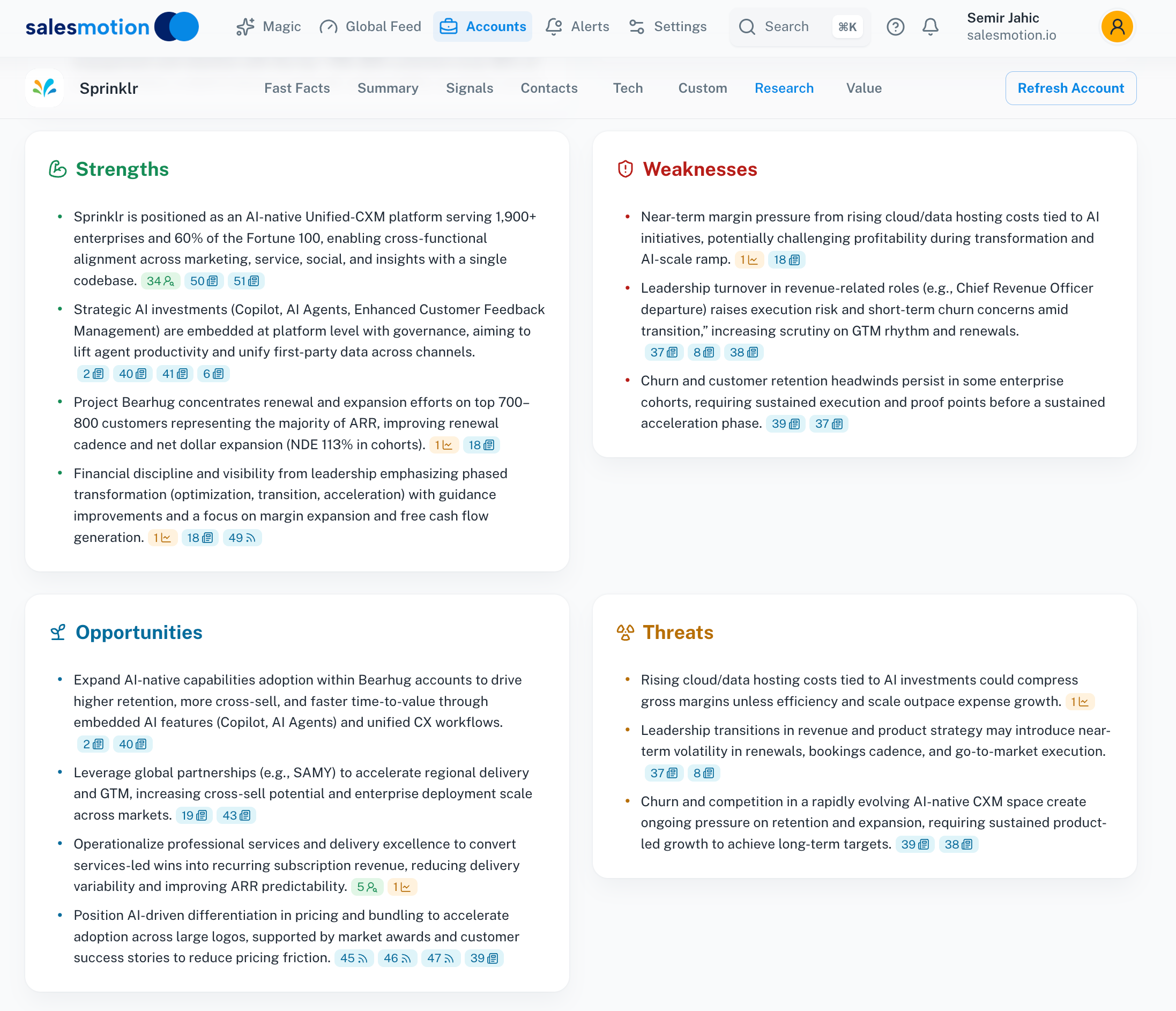 Salesmotion generates AI-powered SWOT analyses for each account, turning the static framework into a dynamic, always-current strategic tool.
Ultimately, knowing your strengths helps you focus your resources where they’ll make the biggest splash. To get a better handle on this, it helps to understand how to measure sales productivity so you know which activities are actually moving the needle.

“Salesmotion empowers me to cultivate a great buyer experience. I'm able to challenge prospects' thinking and be a trusted consultative seller. A major part of this is Salesmotion insights.”
Austin Friesen
Account Executive, FY25 #1 President's Club, Clari
Confronting Your Sales Weaknesses Head On
No sales team is perfect. Let's get that out of the way. Honestly addressing your internal vulnerabilities is the first step toward building a more resilient, predictable sales motion.
Ignoring weaknesses is the fastest way to lose winnable deals, so this part of your SWOT analysis for sales requires complete candor. This isn't about blame; it’s about turning problems into projects.
When you openly identify what's holding your team back, you create a clear roadmap for improvement. This gets both sales reps and RevOps working together to fix the foundational issues that slow everyone down.
Common Sales Weaknesses to Look For
Most teams, if they're being honest, struggle with similar internal challenges. As you start digging in, see if any of these common vulnerabilities feel familiar.
Here are a few I see all the time:
- Inconsistent Messaging: Your reps are all describing the product's value in completely different ways. Prospects get confused, and the message gets diluted.
- Over-reliance on a Single Lead Source: The pipeline is dangerously dependent on one channel, like inbound marketing. If that source dries up, you're in trouble.
- Lack of Timely Account Intelligence: Your team is flying blind. They're jumping on calls without knowing about recent company news, exec changes, or strategic shifts that could make or break the conversation.
Turning Vulnerabilities into Action
Okay, you've identified a weakness. That's only half the battle. The critical next step is to reframe it as an opportunity for improvement. This shifts the entire conversation from problems to solutions.
A weakness isn't a permanent flaw. It's a gap in your process or tech that needs a solution. By defining it clearly, you can build a specific, targeted plan to fix it.
Let's take a real-world example. Say you identify "weak 'why now' triggers" as a major vulnerability. Your reps struggle to create urgency because their outreach lacks a timely, relevant hook.
The action plan starts to write itself: implement a system for tracking real-time account signals. Suddenly, a vague problem becomes a concrete project with a measurable outcome—more relevant conversations and a healthier pipeline. By confronting these weaknesses head-on, you're not just fixing problems; you're building a stronger, more efficient sales engine.
Uncovering Market Opportunities You Might Be Missing
Opportunities are the external factors your team can pounce on—if you can spot them first. In a sales SWOT analysis, this isn't about vague statements like "the market is growing." It's about zeroing in on specific, actionable openings that give you an edge.
Think about tangible events. A major competitor has a public relations nightmare. A new industry regulation creates an urgent need for exactly what you sell. Or maybe a sudden shift in buyer behavior cracks open a new vertical. These are the goldmines.
The key is realizing that opportunities aren't found by luck. They're revealed when you systematically keep an eye on your market and target accounts.
Finding Actionable Account Intelligence
The best opportunities often hide in plain sight, disguised as everyday business news. This is where account intelligence comes in—it's how you spot these trends the moment they happen.
Here are a few examples of high-value opportunity signals I've seen play out:
- A target account brings in a new CRO, signaling a potential strategy shake-up.
- A prospect announces a major expansion or a new product launch, which means new budget and new needs are on the table.
- An executive from a key account goes on a podcast and talks about a challenge your product was built to solve.
An opportunity is an external event that gives your team a credible, timely reason to engage. When you can connect your strength to that opportunity, you create a powerful "why now" that competitors can't touch.
The shift to digital has only amplified these signals. The global B2B e-commerce market is expected to hit a staggering $61.9 trillion by 2030, and by 2025, a full 80% of B2B sales interactions will happen in digital channels. This means there are more public signals for your team to capture, assuming you have the right tools in place.
Turning Signals into Strategy
When you start tracking these signals systematically, you begin to see patterns. As you look at your current sales process, understanding new advancements like how AI Voice Agents are transforming customer service and sales can shine a light on massive areas for improvement.
This proactive approach to finding opportunities helps you get ahead of RFPs and frame the conversation on your terms, long before the competition even knows what's happening. You can get a deeper understanding of how to capture these buying signals by learning about B2B intent data and the role it plays in a modern sales motion.

“We have very limited bandwidth, but Salesmotion was up and running in days. The template made it easy to load our accounts and embedding it in Salesforce was simple. It was one of the easiest rollouts we've done.”
Andrew Giordano
VP of Global Commercial Operations, Analytic Partners
Preparing For External Threats To Your Pipeline
Threats are the external curveballs lurking outside your company that can derail your sales pipeline. Ignoring them is asking for missed quotas and a frantic scramble at the end of the quarter. This part of your SWOT analysis for sales is all about spotting these risks and, more importantly, getting ready for them.
These aren't internal problems you can fix with a new process; they're market realities you have to navigate. A new, well-funded competitor jumping into your space is a classic threat. So is an economic downturn that freezes your target industry’s budgets or a key technology you integrate with suddenly becoming obsolete.
The goal isn't to make a scary list. It's to build resilience so your team isn't caught flat-footed when the market inevitably shifts.
Building Proactive Contingency Plans
Identifying a threat is the easy part. Preparing for it is what separates great sales teams from the rest. The key is to ask, "If this happens, what's our move?" This simple question turns a passive analysis into an active, ready-to-use playbook.
Here are a few common scenarios and the kind of contingency plans you can build around them:
- Threat: A major competitor launches a price war, significantly undercutting your rates.
- Your Plan: Instead of getting dragged into a race to the bottom, you pivot the messaging hard. You arm your reps with talk tracks and case studies that focus exclusively on ROI, total cost of ownership, and the specific value your higher price delivers.
- Threat: Your primary target industry faces widespread budget cuts due to economic uncertainty.
- Your Plan: The team immediately shifts its outreach to focus on cost-saving and efficiency angles. Your messaging moves from "driving growth" to "protecting the bottom line," showing prospects how your solution helps them do more with less.
A good SWOT analysis doesn't just list threats; it forces you to build an "if-then" response for each one. This preparation is what allows your team to be agile and confident in the face of market uncertainty.
By thinking through these scenarios ahead of time, you equip your reps with the strategic responses they need to handle objections, reframe conversations, and protect deals that would otherwise be lost. It’s about controlling what you can—your team's preparation and response—in a market full of variables you can't.
Turning Your SWOT Into Actionable Sales Plays
An analysis is useless if it just sits in a folder. The real value of a SWOT analysis for sales comes from turning what you've learned into concrete, repeatable sales plays that your team can execute right away.
This is where you connect the dots between insight and action. The goal is to systematically match your internal factors (Strengths, Weaknesses) with external factors (Opportunities, Threats) to build a clear game plan. This is often called a TOWS analysis, and it’s the bridge that gets you from a grid on a whiteboard to real-world results.
From Grid to Game Plan
Instead of just looking at each quadrant in isolation, you combine them to forge your strategy.
- Strengths-Opportunities (SO): How can you use your core strengths to jump on market opportunities? For instance, you could use your deep library of strong case studies (Strength) to target a competitor’s unhappy customers after their recent service outage (Opportunity).
- Weaknesses-Opportunities (WO): How can you use an opportunity to fix an internal weakness? If you have a slow, clunky proposal process (Weakness), you can capitalize on a new market need for rapid deployment (Opportunity), which forces you to finally streamline your system.
- Strengths-Threats (ST): How can your strengths be used to neutralize external threats? If a new, aggressive competitor enters your space (Threat), lean hard on your strong brand reputation (Strength) to create messaging that hammers home trust and reliability.
The ultimate goal of a sales SWOT is to build a B2B sales strategy that closes deals and drives real growth. Every combination you identify should result in a specific, actionable play for the team.
This simple flowchart breaks down how to handle threats: you identify them, analyze their potential impact, and then create a plan to mitigate the risk before it hits your pipeline.
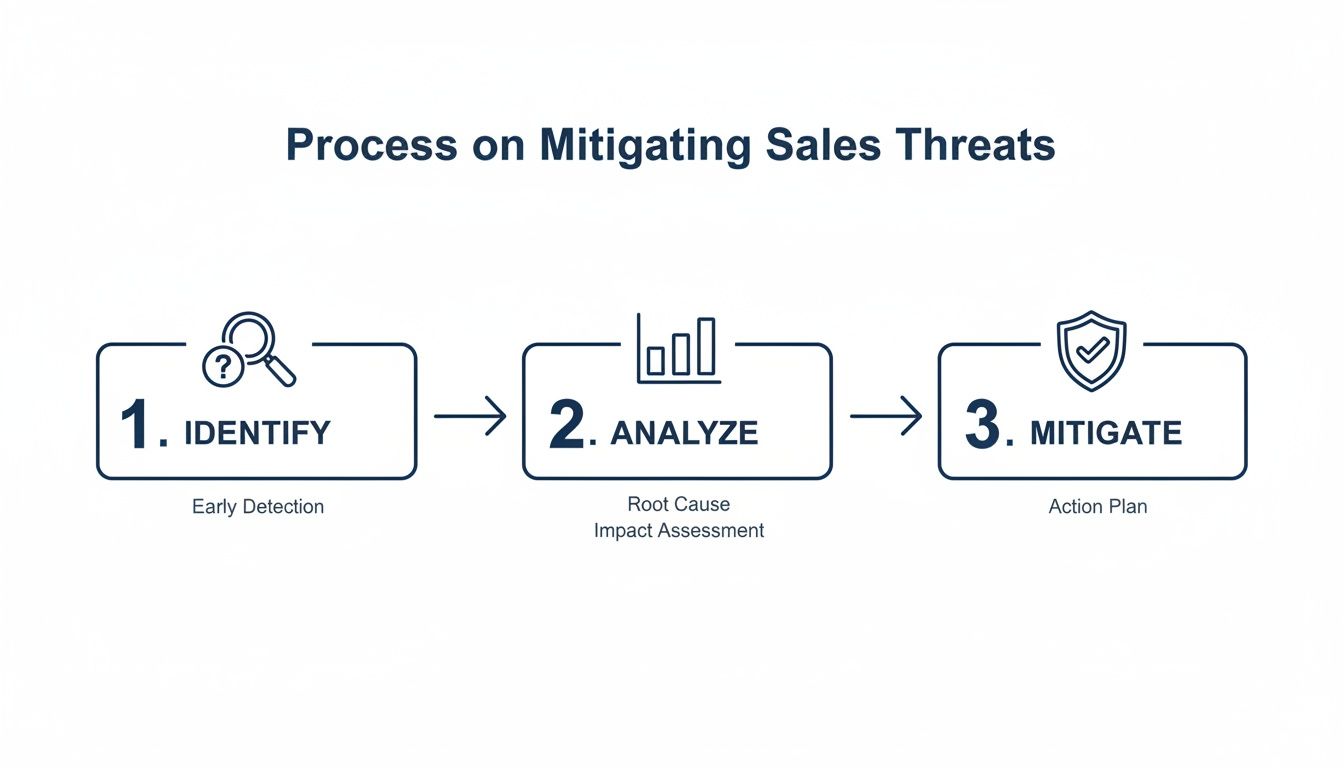
This proactive approach ensures your team isn't caught off guard. These strategies become the foundation for your revenue engine. The next logical step is to organize them. Looking at different sales playbook examples is a great way to structure these plays so your team can use them effectively.
This process directly translates your analysis into more pipeline and, ultimately, more closed deals.
Let's look at how this works in practice. The table below shows how different combinations from your SWOT/TOWS analysis can be turned into specific, actionable sales plays.
Example Sales Plays From a SWOT Analysis
| Strategy Type | Example Scenario | Resulting Sales Play |
|---|---|---|
| SO (Strengths-Opportunities) | Your product has best-in-class security features (Strength) and a new industry regulation requires higher data protection (Opportunity). | Launch a targeted outbound campaign to companies in that industry, highlighting your specific security certifications and offering a "Compliance-Readiness" demo. |
| WO (Weaknesses-Opportunities) | Your sales team has limited experience selling to the enterprise (Weakness), but there’s a surge in demand from large companies in a new vertical (Opportunity). | Partner with a seasoned consultant to run an enterprise sales workshop. Create a dedicated "Enterprise Strike Team" to focus solely on these larger accounts with extra support. |
| ST (Strengths-Threats) | You have a highly-rated customer support team (Strength), but a low-cost competitor is gaining market share (Threat). | Create a "Total Cost of Ownership" battle card for the sales team that emphasizes the value of premium support and the hidden costs of downtime associated with cheaper alternatives. |
| WT (Weaknesses-Threats) | Your product lacks a key integration (Weakness), and your main competitor just announced a partnership with that platform (Threat). | Immediately build a short-term workaround guide for prospects. In parallel, fast-track the integration on your product roadmap and create a pre-launch waitlist to build demand. |
As you can see, the framework doesn't just identify issues—it gives you a clear path to creating strategic responses that your sales team can run with.
Key Takeaways
- A sales-specific SWOT analysis goes beyond generic business planning to examine your team's competitive position, pipeline health, and ability to win specific deals.
- Identifying true sales strengths requires honest assessment of what your team actually does better than competitors, not just what your marketing materials claim.
- Weaknesses like slow response times, gaps in product knowledge, or poor CRM discipline are the internal factors most likely to cost you deals if left unaddressed.
- The real power of SWOT comes from cross-referencing quadrants using SO, WO, ST, and WT strategies that turn the analysis into specific, executable sales plays.
- Regular SWOT reviews, ideally quarterly, keep your team's messaging, competitive positioning, and account strategies aligned with current market conditions rather than outdated assumptions.
Got Questions About Sales SWOT Analysis? We Have Answers.
Still have a few questions? Perfect. Here are straightforward answers to the questions I hear most often from sales leaders digging into a SWOT analysis for sales.
How Often Should We Run a Sales SWOT Analysis?
For most B2B sales teams, doing a full deep-dive every quarter is the right cadence. It keeps you in sync with market shifts, competitor moves, and internal changes. But please, don't let it become a static report that just gathers dust.
A SWOT should be a living document.
The best teams revisit the key takeaways briefly in their weekly meetings. You should also pull it out anytime a major event happens—a new competitor launches a killer feature, you notice a sudden shift in buyer behavior, or the economic climate takes a sharp turn.
Who Needs to Be in the Room for This?
To get a truly 360-degree view, you need a mix of voices at the table. Don't make this a leadership-only exercise. The magic happens when you get a cross-section of your entire revenue team involved.
Make sure you invite:
- Sales leadership (of course)
- A few of your top-performing account executives
- A rep who might be struggling (their perspective on weaknesses is pure gold)
- Your front-line Sales Development Reps (SDRs)
- Someone from marketing and customer success to break down silos
The biggest mistake you can make is running this as a top-down mandate. When the whole team has skin in the game, the analysis is sharper, and more importantly, the action plan that comes out of it actually gets adopted.
What's the Number One Mistake to Avoid?
Getting lazy and being too generic. Vague, fluffy points like "good communication" as a strength or "the economy" as a threat are useless. They don't lead to action.
Specificity is everything. A useful analysis lives in the details.
Instead of "good communication," a better strength would be something you can actually measure, like, "Our team's average response time to new inbound leads is under 5 minutes." That's a real, tangible advantage. This level of detail is what turns a simple SWOT analysis for sales from a box-ticking exercise into a seriously powerful strategic weapon.
Tired of reps wasting hours on manual research? Salesmotion is an AI-powered account intelligence platform that delivers real-time, actionable insights directly into your workflow. Stop guessing and start engaging with context that wins deals. Learn more at https://salesmotion.io.
Frequently Asked Questions
How is a sales SWOT analysis different from a regular business SWOT?
A sales-specific SWOT focuses on factors that directly affect your team's ability to win deals, such as competitive positioning, pipeline health, messaging effectiveness, and rep capabilities. A traditional business SWOT examines broader organizational concerns like brand reputation, supply chain, and corporate strategy. The sales version is more granular and action-oriented, designed to produce specific plays your team can execute immediately.
What is a TOWS analysis and how does it relate to SWOT?
A TOWS analysis takes the four quadrants from your SWOT and cross-references them to create actionable strategies. For example, you combine Strengths with Opportunities (SO) to identify offensive plays, or match Strengths with Threats (ST) to build defensive responses. It is the bridge between identifying factors in your SWOT and turning them into concrete sales plays your team can run.
Who should participate in a sales SWOT analysis session?
The most effective sessions include a cross-section of your revenue team: sales leadership, top-performing account executives, front-line SDRs, and representatives from marketing and customer success. Including a rep who may be struggling is also valuable because their perspective on weaknesses is often the most honest and actionable. Limiting the exercise to leadership alone produces a skewed view that misses critical ground-level insights.
How do I turn SWOT findings into measurable sales actions?
Start by matching each identified factor to a specific, executable sales play with a clear owner and timeline. For example, if you identify a competitor's service outage as an Opportunity and your strong case studies as a Strength, the resulting play might be a targeted outbound campaign to that competitor's customer base. Each play should have a measurable outcome, such as meetings booked or pipeline created, so you can track whether the analysis is driving results.
Can a SWOT analysis help with competitive deal strategy?
Absolutely. A well-done SWOT gives your reps the intelligence they need to handle competitive situations with confidence. By identifying your strengths against specific competitors and preparing contingency plans for their advantages, you can build battle cards and talk tracks that are grounded in real analysis rather than guesswork. This preparation is especially valuable when a new competitor enters your space or an existing rival launches a disruptive feature.