Zymewire
Custom (annual)
biopharma intel · annual
Salesmotion
From $85/mo
monthly contract · verified contacts included
Zymewire is a biopharma data tool. Salesmotion is broader account intelligence with signals across every industry, $85/mo to start.
- 3 AI agents on every account: signals, research briefs, drafted outreach
- Live in an hour, monthly billing, no annual contract
- Verified contacts included; CRM integration on custom team & enterprise plans
Why life sciences teams are re-evaluating Zymewire
Zymewire built its reputation as the sales intelligence platform for teams selling into biotech and pharma. With over 400 clients (including top CROs and CMOs) and deep coverage of stealth companies, funding events, and early-stage biotech data, it became the default choice for service providers targeting the biopharma sector.
But as account portfolios grow and sales motions shift toward signal-based prospecting, teams managing 200+ accounts need more than company discovery. They need real-time alerts, AI-generated account briefs, and buying signal detection that connects clinical milestones to commercial urgency. A March 2026 analysis by CB Insights identified seven specialized alternatives now competing for the same budget, each offering different strengths depending on your sales workflow.
This comparison focuses on platforms built for life sciences sales teams managing large account books, not general-purpose B2B tools repurposed for pharma.
See Salesmotion on a real account
Book a 15-minute demo and see how your team saves hours on account research.
What Zymewire does well (and what it doesn't)
Zymewire excels at three things: identifying stealth biotech companies before they announce publicly, tracking funding rounds and early-stage future plans, and segmenting company lists by over 150 data points including pipeline value and employee count. It's built for business development teams prospecting into newly funded biotechs and positioning for upcoming trial opportunities.
But Zymewire's model is discovery-first, not signal-first. If you're managing a large book of existing accounts and need to know when each account enters a buying window (Phase III progression, FDA approval, new CSO hire), you'll still be manually checking ClinicalTrials.gov, FDA calendars, and LinkedIn. Zymewire provides the "who" exceptionally well but leaves the "when" and "why now" to manual research.
Teams that adopted Zymewire for stealth company identification often layer on other tools for ongoing account monitoring, creating the same five-tool workflow the category is trying to replace.

“Salesmotion is helping Cytel elevate our enterprise sales performance by embedding account intelligence directly into our workflow. The platform gives our commercial team real-time visibility into key account movements.”
Jonathan Burr
Chief Commercial Officer, Cytel
Salesmotion: best for real-time buying signals across clinical and commercial milestones
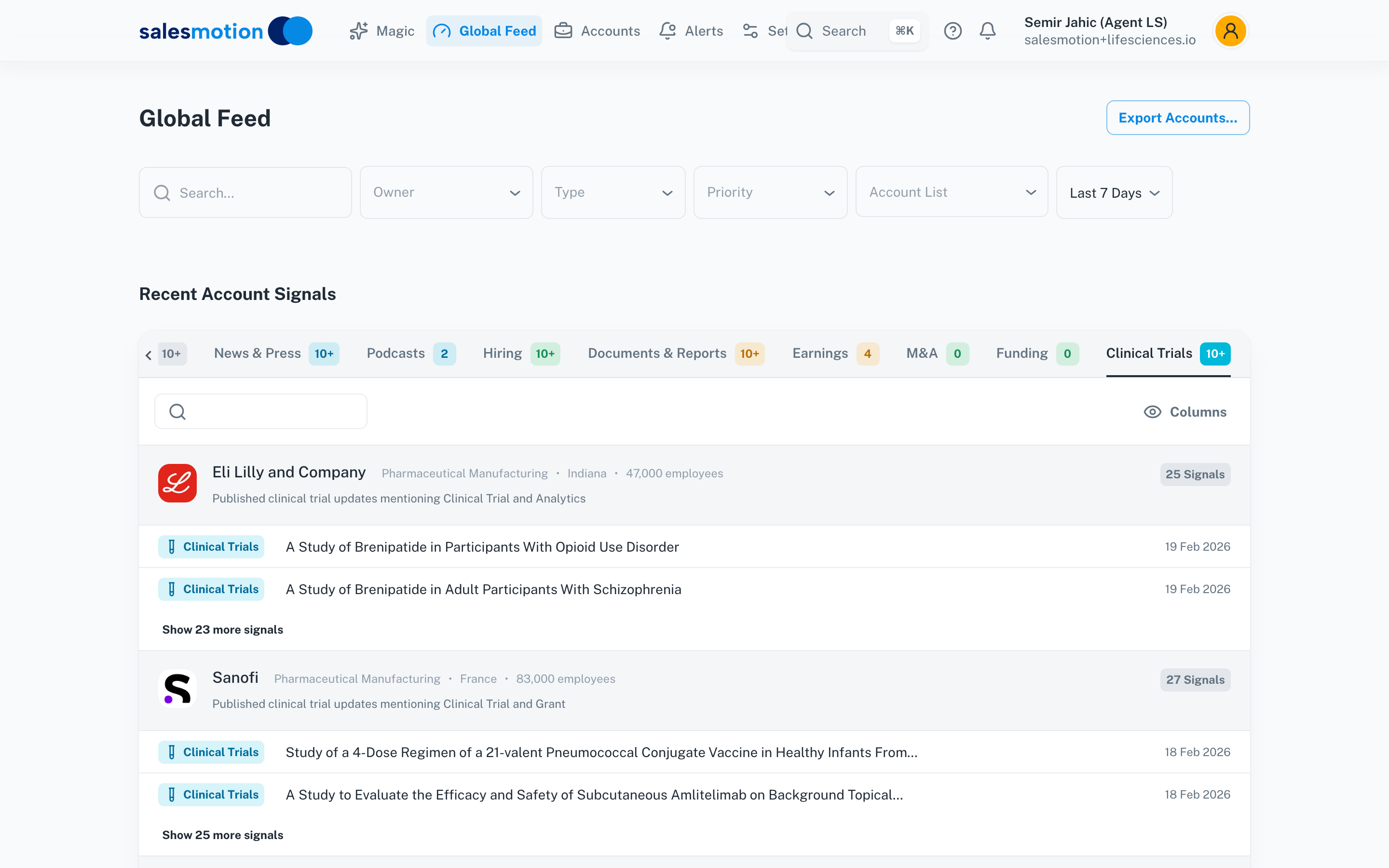 Salesmotion's Signal Feed filtered to clinical trials, showing real-time Phase transitions, trial updates, and regulatory filings across monitored biotech accounts.
Salesmotion is an AI-powered account intelligence platform designed for B2B sales teams managing large account portfolios. For life sciences specifically, it monitors 1,000+ sources including ClinicalTrials.gov, FDA approvals, SEC filings, earnings calls, patent databases, job boards, and industry news to surface buying signals the moment they happen.
The platform is organized around three AI agents: a Signal Agent that monitors accounts 24/7 for compelling events, a Research Agent that generates instant account briefs citing 42+ sources, and an Outreach Agent that drafts contextualized messaging based on detected triggers. In a 2026 case study, Cytel, a leader in clinical trial analytics and evidence generation software, cut account research time by 50% and replaced a workflow that previously required five separate tools. Cytel's commercial team went from manually Googling each biotech account and skimming trial databases to having the platform surface which companies just advanced a Phase III oncology trial or hired a new VP of Clinical Operations — the exact signals that indicate readiness to invest in trial design or statistical software.
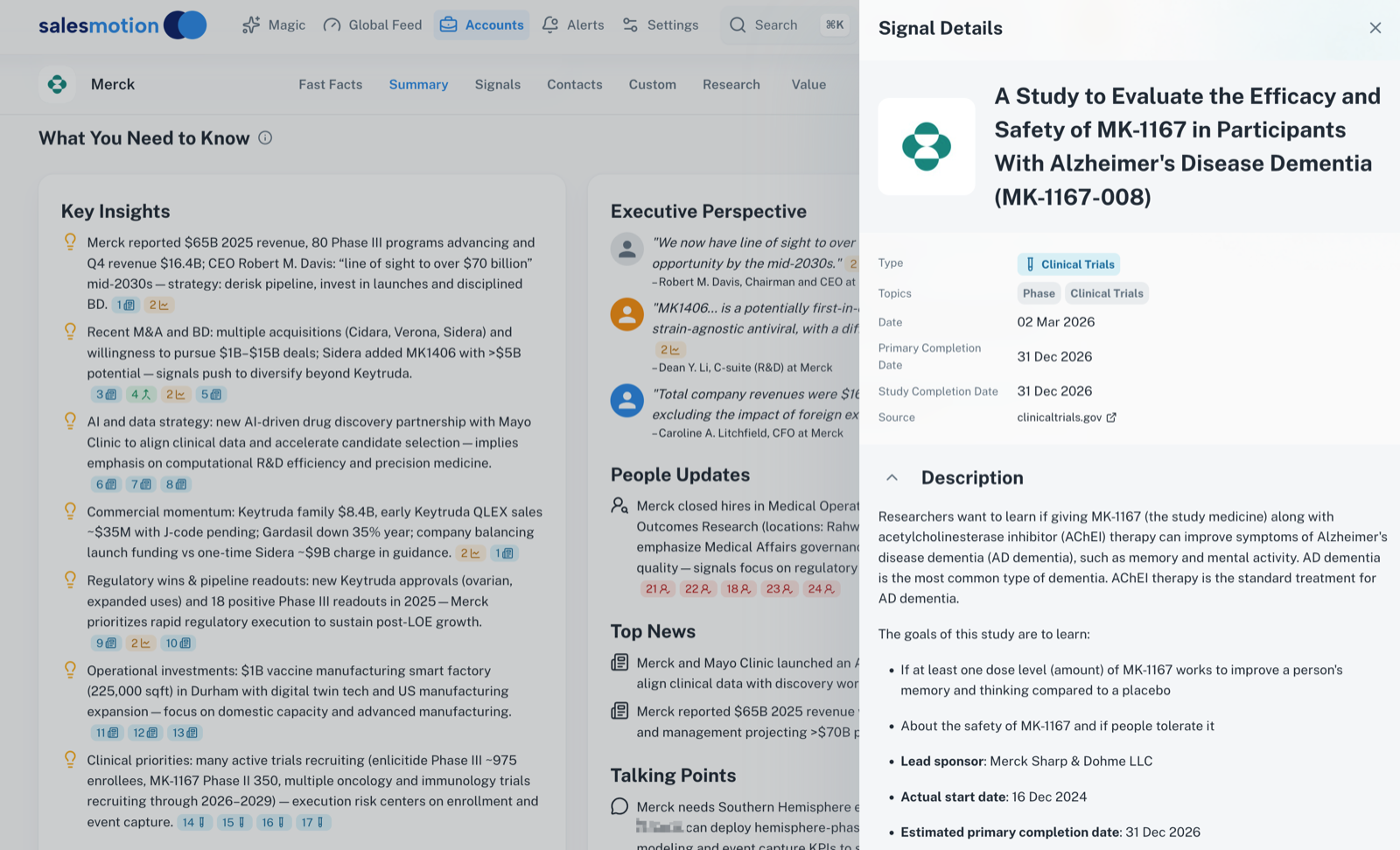 A clinical trial signal for Merck's MK-1167 Alzheimer's study, showing trial phase, completion dates, and full account context in a single view.
What sets Salesmotion apart for life sciences is signal specificity. The platform tracks over 50 signal types relevant to biopharma sales: Phase I/II/III trial transitions, FDA PDUFA dates, NDA and BLA submissions, clinical trial site additions, enrollment completion, patent expiration, biotech funding rounds, CSO and VP-level hires, partnership announcements, and M&A activity. Each signal includes context ("Company X hired a Chief Commercial Officer, signaling preparation for Phase III trial launch in Q3 2026") and suggested next actions.
Unlike discovery-focused platforms that help you build target lists, Salesmotion emphasizes ongoing monitoring across your full book of business. If you're managing 500 accounts, the Signal Feed shows which five accounts had meaningful developments in the past 24 hours, allowing reps to prioritize outreach based on timing rather than guesswork.
The platform operates on monthly contracts with unlimited users on team plans and goes live within hours of setup. Salesmotion holds a G2 rating of 4.8 and is used by companies including Clari, Domo, Sigma, Seismic, and multiple clinical research organizations.
Best for: Teams managing large life sciences account portfolios (200+ accounts) who need always-on signal monitoring, AI-generated account briefs, and integration with Salesforce or HubSpot.
Amplion: AI-powered lead generation for life sciences commercial teams
Amplion (acquired by Science & Medicine Group in 2022) provides machine learning-based market intelligence for life sciences commercial teams. The platform specializes in lead generation by identifying healthcare professionals (HCPs), research institutions, and biotech companies actively working in specific therapeutic areas or disease states.
According to Pharmaceutical Executive, Amplion's capabilities allow commercial teams to "precisely target the right accounts and most appropriate stakeholders" by mining biomedical literature, clinical trial registries, and grant databases. The system uses natural language processing to surface HCPs publishing in targeted therapeutic areas, investigators running relevant trials, and institutions receiving NIH funding for specific disease research.
Amplion's strength is depth in scientific context: it can identify which KOLs are authoring papers on CAR-T therapies, which academic medical centers are enrolling patients in rare disease trials, and which biotech companies have preclinical programs in specific molecular pathways. This makes it valuable for teams selling into early-stage research (reagents, lab services, preclinical CROs) where scientific expertise matters more than commercial maturity.
The limitation: Amplion is optimized for scientific lead generation, not commercial buying signal detection. It won't tell you when a biotech just raised Series B funding, hired a CMO, or filed an IND. Teams use it to build lists of "who to talk to," then rely on other tools to determine "when to reach out."
Best for: Commercial teams in reagents, lab services, and early-stage CROs who need to identify researchers and institutions by therapeutic area and scientific activity.

“We had a variety of tools, and that was the pain — the variety. We had to go to multiple places to get streamlined data.”
Lyndsay Thomson
Head of Sales Operations, Cytel
Kognitic: clinical trial intelligence and pipeline forecasting
Kognitic is an automated clinical trial intelligence platform that accelerates drug development decision-making through AI-powered trial data analysis. The system tracks clinical trial timelines, benchmarks competitor development programs, and predicts trial completion dates with accuracy that has improved substantially over manual forecasting.
A January 2025 study published by Yahoo Finance showed Kognitic's AI model reduced primary completion date prediction errors from 508 days (industry average) to 179 days, enabling more accurate site planning, vendor selection, and resource allocation. The platform monitors ClinicalTrials.gov and other global registries to answer questions such as: Which trial sites are competitors using? What patient populations are being studied? How long do Phase II trials in this indication typically take?
Kognitic offers specialized modules for oncology and other therapeutic areas, providing CI teams with competitive trial landscape mapping, site selection benchmarking, and development timeline forecasting. The platform is used by business intelligence teams, clinical operations, and strategic planning groups who need deep analytical capabilities beyond basic trial tracking.
For sales teams, Kognitic's value is indirect: it provides extraordinary depth on what is happening in clinical development but doesn't surface when accounts are ready to buy. A CRO strategy team might use Kognitic to model which sponsors will need Phase III sites in 18 months, but the sales team still needs separate tools to detect when those sponsors actually post jobs, announce partnerships, or file regulatory submissions.
Best for: Clinical development teams, competitive intelligence analysts, and strategic planning groups that need deep trial benchmarking and predictive timeline modeling.
BioScoutr: cost-effective pharma and biotech leads database
BioScoutr positions itself as the most comprehensive pharmaceutical and biotech leads database, offering access to over 550,000 verified contacts across 4,000+ companies. The platform emphasizes affordability and data quality, claiming to deliver results at 30% lower cost than hiring internal sales reps.
The database allows segmentation by company size, stage (preclinical, clinical, commercial), therapeutic area, funding history, and pipeline status. BioScoutr also offers a managed service where their team conducts outbound outreach on your behalf using a "phone-first, multichannel approach" designed to generate 15+ meetings per week with decision-makers.
According to a September 2024 blog post, BioScoutr differentiates from Zymewire and GlobalData through "proprietary AI-driven data collection and validation," though specific methodology isn't disclosed. The platform provides detailed company profiles, decision-maker contact information, and R&D pipeline insights to support cold outreach.
BioScoutr works well for teams that need a clean, segmented contact list to feed into sequences. It's a database play, not an intelligence platform: you get names, titles, emails, and basic firmographics, but no real-time alerts when accounts change status, no account briefs that synthesize strategic context, and no buying signal detection.
Best for: Teams with tight budgets who need verified contact lists and are willing to handle signal detection and account research separately.
ZoomInfo Sales: largest B2B database with intent signals
ZoomInfo Sales is the largest B2B contact and company intelligence platform, providing access to 320M+ professional contacts and organizational charts across industries. For life sciences teams, ZoomInfo offers contact enrichment, intent data (tracking which accounts are researching related topics), and Chorus.ai conversation intelligence for call analysis.
ZoomInfo's strength is breadth: if you need to find the VP of Clinical Operations at any mid-sized biotech, ZoomInfo likely has that contact with a verified email and mobile number. The platform also tracks technographic data (what software companies use), funding events, and news mentions, making it useful for basic account prioritization.
The limitation for specialized life sciences workflows is depth. ZoomInfo doesn't monitor ClinicalTrials.gov for phase transitions, doesn't track FDA PDUFA calendars, and doesn't parse earnings calls for pipeline updates. Its intent data detects when a company visits your website or researches your category, but it won't tell you when a biotech completes enrollment or files an IND.
Teams often use ZoomInfo for contact discovery and layer on a specialized platform like Salesmotion for life sciences-specific buying signals. The combination works: ZoomInfo provides the org chart, and signal-based tools provide the "why now."
Best for: Enterprise sales teams needing broad B2B contact coverage who plan to supplement with vertical-specific intelligence for clinical and regulatory triggers.
Cognism: GDPR-compliant data for European life sciences markets
Cognism is a sales intelligence platform focused on European markets, offering GDPR-compliant contact data, phone-verified mobile numbers (Diamond Data), and intent tracking. For life sciences teams selling into EU-based pharma, biotech, or CROs, Cognism provides cleaner, more compliant data than U.S.-centric platforms.
The platform tracks firmographic changes, funding events, and hiring activity, and integrates with Salesforce and Outreach for workflow automation. Cognism's differentiator is compliance: every contact record meets GDPR standards, reducing legal risk for European outbound programs.
Like ZoomInfo, Cognism is a horizontal B2B tool adapted for life sciences rather than purpose-built for the sector. It won't track clinical trial milestones, regulatory submissions, or pipeline developments. Teams use it for contact acquisition in Europe and pair it with vertical tools for signal detection.
Best for: Sales teams focused on European pharma and biotech markets who need GDPR-compliant contact data and phone-verified mobile numbers.
Apollo.io: all-in-one prospecting for budget-conscious teams
Apollo.io combines a B2B contact database (275M+ contacts) with built-in email sequencing, dialer, and AI-powered personalization. It's designed as an end-to-end prospecting platform for teams that can't afford (or don't want) separate tools for data, outreach, and engagement tracking.
Apollo offers basic firmographic filters (industry, employee count, funding stage) and tracks job changes and company news. The platform's strength is accessibility: pricing starts significantly lower than ZoomInfo or Cognism, and the workflow is simple enough for individual reps to manage without sales ops support.
For life sciences, Apollo works as a lightweight contact tool for high-volume outbound. If you're prospecting into hundreds of early-stage biotechs and need a quick way to find emails and launch sequences, Apollo handles that efficiently. But it lacks the clinical trial tracking, regulatory monitoring, and pipeline intelligence that define purpose-built life sciences platforms.
Best for: Startups and small teams selling into life sciences who need affordable, all-in-one prospecting and are comfortable with general B2B data rather than specialized biopharma signals.
Choosing the right platform for your life sciences sales motion
The decision between Zymewire alternatives depends on three factors: account coverage model, signal priority, and sales motion complexity.
If you manage a large, defined account book (200+ pharma or biotech accounts) and need to know when each account enters a buying window, prioritize signal-based platforms. Salesmotion's Signal Agent monitors clinical, regulatory, and commercial triggers across your full portfolio, surfacing the five accounts that had meaningful developments today. This model scales: one rep can cover 500 accounts because the system tells them where to focus.
If you're building territory from scratch and need to discover who to target, discovery-focused tools like Zymewire (stealth biotech identification) or Amplion (scientific lead generation) create top-of-funnel lists. These platforms answer "who should I add to my CRM" rather than "which existing accounts are ready to buy now."
For teams needing deep competitive intelligence or clinical benchmarking (common in CRO strategy and BD roles), Kognitic's trial analytics and forecasting provide analytical depth that discovery and signal tools don't offer. It's not a prospecting tool; it's a strategic planning tool.
Finally, if your primary constraint is budget or European market focus, horizontal B2B platforms like Apollo (affordable, all-in-one), ZoomInfo (breadth and org charts), or Cognism (GDPR compliance) provide foundational contact data. You'll need to manually layer on clinical trial monitoring and regulatory tracking, but the cost structure works for smaller teams.
Most high-performing life sciences sales teams don't rely on a single tool. The common pattern: one specialized platform for signal detection and account intelligence (Salesmotion, Amplion, Kognitic), one broad contact database for org charts and enrichment (ZoomInfo, Cognism), and native CRM workflows for sequencing and follow-up. The question isn't "which tool replaces everything" but "which combination eliminates the most manual research while keeping stack costs reasonable."
How to evaluate buying signal coverage for your vertical
Not all life sciences sales teams need the same signals. A lab equipment vendor prospecting into early-stage biotech cares about Series A funding, new lab space leases, and CSO hires. A clinical trial software provider cares about IND filings, Phase II-to-III transitions, and new trial site activations. A pharmaceutical packaging supplier cares about NDA submissions, manufacturing expansions, and commercial launch timelines.
When evaluating Zymewire alternatives, map the platform's signal taxonomy to your actual sales triggers. Request a demo account and ask: "Show me every signal type you track for a biotech company transitioning from Phase II to Phase III." The best platforms will surface 8-12 distinct signals (enrollment completion, protocol amendments, investigator meetings, CMC filings, partnership announcements, commercial team hiring). Weak platforms will show "news mention" and "funding event."
Second, test alert latency. In a February 2026 comparison, we found signal detection delays ranging from real-time (Salesmotion's ClinicalTrials.gov monitoring) to 7-14 days (platforms relying on aggregated news feeds). If a competitor is calling the same account within 48 hours of a trial milestone, 14-day latency means you're always reacting, never leading.
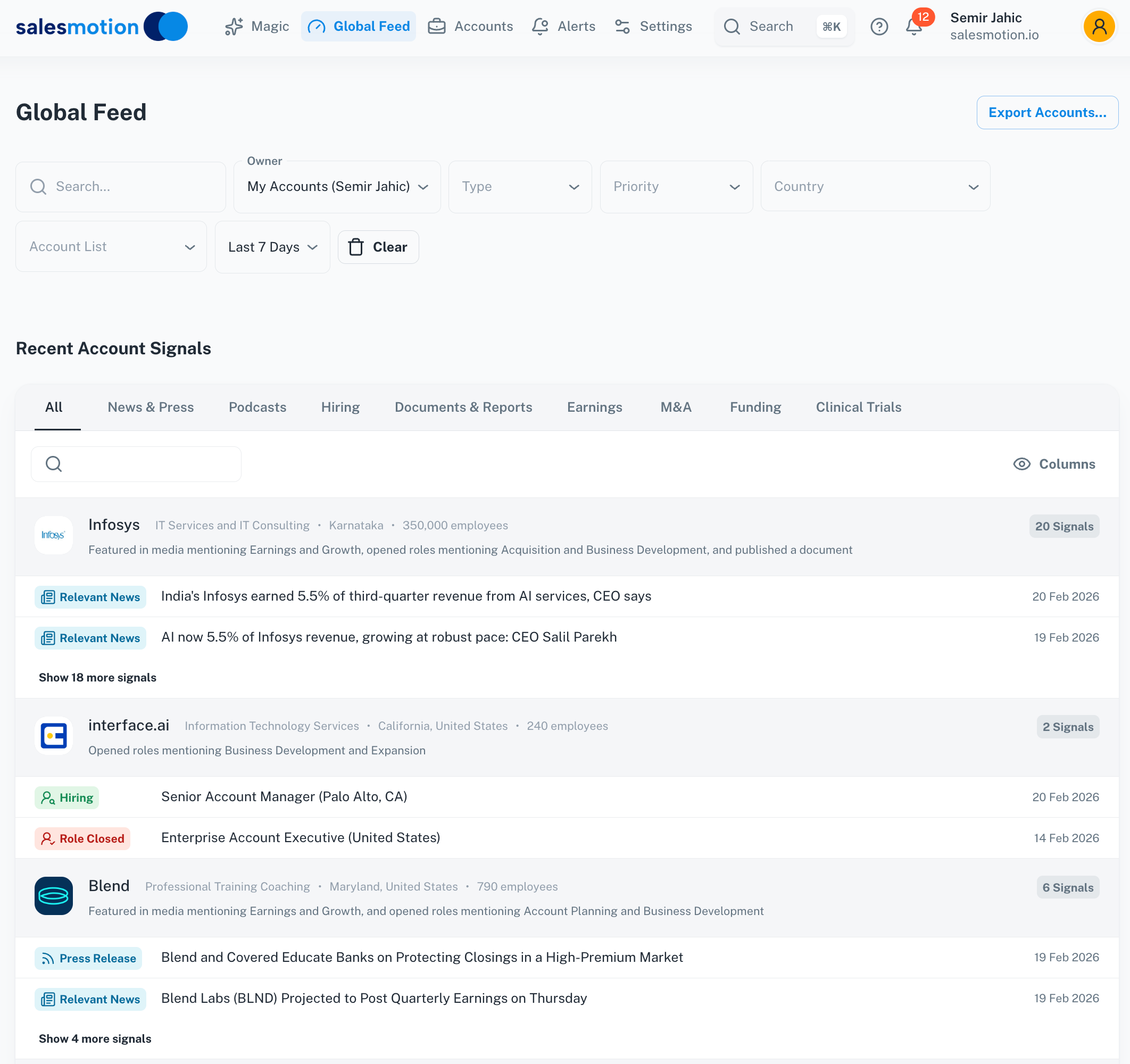 Real-time signal detection means your team sees clinical milestones, funding events, and leadership changes the moment they happen, not days later.
Third, evaluate research depth. Ask the platform to generate an account brief for a target company and measure how many sources it cites, whether it connects clinical milestones to commercial implications, and if it suggests specific talking points. Platforms that pull from 40+ sources and generate "why this matters" context (like Salesmotion's Research Agent) reduce prep time from 60 minutes to under 5 minutes per account. Platforms that return a bulleted news summary still leave the synthesis work to the rep.
What teams managing 200+ life sciences accounts actually need
The shift from discovery tools to signal-based intelligence reflects a broader change in how life sciences sales teams operate. Five years ago, most teams had defined territories of 50-100 accounts and relied on manual research, quarterly business reviews, and relationship selling. Today, account loads have expanded (many AEs now manage 300-500 accounts), buying cycles have compressed, and procurement teams expect reps to arrive with specific, timely insights tied to the company's current strategic priorities.
This creates an operational problem: if account research takes 45-60 minutes per account (the industry average according to a 2026 Salesmotion survey), a rep with 400 accounts would need 300 hours just to research their book once. Even with perfect discipline, that's only possible quarterly, which means 9 out of 10 accounts go untouched between check-ins.
Signal-based platforms solve this by inverting the workflow. Instead of "research every account quarterly and guess who's ready to buy," teams monitor all accounts continuously and surface the 2-3% actively in a buying window. The rep doesn't research 400 accounts; the system flags the 8 accounts that hired a CMO this week, advanced to Phase III, or announced a manufacturing partnership.
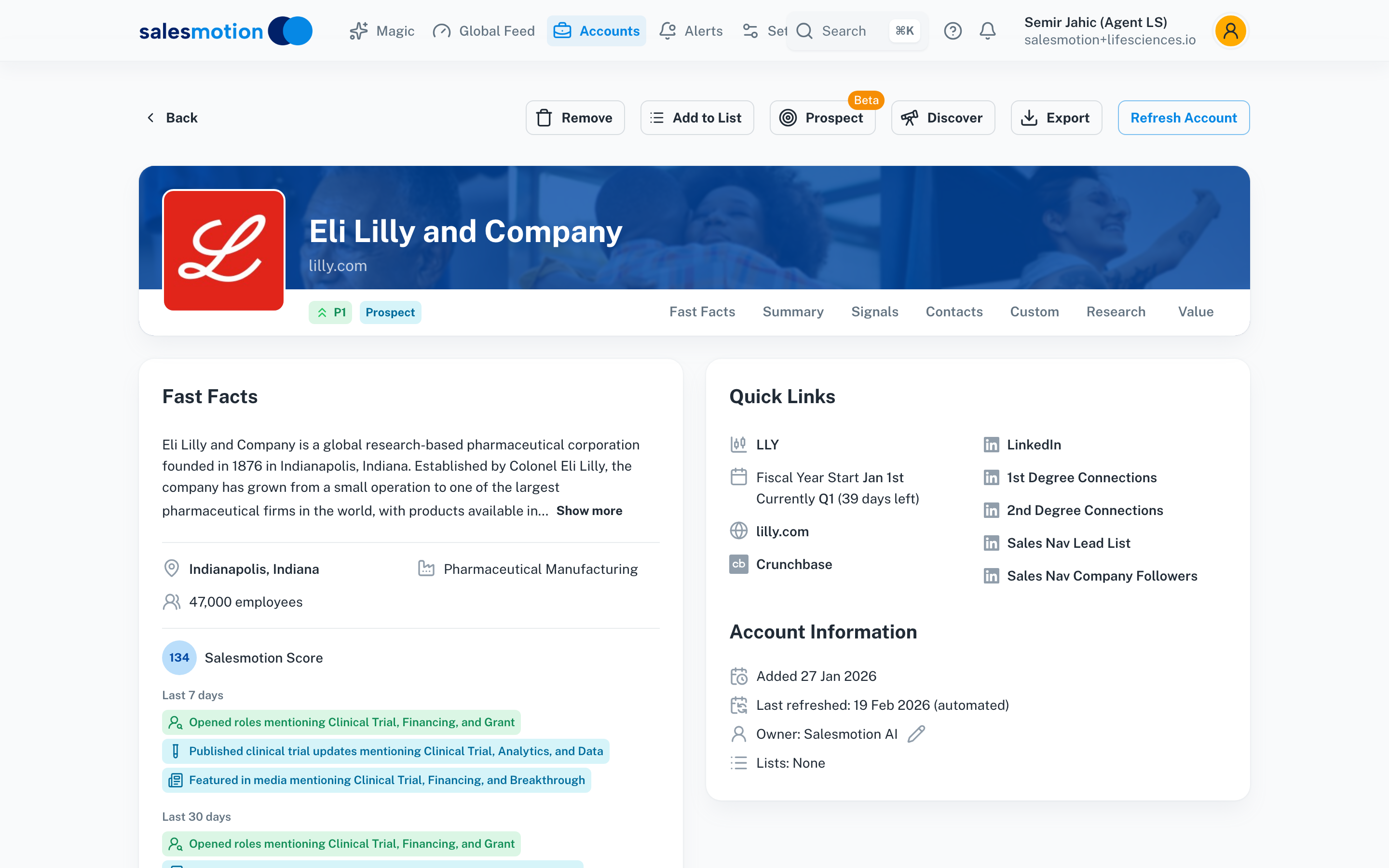 An Eli Lilly account profile showing clinical trial signals, funding mentions, and research activity, all in one view instead of five separate tools.
This model only works if the platform is purpose-built for your vertical. Generic B2B intent ("Account visited your pricing page") doesn't carry the same weight as vertical-specific triggers ("Account filed IND for lead asset, signaling need for Phase I CRO within 90 days"). The platforms that win in life sciences are the ones that understand what clinical trial phase transitions, FDA calendars, and pipeline milestones actually mean for procurement timing.
Zymewire built the category by understanding biotech discovery workflows better than anyone. The next generation of platforms is building for signal-based account management at scale, where the challenge isn't finding companies but knowing when each company is ready to engage.