Most sales teams treat account planning like a once-a-year homework assignment: fill in the template before QBR, present it to leadership, then forget it exists. The result is predictable. According to Momentum ITSMA, fewer than 20% of companies have fully embedded account planning into their business operations. Meanwhile, companies that do it well attribute up to 77% of their revenue growth to account-based strategies.
This guide walks you through building account plans that survive first contact with reality. Not a theoretical framework. A working system you can deploy this quarter.
TL;DR: Effective account planning starts with disciplined account selection using ICP scoring, builds depth through stakeholder mapping and competitive analysis, and only works long-term with a quarterly review cadence. The biggest failure point is not the plan itself but keeping it current. Teams that automate the research layer and connect plans to live buying signals consistently outperform those relying on manual updates and rep memory.
What Is Account Planning and Why Does It Matter?
Account planning is the structured process of analyzing a target account's business, identifying opportunities to create value, and building a coordinated strategy to win, retain, or expand that account. A real account plan maps stakeholders, competitive landscape, strategic priorities, and specific actions your team will take over the next 90 to 180 days.
B2B deals now involve an average of 11 stakeholders, according to Salesforce's State of Marketing 2025 Report. Complex buying groups mean single-threaded selling is a losing strategy. Account planning forces multi-threading by design.
The revenue impact is clear. ITSMA research shows that organizations with mature account-based programs report 72% higher ROI than any other marketing investment. Companies using structured account planning see 28% faster sales cycles and 35% higher close rates. A global study of 1,034 participants across 62 countries found that 75% of organizations won more deals, 49% reported bigger deal sizes, and 58% closed deals faster.
Auto-generate account plans with AI research
Salesmotion builds living account plans from 1,000+ sources — updated continuously, not quarterly.
Why Do Traditional Account Plans Fail?
The once-a-year, check-the-box exercise is fundamentally flawed. Key contacts leave, new executives arrive, strategies pivot overnight. A plan built in January is fiction by March.
While 61% of B2B companies see strategic account management as critical for growth, 71% saw sales improve by less than 26% after launching programs. The manual research tax compounds the problem. Reps spend up to 65% of their time on non-revenue-generating activities. One AWS sales manager reported spending up to 40 hours per customer. At that pace, maintaining plans across a territory is impossible.
Static vs. Dynamic Account Planning
| Attribute | Static (Old Way) | Dynamic (New Way) |
|---|---|---|
| Cadence | Annual or quarterly chore | Continuous, always-on process |
| Data Source | Manual research, rep's memory | Automated signals, intent data, triggers |
| Output | Static PowerPoint or Word document | Dynamic insights in the CRM |
| Focus | Internal review, checking the box | Proactive engagement, timely outreach |
| Rep Experience | A dreaded, time-consuming chore | A value-add that helps win deals |
| Adaptability | Rigid; becomes outdated immediately | Fluid; adapts to market and account changes |
The alternative is signal-based selling applied to planning: continuous intelligence rather than periodic deep dives. A target account hires a new CIO from a company that was your customer. An earnings call reveals a new strategic focus on operational efficiency. A key decision-maker posts about a challenge you solve. These signals give you a timely, relevant reason to connect.

“All of the vendors that I've worked with, all of the onboarding that I have had to deal with, I will say, hands down, Salesmotion was the easiest that I have had.”
Lyndsay Thomson
Head of Sales Operations, Cytel
How Do You Select the Right Accounts to Plan?
Not every account deserves a full plan. Spreading effort evenly across your territory is one of the fastest ways to waste selling time. The first step is ruthless prioritization using an ICP scoring model.
Build Your ICP Scorecard
Your ideal customer profile should combine firmographic data with behavioral signals. Here is a scoring framework you can adapt:
| Criteria | Weight | Scoring (1-5) | What to Evaluate |
|---|---|---|---|
| Revenue / company size | 20% | 1 = below threshold, 5 = sweet spot | Annual revenue, employee count, growth trajectory |
| Industry fit | 15% | 1 = tangential, 5 = core vertical | Alignment to your solution's strongest use cases |
| Technology stack | 15% | 1 = incompatible, 5 = ideal match | CRM, marketing stack, complementary tools in use |
| Buying signals | 20% | 1 = dormant, 5 = active buying window | Leadership changes, hiring patterns, funding, strategic initiatives |
| Relationship depth | 15% | 1 = cold, 5 = multi-threaded champion | Existing contacts, past engagement, champion access |
| Competitive landscape | 15% | 1 = entrenched competitor, 5 = greenfield | Current vendor status, contract timing, switching likelihood |
Score each account on a weighted basis. Accounts scoring above 75% of maximum get a full account plan. Those between 50-75% get a lighter plan. Below 50%, deprioritize.
The behavioral signals column is where most scoring models fall short. Static firmographic data tells you if an account fits your profile. Buying signals tell you if the timing is right. Only 5% of B2B accounts are actively looking to buy at any given time, according to LinkedIn's B2B Institute. Scoring without signals means you are planning accounts that will not buy for 18 months while ignoring ones entering a buying window now.
Segment Your Territory Into Tiers
Once scored, divide accounts into three tiers:
- Tier 1 (5-10 accounts): Full account plans with quarterly reviews. These are your highest-potential accounts with active signals. They get the deep strategic treatment with cross-functional team involvement.
- Tier 2 (15-25 accounts): Abbreviated plans with semi-annual reviews. Strong fit but no immediate buying signals. Worth investigating and validating before heavy investment.
- Tier 3 (everything else): Monitor for signal changes that would promote them to Tier 2. No dedicated plan required. Efficient, largely automated engagement with periodic check-ins.
This tiering prevents the common trap of creating 50 account plans that all get the same shallow treatment. Depth beats breadth in account-based selling. For more on structuring this approach, see our guide on tiering accounts in sales.
The Account Plan Template: What to Include
A useful account plan is a living document, not a static PDF. Here is the template structure that top-performing teams use.
Core Components of a Modern Account Plan
| Component | What It Achieves |
|---|---|
| Account Overview and Snapshot | A high-level summary including firmographics, key business priorities, and current relationship status. Your 30-second brief before any call. |
| Key Stakeholder Map | Identifies the Economic Buyer, Champions, Influencers, Technical Buyers, and Blockers, mapping their influence, individual goals, and buying mode. |
| Goals and Objectives | Defines what success looks like for both the customer and your team over the next 6-12 months, aligned to their strategic initiatives. |
| SWOT Analysis | A realistic, account-specific assessment of strengths, weaknesses, opportunities, and threats relative to this particular account. |
| Whitespace and Growth Analysis | Identifies opportunities for cross-selling and upselling by mapping your current product footprint against the customer's full potential needs. |
| Competitive Landscape | Documents incumbent vendors, their strengths and weaknesses, contract timing, stakeholder sentiment, and specific switching costs. |
| Action and Engagement Plan | The playbook. Specific activities with the "who, what, and when" for execution, tracking progress against key milestones. |
| Success Metrics and KPIs | Defines how success is measured: account health scores, revenue growth, product adoption, and customer satisfaction. |
Section 1: Account Overview
Capture the essentials: company name, revenue, employee count, industry, fiscal year, key products, and recent news. Go beyond the About page. Dig into earnings calls, investor reports, and executive interviews. The "Risk Factors" and "Management's Discussion" sections of 10-K filings are where companies must be honest about weaknesses and strategic gambles.
Section 2: Stakeholder Map
Document every person who influences, makes, or blocks the buying decision:
| Role | Description | Key Questions |
|---|---|---|
| Economic Buyer | Controls the budget and gives final approval | What business metrics are they measured on? What is their strategic priority? |
| Champion | Your internal advocate who sells on your behalf | How can you arm them with internal selling materials? What is their personal win? |
| Technical Evaluator | Puts your solution under a microscope | What are their integration, security, and implementation concerns? |
| Influencer | Respected leaders whose opinions carry weight | What do they post about on LinkedIn? What have they said at conferences? |
| Blocker | May resist change or prefer a competitor | What is their motivation? How can you neutralize their influence? |
Plot contacts on an Influence-Access Matrix: high influence/high access contacts are champions to nurture; high influence/low access contacts are your priority to reach through warm introductions. If you cannot identify at least three influential stakeholders, you do not have enough access to win. Treat that as a red flag.
Section 3: SWOT and Competitive Analysis
Run a competitive SWOT analysis specific to this account. The SWOT should produce specific actions, not generic observations. "Strong product fit" is useless. "Their VP of Ops mentioned tool consolidation on LinkedIn last week, and we replace three of their current tools" is actionable.
For competitive intelligence, document more than "Incumbent: Competitor X." Track contract timing, stakeholder sentiment toward the incumbent, recent pain points, and specific switching costs.
Section 4: Objectives and Action Items
Set 2-3 measurable objectives per quarter with clear owners and deadlines:
| Objective | Key Actions | Owner | Deadline | Success Metric |
|---|---|---|---|---|
| Secure executive sponsor meeting | Warm intro via mutual connection; send pre-meeting brief | AE | End of month | Meeting confirmed |
| Multi-thread to 3+ stakeholders | Map org chart; engage Dir IT via LinkedIn; get champion to introduce | AE + SDR | 30 days | 3 contacts engaged |
| Advance to technical evaluation | Deliver tailored demo; address security requirements | SE + AE | 45 days | POC scheduled |
Every action item should tie to a signal or insight. "Send outreach" is a task. "Send outreach referencing their Q4 earnings mention of 'sales transformation initiative' and recent VP Sales Ops hire" is signal-driven selling.

“We're saving about 6 hours per week per seller on account research alone. That's time they can reinvest in actually selling.”
Derek Rosen
Director, Strategic Accounts, Guild Education
How Should You Research an Account Before Planning?
The research phase is where account plans become genuinely useful or turn into copy-paste exercises. A thorough process should produce intelligence across five categories:
- Financial health and trajectory: Revenue trends, profitability, recent earnings commentary, funding rounds, or IPO plans.
- Strategic initiatives: What the leadership team says they are investing in. Earnings calls, press releases, and executive interviews are goldmines.
- People changes: New executives, departures, reorganizations, and hiring patterns that signal priorities or budget shifts.
- Competitive environment: Who they currently use, what they are evaluating, and what contracts are coming up for renewal.
- Trigger events: Recent M&A activity, product launches, regulatory changes, or market shifts that create urgency.
This is where most plans break down at scale. A rep can do this well for 5 accounts. At 50, the manual account research goes stale within weeks. Teams that invest in company intelligence platforms gain a structural advantage. Cytel's sales team reduced research time by 50% and cut account planning preparation by 30% after consolidating from five tools to a single platform.
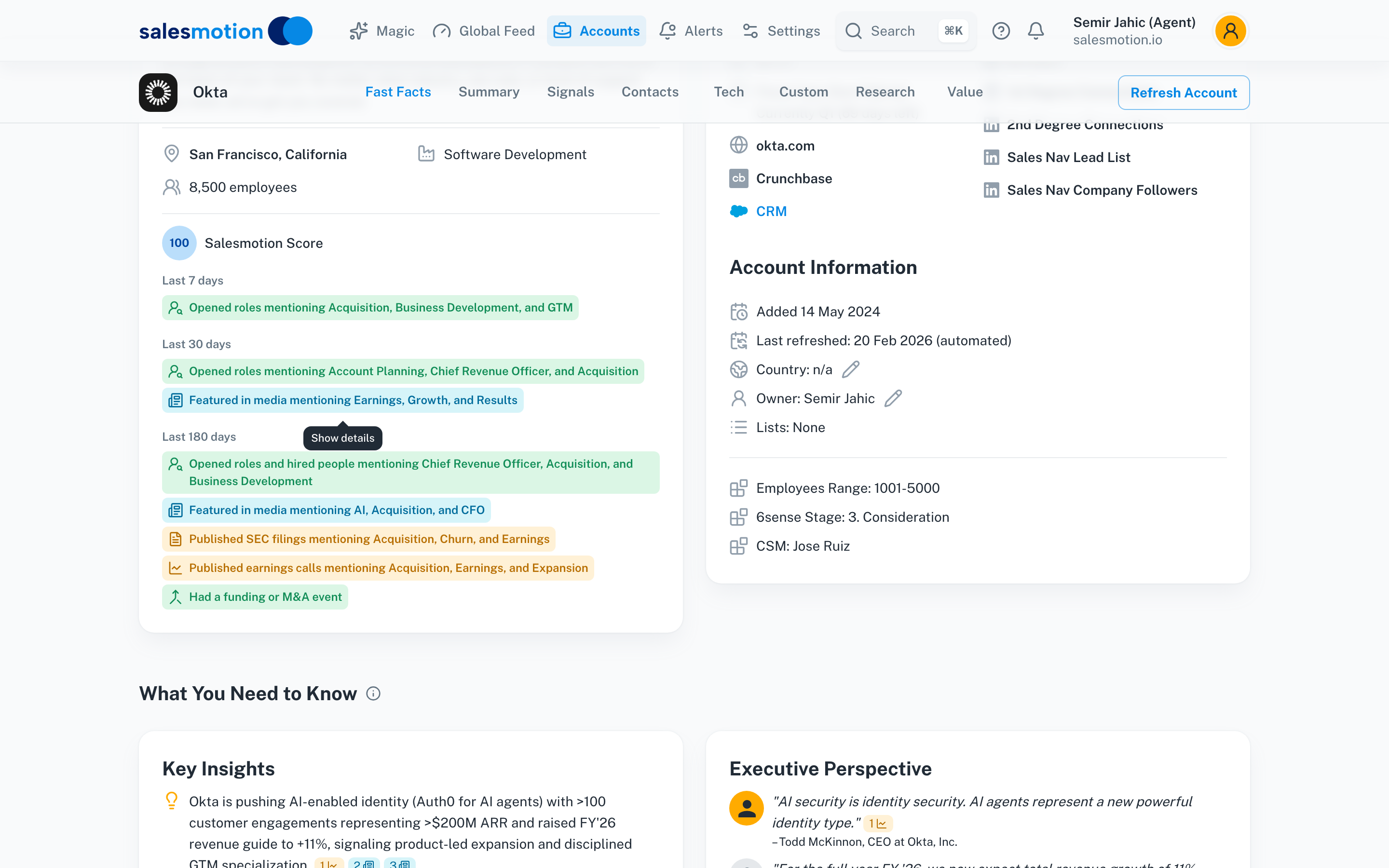 An account intelligence platform automates the research layer -- key insights, executive commentary, opportunities, and people changes updated continuously from 1,000+ sources.
How Do You Map Stakeholders and Analyze Influence?
Stakeholder mapping is the most underrated part of account planning. Most reps can name their main contact. Few can draw the full map of who actually decides, who influences the decision, and who can quietly kill a deal. In complex B2B sales with 6 to 10 decision-makers on the average buying committee, this gap is where deals stall.
Building Your Stakeholder Map in Practice
- Start with CRM data. Who has been in meetings? Who opens emails? This gives you the "known" universe.
- Map the org chart. Use LinkedIn and press releases to identify the full buying group. You likely know fewer than half the stakeholders.
- Identify informal influencers. The person who ran the last vendor evaluation. The team lead whose opinion the VP trusts.
- Track changes over time. Stakeholder maps go stale fast. Monitoring changes through sales intelligence signals keeps your map current.
- Document stance and motivation. Note whether each stakeholder is supportive, neutral, or resistant and what specifically motivates them.
Use signals to understand what people care about. When a VP of Operations shares articles about supply chain efficiency on LinkedIn, that tells you their priorities. When a CEO tells Wall Street they are focused on cutting costs by 10%, you know the metric for the entire leadership team.
Integrating Account Plans with Your CRM
Any account planning effort that lives outside your CRM is doomed to low adoption. Build account plan components directly into the account record: stakeholder maps, business objectives, whitespace analysis, and key signals. When reps open a Tier 1 account, the plan should be right there, not buried in a separate PowerPoint.
For Salesforce-specific account planning, the native Account Plans functionality embeds objectives and tactics alongside all other customer data. Connect your CRM to tools like Slack for automated alerts when trigger events occur: champion job changes, product usage dips, or competitor mentions. Salesmotion integrates natively with Salesforce and HubSpot, pushing continuously updated account intelligence directly into the CRM without manual effort.
Setting Account Objectives and Milestones
Vague objectives produce vague results. "Grow the account" is not an objective. "Expand from a single-department deployment to an enterprise-wide agreement by Q3, increasing ARR from $50K to $200K" is. Each account plan should include 2-3 quarterly SMART objectives: specific, measurable, achievable, relevant, and time-bound.
The strongest objectives are anchored to real events. Their new VP of Sales starts in February. Their vendor contract expires in June. Their CEO mentioned "digital transformation" on the last earnings call. An objective tied to "before their contract renewal in June" carries more weight than "sometime in H1." This is where account planning intersects with signal-based selling and where plans stop being static documents.
Executing the Plan: The Quarterly Review Cadence
An account plan without a review cadence is a document that dies after the first month.
The 90-Day Review Cycle
Every Tier 1 account should be reviewed quarterly in a 60-minute session: progress check against milestones (15 min), stakeholder update (10 min), signal review covering earnings, hiring, and news (10 min), competitive update (5 min), and next quarter plan with new milestones (20 min).
Beyond formal reviews, weave the plan into existing activities: a five-minute scan before any significant meeting, strategic discussion during weekly 1-on-1s, and formal progress review during quarterly business reviews.
Keeping Plans Current Between Reviews
Between reviews, reps need a mechanism to track leadership changes, earnings calls, hiring patterns, and competitive moves. Manually tracking this across 5-10 Tier 1 accounts is feasible. Across an entire territory, it is not. Account intelligence platforms deliver their highest value here, surfacing relevant changes continuously.
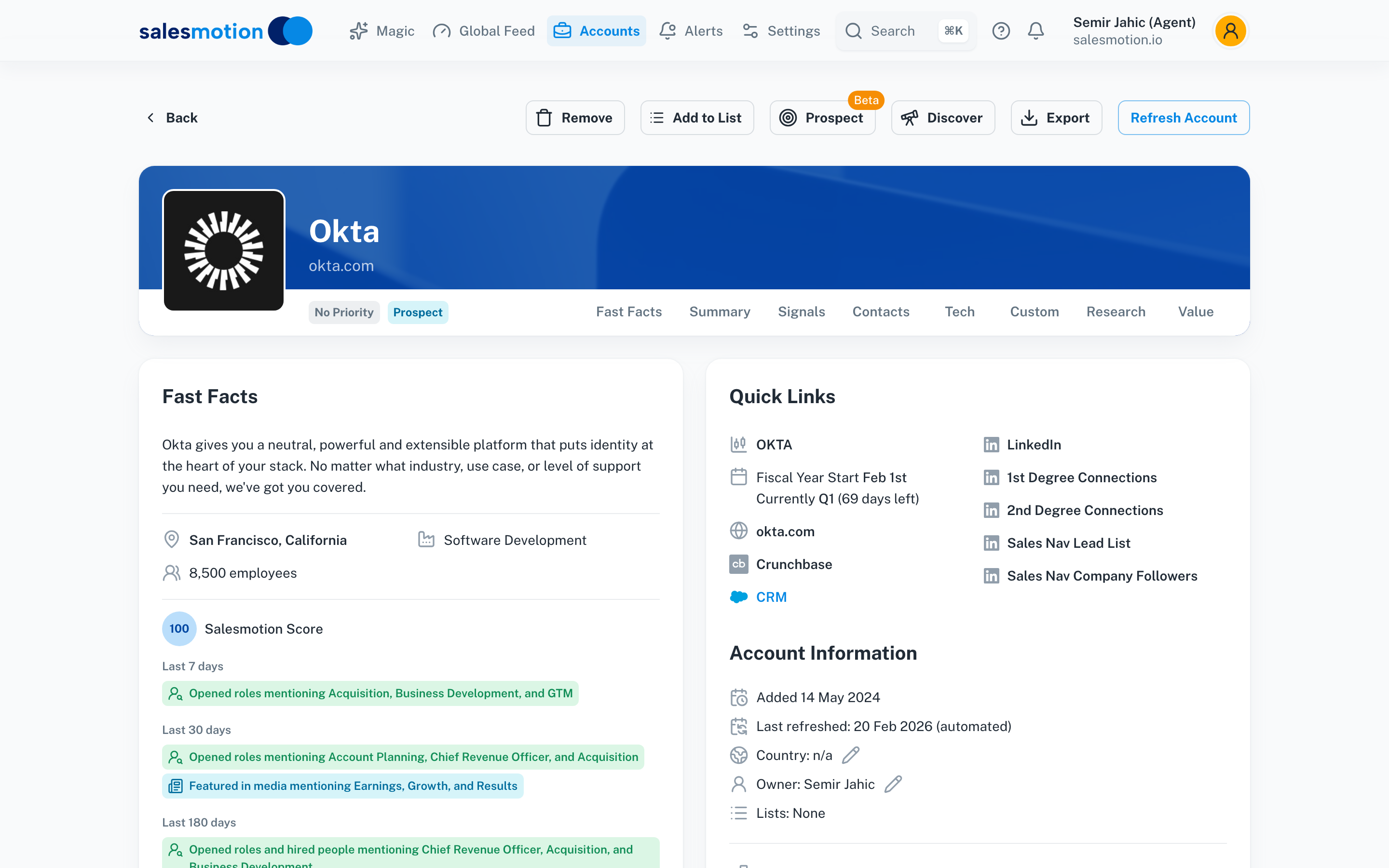 Account intelligence keeps plans current with a continuously updated score, signal timeline, and AI-generated talking points.
Common Mistakes in Account Planning
These patterns consistently undermine account planning efforts:
- Planning too many accounts. If every account gets a plan, no account gets a good plan. Focus on 5-10 Tier 1 accounts. The rest get monitoring.
- Single-threading the relationship. Teams that rely on a single contact are one LinkedIn update away from starting over. Plans must include multi-threading with at least three stakeholders.
- Static plans that never update. A plan built in January is fiction by April. Key account management requires continuous intelligence updates.
- Generic, cookie-cutter plans. If you can swap account names and the plan still makes sense, it is too generic. Every plan needs account-specific insight.
- Confusing activity with progress. "Had five meetings" is not progress. Progress means new stakeholders engaged, technical evaluations initiated, or proposals delivered.
- Operating in a sales silo. Pull in cross-functional input from Customer Success, Marketing, and Product from the start.
Scaling and Measuring Account Planning
Building a Repeatable Process
A small group from sales leadership, RevOps, and sales enablement should own the account planning methodology. Standardize the template inside your CRM, curate gold-standard completed plans as training examples, and coach through frontline managers by making plans central to pipeline reviews. When reps see that a well-executed plan gives them a clear path to quota, adoption follows.
Key Performance Indicators
Track a mix of leading and lagging indicators: pipeline growth in target accounts, increase in average deal size, shortened sales cycles, expansion revenue from upsell and cross-sell, multi-threading engagement (how many stakeholders per account), and contact coverage (what percentage of the buying committee you have engaged).
One global IT company unlocked approximately $1.4 billion in new pipeline within 18 months after redesigning its account planning program. Within their top 400 priority accounts, they achieved 11% year-over-year growth, double to triple the industry average. Analytic Partners grew qualified pipeline by 40% year-over-year using a similar intelligence-driven approach.
Key Takeaways
- Prioritize ruthlessly. Score accounts using an ICP model that combines firmographic fit with live buying signals. Full plans for 5-10 Tier 1 accounts beat shallow plans for 50 accounts.
- Map the full buying group. With 11 stakeholders in the average B2B deal, single-threading is a losing strategy. Build influence maps and multi-thread by design.
- Make plans living documents. Static plans die within weeks. Establish a quarterly review cadence and use automated account intelligence to keep research current between reviews.
- Anchor objectives to signals. The strongest account plans tie milestones to real events: contract renewals, leadership changes, earnings commentary, and strategic initiatives.
- Integrate with your CRM. Account plans that live in shared drives get ignored. Build them into Salesforce or HubSpot where your reps already work, with automated intelligence feeding updates.
- Avoid the common traps. Planning too many accounts, confusing activity with progress, operating in a sales silo, and ignoring competitive intelligence are the most frequent plan killers.
- Invest in the research layer. Manual research does not scale. Teams that automate account intelligence free reps to spend time selling instead of searching.
Frequently Asked Questions
What should an account plan include?
A complete account plan includes an account overview (financials, strategic priorities, recent news), a stakeholder map with influence analysis, a SWOT assessment, whitespace and growth analysis, 2-3 measurable quarterly objectives, specific action items with owners and deadlines, and a competitive landscape section. The plan should document key buying signals that indicate timing and urgency. For templates and frameworks, see our guide to key account plans.
How often should account plans be reviewed?
Tier 1 accounts should be reviewed quarterly with a structured 60-minute session covering progress against milestones, stakeholder changes, new signals, and competitive updates. Between formal reviews, account intelligence should be monitored continuously so that plans reflect real-time changes. Update immediately when trigger events occur: a leadership change, merger, funding round, or surprising earnings report.
How many accounts should get a full account plan?
Most sales reps should maintain full plans for 5-10 Tier 1 accounts, abbreviated plans for 15-25 Tier 2 accounts, and monitor the rest for signal changes. Fewer than 20% of companies fully embed account planning, which means depth on fewer accounts outperforms breadth across many.
What is the difference between account planning and territory planning?
Territory planning focuses on how to divide and prioritize accounts across a geographic or vertical territory. Account planning goes deeper on individual accounts within that territory, building relationship maps, competitive strategies, and execution plans for specific opportunities. Territory planning decides where to focus. Account planning decides how to win.
How do you keep account plans from going stale?
The biggest threat to plan quality is stale intelligence. Manual updates break down beyond a handful of accounts. The most effective approach combines quarterly review cadences with automated signal monitoring that tracks leadership changes, earnings commentary, hiring patterns, and competitive moves continuously. This keeps the research layer current without requiring reps to spend hours on manual updates each week.
What is the difference between an account plan and a sales plan?
A sales plan is the 30,000-foot view: overall revenue targets, markets to pursue, and general strategies for the year. An account plan is a detailed strategy for a single, high-value customer, diving deep into their goals, challenges, and key players. The sales plan sets the destination for the entire fleet. Each account plan is the navigation chart for an individual ship.
How does AI improve account planning?
AI automates the intelligence-gathering pipeline that traditionally consumed up to 50% of planning time. It monitors sources for trigger events like executive hires, M&A activity, and strategic initiatives, then surfaces real-time insights to the sales team. AI also identifies new stakeholders, tracks job changes, and spots growth opportunities as they emerge, making plans truly dynamic.