
Most AI cold email tools personalize from a database. They pull the prospect's name, title, company, and industry, then run it through a template. The result is what buyers now call "AI slop" — emails that feel custom but say nothing specific. They reference your company's mission statement, congratulate you on a funding round from eight months ago, or open with "I noticed you're in the SaaS space." Delete, delete, delete.
Real personalization means referencing something that just happened at the account. A new CFO hire. A strategic pivot mentioned on last week's earnings call. A product launch that signals budget allocation in your category. That kind of specificity is what earns replies at scale — and it requires a fundamentally different approach than most cold email platforms offer.
This guide covers the eight best tools for personalized cold email at scale in 2026, from signal-driven research platforms to deliverability-first senders and AI coaching tools. Each solves a different part of the problem.
TL;DR: The best cold email tools fall into three categories: those that generate personalization from real account intelligence (signal-driven platforms), those that optimize sending infrastructure for volume and deliverability (Smartlead, Instantly), and those that improve the message itself (Lavender, lemlist). Apollo and Regie.ai try to do everything. The right stack depends on whether your bottleneck is research, sending, or copy quality.
How We Evaluated These Tools
Every tool on this list was evaluated against four criteria that determine whether personalized cold email actually works at scale:
- Depth of personalization — Does the tool reference real, timely account events, or just firmographic fields?
- Scalability — Can it handle hundreds or thousands of prospects without manual intervention per message?
- Deliverability — Does it help emails land in the primary inbox, not spam?
- Speed to send — How fast can a rep go from identifying a prospect to sending a relevant message?
No single tool scores perfectly on all four. That is why most teams stack two or three together.
See Salesmotion on a real account
Book a 15-minute demo and see how your team saves hours on account research.
The 8 Best Tools for Personalized Cold Email at Scale
1. Salesmotion
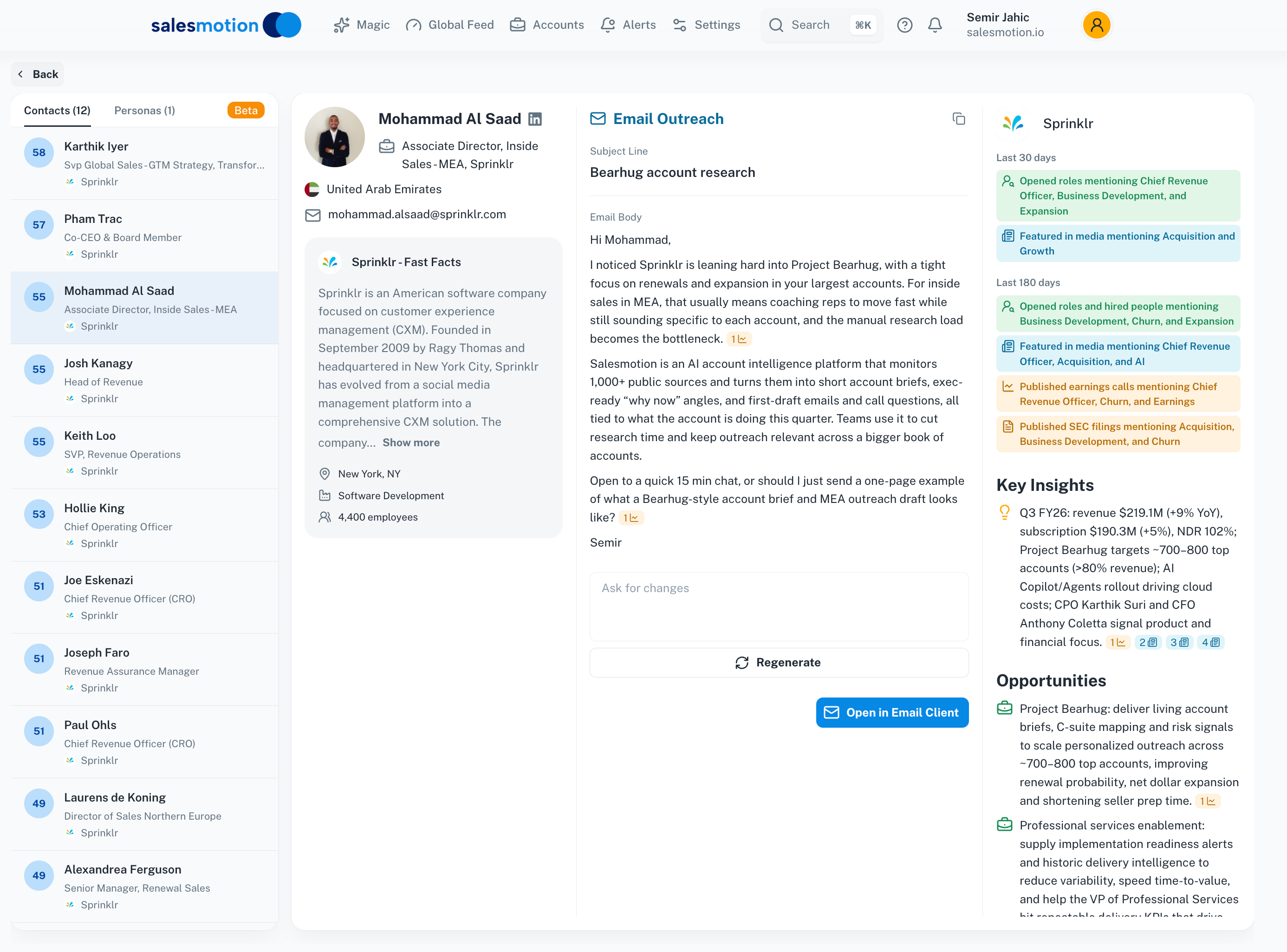 Salesmotion's Outreach Agent drafts emails grounded in earnings calls, leadership changes, and live buying signals — not templates.
Salesmotion takes a fundamentally different approach to cold email personalization. Instead of pulling from a static database, its Outreach Agent drafts emails from real-time account intelligence: earnings call transcripts, SEC filings, leadership changes, hiring surges, product launches, and 1,000+ other signal sources. The result is an email that references something the prospect's company actually did or said — last week, not last quarter. Reps go from signal to sent in under two minutes, with every claim sourced and cited.
Best for: B2B sales teams selling into enterprise accounts who need research-grade personalization without the research time.
- Signal-anchored email drafts from earnings calls, news, hiring patterns, and leadership changes
- Under 2 minutes from signal detection to personalized message
- Account briefs with full source citations so reps can verify before sending
- Native Salesforce and HubSpot integration
- Monitors accounts 24/7 across 1,000+ public and proprietary sources
Pricing: From $85/mo. Unlimited users on team plans. See pricing.
Proof: Cacheflow cut account prep time by 60% and tripled average deal sizes after switching to signal-based outreach.
2. Clay
Clay is the power-user's personalization engine. It connects to 150+ data providers through a waterfall enrichment model — if one source does not have the data you need, it automatically tries the next. You build custom workflows using a spreadsheet-like interface, chaining together enrichment steps, AI prompts, and conditional logic to generate highly tailored email copy at scale. The learning curve is real, but the ceiling is high.
Best for: Revenue operations teams and technical SDRs who want full control over their enrichment and personalization logic.
- Waterfall enrichment across 150+ data providers
- AI-powered message generation with custom prompt templates
- Spreadsheet-like workflow builder with conditional branching
- CRM enrichment and lead scoring automation
- Integrates with every major sequencer (Outreach, Salesloft, Apollo, Instantly)
Pricing: Free tier, then Launch at $185/mo and Growth at $495/mo (roughly $167 and $446 on annual billing). Credits are consumed per enrichment action.
3. Apollo.io
Apollo.io is the most popular all-in-one platform for teams that want a contact database, email sequencer, and AI writer in a single tool. Its database covers 230M+ people and 30M+ companies with direct dials and verified emails. The built-in AI writer generates personalized email variants based on prospect data, and sequences handle multi-step cadences across email and LinkedIn. The free tier is genuinely useful for solo reps getting started.
Best for: SMB and mid-market sales teams who want one platform instead of a stack.
- 230M+ person records with direct dials and verified emails
- AI email writer that generates personalized variants per prospect
- Multi-channel sequences (email, phone, LinkedIn)
- Built-in intent signals from website visitor tracking and job change alerts
- Free tier with 900 credits a year and 2 sequences
Pricing: Free tier available. Basic $49, Professional $79, Organization $119 per user per month on annual billing.
4. Smartlead
Smartlead is built for teams running high-volume outbound campaigns who need bulletproof deliverability. It manages inbox rotation across unlimited email accounts, handles warmup automatically, and uses AI to personalize messages at scale. The unified inbox pulls replies from all sending accounts into one view, so nothing gets lost. If your bottleneck is sending capacity and inbox placement rather than research depth, Smartlead solves it.
Best for: Agencies and SDR teams running 10,000+ emails per month who need deliverability at volume.
- Unlimited email account connections with automatic inbox rotation
- Built-in email warmup across all connected accounts
- AI personalization engine for dynamic email content
- Unified master inbox for managing replies across all accounts
- Subsequences triggered by prospect behavior (opens, clicks, replies)
Pricing: From $39/mo for up to 2,000 active leads.
5. Instantly
Instantly made its name on deliverability. Like Smartlead, it supports unlimited email accounts with warmup and rotation, but Instantly also includes a B2B lead database (160M+ contacts) and an AI-powered CRM. The Campaign Builder uses AI to generate personalized email copy, and the analytics dashboard tracks deliverability metrics in real time. It is the most affordable entry point for teams that want sending infrastructure and a basic contact database in one tool.
Best for: Startups and solo founders who need a low-cost way to send personalized cold email without building a complex stack.
- Unlimited email accounts with automated warmup and rotation
- B2B lead database with 160M+ contacts
- AI-powered email writer and A/B testing
- Real-time deliverability analytics (open rate, spam rate, bounce rate)
- Built-in CRM with deal tracking
Pricing: From $30/mo. Lead database access requires a separate add-on.
6. lemlist
lemlist pioneered visual personalization in cold email — dynamic images and videos with the prospect's name, company logo, or LinkedIn photo embedded directly into the message. That visual hook still sets it apart. Beyond images, lemlist supports multi-channel sequences across email, LinkedIn, and phone, with an AI assistant that generates copy and suggests send times. The LinkedIn automation (profile visits, connection requests, messages) runs natively without a separate tool.
Best for: Creative SDR teams who want visual differentiation and multi-channel sequences in one platform.
- Dynamic personalized images and video thumbnails in emails
- Multi-channel sequences: email, LinkedIn automation, and phone tasks
- AI email writer with tone and length controls
- Built-in email verification and warmup
- Landing page builder for personalized prospect experiences
Pricing: From $59/mo per user.
7. Lavender
Lavender is not a sending platform — it is an AI email coach that sits inside your inbox (Gmail, Outlook) or sequencer (Outreach, Salesloft, Apollo) and scores every email you write in real time. It analyzes subject line length, reading level, word count, tone, personalization depth, and mobile rendering, then suggests specific fixes. For teams that already have a sending tool but struggle with reply rates, Lavender improves the message itself.
Best for: Individual reps and sales managers who want to improve email quality and coach reps on writing.
- Real-time email scoring on a 0-100 scale
- Personalization suggestions based on prospect's LinkedIn profile and news
- Mobile preview and readability analysis
- Team dashboards showing email score trends across reps
- Integrates with Gmail, Outlook, Outreach, Salesloft, Apollo, and HubSpot
Pricing: From $29/mo per user. Free tier with limited emails.
8. Regie.ai
Regie.ai uses intent data and persona modeling to generate entire outbound sequences tailored to specific buyer types. Rather than personalizing one email at a time, it builds full cadences — email, phone scripts, LinkedIn messages — based on the prospect's role, industry, and observed intent signals. The platform is built for enterprise sales teams that need consistent messaging across large SDR organizations while still adapting to individual prospects.
Best for: Enterprise teams with 20+ SDRs who need persona-based sequences at scale with brand-consistent messaging.
- AI-generated multi-channel sequences based on persona and intent
- Content management system for approved messaging and brand guidelines
- Dynamic personalization that adjusts copy based on prospect engagement
- Auto-prioritization of prospects based on intent signals
- A/B testing across sequence variants with automatic winner selection
Pricing: Regie.ai publishes per-user pricing: AI SEP at $180 per user per month on an annual contract with a 10-seat minimum, and Force Multiplier Rep at $499 per user per month with a 5-seat minimum. Enterprise is custom.

“The moment we turned on Salesmotion, it became essential. No more hours on LinkedIn or Google to figure out who we're talking to. It's just there, served up to you, so it's always 'go time.'”
Adam Wainwright
Head of Revenue, Cacheflow
How to Choose the Right Tool for Your Team
The best tool depends on where your outbound process breaks down.
If your emails lack specificity: The problem is research, not sending. Signal-driven platforms like Salesmotion and Clay address this by pulling real account intelligence into the personalization layer — one through an autonomous agent architecture, the other through custom enrichment workflows. Either way, you move from "I noticed your company is in the healthcare space" to "Your CFO mentioned margin pressure on the Q3 call — here's how three similar companies addressed it."
If your emails land in spam: The problem is deliverability, not content. Smartlead and Instantly solve this with inbox rotation, warmup, and sending infrastructure that keeps your domain reputation clean.
If your emails get opened but not replied to: The problem is copy quality. Lavender coaches reps in real time. lemlist adds visual hooks that break pattern. Both improve engagement without changing your sending stack.
If you need everything in one place: Apollo gives you the database, sequencer, and AI writer for the lowest total cost. The trade-off is that no single layer is top-tier.
Most high-performing teams run two or three tools together. A common stack: Salesmotion for signal-based selling and research, Instantly or Smartlead for sending infrastructure, and Lavender for real-time coaching. That gives you depth of personalization, deliverability, and copy quality — the three pillars that determine whether outreach at scale actually works.
Key Takeaways
- Database personalization is table stakes. Inserting a prospect's name, title, and company into a template no longer earns replies. The bar is now event-level specificity — referencing something that happened at the account within the past week.
- No single tool does it all well. The best outbound teams stack a research/personalization layer with a sending layer (Smartlead, Instantly) and optionally a coaching layer (Lavender).
- Deliverability is a prerequisite, not a feature. Personalization is worthless if your emails land in spam. Inbox rotation, warmup, and domain reputation management must be solved before anything else matters.
- Speed matters as much as quality. A perfectly researched email sent three weeks after the buying signal fires is a wasted email. The best tools compress the time from signal to send into minutes, not hours.
- Visual personalization still works. lemlist's image and video personalization breaks pattern in crowded inboxes, especially for creative outbound to marketing and product buyers.

“The Business Development team gets 80 to 90 percent of what they need in 15 minutes. That is a complete shift in how our reps work.”
Andrew Giordano
VP of Global Commercial Operations, Analytic Partners
Frequently Asked Questions
How many cold emails should I send per day per mailbox?
Keep it under 30-50 emails per day per mailbox for cold outreach. Exceeding that threshold damages your sender reputation quickly, especially on new domains. Tools like Smartlead and Instantly manage this automatically by rotating sends across multiple mailboxes, so your total daily volume can be high while each individual account stays within safe limits.
Can AI-written cold emails actually outperform manually written ones?
It depends entirely on the input data. AI emails personalized from firmographic fields (company name, industry, headcount) perform about the same as manual templates — which is to say, poorly. AI emails personalized from real-time account signals (earnings calls, leadership changes, product launches) consistently outperform manually written emails because most reps do not have time to do that depth of research for every prospect. The AI is not better at writing. It is faster at researching.
What reply rate should I expect from personalized cold email?
Generic cold email typically sees 1-3% reply rates. Personalized cold email using firmographic data gets 5-8%. Signal-anchored cold email — where the message references a specific, recent event at the account — consistently sees 15-30% reply rates in B2B. The difference is not the writing quality. It is the relevance of the trigger.
Should I use one all-in-one platform or build a stack of specialized tools?
For teams under five reps with limited budget, an all-in-one platform like Apollo is the pragmatic choice. For teams above five reps where outbound is a primary revenue channel, a specialized stack almost always outperforms. The research layer, sending layer, and coaching layer each have different top-tier options, and the compounding effect of running the best tool at each stage produces meaningfully higher reply rates than any single platform can achieve alone.