The usual advice is to build a giant competitor spreadsheet and refresh it whenever a press release lands. That habit trains teams to celebrate visible milestones and miss the friction that changes a deal. A trial that starts on time can still slip. A funded company can still be months from a purchase. A first approval can still fail outside one market. Biotech competitive intelligence is useful when it answers a narrower question: what just changed a rival's odds, timing, or buying capacity, and who on your team should act this week.
What Biotech Competitive Intelligence Covers
Think of a scout who watches a whole season, not only the final score. Biotech competitive intelligence is the ongoing, structured tracking of rival companies, programs, and markets, so your team sees a move while it is still forming.
Three questions keep the work honest. Who is building what. How fast are they moving. What does that change for your deals or your portfolio. A CRO watching an oncology sponsor cares less about a logo refresh than about a Phase 2 start, a clinical-operations hire, and the cash behind both.
Company news sits on a deeper base: national research capacity. The OECD Key Biotechnology Indicators track business-sector biotechnology R&D expenditures from 2006 through 2022, and government and higher-education biotechnology R&D from 2005 through 2022, in purchasing-power-parity terms so currency swings don't masquerade as investment. A jurisdiction that is adding research spend often shows licensing, hiring, and partnerships later. A press release is the lagging view.

Business development, portfolio strategy, commercial teams, and CRO or CDMO sellers all use the same map for different decisions. Clinicians comparing advanced biotechnology treatments in Cabo already separate a promising mechanism from a program that can be delivered. Your account plan needs the same split.
Practical rule: If a claim isn't tied to a program, a date, and a source, it isn't intelligence yet.
List the three competitor questions your team can't answer today. Those gaps are the watchlist.
Signals and Sources Worth Tracking
Seven signal types cover most of what a revenue or strategy team can act on. Read the row before you celebrate the headline.
| Signal | Where to find it | What it reveals | Typical lead time |
|---|---|---|---|
| Clinical trials | ClinicalTrials.gov and sponsor pipeline pages | Indications, phase moves, trial starts and site changes | Weeks to months |
| Publications | PubMed and conference abstracts | Mechanism data, early efficacy signals and key opinion leaders | Months before filings |
| Patents | WIPO, national patent offices and PCT applications | Targets, modalities, manufacturing approaches and defensive positioning | Often years ahead of market |
| Regulatory filings | FDA and EMA public databases and SEC filings | IND or CTA submissions, approvals and risk disclosures | Immediate to quarterly |
| Funding | Press releases, PitchBook and SEC Form D filings | Development stage, lead investors and runway | Weeks to months |
| Hiring | Job postings and LinkedIn | Clinical, CMC and commercial build-outs | Weeks |
| Partnerships | Press releases and licensing databases | Deal stage, upfront value and partner capability | Immediate |
How to read one row
Say a rival posts a new Phase 2 on ClinicalTrials.gov in an indication you already sell into. The registration tells you the sponsor is entering a crowded space. The site list tells you where it plans to recruit. That is a sales action, not a science abstract. Check whether those countries overlap your installed base, then brief the owner who covers them.
Caveats that change the read
Lead times aren't uniform. A public biotech files on a calendar. A private company can stay quiet for a year. Registries also lag the sponsor's internal update, so a "not yet recruiting" status can be stale by the time you export it.
For private rivals, funding and hiring carry more weight than publications. A Series B release that names the round and the lead investor, paired with a posting for a head of clinical operations, is a build-out. The round says the board expects a trial. The job says they need someone to run it. Patent records sit on a longer horizon. WIPO IP statistics show global filings rose 1.9-fold from just under 2 million applications in 2010 to 3.7 million in 2024, with resident filings growing 4.1% a year versus 1.6% for non-resident filings. Volume is a direction, not a launch date.
In a class as crowded as incretins, a GLP-1 medication comparison is a reminder that mechanism labels hide very different clinical bets. Your competitive analysis should do the same for targets, not lump every agonist together.
Fill one row per signal type for your ten most important rivals. Mark the sources you already open each week, and mark the blind spots.

“The moment we turned on Salesmotion, it became essential. No more hours on LinkedIn or Google to figure out who we're talking to. It's just there, served up to you, so it's always 'go time.'”
Adam Wainwright
Head of Revenue, Cacheflow
Ranking Signals by Priority and Confidence
Priority is a clock, not a vibe. A 5 means someone acts within 24 to 48 hours. A 1 is context for the next conversation, not a reason to rewrite the forecast.
| Signal | Priority (1-5) | Respond within | Owner |
|---|---|---|---|
| Phase 3 readout or filing by a direct rival | 5 | 24-48 hours | Portfolio and BD leads |
| Trial termination or discontinued program | 5 | 24-48 hours | Portfolio and strategy leads |
| Series B or later raise with stated trial plans | 4 | 1 week | BD and sales |
| New trial start in your indications | 4 | 1 week | Sales and clinical operations |
| Senior clinical or CMC hire at a rival | 3 | 2 weeks | Sales |
| New patent family on a shared target | 3 | 2 weeks | Legal and strategy |
| Seed or Series A round | 2 | Monitor and combine with other signals | Strategy |
| Conference abstract or publication | 1 | Use as outreach context | Marketing |
Two modifiers
Confidence asks whether a registry, filing, or company disclosure confirms the change. A rumor in a newsletter stays medium until the record moves. Clinical proximity asks whether a catalyst sits inside six months. The same Phase 2 start is hotter when a readout window is already on the calendar.
Most of the noise is early. A 2025 BIO industry dataset counted 23,875 drugs in development, 7,688 active clinical programs, and 84% of programs still in early clinical stages, with about 4,500 candidates entering and 3,500 exiting. Strategic decisions account for 8.4% of attrition on average and up to 35% in some diseases. A quiet disappearance can matter more than a poster.
A discontinuation, read three ways
A rival drops a Phase 2 in a target your team sells against. Don't rewrite the account plan until you know the cause.
- Data: the biology looks weaker, so whitespace may open for your asset.
- Cash: the company may partner or cut vendors, which changes who can buy.
- Strategy: the team may have a stronger internal program, so the threat moved rather than died.
A Series B that states trial plans sits one level down, at priority 4, because money plus a dated study is a near-term buying window. A seed round is context. It can validate a platform and still leave the company with little near-term purchasing power. Pair raises with the program record using a biotech funding tracker so a headline dollar figure doesn't outrank a terminated study.
Score your current top 20 signals on this table and move the 5s and 4s onto alerts this week.
How to Build a CI Workflow Step by Step
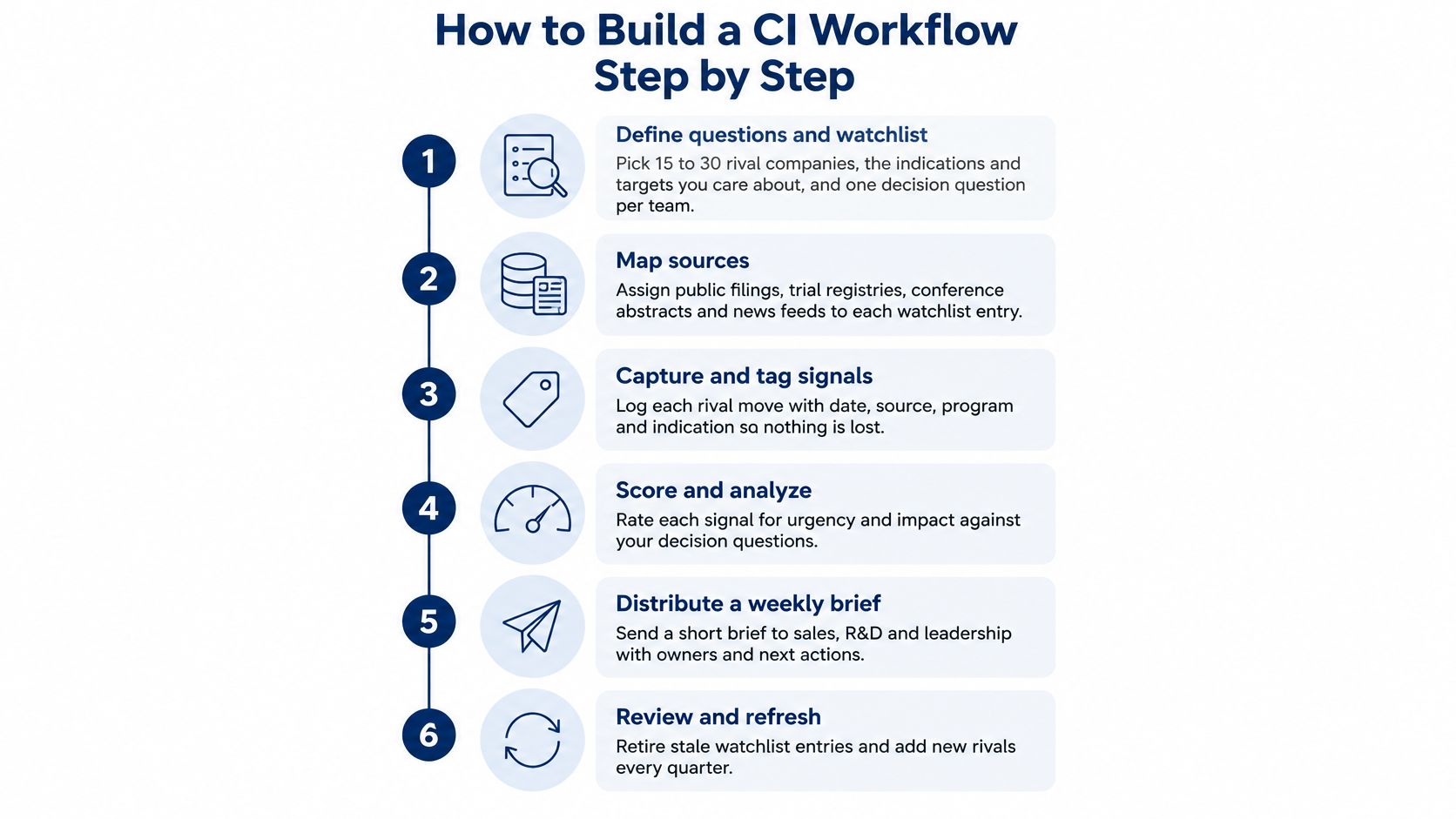
- Define the questions and the watchlist. Pick 15 to 30 rival companies, the indications and targets you care about, and one decision question per team, such as which rival enters your indication this year. A 200-name list fails because nobody reviews it, so weak signals drown the few that change a bid.
- Collect on a fixed cadence. Pull registries, patents, filings, funding, and hiring weekly. Let an agent do the first pass, and keep a person on every source. Alerts alone miss registry edits that never become a press release, which is how a site-country change slips past the team that owns that region.
- Normalize the asset, not the logo. Tag target, mechanism, indication, phase, trial status, sponsor, geography, and next catalyst date. Company-level tracking hides two programs moving in opposite directions inside the same firm.
- Score confidence. Mark each change high, medium, or low, and separate a scientific failure from a corporate reprioritization. One press release isn't a confirmed change until a second primary source agrees.
- Route to a named owner. High-confidence priority 5 and 4 items go to a person within hours, not into a quarterly slide. A shared inbox is how a filing sits untouched until the rival has already booked the CRO.
- Review and retire monthly. Close programs that are gone. A map that still shows a discontinued asset as active sends reps into accounts that no longer exist.
What 30 days looks like
You should have a one-page weekly digest, one owner per tier, and a short log of decisions the signals changed. If the log is empty, the workflow is a clipping service. Tie each brief to a decision question the way a solid account research routine does, so the output names an action instead of a topic.
“Automatic account profile detail I can use to manage my territory. Using Salesmotion AI to generate value statements per persona, account, etc. Using Salesmotion to give me a starting point based on new hires, or news alerts is critical.”
Adam Wainwright
Head of Revenue, Cacheflow
Reading Development Risk and Regional Access
The question most write-ups skip is simple. What changed this competitor's odds, timing, or economics?
Timeline slippage
A filing date in a deck is a forecast. Deloitte's R&D analysis puts the time from Phase I through filing at more than 100 months, with Phase III cycle time up 12% over five years. Trial durations are stretching further, and the gaps between one trial ending and the next starting are widening. Both trends matter because they change when a sponsor will need supply, sites, and services.
So compare registry start and completion dates on every update, and log each slip as a dated event. A six-month delay at Phase II is not trivia. It tells you when recruitment capacity frees up, when a CRO contract comes back into play, and when clinical supply demand shifts into the next half. If the slip pushes supply need forward, your CDMO quote should move with it.
Funding runway
Pair the program with cash and the next financing, not with the last headline. A Series B that names the trials it will fund is a different risk from a seed round with no clinical plan. For BD, the first is a reason to call this month. The second is a reason to keep watching.
The runway calculation gets sharper when you combine both readings. A program that slips two quarters while its sponsor has eighteen months of cash left is a distressed timeline, and the sponsor knows it. That is the account where a realistic proposal on speed or cost lands, because the alternative is a raise into a weak market.
Regional access
IQVIA's global R&D trends describe persistent regional gaps in drug availability and in which countries run trials. U.S. approval counts stay limited each year, and the key trials behind them draw on relatively small patient pools. Approval count doesn't tell you who can recruit, reimburse, or supply outside that market.
Say a rival adds European sites to a Phase 2. Read the site list as a sequencing plan before you read the press release. The country order reveals where the sponsor expects faster enrollment, which regulators it trusts first, and where launch infrastructure will need to exist two years from now. If those countries are on your account map, the regional owner should adjust coverage this week. Clinical trial intelligence is the layer that makes site geography visible early.
The money follows late validation. In 2025, large biopharma paid an average of $185 million upfront for Phase III candidates, up from $53 million in 2024, according to BioSpace's review of deal pricing. A scientific lead without sites, cash, or a regulator sequence is not yet a deployable lead.
Playbooks for Sales and Revenue Teams

Three triggers, three first moves
A mid-size biotech announces a Series B and a Phase 2 in a new indication on a Tuesday. The CRO business development lead sees it the same day, opens the registry, and notes the site countries. The note that goes out names the trial and one recruitment capability that matches those countries. The meeting that follows is about that protocol, not about a capabilities deck.
A rival's Phase 2 then adds sites in Europe. A CDMO rep treats the site add as a supply-scale signal, not as scientific news. The email offers capacity tied to when clinical supply will be short. The buyer replies because the timing matches the amendment, not because the rep said "congrats on the progress."
A competitor discontinues a program in a shared indication. The rep doesn't pitch the dead asset. They call the partner, or the internal team that still owns the indication, and ask what the timeline looks like for whatever replaces it. The result is a conversation about the next study, which is where budget moved.
Sales intelligence for biotech only helps if the first touch carries a fact the buyer can verify.
The card you fill before you send
- Trigger: the registry ID, round name, or discontinuation, with the date.
- Owner: one person, named before the alert goes out.
- 48-hour action: the call, the note, or the internal brief.
- Message angle: recruitment, supply timing, or the inherited indication.
- Evidence line: one sourced fact. Cut every opener that only says you saw the news.
Legal and Ethical Limits of Public Intelligence
Use public, lawful sources, and never pretend to be someone else to get information. Speed doesn't create an exception.
Boundaries
- No pretexting. Don't impersonate a recruiter, a patient, a journalist, or a partner to pull non-public details.
- Stop on non-public material. If a document or a contact looks leaked, record how you found it and escalate to counsel before anyone uses it.
- Respect access rules. Site terms and technical restrictions are part of the collection method, not a nuisance to route around.
- Handle personal data by region. Outreach lists follow the privacy rules that apply where the contact lives and works.
One database is not freedom to operate
A clean public patent page can hide real protection. A peer-reviewed look at the FDA Purple Book in PLOS Medicine found that only about 2% of unique listings for prescription brand biologics contained at least one identified patent, and that a drug has about 12 years of patent protection left, on average, at FDA approval. FDA's publishing role is ministerial. It doesn't decide validity or whether a patent reaches a given biosimilar.
A team that finds no Purple Book patents and sketches a biosimilar plan from that alone is guessing. Cross-check filings, litigation, exclusivity dates, and company disclosures with counsel before anyone treats the asset as open.
Keep a source log on every battlecard claim: date, link, and confidence. If you can't audit it, you shouldn't send it.
KPIs That Show Your CI Program Is Working
Three numbers keep the program honest: signal-to-owner time, action rate, and triggered win rate. Set the baseline from the 90 days before you launch, or later movement has nothing to beat.
| KPI | What it shows | Healthy target |
|---|---|---|
| Signal-to-owner time | How long a priority 5 signal takes to reach its owner | Under 48 hours |
| Action rate | Share of alerts that lead to a logged decision or outreach | Rising month over month |
| Tier-1 account coverage | Share of top accounts with a brief refreshed in the last 30 days | 100 percent |
| Stale watchlist entries | Assets with no update in the last 90 days | Under 10 percent |
| Triggered win rate | Conversion of CI-triggered deals against an untriggered baseline | Above baseline |
| Pipeline influenced | Opportunities that started from a CI-triggered touch | Tracked against last quarter |
Small samples lie in a single month
With a few dozen alerts, one lucky meeting swings the rate. Read 90-day windows and the direction, not a hero week.
Say the team sends 40 outreach notes off CI triggers and books 6 meetings. That's a 15% meeting rate against an 8% baseline from untriggered notes in the prior quarter. Targeting improved. Still check whether deal size moved. A pile of small meetings can flatter the rate and leave the quarter flat.
Stale rows quietly tax every other KPI
An asset with no update in 90 days shouldn't stay "active." Those rows send owners toward dead programs, which lowers action quality and makes win rate look worse than the live book deserves. Each month, the KPI review decides which accounts and programs move on or off the watchlist. If coverage of tier-1 briefs isn't complete, fix routing before you add companies.
Launch Your First Watchlist This Quarter
Thirty days is enough to learn whether the motion works.
- Choose the watchlist. Fifteen to thirty companies across your top indications. Track programs, not logos, so a terminated asset can leave without deleting the account.
- Name owners. One person per tier. Priority 5 and 4 signals have a routing rule before the first alert fires, including what happens when that person is out.
- Turn on three sources and a baseline. For most CRO and CDMO buyers, trial registries, filings, and funding carry the longest useful lead. Set KPI baselines from the last 90 days of outreach so the pilot has a comparison.
- Run the pilot. Compare signal-to-owner time and triggered win rate with that baseline. Expand only if both improve.
Treat agents as the collection layer. They can sweep registries, filings, news, and hiring data and draft a first summary. A person still decides what counts and who acts. Judge any tool on registry and filing coverage, cited outputs, alert routing into Slack, email, or CRM, and whether it fits a 15-to-30 company list. Our Life Sciences module watches trial starts, phase moves, and raises that open a buying window for CRO, CDMO, and lab teams selling into pharma, and the Signal Agent flags leadership changes, funding rounds, and strategic initiatives. Salesmotion is one option to score against those criteria, not a substitute for the owner who acts.
After 30 days, keep the watchlist the same size unless the two KPIs beat the baseline. Adding names before the routing works only makes the digest longer.
Salesmotion turns biotech competitive intelligence into a sales motion by watching trial starts, phase changes, funding, and leadership moves, then routing a cited brief to the rep who should act. The Life Sciences workflow is built for CRO, CDMO, and clinical-services teams that sell into pharma and need a reason to call before the quarter closes. See how the agents fit your watchlist at Salesmotion.