Your Slack channel named competitive-intel has not gone quiet in three weeks. A rival posted a blog, a job ad went up in Austin, a podcast clip landed, and a pricing page shifted by a few lines. Your reps are already behind on calls. Nobody can say which of those pings should change a meeting this week.
That pile of alerts is the trap. More monitoring can make competitive intelligence worse when it adds volume and never changes a decision. What is competitive intelligence if it isn't a bigger feed of rival news? It's the work of turning a few public signals into a timed choice: who to call, what to say, and what to stop doing.
What Competitive Intelligence Means in Plain Terms
A good goalkeeper never watches only the ball. They read the striker's shoulders, where the teammates have drifted, and how much space is left on the near post. The save starts before the shot.
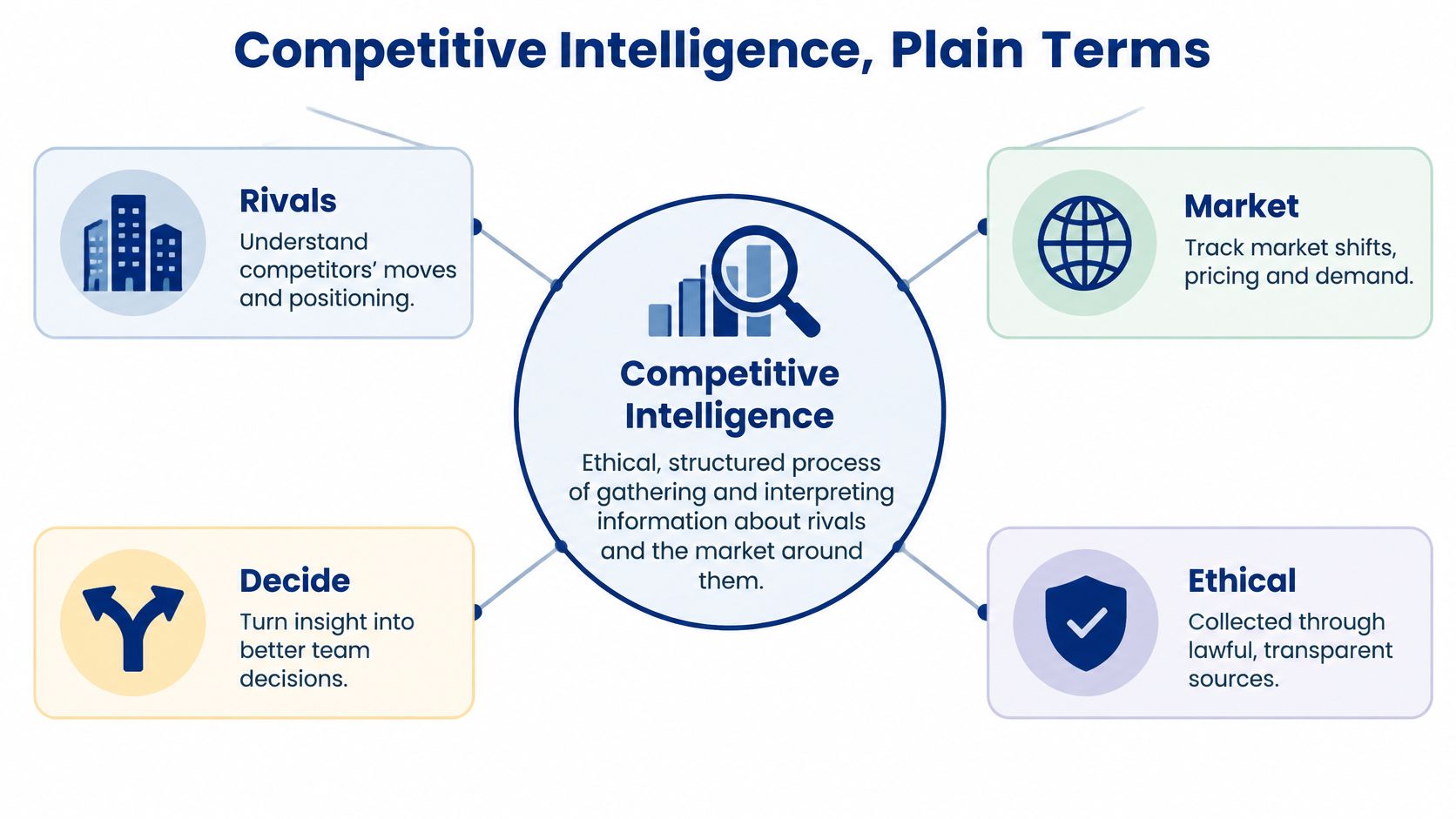
Competitive intelligence works the same way: the ethical, structured process of gathering and interpreting information about rivals and the market around them so a team can decide what to do next. Academic writing frames it as environmental scanning that pulls knowledge from across a company and feeds decisions in marketing, strategy, and structure, as described in this South African business journal review. The discipline grew out of market research and military intelligence. Its corporate job is narrower: turn outside facts into a view of a competitor's strategy, capabilities, strengths, weaknesses, and likely next move.
A single headline is a clip. Read several in sequence and a pattern forms. Say a rival posts a hiring surge in enterprise sales, mentions expansion on an earnings call, and announces a new partner in the same quarter. Each item alone is ambiguous. Together they sketch a likely push into your segment, and the intelligence step is the question that follows: which named accounts sit in the path of that push, and do you defend them this quarter or wait for one more signal? The question has a clock on it. A correct read delivered after the rival's reps have already booked meetings is a post-mortem.
Day-to-day CI draws on public material: filings and earnings that reveal capital plans, hiring and pricing moves, partnerships and executive changes, regulatory shifts in what a rival may sell. Sales, corporate strategy, product, marketing, and executives all work from that synthesis; no dedicated intelligence desk required. One line stays firm: competitors must not exchange commercially sensitive information such as prices, because that can facilitate collusion and violate antitrust law.
Michael Porter's 1980 book, Competitive Strategy: Techniques for Analyzing Industries and Competitors, gave managers a systematic way to study industries and rivals. That framework is still the backbone of modern practice.
Set honest expectations. CI cannot see a rival's private roadmap, and the pattern you read may not be the one they follow. What it does is shrink the guesswork so a decision lands while it still matters. That is the measure: decisions made sharper or faster, with tracked alerts as the raw material rather than the result.
Simple test: if a fact would not change a decision, file it as news and move on.
How CI Differs from Market Research, Sales Intelligence and BI
Ask five teams what "market intelligence" they produce and you will hear five different answers. Each discipline below touches competitors, customers, or revenue, yet each answers its own question and hands that answer to a different person.
| Discipline | Core question | Typical sources | Main users |
|---|---|---|---|
| Competitive intelligence | How will rivals and the market move, and what should we do? | Filings, hiring, news, earnings, customer signals | Strategy, sales and product leaders |
| Market research | How large is the market and what do buyers need? | Surveys, panels, interviews, sales data | Marketing, product and pricing teams |
| Sales intelligence | Which accounts should we contact, and when? | Contact data, firmographics, buying signals | Sales development reps and account executives |
| Business intelligence | What happened inside our own business? | CRM, ERP and finance data | Finance, operations and executives |
| Customer success research | Why do customers stay, expand or leave? | Usage data, renewal notes, support tickets | Customer success and product teams |
Information is what you can observe about competitors, customers, suppliers, regulators, and markets. Intelligence is the analytical step after that: what a rival can do, what it seems to intend, and what your team should do about it. A paper in the Malaysian Journal of Library and Information Science describes effective CI as systematic, networked, actionable, and forward-looking. The useful output is a chain of four links: observed event, inferred initiative, probable commercial impact, recommended action.
None of these disciplines earns its keep by tracking more sources. CI earns the name when it changes a decision or its timing, which is why it is judged on decision quality rather than feed size. Adding monitored rivals can make a program worse, because every extra alert competes with the one fact that should have changed the plan.
One posting is not a strategy
A rival posts a cluster of data-engineering roles. That is information. The intelligence is a testable hypothesis that the company is funding a platform build, plus the technical and economic buyers who would feel that spend, plus one discovery question you can ask on the next call. A single posting is a lead, and leads need corroboration: a leadership move, a filing comment, or a second posting wave pointing the same direction. When the signals agree, the hypothesis graduates into a recommended action.
The overlap between disciplines is real, and the questions should stay separate. Sales intelligence tells a rep which account to contact and when. A sales intelligence platform is built for that contact-and-timing job, monitoring buying signals across target accounts and turning them into outreach. CI explains why the market around that account is shifting. Business intelligence reports what already happened inside your pipeline, your forecast, and your finance system. When two of these feed one decision, share the source data and keep the question written at the top of the note.
"BI" causes one extra mix-up, because the label covers both the internal reporting discipline and a vendor category that investors fund. Lists of top US business intelligence investors answer who is financing the tools, which is a different question from what a named competitor will do next quarter.
List the last three decisions your team made about a rival or a market. Label which discipline supplied each input. If every label says "CI," you are probably storing news under the wrong name.

“Salesmotion empowers me to cultivate a great buyer experience. I'm able to challenge prospects' thinking and be a trusted consultative seller. A major part of this is Salesmotion insights.”
Austin Friesen
Account Executive, FY25 #1 President's Club, Clari
Where CI Data Comes From and Which Sources to Track
Start from the decision, then pick sources. "Should we prioritize this account this month?" needs a different stack than "Is this category getting more expensive?" A source earns a place only when it can move the written answer before the decision is made; more monitoring can make CI worse when every alert arrives with the same urgency.
Filings and earnings calls answer where money and risk language are moving. Capital allocation, caution in the risk section, and expansion plans show budget direction before a rep hears it from a buyer. Reading earnings call transcripts with a question in hand beats skimming every quarter for color.
Job postings answer where a company is staffing up. A cluster of roles in one function or region is a bet on that work. A single requisition is a maybe.
News and press releases answer timing. Launches, partnerships, and executive moves mark when a plan leaves the slide deck.
Funding and M&A announcements answer capacity. A round or an acquisition changes what the company can fund and which priorities get a new owner.
Customer reviews and forums answer where rivals win or lose in the buyer's words. Complaints, switching reasons, and praise are sharper than a feature matrix when you are writing a talk track.
Podcasts and interviews answer how leaders describe their own priorities. The phrasing is useful because you can mirror it without inventing a story.
Keep the set small
Alert tools watch pages. Filing databases and web change trackers catch documents and site edits. CRM-connected monitors push a signal into the rep's day instead of a separate inbox. Category roundups have a narrower use: a list of top PSA platforms for MSPs helps when the question is which tools shape that service market, and it stays parked when the question is a named rival's next move.
A working rule for a sales team: three to five trusted sources per target segment. Automated collection can pull many feeds at once. The team still decides which feeds match the accounts it sells to. If a sixth source does not change the decision, drop it.
Legal, Ethical and Trust Limits on Competitive Intelligence
CI is not corporate spying, and it isn't a scrapbook of competitor headlines. The Strategic and Competitive Intelligence Professionals ethics guidance defines the work as legally and ethically gathering and analyzing information about competitors and the industries they operate in, so the organization can make better decisions and hit its goals.
That definition leaves out bribery, pretexting, and pushing an employee to hand over confidential material. A hiring surge in enterprise sales at a large rival may point to a market-expansion plan. The same pattern at a small startup may point to a fundraising milestone or a go-to-market shift. Either reading is an informed point of view built from lawful material, not a stolen document.
The line you can apply on Monday
Use public filings, published statements, conversations a customer chooses to have with you, and data you license. Don't pretend to be a student, a journalist, or a prospect to get a private rate card. Don't swap pricing with a rival at a trade event, and don't ask a partner for numbers it isn't allowed to share. Sensitive price talk between competitors is how collusion starts, even when nobody meant to fix a market.
Four questions before you act
- Is it sourced? You can point to the filing, the call, or the posting.
- Is it current? The date still matches the account's situation.
- Is the inference labeled as an inference? Facts and guesses are not in the same sentence.
- Does it fit this account? A pattern from another segment doesn't get pasted onto this buyer.
Speculation doesn't belong in a customer email as if it were a fact. When software drafts a summary, a person still checks the source, the date, and the leap. Trust is the scarce part. Access to public pages is not.

“We have very limited bandwidth, but Salesmotion was up and running in days. The template made it easy to load our accounts and embedding it in Salesforce was simple. It was one of the easiest rollouts we've done.”
Andrew Giordano
VP of Global Commercial Operations, Analytic Partners
How the CI Cycle Runs from Collection to Distribution
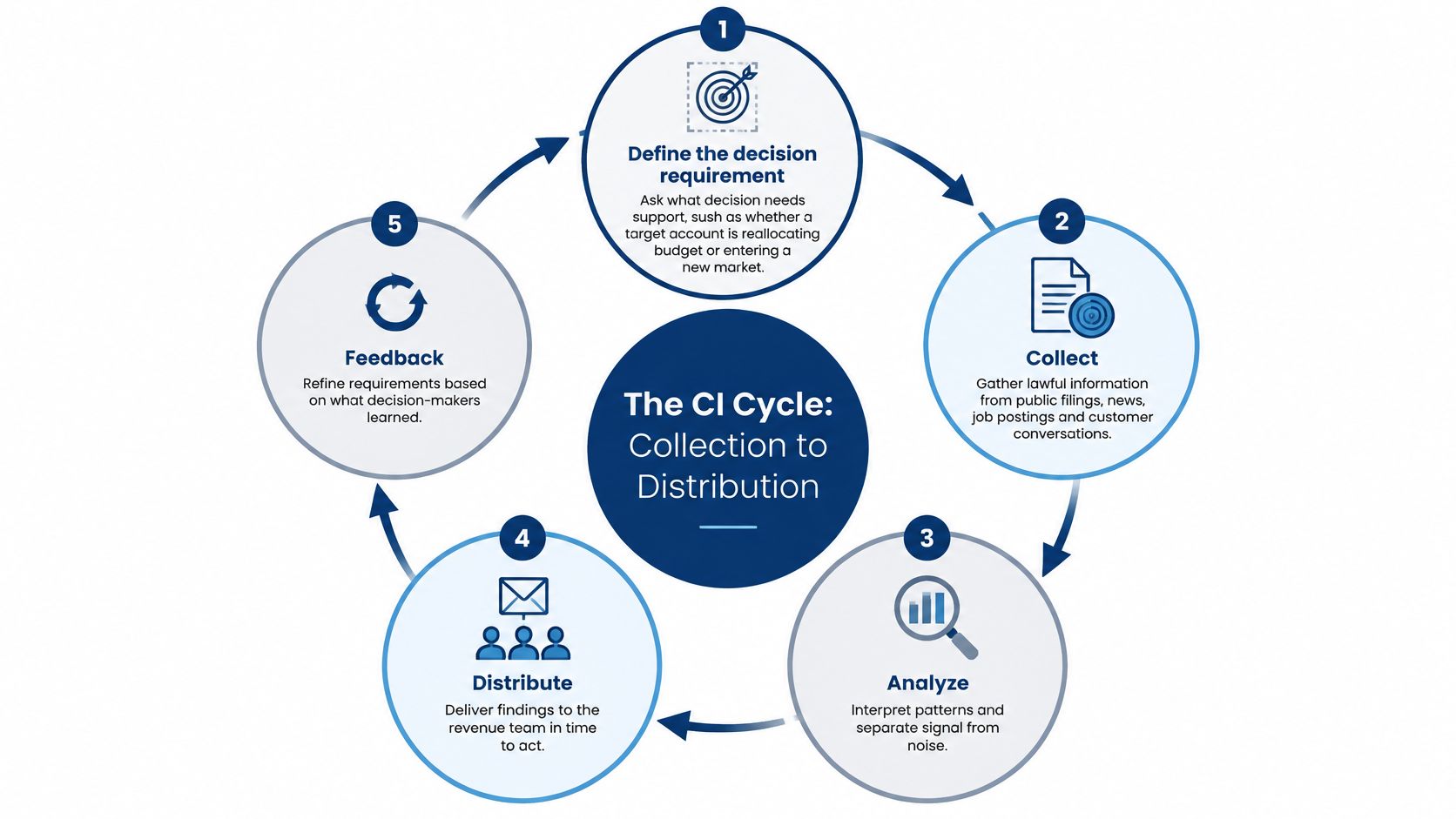
Competitive intelligence is a cycle, not a research project you finish and file. Academic reviews treat planning, collection, analysis, and communication as the core phases, and stronger models add reevaluation so the work changes a decision instead of filling a folder. A Universiti Teknologi MARA review of the intelligence cycle puts the operational test on decision latency: how fast a verified external change becomes an account hypothesis, an outreach action, or a reprioritization.
-
Define the decision requirement. Write the question first. Is this target account reallocating budget, entering a market, or reacting to a rival? A leadership change only matters if it might reset that question. The slip here is collecting everything because the feed is on.
-
Collect from lawful public sources tied to that requirement. Pull the announcement, the latest remarks, and one corroborating item, not the whole archive. For the new leader, that might be the appointment note plus the priorities they stated in their first public comments.
-
Analyze. Check who published the item, whether a second source agrees, and what it implies for budget or stakeholders. Skipping corroboration is how a rumor becomes a talk track. Field sellers already do a version of this when they interpret buyer feedback on a route. One comment isn't a trend until it repeats.
-
Distribute to a named owner with a time-bound action. The account executive gets a two-line hypothesis, a message angle tied to the new priorities, and a follow-up date. A report with no owner is a PDF.
-
Reevaluate after the action. Did the intelligence change the call, the sequence, or the account rank? If the buyer said the new leader hasn't touched vendors yet, update the requirement. Don't keep the same alert live out of habit.
Why the loop beats the archive
Each signal maps to a question, a confidence check, an implication, and an owner. Collection stays narrow because the question was written first. Article volume and alert count don't tell you whether the team got faster. Decision latency does. If a verified change sits for two weeks before anyone writes a hypothesis, the cycle is a library, not a sales motion.
Mini Case Studies and KPIs for Revenue Teams
A useful program tracks triggers and turns them into action. McKinsey's work on personalization at scale starts with who the customer is, how they behave, and the "key triggers" you can act on. An earnings statement alone is raw information. A documented shift in capital allocation, read next to a leadership change, can become a qualified hypothesis about timing. Keep the source attached, and label what you observed versus what you inferred.
These three cases are illustrative. They show the shape of the work, not a promised result.
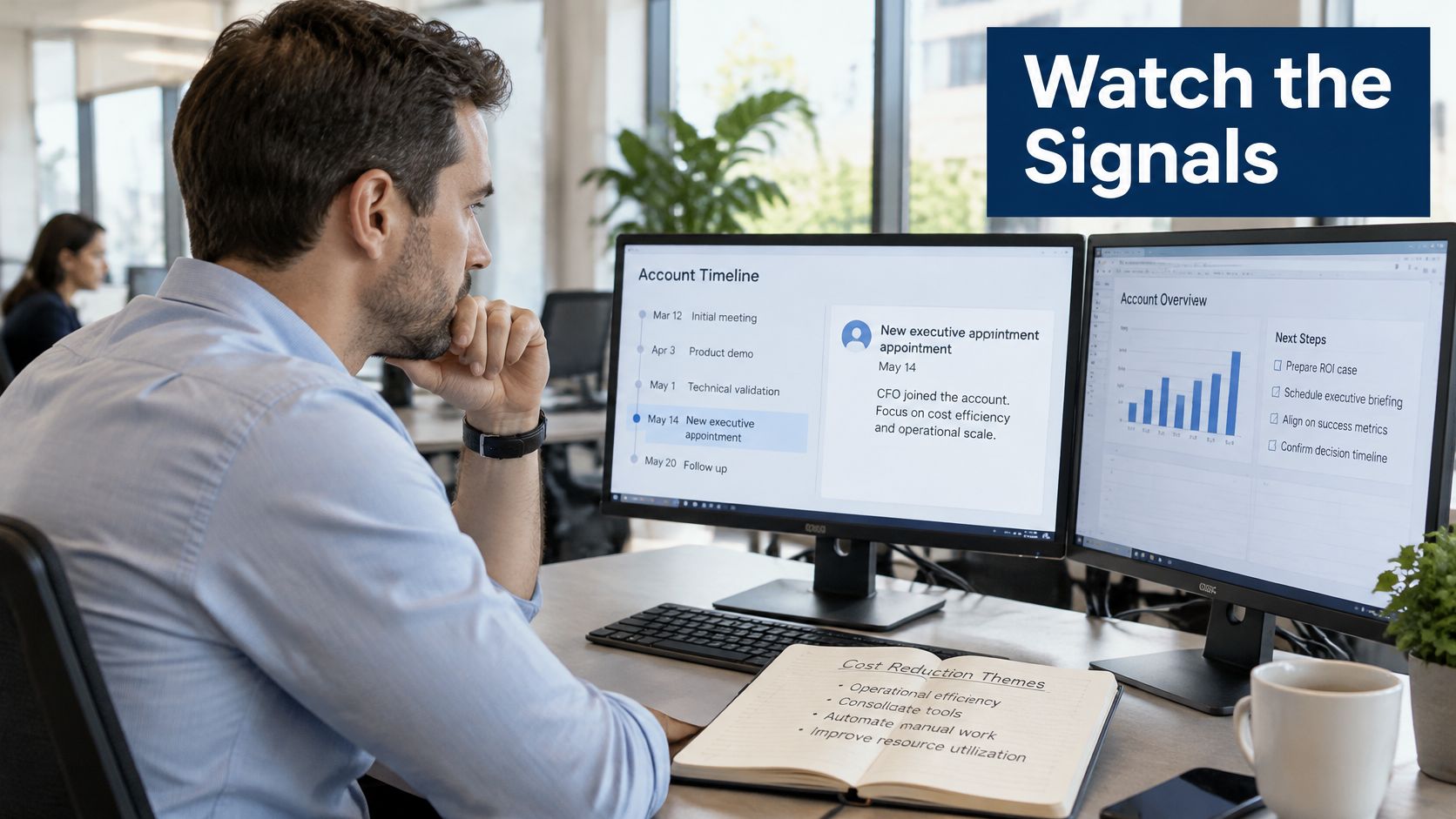
Case 1, mid-market software. The trigger is a new CFO plus a cost-reduction theme on the latest earnings call. The hypothesis is that vendor consolidation is more urgent than a new logo pitch. The rep sends a note about overlapping tools instead of a generic introduction, and the result to measure is whether a meeting gets booked.
Case 2, product marketing. The trigger is a rival's pricing change spotted in a competitor roundup. The hypothesis is that reps are still using last quarter's claim. The lead updates the battlecard within a week. The result to measure is fewer deals lost on an outdated price comparison.
Case 3, an account executive. The trigger is a competitor named on the customer's own earnings call. The hypothesis is that the same priority will show up in discovery. The action is a short question set built around that priority. Teams that track competitor mentions in prospect accounts can tag that moment instead of hearing about it after the deal is gone.
Why the numbers belong on a scorecard
Buyers notice generic outreach. McKinsey reports that 71% of consumers expect companies to deliver personalized interactions, and that personalization commonly produces a 10% to 15% revenue lift, with results varying by company and sector from roughly 5% to 25%. Those figures are not a guarantee for every intelligence-led sequence. They are a reason to tie the message to the account's actual situation.
Competitive deals are common enough to measure on their own. In 2025, sellers faced competitors in 68% of deals, according to Crayon's 2025 State of Competitive Intelligence research. If most opportunities already have a rival in them, win rate in those deals deserves a KPI.
| KPI | How to measure | What it tells you |
|---|---|---|
| Trigger-to-first-touch time | Hours from signal to first outreach | How fast the team acts on intelligence |
| Reply rate on signal-based outreach | Replies divided by sends, split by trigger type | Whether the signal makes messages relevant |
| Meetings created from CI triggers | Meetings booked and tagged to a signal | Whether intelligence creates conversations |
| Win rate in competitive deals | Won divided by closed deals where a rival was present | Whether battlecards and insight change outcomes |
| Battlecard use before calls | Share of competitive calls where the card was opened | Whether intelligence reaches the people who need it |
Baseline each row against your own history for the prior quarter. An outside benchmark won't tell you whether this team got faster after it cut the alert list.
Build Your First CI Workflow Around One Account
Don't roll this out across the whole book. One account, one week, one decision.
- Pick the account and write the decision. Example: is this buyer reallocating budget, or answering a rival that just showed up in their category?
- Choose three sources that match that decision. A filing, a jobs page, and recent executive remarks are enough. Leave the rest off.
- Set one trigger rule. A new CFO, or a hiring surge in a named function. If the rule fires on trivia, rewrite it.
- Name one owner and a 48-hour window for high-priority triggers. After 48 hours the signal is context, not a reason to interrupt the buyer's week.
- Write the hypothesis and the outreach angle in two sentences. What you think changed, and the question you'll ask because of it.
- Record the outcome and the KPI it moved. A reply, a meeting, a lost claim corrected, or a deliberate "no action."
An account research playbook keeps that six-step loop from depending on whoever has a free hour on Friday.
Where agents shorten the path
A Signal Agent watches monitored accounts for leadership changes, funding rounds, tech stack shifts, and strategic initiatives, and it states why each one matters. An account brief is an AI-generated executive summary of leadership changes, earnings highlights, hiring signals, and strategic initiatives, delivered as one cited document. AI Messaging drafts research-backed outreach anchored to the signal. The rep still judges relevance, tone, and whether the account is ready. Speed in collection doesn't replace that judgment.
After a month, compare trigger-to-touch time and reply rate with the week-one baseline. If replies fall while volume rises, narrow the triggers. Don't add sources to compensate.
Salesmotion monitors the public signals around your target accounts, explains why each one matters, and drafts outreach a rep can review before it goes out. If your team is drowning in rival news and still guessing what to do on Monday, start with one account and a written decision. Visit Salesmotion to see how that loop runs on the accounts you already sell to.