
Between 1999 and 2019 the United States recorded 134,516 registered trials, compared with 46,149 in China and 45,856 in Japan, the three largest national contributors on the WHO International Clinical Trials Registry Platform. Oncology has been a major share of that growth, with trial activity rising substantially across the 2000s and early 2020s before recent registration behavior became more uneven. That matters commercially because volume alone creates noise. A sponsor can have several related records, regional IDs, and phase updates in motion at once, and a rep who treats each record as a fresh opportunity will waste time on activity that was already counted.
A registry tab open on Friday afternoon isn't a commercial system. Clinical trial intelligence is the practice of stitching public trial records into one living picture of what a sponsor is starting, changing, delaying, or finishing, then deciding whether that change is a reason to call.
The useful edge comes from provenance plus a decision threshold. A phase move, trial start, or funding event only becomes valuable when the team can see where it came from and what action it justifies. Without that threshold, every update looks urgent. With it, a field change becomes a timed sales action instead of another unread alert.
Why Trial Records Outgrew Manual Research
Registries behave like traffic cameras. Each feed shows one intersection. A route appears only when the feeds share a map, the timestamps line up, and someone decides which turn is worth a conversation.
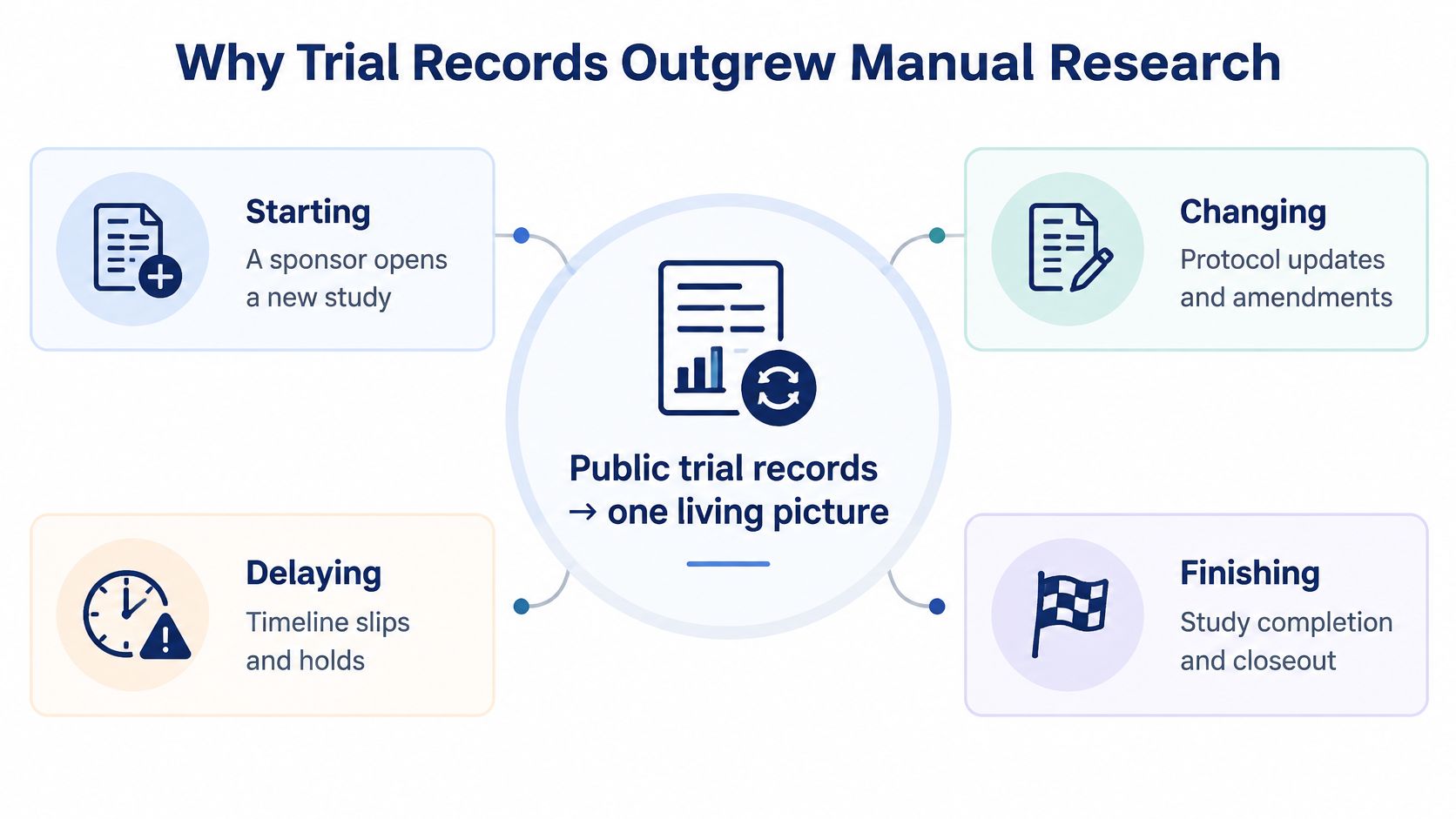
Useful competitive and commercial insight sits across countries, phases, sponsors, and participant groups. A single ClinicalTrials.gov page can look complete and still be the wrong unit of work. The same program often shows up under a slightly different title, a local registry ID, and a later phase record. Reading one record is research. Deduplicating records, normalizing fields, and following phase, intervention, geography, recruitment, and sponsor behavior over time is intelligence.
What manual research still gets wrong
A strong analyst can open a record, note the phase, and write a decent note. That habit breaks once the book of business is more than a handful of sponsors.
Duplicate programs look like new demand. Two registry entries for one asset get scored as two opportunities, and the rep pitches a start that already happened.
A contact edit looks like a strategy change. The record was touched yesterday, so it lands in the alert queue, even though only the public email changed.
A quiet status field hides a buying window. Suspended, terminated, or completed can reorder site outreach and close-out work without a press release.
The readers who need this picture are business-development and account teams at CROs, site networks, and vendors selling to drug developers. Scientific teams already live in protocols. Revenue teams need a shorter question. Did something just change that our service can help execute while the buying window is still open?
A living picture, not a bigger spreadsheet
I would treat four moments as the spine of that picture, not as four separate reports.
Starting. A sponsor opens a new study or advances a phase. The service mix changes with the phase. Startup support is a different conversation from a dose-finding lab contract.
Changing. Eligibility, endpoints, or visit schedules move. The protocol is no longer the document your proposal assumed.
Delaying. Holds, slow recruitment, and version lag at sites stretch the calendar. Someone is paying for idle time.
Finishing. Completion and close-out shift the buyer from operations to medical writing, transparency, and evidence packaging.
Practical rule: If you can't name which of those four moments just happened, and which field proved it, you don't have a reason to call yet.
The payoff is a conversation while the account is still deciding who helps them through the change. A month later, the incumbent has already been asked.
Trial Signals Worth Acting On
Six public changes carry most of the commercial value. Each one has a home in the record, a sales move, and a clock. Paste this into a watchlist and argue about the message later.
| Change | Where it appears | Sales move | Respond within |
|---|---|---|---|
| Phase advance or new trial start | ClinicalTrials.gov and WHO ICTRP | Pitch the service that phase now needs | 48 hours |
| Status flip to suspended, terminated, or completed | Registry history, recruitment status | Rescue, site, or close-out conversation | 48 hours |
| New eligibility, endpoint, or visit schedule | Protocol version versus prior record | Amendment, training, or recruitment reset | 1 week |
| Results still missing after the one-year window | Results tables versus primary completion date | Medical writing or transparency outreach | 1 week |
| Country or site added | Locations module | Local site services or logistics pitch | 1 week |
| Raise or earnings comment on the program | Filings, press, earnings transcript | Expand scope with the economic buyer | 48 hours |
How the record makes a change detectable
Applicable trials are generally registered no later than 21 days after the first human participant is enrolled, under FDA transparency rules for ClinicalTrials.gov. A new NCT record is a start, not a rumor you heard at a conference. Results submissions require structured tables for participant flow, baseline demographics, primary and secondary outcomes, and overall recruitment status, plus the full protocol and statistical analysis plan.
A status flip from recruiting to suspended, terminated, or completed can reorder partnership and site outreach even when the sponsor never issues a press release. A newly posted primary outcome, protocol version, or analysis plan can reveal a design shift the same way. Compare the current record with the prior version so a routine contact update isn't treated like an endpoint change.
Phase and status events deserve a response inside 48 hours, and so does a raise or earnings comment that names the program. Money and phase moves change who can buy this quarter. Amendment, geography, and results-deadline events can wait up to a week if the owner confirms the diff is real. Waiting a week on a phase advance usually means someone else already booked the meeting.
An analysis of trials due to report found that only 40.9% (1,722 of 4,209) submitted results within the one-year deadline, and the median gap from primary completion to results submission was 424 days, 59 days past the statutory year, in a review of ClinicalTrials.gov reporting. An empty results module after that window is a service conversation, not a compliance lecture.
Routine edit versus a real diff
Open the history, not just the current page.
Ignore the noise. Public contact, minor wording, and a facility phone number don't change your proposal.
Act on the design. Eligibility age bands, a new exclusion, a swapped primary endpoint, an added visit, or a country in the locations module change scope, timeline, or who you introduce.
Match the buyer to the row. A phase move belongs with the person who owns the proposal. A missing results package belongs with medical writing. A new country belongs with whoever can staff that geography.
Timing the outreach to the phase, rather than to your quarterly business review, is the whole point of watching phase transitions before the buying window closes. If the diff isn't something you can quote back to the sponsor in one sentence, it isn't ready for a call.

“We're no longer fishing. We know who the right customers are, and we can qualify them quickly. Salesmotion has had a direct impact on pipeline quality.”
Andrew Giordano
VP of Global Commercial Operations, Analytic Partners
Where Revenue Teams Make the Money
Protocol change is where the money and the delay sit. Most amendments aren't mistakes. They're moments when the sponsor needs help executing a change it already accepted.
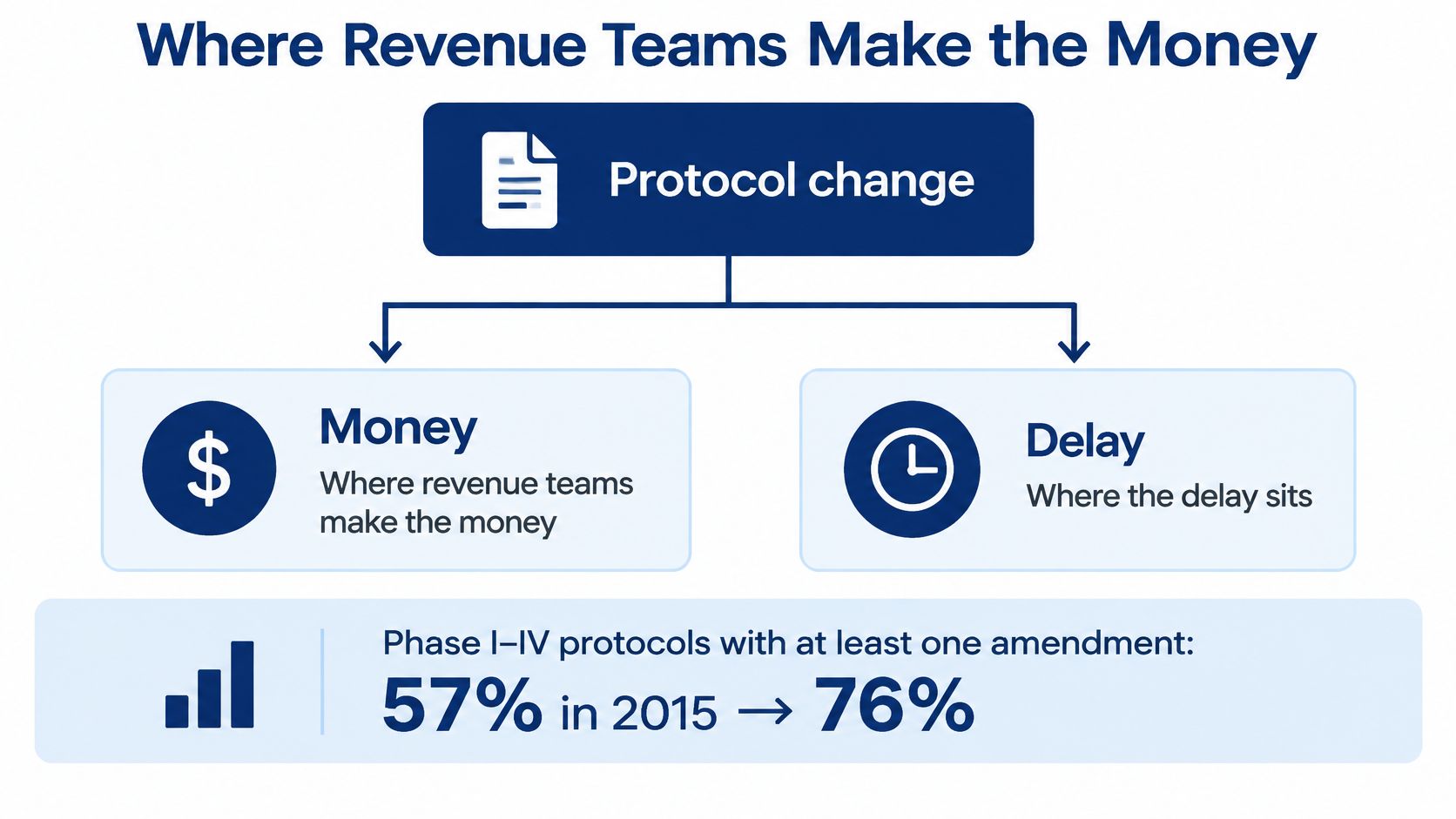
A peer-reviewed analysis of phase I–IV studies found that the share of protocols with at least one amendment rose from 57% in 2015 to 76%, while the average number of amendments rose from 2.1 to 3.3, a 60% increase, according to PubMed's summary of that amendment study. About 77% of amendments were considered unavoidable, most often a regulatory request or a change in study strategy. The average time from spotting the need to final oversight approval reached 260 days, and investigative sites operated under different protocol versions for an average of 215 days.
That lag is a buying window. CROs, eClinical vendors, patient-recruitment firms, and site networks aren't selling "awareness of amendments." They're selling the work that has to happen while two versions of the protocol are both live.
Four buyers, four uses
A full-service CRO reopens a stalled proposal. Say an oncology account went quiet after an indication-level conversation. The registry then shows a phase advance. The account lead doesn't resend the capabilities deck. They send the startup plan that phase now requires, and they ask which workstreams are still unstaffed.
A recruitment vendor rescopes before screen failures lock in. A tightened eligibility line will shrink the funnel. The useful note cites the new criterion and offers a remap, before the site network has three months of failed screens and a story that "patients aren't out there."
A medical-writing or transparency partner fills an empty results record. Primary completion has passed and the structured tables are still blank. The offer is participant flow, baseline characteristics, and outcome tables, built to the format the registry already demands.
A site-network seller uses a new country. The locations module adds a geography the sponsor doesn't staff. The introduction is investigators and startup support in that country, not a global brochure.
Treat the amendment as a structured event, not a PDF sitting in a shared drive.
Name the changed criterion, endpoint, or visit. Then say which sites, recruitment assumptions, patient communications, and budget lines move. A system that stops at "protocol updated" forces the rep to do the diff by hand, which is how the 215-day version lag becomes someone else's problem.
The honest commercial read is simple. Unavoidable doesn't mean unserved. Regulatory requests and strategy changes still need training, system updates, revised patient materials, and a timeline someone will own. That's the work revenue teams get paid for, if they show up with the changed line in the first sentence.
How to Trust a Signal Before You Act
More alerts don't make a better system. Incomplete records, late uploads, and lookalike studies mean a raw hit can point at the wrong program. A 2025 review of clinical AI describes the same implementation gap: performance in a tidy study isn't the same as a recommendation someone will defend in a diverse clinical setting, with open questions on accountability, data ownership, consent, and legal liability, as covered in npj Digital Medicine.
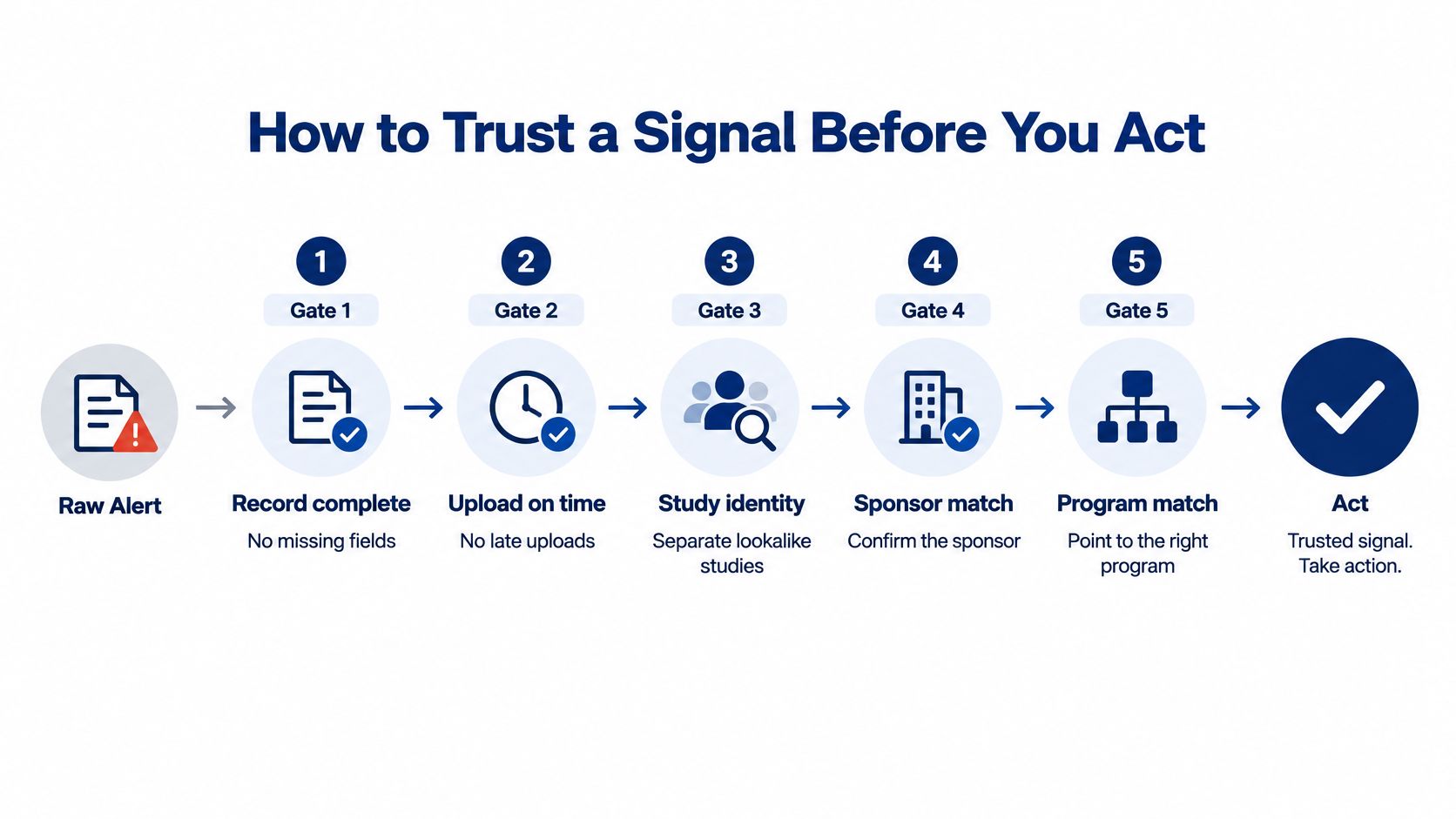
Trust comes from five fields on every alert. If a new teammate can't explain why this account moved up the list without opening five tabs, the alert isn't finished.
The five-field check
-
Signal. Write the change in one line. "Phase II to phase III" or "eligibility upper age cut from none to 75." If you need a paragraph, you haven't found the signal yet.
-
Validation. Keep the source link, the prior value, and the new value. A rep should see that eligibility changed from adults 18 and older to adults 18 to 75, not merely that the record was edited on Tuesday. Provenance is the difference between a hunch and a note medical affairs will accept. The same discipline shows up in source-backed account intelligence, where every claim has to point at the filing or the record.
-
Owner. One person, usually the account lead. A shared inbox is how a phase advance sits untouched until the weekly meeting.
-
Decision threshold. Make it explicit before the alert fires. A phase advance, or a status flip to suspended, is enough to reprioritize that week. A single administrative contact edit is not. A country add is enough only when that country is in the territory the team can serve.
-
Outcome. Name what you'll measure. A logged first touch, a meeting, or a dismissed alert with a reason. "We sent more alerts" isn't an outcome.
When the human overrides the registry
The override is part of the design, not a failure of the tool. If the sponsor's own investigator call contradicts the registry, the call wins. Mark the alert overruled and write the reason. Registries lag. Uploads slip. Two sponsors can run studies with near-identical titles.
Keep an audit note of source, timestamp, and who acted. Revenue teams resell this judgment into medical and feasibility colleagues, and those colleagues will ask where it came from. Incomplete EHRs, missing device data, asynchronous reporting, biased sets, and thin explanations are why an algorithm score alone shouldn't move a forecast.
A phase advance with a link and a before-and-after is enough to call. A score without a field change is not.
I would rather ship fewer alerts that a rep can defend than a dashboard full of signals nobody will stake a meeting on.
“We have very limited bandwidth, but Salesmotion was up and running in days. The template made it easy to load our accounts and embedding it in Salesforce was simple. It was one of the easiest rollouts we've done.”
Andrew Giordano
VP of Global Commercial Operations, Analytic Partners
KPIs That Show Intelligence Is Working
Judge the program on six measures. The revenue leader and the rep who owns the account should read them monthly. Don't add a vanity count of alerts sent.
| KPI | What it counts | Early bar |
|---|---|---|
| Signal-to-first-touch | Hours from detected change to logged outreach | Under 48 hours for phase and status events |
| Signal-sourced pipeline | Share of new opportunities tagged to a trial change | Rise quarter over quarter after rollout |
| Research hours per account | Rep time before a first meeting | Toward half the manual baseline |
| Account-plan cycle time | Days from account added to a usable brief | About 30 percent faster than today |
| Amendment exposure | Open opps on a phase III study with a substantial amendment | Escalate the same week |
| Enrollment representativeness | Actual versus intended age, sex, race, and ethnicity mix | Flag skew before enrollment locks |
Speed, pipeline, and the hours you get back
Signal-to-first-touch is the median hours from a detected change to a logged outreach. Phase and status events should land under 48 hours. If the median is a week, the watchlist is a newsletter.
Signal-sourced pipeline is the share of new opportunities tagged to a trial change. Read it quarterly. A one-week spike after launch isn't a system. A steady rise means reps are tying live pursuits to a field that moved.
Research hours per account should fall toward half the manual baseline once a brief replaces tab-hopping across registries, filings, and old call notes. Account-plan cycle time is days from adding the account to a brief a seller will use. About 30 percent faster than today's plan is a fair early bar, not a trophy.
Amendment exposure counts open opportunities sitting on a phase III study with a substantial amendment. Those changes should be escalated the same week, because phase III scope moves hit budget and timeline harder than an early administrative edit. The point of the count is the escalation, not a larger number on a slide.
How those hours and cycle times show up in pipeline math is laid out in a practical look at the ROI of sales intelligence tools. Keep the tag on the opportunity honest. If the meeting happened because of a conference badge scan, don't credit the registry.
Representativeness is the sixth measure
Speed can beat the science. FDA guidance on enrollment asks sponsors to enroll participants who reflect the people likely to use the product, with regard to age, sex, race, and ethnicity, and to use a broad site mix when subgroup differences matter.
A 2025 recruitment study found digital channels produced the largest share of enrollment at 39.1%, while targeted hybrid letters and text messages put 87.5% of participants in groups historically underrepresented in research, versus 48.5% for traditional methods and 32.3% for digital approaches, as reported in npj Digital Medicine's recruitment comparison. The fastest site can still skew the cohort.
Compare actual enrollment mix with the intended-use population and flag a gap before enrollment locks. A slower site that reaches the population carrying the disease burden can be the better commercial and scientific partner. For a recruitment vendor, that contrast is a reason to sell channel mix, not just volume.
Three Signals Turned Into Sales Moves
Three composites show the path from a public diff to a note a rep can send. Each one names the field that changed, points at the record, and asks one question the buyer can answer.

Tufts Center for the Study of Drug Development research put the median direct cost of a substantial amendment at about $141,000 in phase II and $535,000 in phase III, in an analysis published via Springer. The same design tweak is a different conversation once the phase changes. That analysis also found 57% of protocols had at least one substantial amendment, nearly 45% of those amendments were considered avoidable, and phase II and phase III protocols averaged 2.2 and 2.3 global amendments. Amended studies generally ran longer on recruitment and overall duration than studies without global amendments. Phase III eligibility or endpoint changes outrank a minor administrative edit. Avoidable work is also a reason to offer design review before the next amendment, not only rescue after it.
A phase move and forty new sites
A mid-size oncology biotech moves a study from phase II to phase III and adds 40 sites across two new countries. The account lead doesn't open with a generic CRO capabilities deck. Startup burden and country regulatory support are the offer, because the cost and the operational load just changed scale.
The note cites the phase field and the new locations, links the record, and stops. The question is which of the new countries already has a vendor. If both are covered, the rep learns it in one reply instead of building a proposal nobody needs.
An exclusion that will raise screen failures
A phase III protocol adds an exclusion. The recruitment lead quotes the new line, offers to remap the funnel, and doesn't propose a bigger media buy on the first call. Volume without a diagnosis just buys more screen failures.
The one question is the current screen-fail rate. With that number, the remap has a baseline. Without it, the rep is guessing at a percentage the site already knows.
Results tables still empty
Primary completion was 14 months ago and the results tables are still empty. The transparency lead doesn't lecture. They point at the blank participant-flow and outcome tables, reference the missed reporting window, and offer to build the structured submission, including the protocol and statistical analysis plan the record is supposed to carry.
The question is who inside the sponsor owns the results package today. If that person is already under contract, the right move is a smaller assist, not a full rewrite.
In all three notes the discipline is the same. One changed field. One link. One question. A phase III eligibility or endpoint change gets the earlier slot on the calendar. A contact-only edit doesn't get a slot at all.
Start Watching the Accounts That Buy
Pick 25 accounts that already sit in active pursuits, not a theoretical universe of every sponsor in a therapeutic area. A rare-disease cell therapy and a primary-care pill don't deserve the same score, so tag each account by therapeutic area, phase, and modality before you rank them.
Load the six changes from the watchlist. Route phase moves, new starts, status flips, and raises inside 48 hours. Give amendments, geography adds, and missing results a one-week review once someone confirms the diff. Name one owner per account. Require the source link on every alert. Review the queue once a week and mark each item acted, dismissed, or overruled. That weekly mark is what keeps the list from becoming a second inbox.
I would start with accounts you can already get a meeting on. A perfect signal on a cold logo won't teach the team as fast as a real diff on a live pursuit.
Salesmotion is built for this watch. Our life sciences offering includes clinical trial signals, earnings analysis, and AI meeting prep. The module finds drug developers by therapeutic area, phase, and modality and watches for trial starts, phase moves, or raises, then puts that context where reps already work. Cytel, a life-science user, cut research time by half and sped account planning by 30% after consolidating scattered sources. You can see how indication and phase change the account list in this walkthrough of clinical pipeline analysis by indication and phase.
The first month is a success if signal-to-first-touch on phase events is under 48 hours and at least a handful of opportunities are tagged to a real registry change. Expand past the original 25 only after that bar is met. A longer list with the same unread alerts is how teams go back to manual research.
Salesmotion watches trial starts, phase moves, and raises alongside earnings and meeting prep, so a registry change reaches the account owner with the source attached and a clear next step. That is clinical trial intelligence aimed at a live book of business, not another unread feed. Visit Salesmotion to put 25 active accounts on that watch and see which signals are worth a call this week.