It's 7:40 on a Monday, and a field director has forwarded you a single line. The competitor's Phase 3 readout has moved from the fourth quarter into the third. No link. No analysis. Just a date that changed.
By nine you'll be asked what it means. Does it pull a launch forward? Does it change which accounts your team calls on between now and June? Should market access start earlier on the payer dossier? You have a partial answer and a full calendar.
That gap, between noticing that something moved and knowing what to do about it by Friday, is where most competitive intelligence work in pharma lives. Closing it doesn't require a bigger database. It requires a shorter path from a public fact to a named owner and a dated action, plus the honesty to state how confident you are while you're still guessing.
What Pharma Competitive Intelligence Means for Your Team
A competitor changes a trial date, hires a market access lead and shifts launch messaging in patient-facing language. By Friday, your team needs to know which of those moves changes a decision. Pharma competitive intelligence gives that judgment a working system: collect public and licensed information about rivals' pipelines, approvals, partnerships and commercial moves, then turn it into calls for R&D, marketing, sales and business development. The output is a decision table, not a news feed. It says where to spend, who to call on and when to move.
It works like a weather forecast for your market. A rain report tells you it poured. A forecast tells you to move the field day indoors. Good intelligence gives the same practical direction. If a rival's filing is likely to land before your launch, the payer story starts now rather than in the spring.
The work itself is less glamorous than the phrase suggests. Analysts reconcile signals, ask what each one changes, and separate a real shift from background noise.

Why the Pipeline Matters More Than the Product List
Launched products are the last chapter of a long story, and earlier chapters are public. The FDA approved 1,355 new drugs between 1980 and 2022, an average of 31.5 a year, according to a 2024 analysis in Scientific Reports. That history matters because approval is a filtering process. Some applications clear review on the first cycle, while others need more work before a product reaches the market. Clinical development also takes years, so a rival's intentions can be visible long before its revenue is.
The practical consequence: a competitor's revenue is invisible for years while its intentions are not. A trial registration, a filing, a hiring wave and a patent listing all surface long before the first invoice.
That is why serious programs track pipeline stage, regulatory pathway, review outcomes and trial timing alongside sales. A rival with a thin filing record and a readout next quarter is a different threat from one with a clean record and a two-year runway. The first may be scientifically interesting but commercially uncertain. The second may need a market access response while your own team is still planning its next field cycle.
A competitor's approved label tells you what it may claim. What it says at the point of dispensing is a separate question, and a consumer Online pharmacy listing shows the plain-language positioning patients and prescribers meet first. That wording can reveal how a rival frames benefit, convenience and trust before sales numbers make the choice obvious.
Judge intelligence by the speed and quality of the decisions it supports. Pick the three decisions this quarter that it should serve:
- R&D investment. Whether to accelerate, pause or re-scope a program because a rival's endpoint choice narrows your differentiation.
- Account prioritization. Which health systems, integrated networks and prescriber groups your field team touches first.
- Launch timing. Whether to pull market access work forward by a quarter, and what that costs.
A useful answer names the owner, the next step and the date. Everything else is commentary.
Signal Sources and How Early Each One Reveals a Move
Rank sources by two things: what they reveal and how early they arrive. Intent shows up years ahead. Confirmation shows up months or weeks ahead. A program that reads only the late sources is a program that reacts.
| Signal source | What it reveals | Typical lead time | Where to look |
|---|---|---|---|
| Clinical trial registries | Phase, endpoints, enrollment and planned readout | 1-3 years before filing | ClinicalTrials.gov and national registries |
| Patent filings | Composition, formulation and method-of-use claims | Years before launch | Patent offices and Orange Book listings |
| FDA Orange Book | Approved products, patent and exclusivity dates | Current status, updated monthly | FDA download and Orange Book API |
| Regulatory submissions and agency feedback | Filing timing and review outcomes | Months before approval | Company releases and agency databases |
| Publications and conference abstracts | Mechanism and early efficacy data | Months to years before launch | PubMed and congress programs |
| Partnering and licensing deals | Gaps a rival is filling and budget priorities | At announcement | Press releases and deal databases |
| Earnings calls | Launch timing, priorities and budget shifts | Quarterly | Investor relations transcripts |
| Hiring and org moves | Launch readiness, market access and field build-out | Typically months before launch | Job boards and professional networks |
| Conference programs | Data presentations and key opinion leader focus | Scheduled weeks to months ahead | Congress calendars |
| Social listening | Physician and patient sentiment | Real time, but noisy | Forums, social platforms and media monitoring |
Read the table in pairs, because no single row is decisive. Registry entries and patent filings tell you a company has committed money to a specific question in a specific population. A registration on its own might be exploratory. A registration plus a cluster of method-of-use patents in the same indication is a strategy.
Regulatory submissions and Orange Book records give you timing within months. Earnings calls, hiring and social listening give you momentum in something close to real time, and they're the noisiest of the ten. Pair an early signal with a later confirmation: a trial registration followed by a hiring wave in the same geography is a much stronger read than either alone. An early signal with no follow-through after eighteen months has stalled.
The Source You Can Start With Today
In the United States, the FDA's Orange Book combines approved drug products, therapeutic-equivalence evaluations, and applicable patent and exclusivity information. Its downloadable data are updated monthly and include product, patent and exclusivity records, so an analyst can follow a reference product's approval date, application type, patent number, patent expiration, use code, therapeutic-equivalence code and exclusivity expiration from one repeatable dataset rather than a stack of press releases. The same records are available programmatically through the Orange Book API, which is how a portfolio team monitors generic-entry risk on a schedule instead of by memory.
If your team has no intelligence function yet, start with three sources on a weekly rhythm: a trial registry for the two indications you care about, the Orange Book for the products already on patent clocks, and earnings call transcripts for the two competitors most likely to move first. An hour a week is enough to catch a phase shift before the press release, which is exactly the moment discussed in phase transition timing as a biotech sales trigger. Add paid layers after you can predict a move, not before.

“Salesmotion helps you spot signals from prospect accounts, news items / job hiring alerts etc that indicate that now is a good time to reach out with a well-crafted message.”
Rob Douglas
Director of Sales, icit business intelligence
Turning Trial Registries into a Competitor Timeline
A registry entry isn't news. It's an admission of intent, published early and voluntarily, and it usually sits unnoticed for months. Phase, enrollment target, eligibility criteria, comparator, endpoints, geography and status changes together reveal a rival's intended label and launch sequence before anything is filed. The scale is why this needs a method: one industry database snapshot reports coverage of more than 250 clinical trial registries and 200 conferences worldwide, per this registry and conference coverage overview. You won't read them all. You'll read six assets carefully.
Build the timeline asset by asset:
- Log the asset. Sponsor, phase, indication, modality, and the date you first noticed it.
- Record two dates. Protocol registration and first-patient-in. The gap between them tells you how fast that sponsor executes.
- Watch recruitment. A raised enrollment target, new countries, or wider eligibility hints at a broader label than the one you're defending.
- Note completion and readout. Primary completion date, plus the sponsor's stated topline window.
- Add submission and approval milestones as company disclosures appear, so the timeline keeps moving to the right.
- Overlay the incumbent's patent and exclusivity dates. Anything landing inside that window is a near-term threat. Anything outside it is pipeline noise until something changes.
Say a rival adds a payer-relevant endpoint, such as a hard outcome or a quality-of-life measure, and expands enrollment into two new European countries in the same quarter. Two things follow. The label they intend to claim is broader than yours, and they intend to file in Europe early. The useful response isn't a memo. It's moving the market-access review forward by a quarter and briefing the pricing team on a comparator they'll have to argue against.
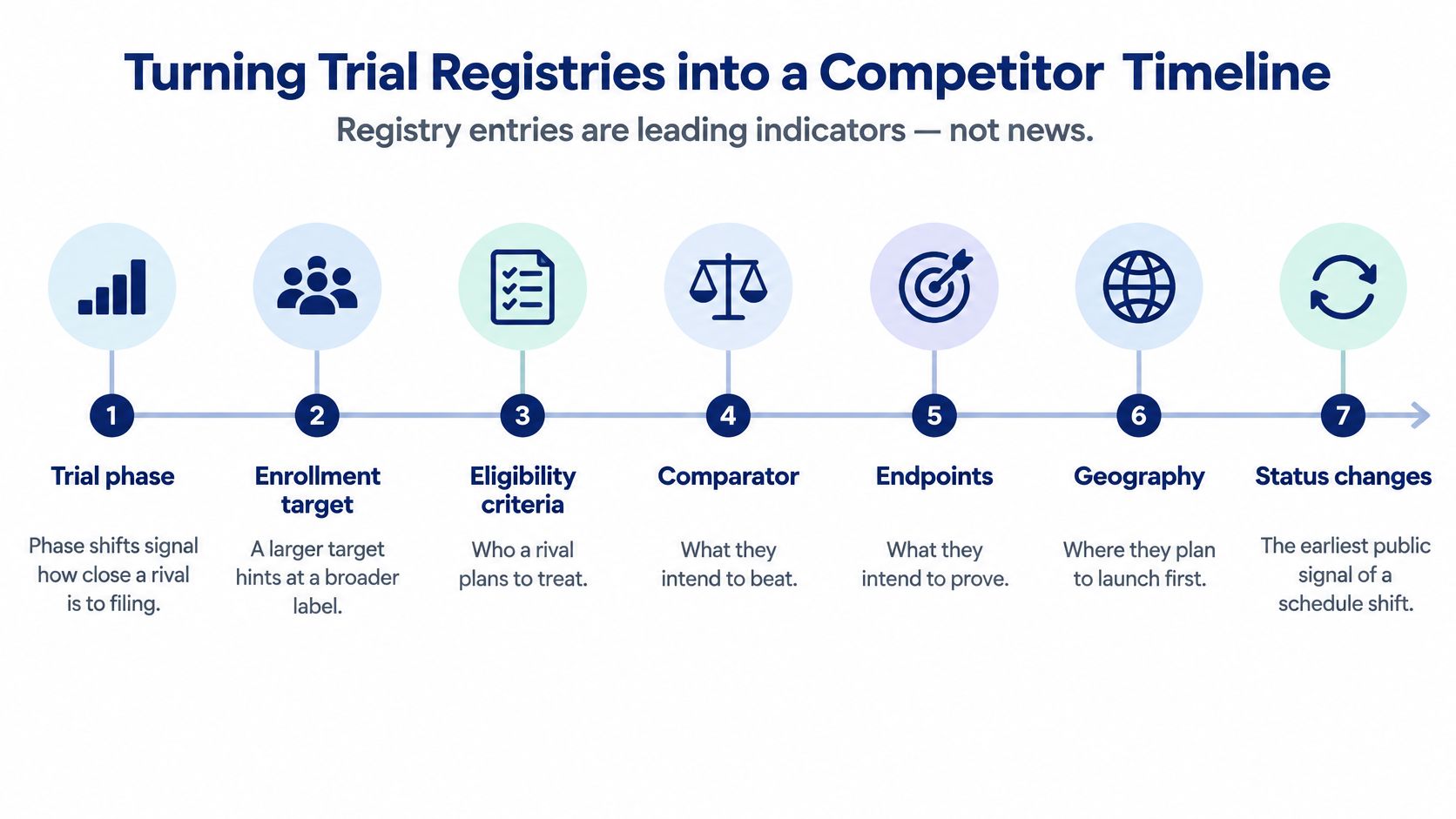
Store it where the whole team sees it: a shared sheet or project board with one row per asset, one column per milestone, and a source link in every cell. The value isn't the chart. It's that a field director and a regulatory lead argue from the same dates. Teams building this out often pair the timeline with clinical trial intelligence so a status change triggers an alert rather than a manual check.
Patents and Exclusivity as Launch Clocks
A single date can give a commercial team false confidence. A patent expiry goes into the model, the generic-entry year follows, and then the market moves earlier or later because another clock was running in parallel. The practical job is to treat patents and exclusivity as two interlocking timers, then write the date as a range until the overlap is clear.
Patents and regulatory exclusivity are separate mechanisms that overlap without being identical. The FDA explains that patents can issue at different points during development and can cover the drug substance, the drug product or a method of use, while exclusivity is a statutory delay or prohibition on approval of competing products that attaches when the drug is approved and the legal requirements are met, as set out in the FDA's guidance on patents and exclusivity. A patent works like a private right you can enforce in court. Exclusivity works like a gate on approvals. They can end on different days, so the later constraint often sets the actual entry window.
Use a worked example with a relative date, not a fake precision. Assume the headline patent for a small molecule expires in a given March, so the first model says entry in that year. Pediatric exclusivity, if granted, can add six months to existing patents and exclusivities the sponsor holds for the relevant active moiety. The model shifts toward the end of that year. A listed method-of-use patent may still limit a generic competitor for one indication after the main patent lapses, which means the first entrant could face a narrower label than the headline date implies. The date is therefore a clock with gears, not a line in a calendar.
The Three Questions to Ask Before You Write a Date
- Which patent covers the product? Composition of matter, formulation, manufacturing, or a method of use. Each one blocks a different competitor.
- Which exclusivity applies, and when does it run? The statutory clock and the patent clock rarely stop together.
- What has the sponsor listed, and when? Patents issued after approval can be submitted after approval, and late or amended listings can move expected dates without a clear market announcement, as the FDA's guidance on patents and exclusivity explains.
A strong commercial read keeps all three answers visible. If the sponsor lists multiple patents around the same molecule, separate the one driving the base case from the ones creating tail risk. If the exclusivity clock runs beyond the patent clock, show both dates in the model instead of hiding the later one in a footnote. If a method-of-use patent remains, state which indication is constrained. That distinction matters because a generic entrant with a narrow label may not pressure the whole franchise at once.
Say it as a range. Earliest realistic entry sits between the headline patent date and the pediatric-extended date, with a method-of-use caveat on one indication. A range with stated reasons survives a portfolio review. A single date invites an argument you'll lose.
Pull every one of those dates from the Orange Book fields rather than from a press release summary. Press releases compress legal detail into a clean story. Field-level patent and exclusivity records let the team see which protection is listed, what it covers, and how the clocks line up. That is what turns a date into a decision tool: the commercial lead can say when the threat starts, what it applies to, and what would change the call.

“Automatic account profile detail I can use to manage my territory. Using Salesmotion AI to generate value statements per persona, account, etc. Using Salesmotion to give me a starting point based on new hires, or news alerts is critical.”
Adam Wainwright
Head of Revenue, Cacheflow
Turning Weak Signals into Ranked Decisions
Most programs are good at finding signals. Fewer are good at proving which ones deserve action, and that's where the commercial value sits. Recent survey data from the State of Pharma Intelligence 2026 report makes the imbalance explicit: 38% of surveyed life-sciences leaders named judging which candidates will succeed as a major gap, against 20% who cited signal-detection speed. 77% needed at least three weeks to produce initial screening intelligence, and 48% pointed to internal alignment as the constraint.
The bottleneck is judgment and routing, not discovery.
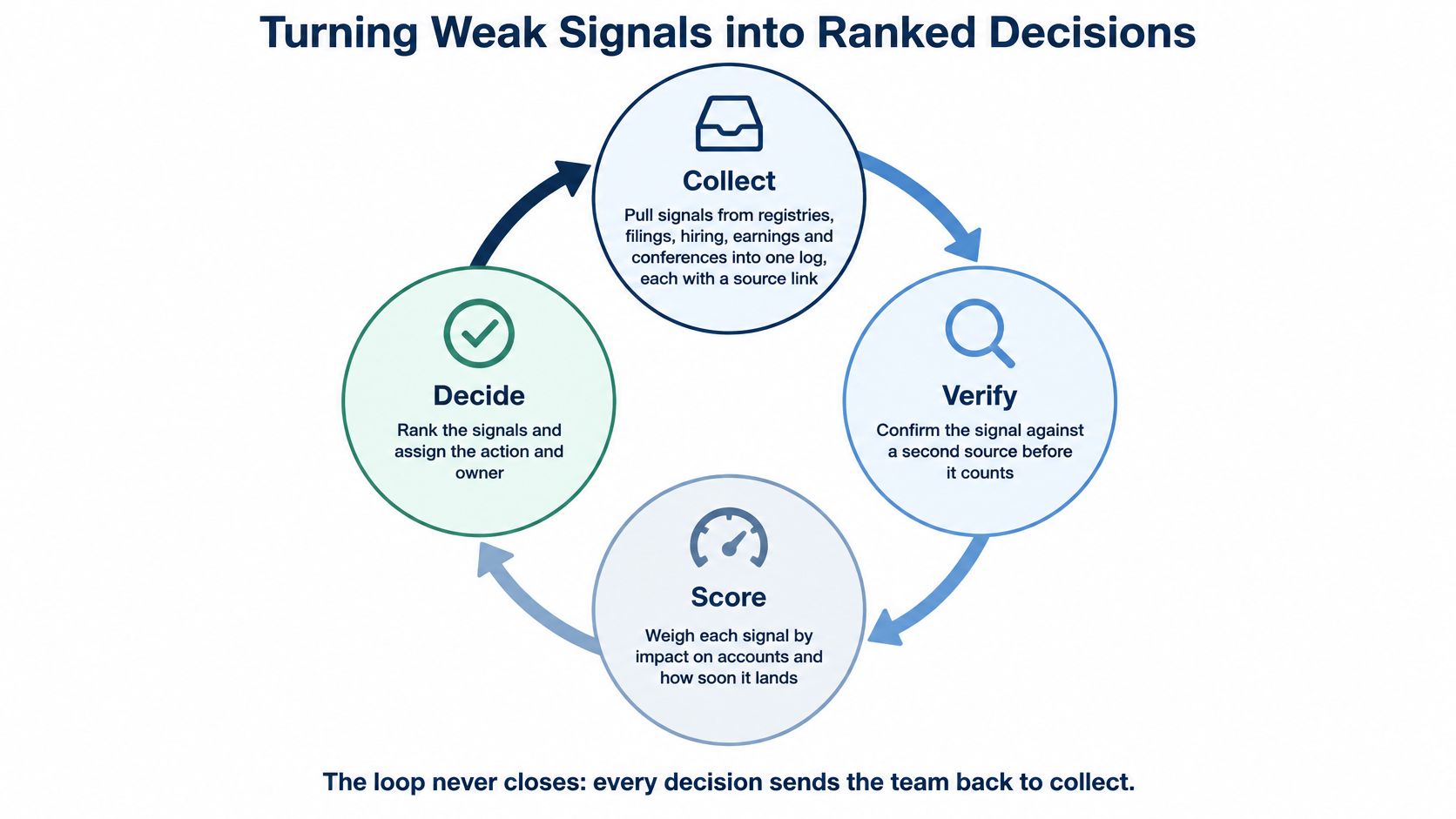
Treat the workflow as a loop with four stages, each with an owner.
Collect. Pull signals from registries, filings, hiring, earnings and conferences into one log. Every entry gets a source link and the date you saw it. The CI lead owns the log.
Verify. Confirm the signal against a second source before it counts. An analyst owns this, and "one source" isn't enough to move an account.
Score. Weigh each signal by impact on named accounts and by how soon it lands. A Phase 3 readout in nine months outranks a patent filing in six years, even though both are real.
Decide. Write the hypothesis in one sentence, attach a confidence level, name an owner and set a deadline. "The rival files in the second half and targets community oncology first" is a hypothesis. "Competitor active in oncology" is a headline.
Then close the loop. Check the outcome against the hypothesis within 30 to 90 days and adjust the scoring. The review step is where a program learns; skip it and you're back to collecting news with extra steps.
What good looks like in one line: a logged signal, a ranked hypothesis, a stated confidence, a named owner, a date.
If your team already runs account-based outreach, the discipline that improves pharma lead generation applies here directly. A signal only earns its place if it resolves to an account and a next step.
A 90-day start looks like this. In weeks 1 and 2, pick three competitors and two therapeutic areas, and agree what decision each one would change. In weeks 3 to 6, run the log weekly and produce the first ranked hypotheses, even if the confidence is low. In weeks 7 to 12, pilot two decisions, one with a commercial owner and one with an R&D owner, and review both against what happened.
Roles, Guardrails and the KPIs That Prove Value
A strong program works like a clean lab notebook: every entry has an owner, a method and a result that can be checked later. When a signal lands, four questions decide whether it becomes action or noise: who verifies it, who challenges the claim, who acts, and when the outcome will be reviewed.
Who Owns What
The competitive intelligence lead owns the log, the scoring rules and the monthly readout, and answers for whether decisions get documented. Analysts verify sources and keep competitor timelines current, because an old date can push a launch plan in the wrong direction. A medical or regulatory reviewer checks any statement about label, mechanism or filing status before it reaches a customer-facing team. Every accepted hypothesis needs a named commercial or business development owner with a deadline; without one, the finding stays interesting reading.
Guardrails That Keep the Program Defensible
Your counsel sets the final line. Treat these as working rules for daily collection and use.
- Use only public, licensed or lawfully obtained information. If the source would look wrong quoted in a filing, leave it out.
- State who you are in outreach, interviews, conference calls and informal congress conversations.
- Keep personal data inside GDPR or local privacy rules, especially physician-level contact data and social listening.
- Send questions about competitor contact or information sharing to legal before acting.
- Record the source beside the decision so the reasoning can be audited when someone later asks why the launch moved.
The test that catches most problems: could you hand the source to a regulator, a partner's diligence team and your own general counsel on the same day?
Measuring Whether Any of This Works
Judge the function by decision speed and action quality. A KPI can prove the team saw, verified and acted; it cannot prove a competitor will behave as forecast. Set targets from a first-quarter baseline, then improve that baseline instead of importing an impressive number.
| KPI | What it measures | How to set the target |
|---|---|---|
| Days from signal to documented decision | Speed of action | Define "decision" as owner, action and date logged; baseline in the first quarter, then reduce it |
| Share of alerts that lead to an action | Signal quality | Count after deduplication each month; a low share means source filters are too loose |
| Accuracy of predicted competitor launch dates | Timeline reliability | Compare forecast windows with actual dates each quarter, not only single-day calls |
| Hypotheses confirmed or refuted within 90 days | Learning rate | Review quarterly, adjust scoring, and keep refuted calls visible so the model improves |
| Pipeline influenced by competitive intelligence-triggered outreach | Commercial impact | Agree the attribution rule with sales operations before launch |
If you have to defend a metric that isn't a sales number, a nine-part reporting framework for operators shows how to structure the argument around baselines and movement rather than one flattering figure.
The failure pattern is easy to spot: forty alerts, two documented decisions, no owner named after review. That is a monitoring service.
Three Plausible Cases from Launch, Filing and Generic Entry
Each case below is a plausible scenario rather than a reported result, and each follows the same shape: the trigger, the decision, the result to watch, and the question the team asked before acting. Launch-timing questions in crowded classes, including when orforglipron reaches UK patients, usually come down to exactly these mechanics.
Case 1. A Phase 3 that speeds up. A mid-size biotech notices a rival's Phase 3 expanding into two new countries in the same month it posts three market-access manager roles. The trigger is the combination, since either item alone could mean little. The team moves launch planning forward a quarter and prioritizes accounts where the rival's listed investigators practice, because those sites see the data first. Before acting, someone asks whether the whole mechanism class is accelerating or just this asset. Annual FDA approval counts swing hard, from an average of 34 new drugs a year in the 1990s to 25 a year in the 2000s and 41 a year from 2010 through 2018, according to the published FDA analysis, so one busy year does not make a trend. The result to watch is whether the rival files inside its stated readout window or slips; a slip usually shows up first as a quiet completion-date change. Teams that run this view off the filing calendar can follow PDUFA, NDA and BLA sales triggers.
Case 2. A biosimilar window that opens slowly. A biosimilar developer starts from the reference product's European authorisation date. A biosimilar can be authorised only after the reference biological medicine's data-exclusivity period has expired, and in general the reference product must have been authorised for at least eight years before another company can apply for approval of a similar biological medicine, according to the European Medicines Agency. The team sets its filing window from that date, then watches manufacturing announcements and comparability disclosures for confirmation. The question it asks before committing budget is blunt: are we treating eligibility to apply as if it were a launch date? It is not, and the gap between the two is where forecasts go wrong.
Case 3. A method-of-use patent that survives. A generics team reads FDA patent and exclusivity records directly instead of relying on a summary table, and finds a listed use patent still protecting one indication while the approval-related fields show different therapeutic-equivalence codes across competing products. FDA records carry patent number, expiry date, drug-substance or drug-product designation, and patent use code for method-of-use patents, alongside reference listed drug status, approval dates, application types, strengths, applicants and therapeutic-equivalence codes, all covered in the FDA Orange Book data files. That detail separates composition-of-matter protection from formulation protection, distinguishes a use claim from broader cover, and shows why a product with an AB rating is a different competitive threat from one without it. The team re-models entry risk per indication. The question asked: which protection covers the indication we compete in?
None of the three decisions needed new data. Each needed someone to read a public record closely and then say what it changed.
Pick Your First Three Signals and Act This Quarter
One action this quarter: choose three signals and two competitors, then name an owner for each signal. Not a platform. Not a steering committee. Two competitors you expect to move within twelve months, and three sources you'll read every week.
When you evaluate tooling, including our own, test against four criteria:
- Coverage of registries and regulatory data, not just news. A feed that misses trial status changes will miss the earliest signal you have.
- Routing into Slack, email or the CRM, so an alert lands where the work already happens instead of in a login nobody checks.
- A decision log that records the hypothesis, the confidence level, the owner and the review date.
- Account linkage, so every signal resolves to a named account rather than a therapeutic area.
Salesmotion's life sciences module finds drug developers by therapeutic area, phase and modality, and watches for trial starts, phase moves or raises. Hold it to the same four criteria you'd apply to any other option.
Before the quarter ends, write down four things: the three signals you'll track, the owner for each one, your first ranked hypothesis in a single sentence, and a review date 30 days out. Bring that hypothesis to the next team meeting and check it against the first real signal that lands. The first one will probably be wrong in some detail, and that's the useful part. A wrong hypothesis with a date on it teaches a team faster than a dashboard nobody argues about.
Salesmotion tracks the signals that come before a competitor's next move, from clinical trial starts and phase changes to earnings commentary and leadership shifts, and routes them to the people who can act on them. The life sciences workflow pairs clinical trial signals with earnings analysis and AI meeting prep, so a registry change becomes an account brief with the next step already written. Visit Salesmotion to put the trial-to-timeline build to work on your own accounts.